Showing posts with label Science. Show all posts

Saturday, February 22, 2014

[science] Dogs and their understanding of human voices

Scientists in Hungary have been investigating how the brains of dogs and humans react to different noises. This has involved training dogs to lie still while undergoing MRI scans. The trainers used positive reinforcement strategies ("lots of praise", says Dr Attila Andics of the Hungarian Academy of Science's Eotvos Lorand University).

The scientists then played a variety of noises to their human and dog subjects. These included dog vocalisations, human sounds and various environmental noises. They discovered that when dogs and humans heard the human noises, in both cases there was activation in the same part of the brain (the most anterior part of the temporal lobe). Furthermore, the activity in human and dog brains was remarkably similar when exposed to emotionally charged human sounds (such as the sounds of laughter and crying).

For other sounds, human and dog brains reacted differently. The human brain responded far less strongly to recordings of dog vocalisations. And dog brains seemed far more engaged by environmental sounds, which is not particularly surprising to anyone who has ever seen a dog excited by a barely perceptible sound off in the distance.

These differences in human and dog responses to other noises make the similarities in response to human noises all the more fascinating. Dogs have of course been selectively bred for closeness to people for a long time now, so it is not too surprising that they would have some sensitivity to human voices. But the apparent emotional engagement with human vocal sounds is rather interesting and suggests perhaps that our canine friends really are able to tell when we are happy or sad.

More (BBC article by Rebecca Morelle, from which come the images)

Even more (Article in Current Biology, so you won't be able to read it unless you have a subscription)

An inuit panda production

Thursday, January 09, 2014

Adaptable Penguins Soldier On

Everyone loves emperor penguins. The large flightless birds who swim in the seas around Antarctica and breed on frozen sea ice had their curious ways popularised by films such as March of the Penguins. But concerns have been expressed about the future of the black and white birds, with the International Union for Conservation of Nature classifying them as "near threatened".

Unlike other animals, the penguin is not threatened by human encroachment into their harsh environment. Rather the fear is that the changeable weather conditions created by man-made climate change will disrupt their habitat and prevent them from successfully breeding. With the penguins typically breeding on sea ice, concerns have been expressed as to what they will do if climate change leads to the ice forming late or not at all.

However, scientists observing four particular penguin colonies have discovered that the little fellows are more resilient than expected.When their preferred sea ice is not available, the penguins move to alternative sites, somehow climbing up onto the almost impenetrable ice shelves closer to land. Although this puts them much further from the sea and atop strange and unscaleable cliffs, the penguins still manage to travel to and from their breeding sites to gather food for their young. It appears they slide or jump down the cliffs on the way to the sea and then make long detours around them when returning back to feed the little chicks.

It is unclear whether this penguin adaptability is unique to there four colonies, or if all emperor penguins are able to seek out new breeding sites when necessary. It is also unknown whether other penguin species are also as adaptable. But the plucky behaviour of these penguins suggests that the flightless birds will not be easily defeated by climate change.

more

An inuit panda production

Sunday, December 22, 2013

The sensual growl of the male Koala


Scientists have long been astonished by the low growl of the male koala. The marsupial bear emits this strange burping sound to let lady koalas know that he is in the area and ready to see to their sexual needs. What has confused scientists is how such a small animal has been able to make such a low pitched noise. Were their vocal tracts to be structured in the normal manner, koalas would apparently need to be the size of an elephant to make such strange rumbling tones.

But the vocal tracts of koalas are not like those of other animals. Scientists have discovered that, as well as their larynxes, koalas also have an extra set of vocal folds specially designed for male koalas to sing their sensual song.

It is unclear as to exactly what the male koala communicates with his low rumbling moan. Perhaps lady koalas can identify individual males from their calls and decide to stay away from that cad who gave them koala chlamydia last autumn. Or perhaps the quality of the growl is a signifier of the health and reproductive fitness of the male koala. Or perhaps, as the Guardian suggests, the purpose of the male koala’s growl can be understood with reference to certain human sexual behaviours.


more:

Koalas bellow with unique voice organ (BBC) (image source)

Is it a snore? Is it a burp? It’s a male koala trying to attract a mate

An inuit panda production

Monday, October 14, 2013

Power and Exploitation among the Meerkats

The Meerkat is a popular little animal that lives in desert regions of southern Africa. They famously live in large social groups, taking turns to watch out for predators and looking very cute while they do it. But there is a dark side to meerkat society. Although they live together, their societies are not ones based on friendly cooperation. Rather, the cute little animals live lives that are hierarchically ordered.

Meerkat groups are led by a dominant female. It seems that these boss meerkats reinforce their position by preventing junior females from breeding. The matriarch keeps the juniors down by killing their young or else by expelling them from the group. Expulsion is akin to a death sentence - in the harsh environment the animals live in, a solitary meerkat falls victim easily to predation.

But the dominant meerkat is not content with stopping the other females from breeding. Scientists, including Kirsty Macleod from the University of Cambridge, have discovered that the dominant female extracts a rent from the junior females - they are forced to look after the matriarch's young as a price for acceptance in the group. As well as minding the little pups, lactating females are obliged to serve as wet nurses for the matriarch's offspring.

At present the junior meerkats seem to be taking it from the alpha females. If they have any plans to improve their situation, it is through individual aspiration to replace the boss lady meerkat at the top of the ladder. This atomisation supports the maintenance of the current power structure. There are rumours, however, that some meerkats are beginning to whisper to each other that a truly cooperative reorganisation of their social relations is required. It is even reported that some meerkats are beginning to form a vanguard party that will be able to strike for freedom when the time is right.

The roll of male meerkats in all this class conflict is curiously unmentioned in the one article I have read on the subject.

More

An inuit panda production

Tuesday, September 24, 2013

City Birds Fare Better in Cold

Scientists have long been interested in whether animals do better in urban or rural environments. In the case of blue tits, scientists from the Angela Ruskin University have been comparing the progress of bird colonies in the city of Cambridge with ones living out in the Brampton Wood nature reserve. In the past they found that the country birds "fared significantly better" than their urban friends, also breeding more successfully.

In 2012, however, the situation reversed. The cold and wet weather of that year hit the country birds much harder. The city birds bred more successfully, laying more eggs and hatching out chicks much more quickly than their rural counterparts.

The main food source of the blue tit is the caterpillar. In the harsh weather of 2012, there was a reduction in the availability of these tasty grubs. This hit the country birds hard. However, the urban blue tits were more used to looking around for other food sources, so they were better able to find other things to eat.

Scientists speculate that if global warming leads to more extreme weather conditions then this may work further to the advantage of the urban blue tit.

More

An inuit panda production

Monday, August 19, 2013

The shortest way with unruly children

Burying beetles are one of those insect species where mothers take an interest in the early lives of their offspring, bringing their larva tasty treats to eat. Hungry larvae pester their mothers for food, as is the case with many other species. Scientists have discovered, however, that exasperated burying beetle mothers have a direct punishment for any of their young who beg too much for food - they eat the greedy little bastards.

"It's the only language they understand", commented a burying beetle mother, whose young are careful to only beg for food when they are very very hungry.

Scientists have cautioned against a similar approach being applied to human offspring.

More

An inuit panda production

Thursday, August 15, 2013

New small but fierce animal discovered in Ecuador

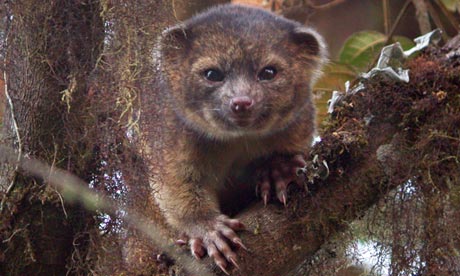
Scientists have discovered a new fierce little animal living in Ecuador. It is the Olinguito, described by the Guardian as "a cross between a teddy bear and a house cat". The odd thing about these fellows is that they were not unknown to science - specimens have been exhibited in museums and a female Olinguito called Ringerl spent many years living in the zoo system of the United States. But scientists had previously mixed up the Olinguito with the Olingo, an entirely different animal (which explains why zoos were unable to persuade Ringerl to breed, as they kept trying to mate her with Olingos).

The Olinguito is classed as a carnivore, meaning that it belongs to the order Carnivora with dogs, bears, lions, cats and other fierce animals. However, Olinguitos primarily eat fruit, though they are still very fierce for their size.

More

An inuit panda production
Wednesday, July 24, 2013

Tyrannosaurus Rex was very, very fierce, discover scientists

The Tyrannosaurus Rex is the famous monster predator dinosaur. It walked on its hind legs, had stumpy little front legs whose purpose (if any) is somewhat mysterious, and had a huge mouth full of teeth. In the popular imagination, it was a top-level predator that went around chasing and eating any of the other big herbivore dinosaurs it could catch.

Some scientists, however, turned against this view. They took to arguing that the Tyrannosaurs Rex could not have been this kind of predator. Instead, they saw it more as a giant scavenger, a carrion feeder who would lumber around until it had found an animal that had died of natural causes or been taken down by smaller and nimbler predators. The Tyrannosaurus would then tuck in. These kill-joy scientists are no doubt associates of the others who argue that the giant winged dinosaurs were only able to glide and could not truly fly.

However, a recent discovery seems to have established that the Tyrannosaurus Rex was a top-level predator after all and no pathetic scavenger. Palaeontologists working in South Dakota found the fossilised skeleton of a Hadrosaur, a large Cretaceous herbivore, with the tooth of a Tyrannosaurus Rex embedded in its spine. It appeared that the Tyrannosaurus had attacked the Hadrosaur and bitten into its back, whereupon the tooth had come loose, but the herbivore escaped and survived the encounter.

This finding seems to prove that the Tyrannosaurus Rex was a hunting animal. Like any hunter, it would eat carrion if it found it, but it would also attack other animals, albeit not always with success.


More:

T rex tooth found embedded in prey, restoring dinosaur's reputation

A near miss for a Tyrannosaurus rex: evidence of failed predation

"Her Pack of Tyrannosaurs Came Screeching to Her Side!" (image source)

Saturday, April 27, 2013

Koalas' STD Crisis

Everyone loves Koalas, but what not everyone knows is that the honorary bears are in a lot of trouble. Some of their problems are the result of human activity, with Koalas suffering from habitat loss thanks to urban sprawl. Many of them are also being hit by cars or killed by dogs. But some of the problems Koalas face are their own little furry fault, as the marsupials are suffering from an epidemic of sexually transmitted diseases spread by their promiscuous habits and lack of interest in safe sex.

Chlamydia seems to be a particular problem, with up to 90% of Koalas being infected in some areas. The disease can prove fatal, but it also has a tendency to leave its survivors infertile, which is depressing the Koala birthrate. Worse, a new retrovirus, akin to HIV/AIDS in humans, has started to affect the cuddly marsupials.

Fortunately some help is at hand. Koalas infected by Chlamydia are being given courses in antibiotics in special Koala-hospitals, where they can recuperate for a couple of months until they are ready to go back into the wild. Volunteers are also looking after the little baby Koalas (known as Joeys) who are left abandoned when their mother succumbs to disease. These people look after the furry orphans until they are old enough to fend for themselves, bringing them tasty eucalyptus for the little fellows to eat in the meantime.

The hope of scientists, though, is to develop an understanding of why Koalas are so much more susceptible to Chlamydia than other animals. That may lead to a vaccine that would protect the marsupial bears from this ailment, while also possibly leading to a vaccine that would protect humans from our own strain of that disease.

More

Thursday, April 25, 2013

I for one welcome our new robot insect overlords

A UK man has built a giant six-legged robot. "It wasn't built to be efficient and fast. It was built to look cool and insect-like and fun," said Matt Denton of his monstrous robot, before it slew him and began building more replicas of itself.

More

Even More

Sunday, February 17, 2013

Dogs are clever, discovers scientist

Science suggests that dogs are cleverer than previously thought. In particular, experiments into dog behaviour by Dr Juliane Kaminski indicates that they are capable of understanding situations from a non-canine point of view. Her experiment saw a human forbidding a dog from eating some food. Dogs were four times more likely to eat the forbidden food if the lights were turned off. Apparently the dogs understood that with the lights out, the human would not see them sneaking over to and eating the tasty food.

More

An inuit panda production

Friday, January 04, 2013

Invasion of the Mutant Rats

Scientists have discovered that increasing numbers of rats are now resistant to poisons commonly used against them. In fact, 75% of rats in Bristol, Gloucestershire and Wiltshire are now resistant to the standard suite of poisons. Scientists fear that in as little as ten years all rats in those areas will be resistant.

Rat sources suggest that once this stage has been reached, they will progress to Phase 2.

The Rats by James Herbert

more

Thursday, January 03, 2013

PANDAS IN DANGER!

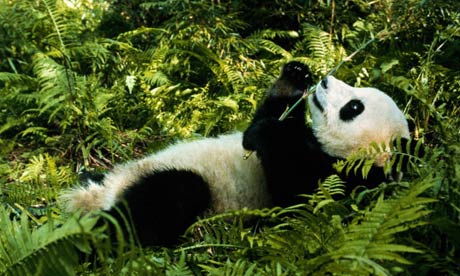
Scientists report that climate change is putting Pandas in danger of extinction. As you know, Pandas love nothing more than stuffing their faces on bamboo and tend not to eat much of anything else. Unfortunately, climate change means that there is an increasing likelihood of bamboo diebacks. And because of ever-expanding human settlement, Pandas in an area where bamboo has died off will find it difficult to migrate to an area where it remains abundant.

The Pandas in the Qinling Mountains in Shanxi province are believed to be particularly vulnerable, as their range is completely surrounded by human settlement - if their bamboo dies out, they will have no way of escape.

More

Tuesday, October 23, 2012

Is it worthwhile being a clever tit?

Scientists have established that great tits are very clever birds - they seem to be adept at solving all kinds of puzzles in order to obtain tasty morsels of food. But one question that has perplexed the scientific community is whether their ability to solve problems is of any advantage to the little birds. After all, in the wild it is not particularly common for tasty morsels to be hidden inside a box that can only be opened by pulling on levers in an exact sequence. Could it be that all this great tit intelligence is just going to waste?

Dr John Quinn led a team that investigated this question while based in Oxford. They tested the ability of some great tits to solve problems and then tagged them with tiny radio transmitters and released them back into the wild. The scientists were then able to monitor the reproductive success or otherwise of the clever tits versus their less clever fellows.

The results were surprisingly inconclusive. Clever tits were more likely to produce a clutch of eggs, but they were also more likely to abandon their eggs. The scientists theorised that the clever birds were more likely to be frightened away from their nests than their more simple-minded fellows. The overall result was that there was no significant difference in reproductive success between more and less clever great tits.

But that is not the whole story, as there is more to success in life than an ability to spew forth progeny into the world (at least I hope so). The scientists found that the clever tits were able to spend far less of their time foraging for food and so were able to enjoy more leisure time than their less bright fellows.

More

An inuit panda production

Thursday, September 20, 2012

Scotland's adventurous voles

Water voles in the north-west of Scotland live in naturally fragmented habitats. The furry little animals live in small groups with a normal range of only a few hundred square metres, often separated from other groups by several kilometres. However, when young voles reach maturity, they often head off on big adventures, travelling many kilometres from their home territory. A search for love seems to be the driver of these vole journeys. This behaviour helps prevent inbreeding among voles and allows small vole groups to be rejuvenated by new arrivals.

Scientists researching the voles' behaviour think it may have relevance to other animals who have seen their habitats fragmented by human expansion.

More

Even more

An inuit panda production

Wednesday, May 02, 2012

Subordinate Meerkats Solve Problems

Meerkats are cute little animals who live in southern Africa. They are famous for their cooperative social structure, but their society is not egalitarian. In a given Meerkat troop there will usually be a higher ranking male who bosses around the other males of lower status (I am not sure where female Meerkats fit into this hierarchy).

Now scientists have discovered that the subordinate Meerkats are better at solving problems than their higher status fellows. Meerkats were presented with openable glass jars containing scorpions (a tasty treat for the social mongooses). High status Meerkats rapidly gave up trying to extract the scorpion, but the lumpen-Meerkats would toil away until they had the jar open and the scorpion scoffed.

Persistence seems to be the characteristic that allows the subordinate Meerkats to solve problems. They appear to open jars by trial and error, and when presented with a new jar identical to the old one they spend the same length of time fiddling about with it until they open it, suggesting that they are incapable of learning and remembering how to do it. But scientists believe that this persistence is an important characteristic of junior male Meerkats, as they are the ones who leave their home troop to go off in search of mates. High status Meerkats, meanwhile, are like high status humans – they do not need to solve problems as they can profit from the work of others.

More (includes film of a Meerkat solving a problem)

Even More

An inuit panda production

Monday, April 30, 2012

Great Tits Help Their Friends

Anyone who has ever seen Great Tits fussing at a bird feeder would not think of them as animals prone to cooperation. However, the popular garden birds commonly join together to chase away predators like weasels and woodpeckers who might be planning to make a meal of their young. Scientists have now discovered that Great Tits recognise alarm calls from birds who have nested beside them for several breeding seasons. The birds are then more likely to respond to calls for help from their friends than from birds they do not know.

Scientists suggest that the birds may not be acting altruistically when they respond to their neighbours' calls of alarm. They might just be thinking that if their neighbour's nest is being threatened then theirs could be next. Or they might be helping their neighbour to ensure that when they themselves are in trouble they will be able to call in the favour, something Ada Grabowska-Zhang of the University of Oxford describes as a "Great Tit tit-for-tat".

More

even more

An inuit panda production

Tuesday, April 24, 2012

Workplace Dogs Reduce Stress

Scientists have discovered that having dogs in a workplace reduces employee stress. This is the case both for employees who bring their own dogs into work and for other employees who do not have their own dogs. The presence of dogs generally improved morale and led to more interaction between workers as people came over to pet the dogs or offer to take them for walks. The dogs also liked coming into work rather than being left home alone all day.

It is however possible that the presence of dogs may lead to increased stress levels in bad people who do not like dogs.

More

See also:

Hearing dogs are changing deaf children's lives

Dogs help families with autism, RSM conference told

An inuit panda production

Saturday, March 31, 2012

When Cats Fall

Great interest was excited by Sugar, the Boston cat who survived a 19 storey fall from her home. The BBC has looked into the question of how she managed to survive this great fall and whether cats generally are resilient to drops from great heights. This appears to be a matter to which scientists have applied some attention. Unfortunately, moral squeamishness and possible public relations issues have prevented this important matter from being investigated by throwing a series of cats from ever higher windows. Instead they have had to rely on statistical evidence from emergency vet surgeries in cities with high windows from which cats can fall.

What is striking is how high it is possible for cats to fall without suffering fatal injury. Sugar seems not to be the record holder in this regard – while she fell 19 storeys onto grass and mulch, another cat fell a staggering 32 storeys onto concrete but survived with only a chipped tooth and a collapsed lung. The statistics from the vets revealed that 90% of falling cats survived, with only 37% needing emergency treatment to save their lives.

The reason for the cats' survival is simple enough. The animals evolved to live in trees, where the occasional fall is going to be a fact of life. Their bodies are designed to slow their rate of descent and then to cushion them on impact with the ground. So a fall that would definitely kill you or me leaves them with a good chance of survival.

But before you start sending your own cat out on a skyscraper ledge, perhaps to start hanging onto the hands of a clock or suchlike, beware. Scientists report that cats like Sugar are very lucky to survive such a fall and that many suffer terrible injuries from their unplanned descents. Even those statistics of a 90% survival rate are not as good as they look – they do not include the cats who were immediately killed on impact, and they may not include those cats who were injured so badly that they were taken to a vet to be euthanased. And the figure for "survival" may mask cats who lived on after their fall but who suffered horrendous life-changing injuries. As Dr Jake Socha is quoted as saying at the end of the article: "The lessons learned: screens, please, on the windows".

An inuit panda production

Thursday, August 18, 2011

Scientists: Clever dogs can sniff out cancer


Scientists have demonstrated that trained dogs are capable of sniffing out lung cancer. In a controlled trial, the dogs had a 71% success rate in identifying patients suffering from the cancer. They also were very good at avoiding false positives.

There are apparently no plans to train up an army of clever dogs to assist doctors in diagnosing patients – it is believed that using dogs in clinics would be problematic. Instead the plan is to develop special robot noses that will be able to identify whatever it is about cancer that the dogs are smelling. As scientists do not yet know what it is that the clever canines use to sniff out cancer, it could be a while yet before these robot noses are among us.

More

An inuit panda production