Showing posts with label History. Show all posts

Monday, August 04, 2025

Troubled Songs: Music of the Northern Ireland Conflict

I had the great idea of putting together a compilation of songs about the Troubles, by which I mean the violent conflict that erupted in Northern Ireland in the late 1960s and continued until the peace process of the 1990s mostly moved the conflict into the political arena. I am trying to look at the conflict through the way it was represented in song and to explore the events that inspired particular pieces of music. So I've put together slightly more than a CD's worth of tunes, which you can listen to as a playlist on Spotify or YouTube.

A word of warning: musically speaking, these songs are of variable quality and some of them are not good at all. I'm not expecting anyone to listen to these tunes over and over and feel that they have discovered some lost classics (although I think some of these songs are worthy of a wider audience). My hope more is that people will find the songs and the accompanying text an informative and interesting way of exploring these events that are now starting to recede into history.

But first a history lesson on the origins of the conflict, with the massive caveat that the historiography of the Troubles is itself a contested subject. In the 1920s Ireland was partitioned, with 26 counties becoming a self-governing free state (and later a fully independent republic), while six counties in the north east remained part of the United Kingdom as Northern Ireland, with its own devolved parliament. The Unionist-Protestant majority monopolised power in Northern Ireland, keeping the Nationalist-Catholic majority marginalised, discriminating against them in the workplace and the provision of social housing. The Irish Republican Army (IRA) launched periodic military campaigns to force the British out of the Six Counties; these proved ineffectual and by the mid-1960s the IRA had tacitly given up on the armed struggle and was devoting its efforts more towards non-violent engagement with social issues.
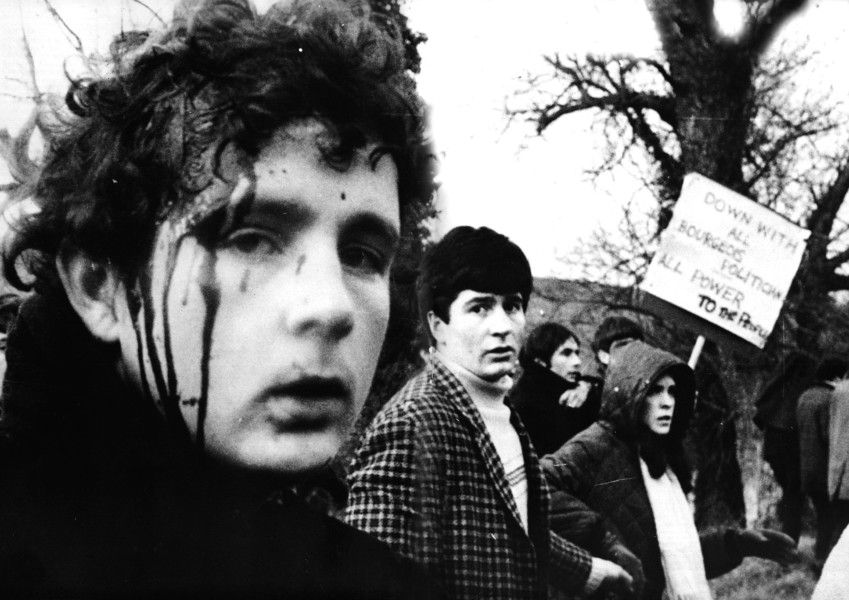
In the 1960s a new civil rights movement emerged through which members of the Catholic-Nationalist community sought greater equality in the life of Northern Ireland. Inspired by the African American civil rights movement, this campaign used sit-ins, marches and civil disobedience to advance its goals. Members of the Protestant-Unionist community were unnerved, fearing the loss of their privileges but also concerned that the civil rights movement was simply a ruse by the IRA. At the time Northern Ireland had a reformist prime minister, but he was moving too slowly to satisfy the demands of the increasingly radicalised civil rights movement while also contributing to the sense of his own Unionist community that events were spinning out of control. Loyalists (hardline Unionists) reacted violently against the civil rights movement, attacking marchers (often with the overt or tacit support of the local police). Loyalist paramilitaries launched a bombing campaign.

In August 1969 Northern Ireland exploded, with rioting and sectarian violence erupting in the towns. The police lost control and the British Army was deployed. The previously moribund IRA was revitalised, with an influx of new members initially seeking to defend their communities but then seeing the disorder as an opportunity to advance the cause of Irish unification.

That's the background for these songs. I've only picked ones from the time of the conflict (so no "A Nation Once Again", "Only Our Rivers Run Free", or "Come Out Ye Black and Tans") and I've mostly avoided ones that address the conflict so obliquely that they could be about anything (so no "Invisible Sun" or "Spirits in the Material World"). I'm presenting them chronologically so that they can bring us from the conflict's start up to the time it began to fade away.

The Barleycorn "The Men Behind the Wire" (1972)

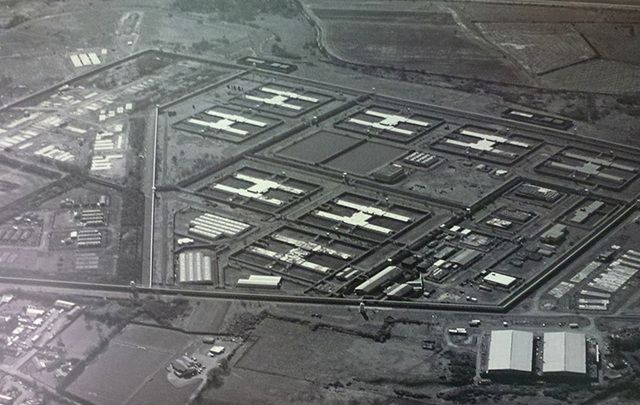
There was a brief moment where some Catholics in Northern Ireland welcomed British troops as a more palatable alternative to the Unionist-controlled police, but the honeymoon proved short-lived. Soon the IRA and British Army were trading shots. In an effort to crush the growing IRA campaign, the authorities in 1971 introduced internment without trial, rounding up Catholics suspected of IRA involvement. This proved controversial and also ineffectual, as the authorities had no accurate list of IRA activists. This song sees The Barleycorn protest against internment with a surprisingly jaunty tune, which spent three weeks at the top of the Irish singles charts (and was more recently sung by Alan Partridge's Irish doppelgänger). The Long Kesh prison mentioned was subsequently the site of the H-Blocks, where IRA and other Republican prisoners staged the blanket and dirty protests and then in 1981 the hunger strikes, in which 10 prisoners died.
Wings "Give Ireland Back to the Irish" (1972)

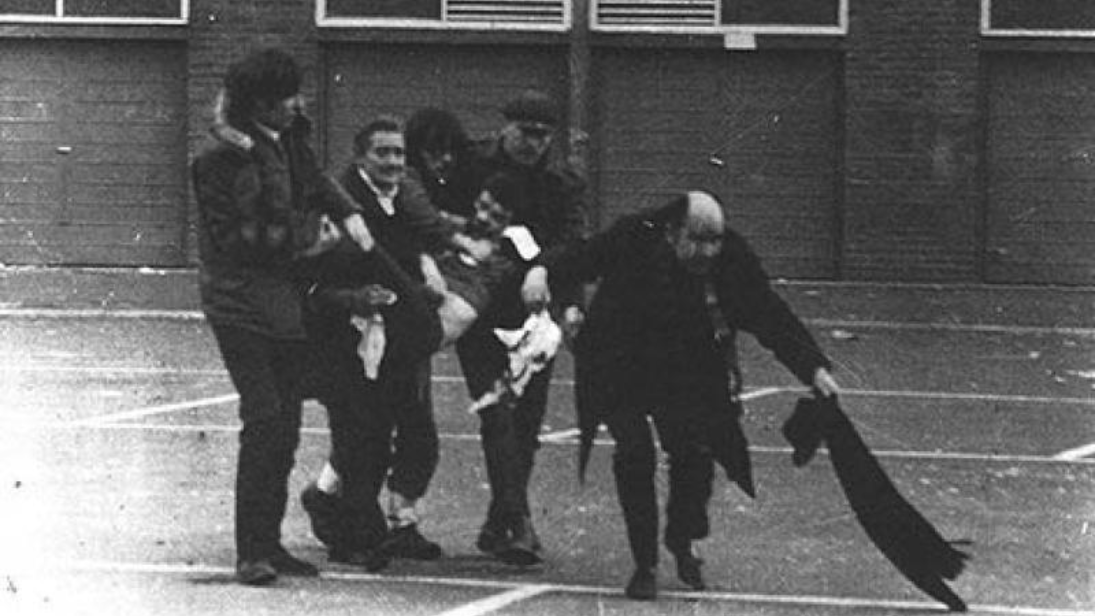
On Sunday 30 January 1972 in Derry British paratroopers shot 26 unarmed men taking part in a demonstration against internment, 13 of whom died immediately with another dying later. Unsurprisingly this caused outrage and led to a surge in IRA recruitment. Paul McCartney's Wings rushed this song out as their protest against the paratroopers' actions. It is a strangely anodyne offering, failing to communicate any real sense of shock and anger at what had just happened and featuring lyrics and a tune that are all pretty fatuous. It was banned by the BBC but still made number 16 in the UK singles chart.

Plastic Ono Band "Sunday Bloody Sunday" (1972)

John Lennon also felt the need to comment on Bloody Sunday and his band released this record, which I had somehow never heard before. Lennon's solo career I mostly associate with schmaltzy piano led ballads so this groover was a pleasant surprise. Unlike McCartney's tune, this actually engages with the events of Bloody Sunday and attempts to communicate a bit more detail about the history of the conflict, albeit from a partial perspective.

The Dubliners "The Town I Loved So Well" (1973)

The Dubliners are not from Northern Ireland (the clue is in the name) but their manager Phil Coulter was a native of Derry. Coulter is often portayed as the bad guy in Irish traditional music narratives: the breadhead impressario with the ear for cheesy pop adjacent tunes and plinky piano flourishes. Yet he wrote this affecting song for The Dubliners, sung here by the legendary Luke Kelly. By now the penny was beginning to drop that the Troubles were not going away any time soon. The song nostalgically compares the pre-conflict era, warts and all, with the disconcerting present.

I'm not including any related music but I should also mention the 1975 Miami Showband massacre, whose anniversary fell a few days ago. This saw three touring musicians killed and another two left for dead by loyalist paramilitaries. Following this horrific event many bands gave up on playing gigs in Northern Ireland.

Boney M "Belfast" (1977) Boney M were a vehicle for German record producer Frank Farian. They had already had a hit with a song about Depression-era gangster Ma Baker and would go on to release one about Rasputin, so why not a disco song about the horrors of the Northern Ireland conflict? This song could really do with a spoken word breakdown explaining the Troubles or a closing explanation along the lines of "Oh, those paramilitaries" but it's still a classic and with a few lyric changes could surely become a theme song for the Belfast tourist board.

Stiff Little Fingers "Suspect Device" & "Alternative Ulster" (1978)

Anyone who has scene the brilliant film Good Vibrations will be aware that punk was a big deal in Northern Ireland, with some even claiming that punks played an important role in keeping Belfast's city centre open at a time when many were afraid to go out after dark. Stiff Little Fingers were not shy about railing against the shit situation in which they found themselves, with "Suspect Device" skewering the paramilitaries promising a bright future while "Alternative Ulster" seems more hostile to the forces of the state. These could be the two best songs in this compilation.

Gang of Four "Ether" (1979)
Gang of Four were one of the more political of the British post-punk bands. In this song they evoke the enhanced interrogation techniques British forces took to using on IRA suspects (techniques subsequently recognised legally as torture). The H-Blocks get another mention and the song hints at an economic reason for the British presence in Northern Ireland with its reference to possible oil reserves under Rockall, an uninhabited island north-west of Ireland whose ownership is disputed by Ireland and the United Kingdom.

Kate Bush "Army Dreamers" (1980)

The song does not mention Northern Ireland but in 1980 this was the only place where British soldiers were fighting or dying, something that was probably not lost on the half-Irish Bush.

Eric Bogle "My Youngest Son Came Home Today" (1982)

Australian folk singer Eric Bogle is best known for his anti-war songs dealing with the futility of fighting for the British Empire, notably "And the Band Played Waltzing Matilda" and "The Green Fields of France". Here he gives us an anti-war song about the Troubles, which I first heard sung by Billy Bragg. I gather this has subsequently been adopted by Irish Republicans; if so I think they understand the lyrics differently to me, as I hear the song as articulating the pointlessness of dying for the IRA.

Fun Boy Three "The More I See (The Less I Believe)" (1983) The lack of any coherent message here is what appeals to me about the lyrical content, with the vocals just enunciating a sense of "what the fuck, that shit is fucked up" while the music has an appealing post-punk oddness to it that makes me want to explore further this band's work.

U2 "Sunday Bloody Sunday" (1983)

They used to say of peak-era method actors like Marlon Brando that you might not know what they were saying, but you definitely knew what they were feeling. And so it is here with Bongo and his buds. Reputedly the song has its origins in U2 being scheduled to appear at New York's St. Patrick's Day Parade but then withdrawing on discovering that the honorary grand marshal was likely to be deceased IRA hunger striker Bobby Sands. Like Edwin Starr's "War", the song uses the classic device of combining anti-war lyrics to a martial beat.

Paul Brady "The Island" (1985)

Strabane-born Paul Brady started life as a folkie but over the years moved in a far more lucrative AOR and pop direction. This is another song about the pointlessness of the struggle, with Northern Ireland compared to Lebanon (very much the poster child at that time for countries tearing themselves apart in internecine violence), with Brady contrasting his disdain for the IRA's struggle with his longing for a bit of seashore shagging. I could probably do without the smutty content but I've always liked the piano line in this song, although some consider that the tune veers overly into schmaltz.

Spandau Ballet "Through the Barricades" (1986)

Belfast native Thomas "Kidso" Reilly worked for a number of British bands, including Altered Images, Bananarama, and Spandau Ballet. While on a trip home he was out with some friends and happened to fall foul of some British soldiers, one of whom shot him in the back, killing him (the soldier was convicted of murder but released on parole after two years). Spandau Ballet's Gary Kemp subsequently visited Kidso's grave and met his brother; while traveling through West Belfast he was shocked by the sight of "peace line" barricades that separated Catholic and Protestant areas of the city, and so came the inspiration for this song (Joan Lingard's YA novel Across the Barricades might also have played an uncredited part here). The lyrics centre on that great cliche of Northern Ireland fiction, a cross-community love affair. And for all the Yeats-quoting lyrics it is a song I am including here for its noteworthiness but not because I in any way like it. I'm not sure if it is actually bad or if it is just my youthful dislike of Spandau Ballet being impossible to shake off, but it does feel too much like a "lovely song" for me.
The Pogues "Streets of Sorrow/Birmingham Six" (1988)

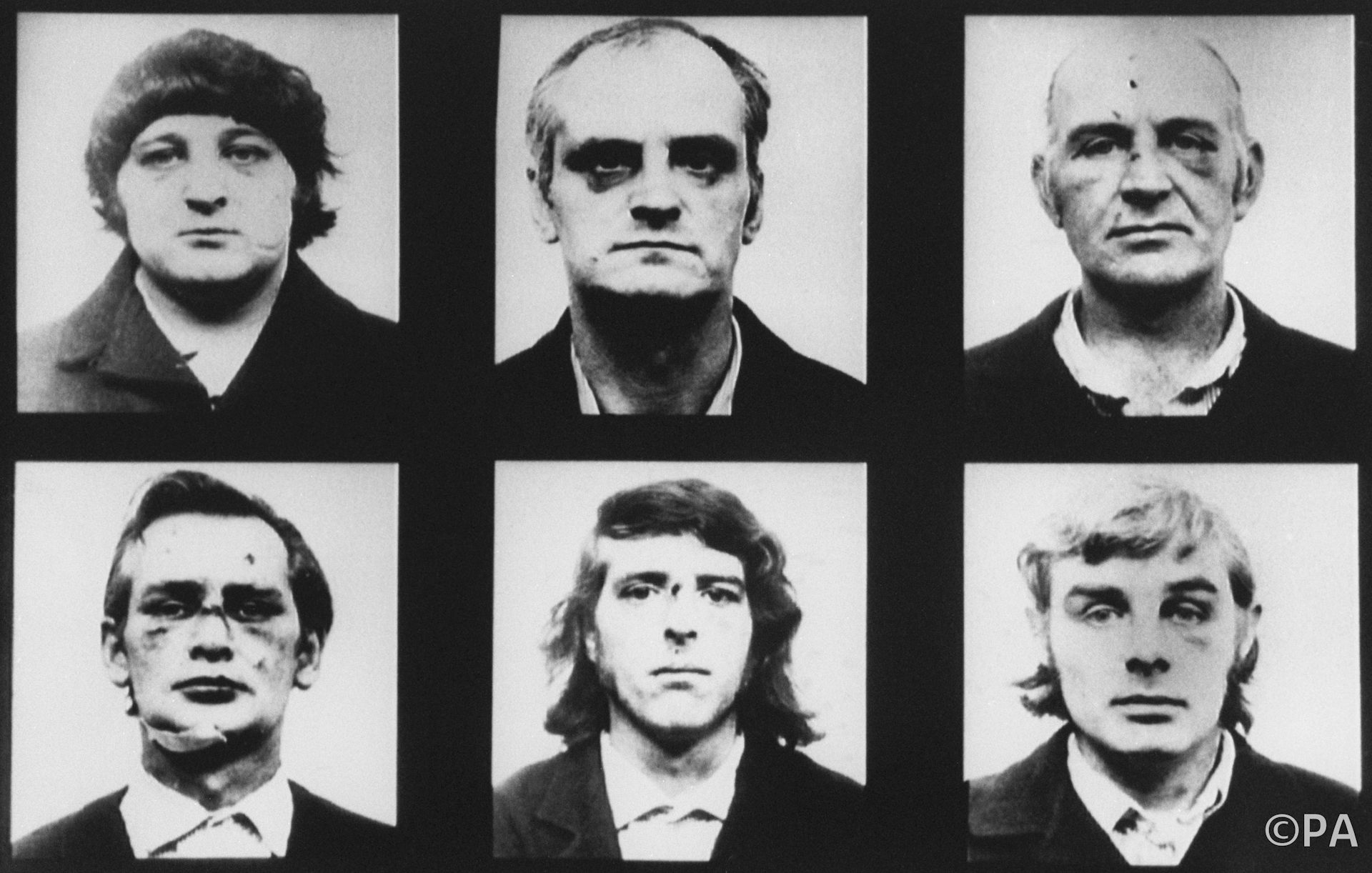
In the first half Terry Woods sings from the point of view of someone who has had enough of Northern Ireland's political violence and is leaving, never to return. But then Shane McGowan sings of some of those who did leave, the people known as the Birmingham Six and Guildford Four, who were convicted for IRA crimes (pub bombings in Birmingham, Guildford and Woolwich that killed 29 people and injured 320) they didn't commit on the basis of confessions extracted under torture and, in the case of the Birmingham Six, deeply flawed forensic evidence. The Birmingham Six and Guildford Four were subsequently exonerated but when this song was released its subjects were still in prison.Although doubts as to the safety of their convictions were becoming more widespread, suggesting their innocence and the moral corruption of the justice institutions was still controversial, and the Shane McGowan portion of the song was effectively banned from British television.

Simple Minds "Belfast Child" (1989) The title references Belfast, but the song appears to have been inspired by the 1987 Enniskillen bombing, when the IRA killed 10 civilians and one policeman. The melody draws on the folk tune "She Moved through the Fair", while the lyrics are somewhat oblique but suggest a certain "war is bad" sentiment.

Tina Turner "The Best" (1989)

What, you may be wondering, is this song doing here? Tina Turner has no obvious link to Northern Ireland and the song's lyrics do not suggest any link to the Troubles. But somehow this song became a loyalist anthem, often played when loyalists were celebrating a release from jail or a successfully completed sectarian murder. Loyalists are often portrayed as the irredeemable bad guys of the Northern Ireland conflict, their insularity, thuggishness, reactionary far-right adjacent tendencies and fondness for their links to a country that isn't that pushed about them making it easy to dislike them. There was also their tendency to really go for it with sectarian killings of random civilians, in contrast to the other actors who made a bit more of an effort to go after enemy combatants at least some of the time. And then there is their heavy involvement in the North's drug trade. So it isn't hard to see why some might describe them as simply the best.

The Cranberries "Zombie" (1994)

One tactic the IRA became quite attached to was detonating bombs in the commercial districts of English towns and cities. In 1993 the IRA hit the Cheshire town of Warrington twice, a few weeks between each attack. The first explosion caused extensive damage but no injuries, but the bombs exploded on 20 March on a shopping street injured 56 people and killed two children (one of them just three years old). Dolores O'Riordan of the Cranberries wrote this song in response. It's easy to scoff at the song's somewhat simplistic anger but I like how the lyrics reference "The Men Behind the Wire" and I feel it does capture the pointlessness of the IRA's struggle at this time. No longer could the Republicans claim to be defending Catholic communities in Northern Ireland and their efforts were not obviously bringing a united Ireland any closer, so it was hard to see what they were still killing and dying for. To many it looked like the IRA's war had become self-perpetuating and was continuing because the organisation's cadres could not see any way of stopping that would not be an admission of failure.

In the shadows though strange things were happening. Back channel negotiations were taking place between British representatives and figures close to IRA thinking, combined with more public discussions between the Irish and British governments and different nationalist-republican political leaders in Northern Ireland. Something was going on, even if no one quite knew what.

By the time "Zombie" was released as a single the IRA had already declared a ceasefire, which lasted until January 1996 before becoming permanent in July 1997, with loyalist paramilitaries eventually following suit. The Good Friday Agreement of 1998 is seen as effectively bringing the Troubles to an end (even though the Omagh bombing later that year by dissident Republicans was the single bloodiest incident in Northern Ireland during the whole of the conflict). Since then the troops have come off the streets, the prisoners have left jail, and the gun has largely been removed from Northern Irish politics, which now revolves around a somewhat dysfunctional but non-violent enforced power-sharing arrangement.

Even so, Northern Ireland remains a divided society, with Belfast reputedly featuring more peace walls now than before the Good Friday Agreement. Northern Ireland's government regularly collapses over issues that seem pretty minor and inconsequential to outsiders. And intermittent street violence remains a thing, with loyalist mobs driving immigrants from their homes in riots a few weeks ago. But compared to the early 1970s it's all pretty quiet.

"Zombie" has had an odd afterlife, becoming a popular stadium song for sports fans from Limerick (the Cranberries' home town) and further afield.

The Young'Uns "Lyra" (2023)

The gun has largely departed from Northern Ireland's politics, but not entirely. The IRA went on ceasefire and eventually left the stage entirely, but various dissident Republican groups attempted to continue armed struggle against British rule. Their efforts have been relatively unsuccessful, although their attacks occasionally kill or injure people, mostly members of the security forces. In April 2019 during rioting in the Creggan area of Derry, dissident Republicans shot at the police and missed, but one of their bullets fatally wounded journalist Lyra McKee. Dissidents have not staged a fatal attack since then, so for now Lyra McKee remains the last person killed in the Troubles.

English folkies The Young'Uns commemorated McKee on their Tiny Notes album. Like all the Troubles' victims she deserves to be remembered as more than just a statistic, with her LGBT activism and investigative journalism making her an inspirational figure. Like the other victims of the conflict, she died far too soon. Some readers might find this song mawkish, but it brings tears to my eyes whenever I listen to it. Born in 1990, McKee came of age when the Good Friday Agreement seemed to have consigned the Troubles to the dustbin of history and looked like someone who represented Northern Ireland's future, except the past still reached out to claim her.
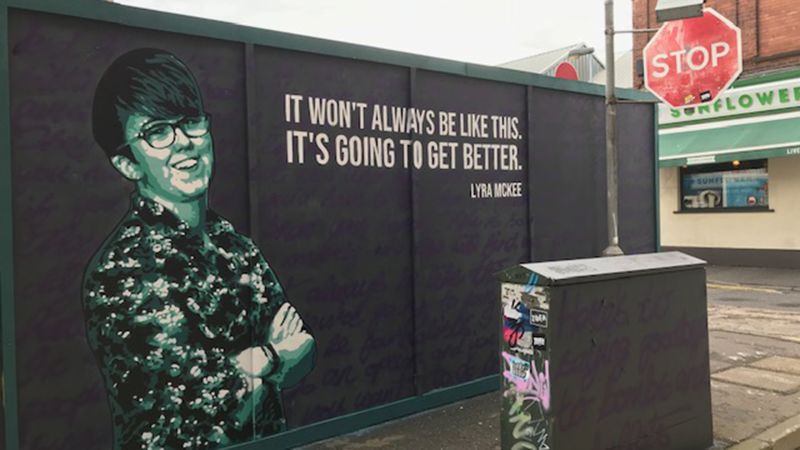
image sources:

Billy Campbell after being beaten by loyalists at Burntollet Bridge (Derry Journal: "Fifty year ago the People's Democracy organised civil rights march from Belfast to Derry bravely completed its journey")

British troops on the streets of Belfast, August 1969 (Guardian: "Paul Hill’s best photograph: the day troops arrived in Belfast, 1969")

Bloody Sunday: Father Edward Daly waves a white handkerchief as he tries to bring the fatally injured Jackie Duddy to safety (Ulster Museum: Bloody Sunday)

Miami Showband massacre aftermath (Belfast Telegraph: "The Miami Showband Massacre: 'They tried to wipe out the entire band'")

The H-Blocks (Irish Central: "Cillian Murphy, Jamie Dornan and Pierce Brosnan to star in new H-Block Jim Sheridan movie")

Bananarama at Thomas Reilly's funeral (RTÉ Archives: "Kidso Laid To Rest 1983")

Mugshots of the Birmingham Six, showing the beatings they had received after their arrests (The Conversation: "Would the Birmingham Six be victims of miscarriage of justice today?")

Loyalist mural, Belfast (The Clairmont Colleges, Digital Library)

Cupar Way peace line, Belfast (Wikipedia: "Peace Lines")

Emmalene Blake's mural for Lyra McKee, Belfast (CNN: "Belfast mural memorializes journalist Lyra McKee")

Saturday, March 21, 2015

Why am I writing a live blog about the First World War?

People have asked me why I am doing my World War 1 live blog. One inquirer in particular wondered whether I have been caught up in the commemoration frenzy and found myself stuck with a desire to mark the "brave sacrifice" of the men who fell in battle.

The question is an interesting one. As is often the case with matters of human motivation, I have I have no ready answer to it. I think it was the neatness of the 100 year anniversary that seduced me. I have been deriving great enjoyment from @RealTimeWWII on Twitter (which tweets real time stuff from the Second World War) and that influenced my decision to try something similar (but not as good) for the First.

One of the big things I am trying to do with the First World War blog is counter the nationally specific nature of so much of the way the event is remembered. I live in Ireland and exposure to the British media means that it is easy to slip into a very narrow view of how and where the war was fought and who took part in it. Irish media largely reinforces that; the war was fought before my own country became independent, meaning that Irish soldiers fought in the British army. So it seems that for many the war was fought entirely by Britain and Germany at the Somme and in Flanders (apart from a jaunt off to Gallipoli featuring some Australian guest stars, while later Lawrence of Arabia does something in Arabia). I want to try and counter that and bring forth that the war was fought in many places and by people from many countries, some of which no longer exist.

I am enjoying learning more about the conflict as I prepare the posts on it. The discipline of keeping the posts coming is a useful one. Readership of the World War 1 blog is not what it could perhaps be, but I am finding the process sufficiently rewarding that I will continue with it for the foreseeable future.


images:

German soldiers advance into Belgium (1914) (Telegraph)

Senegalese soldiers (RTS Canada)

crosses (RTS Canada)

Sunday, April 20, 2014

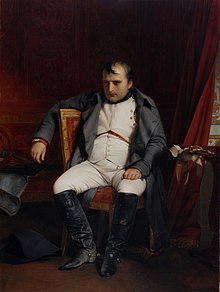
Napoleon's farewell

This is a year of anniversaries. Later many will mark the 100th anniversary of the start of the First World War. But this year is also the 200th anniversary of the first fall of Napoleon. As the year began, he tried to defend France from an invasion by the combined forces of Austria, Russia and Prussia. By now Napoleon's armies had been devastated by decades of combat - he had lost one vast army in Russia in 1812 and another in the 1813 battles in Germany that brought his enemies to the borders of France. By 1814 he was commanding an army largely composed of press-ganged 17 year olds and was terribly outnumbered, facing half a million enemy troops with something like 75,000 men.

Despite this, Napoleon almost managed to turn things around. With his back against the wall, he seemed to recover his old poise. In February he raced his army around and won a series of battles against the dispersed enemy forces. For a brief moment it seemed that the allies would abandon their attempt to seize Paris, but their nerve held and they continued their advance. Napoleon tried to lure the allies away from the capital, but they pressed on and seized it on the 31st of March.

Napoleon then proposed to lead his army against the occupiers of Paris, but his war-weary marshals mutinied, refusing to lead the army against France's capital. The revolt of the marshals eventually convinced Napoleon that the game was up. He entered into negotiations with the allies and unconditionally abdicated on the 12th of April. He then attempted suicide, but the vial of poison he had been carrying since 1812 was no longer lethal; though he became very ill, he survived.

The allies decided that they would exile Napoleon on the Mediterranean island of Elba. There he would retain the title of Emperor and exercise sovereignty over the island, and would also receive a substantial annual subsidy.

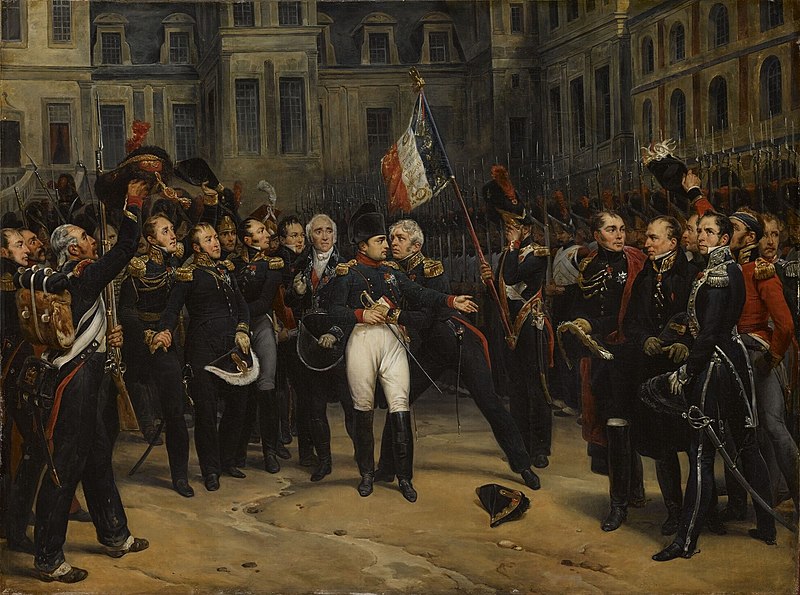
On the 20th of April, Napoleon bade farewell to the Imperial Guard before departing for exile. He addressed his men:

"Soldiers of my Old Guard, I bid you goodbye. For twenty years I have found you uninterruptedly on the path of honour and glory. Lately no less than when things went well you have continuously been models of courage and loyalty. With men like you our cause was not lost; but the war could not be ended: it would have been civil war, and that would only have brought France more misfortune. So I have sacrificed our interests for those of the Patrie. I am leaving you, my friends, are going to go on serving France. France's happiness was my one thought; and it will always be what I wish for most. Don't be sorry for me; if I have chosen to go on living, I have done so in order to go on serving your glory. I want to write about the great things we have done together! …. Goodbye, my children! I should like to press you all to my heart, but at least I shall kiss your flag!"

It is reported that many of Napoleon's veterans wept as their master delivered this address, as did the representatives of Britain, Prussia and Austria who were present (the Russians were unmoved).

Napoleon then left his army and departed for Elba, expecting to never see France again.
Image source (Wikipedia: an account of the 1814 campaign whose neutrality is disputed; it is the least 'Wikipedia' article I have ever seen on that website, which might explain why it reads so well, particularly the account of Napoleon's farewell to the Guard)

An inuit panda production

Thursday, August 22, 2013

Film: "A Field in England" (2013)

This is the latest film from that Ben Wheatley guy, who made Kill List, which I have yet to see.

This one is set during the English Civil War (actually during the Second Civil War, history fans, as there is a reference at one point to the Engagers; see dull historical note below), which made it essential viewing for me as that is one of my most beloved periods of history. It focuses on four guys pegging it from a battle (battle not shown for budgetary reasons). Three of them are soldiers and the other is something else - some kind of scholarly servant of someone who has had things taken from him. Quite what he is doing in the battle in the first place is not adequately explained, like much of what happens in the rest of the film.

The four guys tramp across some fields looking for a pub one of them reckons is in the vicinity, but then a series of transitions occurs. One of the four is not what he seems. A fifth character appears, one with his own sinister agenda. There is a wonderfully horrible scene in which he takes the scholar into a tent and does something to him, something that makes him scream while the others stand outside looking horrified. Then the stranger brings out the scholar who seems physically unharmed, yet somehow transformed.


The film is notable for its strange logical leaps and discontinuities. The characters are doing one thing - and then they are doing something else. Some events occur that do not seem to make any sense at all (like the rope they are all pulling on at one point, what was that all about?) And there are a series of odd tableaux in which they seem to be posing like characters in a painting for the camera (of which some feature in the clip above). In these regards it reminds me more of a continental European arthouse film of the 1970s more than anything else being made around now.

What it does have is a great visual look. It is filmed in black and white, which suits the odd and surreal nature of the film (though lurid colour probably would have done the same). The baggy 17th century costumes are wonderfully realised and did have me thinking that it would be great if people started dressing like that again. And there is a fantastic representation of the effects of imbibing magic mushrooms (it is that kind of film).

The sound is also intriguing. There is some old English folk music, sung by the character themselves. The overall soundtrack mixes in folky motifs with orchestral and electronic sounds to create a generally disconcerting aural environment, mirroring the fear and confusion of the characters. The soundtrack is mostly by Benjamin Power, but a pre-existing piece by Blanck Mass called 'Chernobyll' also makes an appearance.

Overall, this is an intriguing if perplexing film. I think it is one best appreciated by people who enjoy the feel and atmosphere of films rather than their simple plots.


Dull Historical Note

The First English Civil War is the famous one in which the armies of the King and Parliament laid into each other at such battles as Edgehill, Marson Moor and Naseby. Parliament allied with the Scots and eventually overwhelmed the King. He surrendered to the Scots and they handed him over to Parliamentary forces.

The Second Civil War was an attempt by the King's party to reverse the results of the first. English Royalists staged a number of uprisings. The imprisoned King also reached a secret alliance (known as the Engagement) with some of the Scots. This Scottish faction, known as the Engagers, sent an army into England. However the Parliamentary armies were able to crush the Engagers and the English Royalists, after which the King was put on trial and executed.

None of this historical information is needed to enjoy the film; I have merely posted it to show how clever I am.

An inuit panda production

Sunday, August 11, 2013

The Sad History of King Henry VI

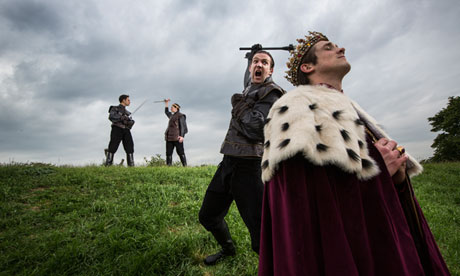
I went to York. I went to see plays. The people that run Shakespeare's Globe in London were touring performances of Shakespeare's three Henry VI plays to places in England that are significant to the action within them (including to some of the battlefield sites). York is significant because one of the big battles takes place near to it, with the loser's head ending up stuck on a pole over the city walls.

Although the plays are known to us now as Henry VI Parts 1, 2 and 3, they were not written in that order and were not conceived as a trilogy. And they were only given those titles retrospectively by some posthumous publisher of Shakespeare's plays. It seems that our Parts 2 and 3 were performed first, with titles something like The Houses of York and Lancaster and The True Tragedy of the Duke of York. Our Part 1 was written later, as Harry the Sixth, for a different theatre company, to tell the early years of the reign of Henry VI (who ascended the throne as a young child on the early death of his father). This makes it one of history's first prequels, with all that that implies.

The first play is mainly about the loss of the English empire in France as bickering nobles fail to assist the brave fighters there against the treacherous Frenchies, who have managed to enlist the aid of one Joan de la Pucelle, a young woman in league with satanic forces. The play has great bits in it (the Joan of Arc scenes, the heroic English fighters in France who are blatantly maniacal nutters, a worldly bishop, a scene where it is ponderously explained to Richard of York that he is actually the rightful king of England, etc.) but it seems to be one of those plays were loads of things happen without there being any real narrative thread. Strangely, this seems to have been the most popular of the three plays back in Shakespeare's time, with the story of the loss of the French empire and the death of heroic figures like Talbot (a blood-crazed thug) having audiences weeping in the aisles.

In the second play, the feuding of the English nobles explodes into vendetta and then open conflict. Richard of York stakes a claim for the throne, backed by some powerful nobles. He also has his sons behind him, with the thrill power ramping up considerably once this trio of badasses appears. He is opposed not so much by the King, a saintly figure a bit too prone to simpering, but by the King's wife and various other nobles. They all lay into each other in a series of battles. York, an ambiguous figure, also causes trouble by inciting a mob of revolting peasants to descend on London and murder anyone who can read, Khmer Rouge style.

It all turns into a bit of a bloodbath, with various nobles murdering each other and then being murdered themselves by their victims' friends and relations. One of the grimmer scenes is the one in which Richard of York is humiliated and tortured by the Queen and her associates, before being beheaded (it was his head that ended up on a stake on York's' walls, over a guardhouse near to where I was staying).
Gate

By the end, Richard of York's son Edward is reigning as King Edward IV, largely because everyone else is dead. Well, his two shifty brothers are still alive but one of them has changed sides so often that no one could take him seriously. And the other (Richard Jr, Duke of Gloucester) - well he is a deformed hunchback so there is no way he could be plotting to engineer everyone's death so that he can become king, right? So all is well, kind of like at the end of a game of Family Business when peace reigns because the graveyard is full.

The portrayal of Gloucester, the future King Richard III, was interesting. In the Globe last year I saw a performance of Richard III, the play that depicts his final rise to the throne and brief but bloody reign. Mark Rylance played the part of this great Shakespearean villain in a manner reminiscent of Derek Jacobi in I, Claudius, someone using physical disability as a mask, in this case to hide his lust for power. In the last two parts of Henry VI, Simon Harrison plays the younger character as a creature of pure malevolence. To a modern viewer, however, the continuous jibes he receives about his twisted form are strikingly unpleasant.

With our more enlightened views of such matters, it seems hardly surprising that someone subjected to such abuse would develop a warped character and a general hostility to the human race. I think perhaps this is what makes Shakespeare's character oddly sympathetic to modern viewers. He is a violent and malevolent creature, to be sure, but with a modern mindset we can see him as made like that by society rather than cruel fate. And with the hostility he has had to endure from his fellows on account of his form, he makes for a perfect outsider anti-hero.

If you have ever been to the Globe in London you will know that music is a big part of the way their plays are presented, with musicians playing before the performance starts and then accompanying the dance of the actors that happens at the end. With these performances the music was a bit stripped down, perhaps because it was a cut-price touring production. Any music in the play was made by the actors themselves. This was either percussive (good for the military stuff) or made by scraping the edge of something to create strange disconcerting droning sounds. The latter in particular sounded almost electronic. Perhaps because the plays were being performed over one day, making them seem like one monster play, they left the actors' dance to the very end.

These plays are on over the summer in a number of places, including back in London. I encourage you to see them, ideally all in one day for the fully immersive experience. If that sounds like too much, you could skip Harry VI, and if you reckoned one would be enough then I say to make that one The True Tragedy of the Duke of York.

Seeing these plays has also got me thinking about other theatre marathons that would appeal to me. One thing I would love would be if someone could stage all eight of the Plantagenet plays (dealing with the reigns of Richard II, Henry IV, Henry V, Henry VI and Richard III) over, say, four days with two plays a day. Another obvious one would be the Oresteia of Aeschylus, the only surviving trilogy of plays from ancient Greece. That one deals with a terrible cycle of murder and vengeance within the kind of dysfunctional family that is so common in Greek tragedy. A performance of all these plays in one go would make for a fascinating theatrical experience.

Links:

These plays are being performed in the Globe and around England and Northern Ireland, sometimes in places of relevance to the occurrences depicted, including battlefield sites. See if they are playing near you here.

Shakespeare on the battlefield: the Globe theatre step out - a piece in the Guardian on the battlefield staging of these plays, with particular reference to Towton, the bloodiest battle ever fought in England. The illustration of Henry VI and the three sons of the Duke of York are sourced from here.

More pictures of York

An inuit panda production

Thursday, March 21, 2013

The Well Revisited

Some time ago I mentioned a report on the BBC website about the bodies of 17 people found in a well in Norwich. The 17 had been murdered in the 12th or 13th century and were almost certainly members of the city's Jewish community who had fell victim to their Christian neighbours. 11 of them were children aged between two and 15. The remainder were adult men and women.

The BBC reports now that the 17 have been reburied in a Jewish cemetery in accordance with Jewish religious practices.

More

My original post

Saturday, August 25, 2012

"Rockism swept through Munster and south Leinster between 1821 and 1824"

Rockism is generally thought of as a modern phenomenon, particularly beloved of those who decry the shallowness of pop music and feel that real music is on real instruments by musicians who have paid their dues and worked on their chops. But the Irish Times reports that Rockism seems to have originated in 19th century Ireland. Under the leadership of the semi-mythical Captain Rock, the Catholic Rockists of rural Ireland engaged in a campaign of terrifying violence against their richer Protestant fellows, who were accused of liking disco and other inauthentic forms of music. The Rockists also believed that the End Times were about to arrive and with them God would deal out terrifying punishment to the heretical adherents of the Protestant faith.

The authorities were only able to suppress the Rockists by the most violent means - suspending civil liberties and carrying out mass executions. But the cancer of Rockism was never fully eradicated, reappearing in the later 20th century. By then it had lost its millennial Catholic overtones and could appeal to people of all religions who love music made with real craft and hate manufactured pop.

The attached image is a threatening letter sent by Captain Rock in 1842 to the then Chief Surveyor of Ireland.

More on 19th century Rockism in Ireland

More on modern Rockism

An inuit panda production

Monday, July 09, 2012

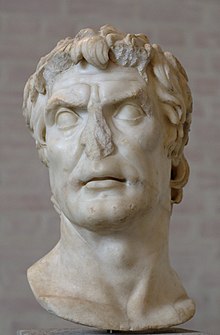
His very meat was polluted: the death of Sulla

"Notwithstanding this marriage, he kept company with actresses, musicians, and dancers, drinking with them on couches night and day. […] By these courses he encouraged a disease which had begun from some unimportant cause; and for a long time he failed to observe that his bowels were ulcerated, till at length the corrupted flesh broke out into lice. Many were employed day and night in destroying them, but the work so multiplied under their hands, that not only his clothes, baths, basins, but his very meat was polluted with that flux and contagion, they came swarming out in such numbers. He went frequently by day into the bath to scour and cleanse his body, but all in vain; the evil generated too rapidly and too abundantly for any ablutions to overcome it. […]

"However, he could not refrain from intermeddling in public affairs. […] And the very day before his end, it being told to him that the magistrate Granius deferred the payment of a public debt, in expectation of his death, he sent for him to his house, and placing his attendants about him, caused him to be strangled; but through the straining of his voice and body, the imposthume breaking, he lost a great quantity of blood. Upon this, his strength failing him, after spending a troublesome night, he died, leaving behind him two young children by Metella".

- Plutarch, translated by John Dryden

image source

Wednesday, August 24, 2011

The Well


The picture reconstructs the positions in which a number of skeletons were found in a well in Norwich. The 17 skeletons date back to the 12th or 13th centuries and, from DNA testing, they seem to have come from the members of one extended family of Jewish people. Norwich had hosted a large Jewish population in the period after the Norman Conquest, but as the 12th century wore on they faced increasing persecution, including mass murder during sectarian riots.

It is in one of these riots that the 17 people killed met their terrible fate. They appear to have been thrown head first into the well by their Christian neighbours. The dead included men, women and children.

Those Jewish people who had not been killed in pogroms and riots were expelled from England in 1290. They only began to return in the 17th century, during the more enlightened rule of Oliver Cromwell and the Protectorate.

Those of us who live in countries far away from Central and Eastern Europe find it easy to forget the ghastly history of religious and ethnic persecution that Jewish people have suffered. The well reminds us that these kind of horrific crimes once happened closer to us than we would like to think.

More

An inuit panda production

Monday, March 23, 2009

My Boring Weekend

I finished the weekend gone by with a dreadful sense of having pissed it away. In an effort to make my life seem more exciting to myself, I will now list the things I did when I was not staring into space or looking at shite on the internet.

On Saturday afternoon, I went to see a 1950s film called Gun Crazy in the IFI. It is a B-Movie about this guy who is obsessed with guns yet unable to hurt a fly. Sadly for him, he falls in with a bad girl who is also crazy about guns but perfectly able and willing to kill anyone who gets in her way. They embark on a life of crime. You can guess how it ends. The film has a very noir feel to it – great use of shadows and general noir shady-lady action, even if the plot is not really noir as such. For all that the story was maybe a bit slight, it was really well filmed, with some striking shots taken from the back seat of a car (one long tracking shot building up to a bank heist in particular). There was also a lovely tracking shot of the guy walking through a meat packing factory (past endless rows of cadavers) while on his way to do a job. I reckon the film is worth seeing just for the look of it, though I wish they had been showing The Big Combo, the originally advertised film by the same director.

On Saturday night, I watched a DVD of film Aguirre – Wrath of God. This was Werner Herzog's breakthrough film, and it starred Klaus Kinski as the eponymous conquistador. Together with Fitzcarraldo and The Making of Fitzcarraldo it forms a loose trilogy of films about nutters boating up and down the Amazon. In this one, Aguirre is taking part in an expedition to find the fabled city of El Dorado, which the Spanish believe to be located somewhere down the Amazon. The opening scene communicates the folly of this endeavour, as we see an army of conquistadors humping loads of crap down the side of a mountain into the jungle. It is easy to tell that this will not end well, and indeed it does not – by the end of it, Aguirre is trying to conquer the world with an army of squirrel monkeys. That is an odd thing about this film – it is a tale of madness and delusion, but it is oddly humorous. It also has one of the great spooky film soundtracks of all time, by the Krautrock sensations Popul Vuh.

On Sunday afternoon I went to visit the Dublin Jewish Museum, one of the great local attractions I had never hitherto made it to. Where I live is broadly speaking the heart of what was once the Jewish area of Dublin (with the Jewish community reputedly now concentrated out in Terenure). The museum is a great old-school museum, largely just a collection of random bits of stuff. At times I got the impression that this was a museum primarily aimed at the Dublin Jewish community, with the preponderance of old photos being so that people could see what their neighbours parents used to look like. There is some wonderful detail in it. The first mention of Jews in Ireland comes from some monasteries annals, where it records several arriving from abroad on a boat and then being sent away again*. I also liked the photographs of all the taxis some guy owned.

I have tended to think of Ireland as somewhere largely untroubled by anti-Semitism, for all that there were some unsavoury incidents**. The museum made me think again about this, as it has a section reproducing some rather crazy pamphlets produced the odder end of Irish life. I was also struck by several reproduced advertisements from the Dublin Tweed Company, who proudly boasted that no Jews were in their employ. That said, you do not really get much sense from the museum that Irish Jews led or lead now a sadface life of endless persecution.

One thing I thought the Jewish Museum could have done better would be to give out (or sell) some kind of local area map that would guide you to what were once Jewish community centres or businesses in the area. They could probably get sponsorship for this from the Bretzel, this being a local bakery, no longer owned by Jews but still making kosher bread and thus, apart from the museum, the only functioning link to the area's Jewish past. Sadly, the Bretzel's treats have been outsourced and are now non-kosher***, so eat them at your peril.

That evening I finished reading The Left Hand of Darkness, Ursula Le Guin's novel about weirdo androgynous aliens and their funny planet. I will talk more of this subsequently, but the many Le Guin fans reading will be pleased to hear that I enjoyed this book a lot.

*It seems like that was a particularly exciting time for the monastic chronicler. One of the four other noteworthy things that happened that year was the local bishop having a rest somewhere.

**of which the Limerick pogrom is the most notorious. Although nothing like the kind of pogrom you would get in Tsarist Russia, this early 20th century boycott of Jewish businesses did see many Jewish people flee from that city; given that this is Limerick we are talking about, some may say that the boycott was indirectly doing them a favour.

***what do you do to confectionary to make it non-kosher?

Friday, September 26, 2008

A Question for Readers

I am looking for two books, to give to someone. Ideally, I want each book to require very little prior knowledge about their subject on the part of the reader. I would also like each book to be fairly short, or at least small - so that the cost of posting them would not be too great. I'd also like the books not to be too expensive, as I am a bit of a tightwad. You are erudite people, maybe you can recommend books for me. The subjects I am looking for are:

1. A book about Ireland, tracing the country's history roughly from independence to the Celtic Tiger and peace process Northern Ireland. The most convincing candidate I have seen so for is some book of Irish social and cultural history by that Terence Brown fellow.

2. A book about Europe during the Cold War. I have seen two possible candidates for this, both of which have their problems. First of all, there is Tony Judt's book about post war Europe (possibly even called "Post War" - very impressive looking, and by someone who is brainy and says sensible things I agree with, but it is a bit porky. The other one is Mark Mazower's Dark Continent - nice and concise, by a well regarded writer, but it covers Europe's whole 20th century, not just the Cold War period.

Do you have any better suggestions?

Thursday, August 02, 2007

The Sword of the Lord of Fury

I got on a bit of a roll with stuff to do with India after reading Mike Dash's book, so with a book token birthday present I acquired a copy of William Dalrymple's The Last Mughal. Dalrymple is an author I have been interested in for a while, hearing good things about his books From the Holy Mountain (an account of travels in modern Turkey, Syria, and Lebanon, tracing the religious history of these places) and The White Mughals (about early officials of the East India Company who took local wives, adopted local customs, sometimes converted to Islam, and generally went native; it is referenced approvingly in Thug). The Last Mughal is about Bahadur Shah Zafar II, the last Mughal Emperor. Originally the East India Company acknowledged the Mughal Emperor as its real or notional overlord, but by the 1850s, the septuagenarian Zafar was a 'chessboard king', ruling in Delhi over a court of literary and artistic luminaries but with no real power whatsoever. The Company had furthermore given notice that they were going to block the succession of his heirs and terminate the reign of his dynasty.

If The Last Mughal was a badly written melodramatic play, there would be a couple of scenes setting forth what I have outlined previously, and then suddenly someone would run onstage shouting "My Lords! The Indian Mutiny has begun!". This is essentially what happened, with Indian troops of the Company in Meerut revolting against their officers and then charging to Delhi to massacre every Christian they could find, but sparing British converts to Islam (some of him became enthusiastic supporters of the rebellion). The mutineers the Emperor to lead them and, deciding that he had nothing to lose, Zafar gave the rebels his blessing, so becoming the titular head of the greatest anti-colonial struggle the world has ever seen.

That's about as far as I have got in the book thus far, but given that Zafar is indeed the last Mughal then it is safe to predict that the uprising is eventually crushed and everything goes a bit sadface. The book thus far is great crack, both the picture of Delhi before the mutiny and then as the sword of the Lord of fury is unleashed being fascinating. Dalrymple has apparently used Indian sources on the Mutiny that no one else has bothered to use before, making this the first account of the struggle to seriously engage with the Indian side.

It is also a book with some great vignettes. My current favourite is the description of some English officers impatiently waiting for their dinner, only to hear one General Nicholson introduce himself with a cough before saying "I am sorry, gentlemen, to have kept you waiting for your dinner, but I have been hanging your cooks". Likewise, the antipathy of one John Lawrence for junior Company officials of a "cakey" character is also rather chortlesome.

If you have been to India then maybe you have seen some of the places described in the book. I understand that the Red Fort (Zafar's palace) still just about stands in Delhi.

LATER – the book gets very sadface when the rebellion collapses and the British storm Delhi and kill everybody. Anti-colonial struggles are much more entertaining to read about when it is colonisers being kebabbed. Oh well, such is life. Zafar ends up seeing almost his entire family exterminated, but was taken alive himself by the British and sent into exile in Burma. While there he reputedly wrote a mopey poem about how bad his life had turned out: My heart is not happy

Saturday, July 28, 2007

"Thug: The True Story of India's Murderous Cult" by Mike Dash

This book is about the practitioners of Thuggee, the practice of strangling unwary travellers and stealing all their possessions, with Thugs often going to elaborate lengths to hide the bodies of the victims. These unsavoury characters worked the roads of India until they were wiped out by the British East India Company. I have been fascinated by the Thugs since I read a brief article on them in The Unspeakable Oath, a journal dedicated to researches into the outré. That whetted my appetite for more, but I lamented the lack of a good book on the subject. Thankfully Mike Dash, author of Batavia's Graveyard has leapt into the breach and served up this book.

The great thing about the Thugs is that the main things everyone knows about them are not true. They were not a religious cult, murdering to appease Kali, goddess of death; rather they were economic murderers, killing to support their families. And they were not a closed hierarchical order either, but more a loose mass of killers who shared methods among their fellows, coming together to kill and then splitting up again into their own sub-groups. For all that, they are still terrifying, people capable of befriending travellers, passing time on the road with them, and then killing them in the most intimate manner.

They met their match when the British East India Company became aware of their existence. The book describes how Thuggee was systematically wiped out by an expanding British presence unwilling to tolerate maniacs making the roads unsafe. The chapters on the anti-thug campaign, led by William Sleeman, are fascinating but also disappointing – disappointing not in the writing style but in the subject matter. Sleeman crushes the Thugs by the systematic application of modern policing methods and informers against which the traditional killers can do nothing. They do not stage any kind of counter-attack against Sleeman, or make any concerted attempt to avert their doom. This is hardly surprising, given that the Thugs were not actually a hierarchical devil cult with a supreme leader directing them, but it would make history far more exciting if they were.

In other ways, the book is a bit sadface and exciting of melancholic thoughts. Partly I found myself dwelling on the victims of the thugs – men, women, and children strangled by those they thought their new friends. Or else consider their families, who had to live after their loved ones simply disappeared on the open road. But there is something poignant about the Thugs themselves, as they were often people driven by economic desperation to take to a life of murderous crime. The inexorable campaign against them of the Company also excites some sympathy for them, as the hunters become the hunted and their wicked way of life is extinguished. The book ends with an account of the last Approvers (the name given to the Thug turncoats who informed on their fellows to escape hanging) being released from jail as old men, hobbling through an India that had changed completely since they had worked the roads. Dash describes them as walking the roads of India, not looking for people to kill but for somewhere they themselves could die.

Sunday, March 25, 2007

Extreme Reaction

I am reading this book with the amazingly long winded title of The Origin of Consciousness in the Breakdown of the Bicameral Mind. By "reading" I mean that I have borrowed a copy from the Spy School library and have skimmed it slightly. I've not read enough to give you a summary of its thesis (if you want that, check out a Freaky Trigger post on the book that piqued my interest, together with recollections of someone telling me about the book some years ago). I mention it here just so I can recount an anecdote from it - the story of Phrynicus, who wrote the first tragedy performed in Athens (possibly the first non-comic play performed anywhere in the world). It was about the recent sack of Miletus by the Persians, and was so upsetting to the audience that Athens shut down for a week, and the Athenians ran Phrynicus out of town and burned all copies of his manuscript. Everyone's a critic.