Showing posts with label Books. Show all posts

Sunday, December 11, 2022

Octocon 2022: two months on

Octocon is the Irish national science fiction convention, which takes place each year in October. After an interlude as an online con, Octocon resumed as an in-person event this year, with fans of science fiction and related genres gathering in a Croke Park conference facility. Others joined us online, as this was a hybrid convention. I have already written about some of the programme items that I unfortunately missed, so now it is time to look back at some things that I was lucky enough to witness or even in some cases take part in.

After a brief stint on the Octocon information desk (where I fear that every piece of information I gave out was incorrect), I found myself moderating a panel entitled Crafting Non-Human Worlds and Societies, with the panelists all being people who had created non-human societies in their own works. This was my first time moderating an in-person panel, so obviously there was the fear that angry attendees would take a dislike to the way in which discussion progressed, blame me for their disappointment, and then chase me from the venue with threats of violence. Fortunately the panelists (Máire Brophy, Michael Carroll, Peadar Ó Guilín, and Jo Zebedee) were all dream programme participants: the kind of people who could talk knowledgeably on the subject, illustrating points both from their own works and those of other writers (including Jack Vance, Piers Anthony, R. Scott Bakker, Adrian Tchaikovsky, & Ted Chiang (in particular for "Story of Your Life", which was adapted into the film Arrival). Discussion of animals that a writer might usefully adapt into an alien civilisation naturally turned to cats but also to the octopus and rabbits (with Richard Adams' Watership Down receiving a favourable mention).

Subsequently I sat in the audience for Movie Monster Mash, which looked at cinematatic monsters. I liked the discussion of how some monsters go through cycles of being seen as irredeemably terrifying before shifts present them as either sympathetic or comical before they go back to being terrifying again, with vampires being an obvious example here. I also agreed with those panelists who argued that the 1992 Bram Stoker's Dracula is an absolutely terrible film. I was not sure what to make of the revelation that there is now a revival of interest in werewolves, those most rubbish of monsters.

I missed the start of Fictional Words to Live By, a panel on the way in which fictional works of science fiction and fantasy can contain philosophical nuggets that gestate in our brains. I was interested by the point that much of SFF has now become contemporary myths, with superhero comics & films and Trek Wars being specifically referenced here; given that all of these have gone on far too long and fallen into cosy self-plagiarism I'm not entirely convinced of the quality of myth we are bequeathing to future generations.

And then two readings, firstly by RB Kelly and Jonny Nexus. Kelly's was from the recently published On the Brink, in which the characters are on a Dutch space station. Science fiction usually imagines US or sometimes Chinese controlled space programmes, so it was nice to see some of the smaller nations getting their go (I feel like I should go away and cobble together a series in which some technological breakthrough leads to Ireland colonising the moons of Jupiter). Nexus's first reading also gave us the space programme of a small-ish nation, in this case the United Kingdom in an alternate history where it somehow managed to get an exciting space programme going much earlier than anyone else did in the real world. The setting reminded me of Ministry of Space (by Warren Ellis & Chris Weston), though it felt tonally different, as befits his description of the setting as Dan Dare meets James Bond. The excerpt had an appealing retro-future ambience. Nexus also read a snippet from a work about the Olympian gods playing a table top roleplaying game, which was every bit as bizarre as that sounds.

That took me to the end of Octocon's first day. There was a social event in the evening sponsored by the 2024 Glasgow Worldcon, but I couldn't face the prospect of trying to socialise while wearing a mask (unlike the rest of society, Octocon sees the Covid pandemic as very much still with us). Also I had a cat to feed. And I had to get up early in the morning, as I was appearing on a 10.00 A.M. online panel Monarchy and Nepotism in Fact and Fiction, looking at the fondness of SFF for narratives based around monarchy. Ably moderated by Cheryl Morgan, this saw Jean Bürlesk, Aliette de Bodard, Gillian Polack and myself grumbling that creators all too often misunderstand what they are bringing from the real world into their history, in this case tending to present absolute monarchies and never considering the kind of constitutional or constrained monarchy seen in Europe past and present (to say nothing of monarchies further afield). And while the panel generally felt that the absolute monarchies of SFF are generally not great, it didn't really turn into republics-are-best panel either, for all that I lean that way myself. Jean Bürlesk even went so far as to argue the case for constitutional monarchies, though maybe if I lived in the world's only grand duchy I might do similar. The History of Irish fandom
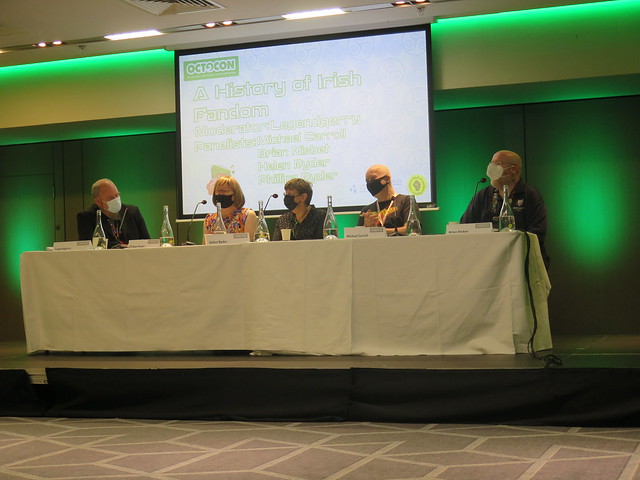
After that I made the relatively short journey from my home to Croke Park, and somehow managed to miss all programme items until a post-lunch panel entitled A History of Irish Fandom. This to some extent turned into a history of Irish SFF cons, with zines and the like receiving relatively short shrift. There was a bit of talk about the now moribund Irish Science Fiction Association and how it performed a useful role, with Philippa Ryder suggesting that it would be great if someone were to revive it. Having an organisation for science fiction fans sounds amazing — I am imagining membership books, badges, secret codes, possibly uniforms — but I didn't really get much sense from the panel of what ISFA actually did. I should perhaps have a look at FANAC and see if there are any scans of ISFA publications there.

It was fun hearing about the cons of yore though, with the mention of the 1992 Trincon being a particular highlight for me as that was my first (and for a long time only) experience of organised science fiction fandom. One thing I don't think the panelists really touched on is that there was a definite arrogant Trinity student aspect to Trincon, which might have jarred with the wider SF community. It's been a long time but I remember there being panels at Trincon that you would never get at Octocon today (I can't imagine Octocon ever running panels on how Star Trek is stupid or how film science fiction is mostly just a facile dumbed down version of what appears in print). But the Trinity students got their comeuppance in 1997 with Trincon 2, which attracted so few attendees that there was one guest of honour for every five paying punter.

I arrived slightly late to Comics Is Literature, discovering subsequently that the cavalier approach to subject-verb agreement in the panel's title references an internet controversy. This explored the recurring SFF question: "why don't the squares in the literary establishment take our genre stuff seriously?" One thing I did like was the mention of how comics have always been a somewhat disposable medium, with the transition from print to online distribution not necessarily changing this: previously people bought monthly comics that had a tendency to fall apart, now they often view them on a website that might well disappear in the morning. There was also discussion of how comics have long been seen as primarily a medium for children, which undermines their acceptance as something adults can unproblematically enjoy or take seriously. Subject verb agreement

I was struck though by how the comics panel only really talked about comics in the anglophone world, as my understanding has long been that on the European continent and in Japan it is far less the case that comics are seen as things exclusively for the kids. It would be interesting to look at why there might be that divergence. Also, given that the kids' comic market has now largely disappeared (apart from The Beano), the idea that the problem with comics is their association with children might be something that will no longer hold in the future.

One other point made by the panelists interested me, the idea that comics are a form, not a genre. That is obviously true, with comics covering a range of subject matters, even if ones about guys in funny costumes punching each other are still rather dominant. But I think there is still an extent to which people who like comics and people who create them do kind of see them as effectively a genre. Even the fact that you can have a comics is literature panel without panelists saying "I've nothing in common with you guys because I write romance comics while you are writing crime comics" suggests a certain collective appreciation. There is something a bit circular here of course: regardless of genre, comics are sold in comics shops or in the comics section of bookshops, which reinforces the idea that they are a thing apart from true literary works like the latest Andy McNab tome.

For me though a gap in the comics panel was any discussion of what constitutes literature. Is literature anything with written text? Or is literature a qualitative term (something only becomes literature if it is… literary)? If you take the first approach then any comics that have text are literature, but there is a certain so-what quality to this as the same would be true of a shopping list. If you go down the second road then it becomes possible to argue that some comics are literary enough to be classed as literature, but this also implies that there will be some comics that will not make the grade.

The panel also has me thinking that it is really time I got back into buying monthly comics. It further reminded me that I should be checking out IrishComics.ie on a more regular basis.

I then took a break from panels to attend Half a Man in a Trenchcoat: Network Theory and Storytelling. This was a talk by Harun Šiljak, who took ways of modelling real-life human interaction and then applied them to works of fiction. He began with such mythic works as Beowulf and the Táin Bó Cúailgne, noting that the networks between the characters are statistically similar to those observed in real life networks, once the main characters are excluded (this had me wondering if real life social networks might look a bit unrealistic if mapped from one person's point of view). He then went on to the core of his talk, applying network theory to the first season of Twin Peaks. There was a lot to unpack here — the change in the way the character interactions work once Dale Cooper appears in the first episode (which in turn sees about half of the main characters appearing before and after Cooper first hits the screen), and then the way Cooper and Sherif Truman frequently appearing together skews the network in a way that can be resolved by treating them as one person. The thing I found myself wondering was whether in a show with a whodunnit element like Twin Peaks do the character networks provide clues to the killer's identity.

And then the closing ceremony saw the announcement that Sakura is stepping down as chair, with the new occupant of the hot seat being Paul Carroll. Onward and upward. Things I bought at Octocon I should also mention the trade hall at this year's Octocon, which was perhaps in a smaller space than the last in-person con but which felt like it was completely jam-packed with product. I came home with a pile of stuff. And I should note that I missed the non-appearance of the Golden Blasters and the Vault of Horror. The Golden Blasters was a short film competition and festival that always featured some amazing stuff, while the Vault of Horror saw John Vaughan playing clips from terrible films while drawing attention to their awfulness (this was way more entertaining than I am making it sound). Good things cannot last forever.

One great thing that was back at Octocon was the Lally Wall. This a wall featuring hand-drawn posters by Dave Lally outlining ways people can travel to other conventions happening in Britain and Ireland (and sometimes further afield). No online con has ever managed to replicate these successfully. How to go from Ireland to Glasgow

So that was that. It was great being back at an in-person science fiction con. Croke Park felt like the nicest venue I've experienced Octocon in (the right size, useful layout, convenient location), with the one caveat about the pretty terrible catering options (for vegetarians: the options were cakes of various kind (all of which ran out by Sunday afternoon), chocolate bars, crisps, manky pre-made sandwiches, and potato wedges (which rapidly ran out); I don't think the meat people did much better.

If you've got this far you might have noticed another thing about Octocon: everyone was wearing masks. This was mandated by the conrunners as an anti-Covid measure, to protect vulnerable attendees. That it was enforced for programme participants was non-ideal for attendees with hearing impairments. The mask requirement seemed a bit strange to me, as by the time Octocon took place almost nothing else in society was enforcing a mask mandate. Was Octocon being excessively cautious, or is the rest of society insanely reckless? I'm not sure how we could answer this question.

For another view of Octocon, check out this report on File 770 by James Bacon: Octocon 2022

More of my Octocon pictures (inessential)

Sunday, July 10, 2022

A song and a story: "Where Oaken Hearts Do Gather"

This year the World Science Fiction Convention (i.e. Worldcon) is taking place in Chicago. I am not going, but because I voted in site selection I have a supporting membership of the convention, which means I get to vote in this year's Hugo Awards. That means I receive the voters packet: digital copies of most of the works that made it onto the ballot. But before the packet was distributed I went and read all the finalists in the short story category, as these are all available to read online. To be honest, not all of these are great, but one really stood out for me, that being Sarah Pinsker's "Where Oaken Hearts Do Gather". This is presented as though it were the talk page of Lyricsplainer, one of those websites like Mudcat where people discuss the lyrics of folk songs. In the story the people are discussing the obscure folk tune "Where Oaken Hearts Do Gather", whose lyrics can also be found in both the Child and Roud collection of ballads. The song tells of a man and woman meeting together for a tryst in the woods, where oaken hearts do gather (that line is repeated throughout the song). There is an element of foreboding, with the reader perhaps fearing that the man will have less than noble intentions, but things take an unexpected turn and it is the man who suffers a terrible fate. The lyrics go on to suggest that his fate is a ritualistic one and that these events will be repeated when other men find themselves lured into the woods, where oaken hearts do gather. What exactly is happening here remains oblique, but that only adds to the sense of unease the lyrics generate.

Meanwhile, in the Lyricsplainer comments people there are discussing the song and making the case for particular variants of the words. We also see the kind of feuding and trolling that bedevils the online world. But buried in among all the chatter one of the commenters starts talking about how he thinks the song is set in a specific place in England, which he decides to find for himself. As the discussion progresses he posts again about how his inquiries are progressing. What happens next may not surprise you; in the best tradition of folk horror, the reader twigs where the story is going a good bit before the protagonist does. That does not stop the ending from packing a considerable punch.

You can read the story for yourself on the website of Uncanny magazine here: https://www.uncannymagazine.com/article/where-oaken-hearts-do-gather/ Sarah Pinsker meanwhile is a musician as well as a writer. Her band The Stalking Horses have recorded their own version of the song. It would not spoil your enjoyment of the story if you listened to this first, or vice versa. image source (Guardian: "Getting back to nature: how forest bathing can make us feel better")

Monday, December 14, 2020

The novels of John le Carré: a partial ranking

The passing of popular novelist John le Carré has led many people to write things about him and his works, which mostly dealt with spies working for the British intelligence services. If you've never read his work, then I say dive in as his books are very impressive, somehow turning his stories about people perusing files and going to meetings (plus occasionally flying off to do mysterious things in strange places) into dramas of high import that seemed to say something about the world we live in. A good starting point is The Spy Who Came In From The Cold, the book that made his name. From there I recommend progressing to the Karla trilogy (Tinker Tailor Soldier Spy, The Honourable Schoolboy, and Smiley’s People) and then reading whatever ones of his books you come across.

I have enjoyed all the books by le Carré I have read, though I have not read them all. And I have enjoyed some of them more than others. So here is my ranking of the nine novels I have read, from least to most liked.

9. Absolute Friends (2003)

This is about an English and a German guy who become friends in the 1960s and then find themselves being used by intelligence services in the decades that follow. It's OK but it became less interesting to me as it went along, with the ending a bit outlandish.

8. The Secret Pilgrim (1990)

This is really a collection of short stories masquerading as a novel in which an old retired spy reminisces about his career. This is probably one to read after the others as you'll get more mileage out of cameo appearances by some of le Carré's star characters that way.

7. The Honourable Schoolboy (1977)

This is the middle book in the Karla trilogy, with much of the action shifting to South East Asia. It might be the closest to a James Bond story of anything le Carré wrote, for all that it retains his grubby cynicism. One of the big problems with le Carré's writing is that he struggles to write convincing women characters, an issue that is not usually a problem in the male-dominated world his characters inhabit but one that is more salient in this book.

6. A Murder of Quality (1962)

George Smiley is le Carré's most famous recurring character. In this early book Smiley has been retired from spy work and finds himself drawn into investigating a murder mystery in a quiet English country town. Aside from the charms of following Smiley's investigations, the book is also a window into a past where it matters whether someone is Anglican or non-conformist.

5. Call for the Dead (1961)

Le Carré's first novel introduced George Smiley, whose routine vetting of a civil servant opens a dangerous can of worms. As well as introducing Smiley's bureaucratic approach to spy work and his nose for suspicious activity, le Carré also begins as he means to go on here by establishing the largely miserable nature of Smiley's marriage.

4. The Looking Glass War (1965)

Le Carré said this was the most realistic of his spy novels, which he said explained its relative lack of popularity. This is gritty tale of rivalry between British intelligence agencies and a disastrous attempt to infiltrate an agent into East Germany.

3. Smiley’s People (1979)

In this, the third of the Karla trilogy, Smiley stumbles onto a secret that allows him to strike back against Karla, the fearsome head of the Soviet intelligence services. Sometimes I think le Carré's writing career should have ended with this book - the closing scene both brings the Karla story to a close but also hearkens back to the conclusion of The Spy Who Came In From The Cold. And the book highlights the dirty compromises required to successfully prosecute intelligence work.

2. The Spy Who Came In From The Cold (1963)

Le Carré's first two novels attracted relatively little attention but this caused a sensation, with its tale of a washed-up former spy allowing himself to be used in a fiendishly complicated disinformation operation. Spy fiction is always set in the shadows, but this brings us into a morally compromised world where Western intelligence services find themselves using deeply problematic methods to combat their Eastern counterparts. Like some of le Carré's earlier book, this is also a window into a time somewhat different to our own, and modern readers may recoil from the casual homophobia of the early 1960s.

1. Tinker Tailor Soldier Spy (1974)

In the first of the Karla trilogy le Carré presents us with a Smiley who has been forced into early retirement, but who starts to suspect that Karla, the Soviet spymaster, is running an agent at the heart of the British intelligence service. The book follows his investigations, which range backwards over past intelligence operations and include a fateful but enigmatic meeting between Smiley and Karla himself, when the latter was a field agent. The book gains much of its power from parallels with the real-life penetration of the British intelligence services by Soviet spies, with Smiley investigating analogues of actual Soviet moles. It is very evocative of a country struggling to find its way after losing its empire, its elite gripped by malaise as they face the fact that their country is now just a camp follower of the United States.

Many of these have been adapted for the screen or radio; I particularly recommend the BBC adaptation of Tinker Tailor Soldier Spy from the 1970s, with Alec Guinness as Smiley and Patrick Stewart appearing momentarily as Karla.

See also the fascinating obituary in the Guardian, which both runs through the story of his life and provides a useful guide to his works.

images:

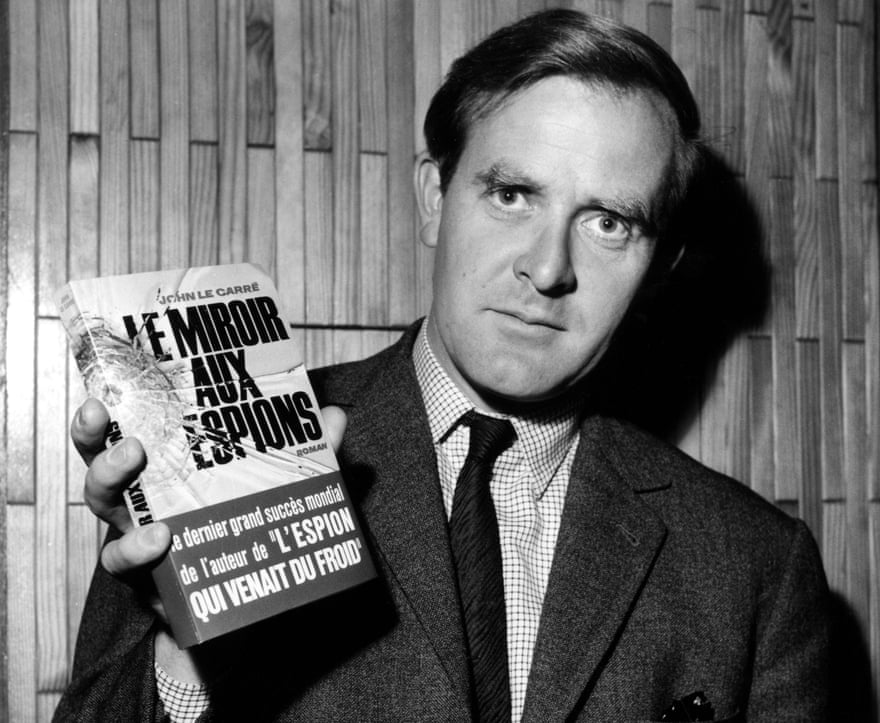
John le Carré in 1965 (Guardian - John le Carré: a life in pictures)

Tinker Tailor Soldier Spy, first UK edition (Wikipedia)

Monday, January 01, 2018

1/1/1818 "Frankenstein": the dawn of science fiction

Two hundred years ago today the novel Frankenstein; or, the Modern Prometheus was published. Its author was the 20 year old Mary Shelley. The novel's strange gestation is well-known. Shelley and others, including her lover Percy Shelley and Lord Byron, were staying in the Villa Diodati by Lake Geneva in Switzerland. Seeking to amuse themselves, they endeavoured to create ghost stories. In a dream Shelley imagined a scientist engaged in the process of creating life; the thought horrified her and from the dream came the novel.

Frankenstein is sometimes hailed as the first science fiction novel. The eponymous scientist creates his Creature not through magic but through science, though the exact processes by which he does so are not described (supposedly to prevent readers from replicating his obscene experiments). Nowadays most people know Frankenstein through its many film adaptations but the novel has its charms and is worth exploring. Much of the book deals with Shelley's progressive social and political ideas, with a recurring question being whether the Creature is an evil monster or an unfortunate driven to terrible acts by the rejection of its creator.

Shelley's later writings may well have produced better books than her first novel. Nevertheless, in Frankenstein she created stories and characters that have become modern myths, cautionary tales for us of the dangers of unfettered science.


image sources:

Title page of Frankenstein first edition (Wikipedia: Frankenstein)

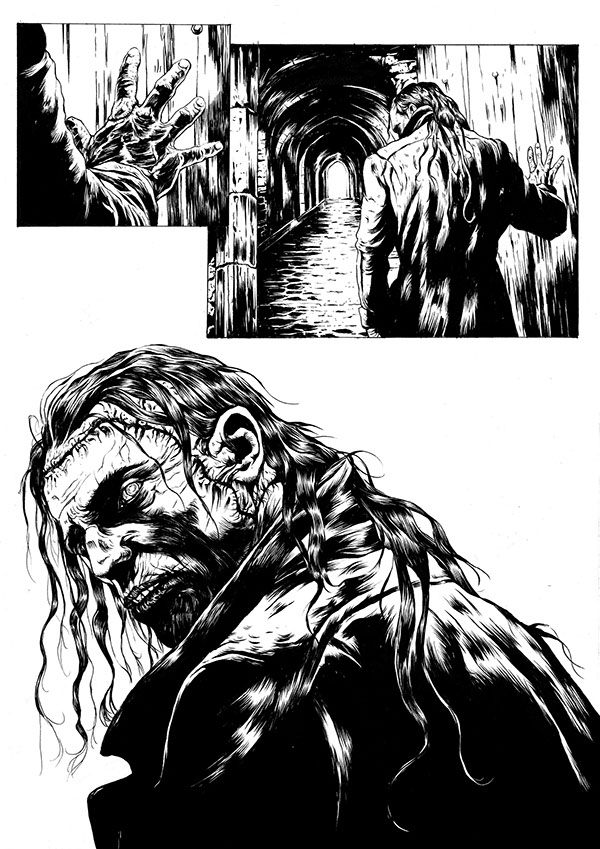
Frankenstein's Creature, by Marek Oleksicki, from the comic Frankenstein's Womb, by Warren Ellis & Marek Oleksicki (Marek Oleksicki on Behance)

Wednesday, March 11, 2015

A Trip to London Part 3: Gothic

I allowed myself a non-musical interlude the next day, popping up to the British Library for an exhibition they were having on the gothic. This went roughly chronologically from Horace Walpole's The Castle of Otranto up to the present day, taking in various aspects and detours along the way.

The short Jan Švankmajer animated version of Otranto they had at the exhibition's beginning was fascinating. Apparently this is the only attempt thus far to adapt that classic novel for the screen. Švankmajer is most famous for weird puppetry (e.g. see his Dr Faustus), but this was a combination of Terry Gilliam-style animation and filmed interview with a researcher who had discovered that Walpole's novel is in fact based on a true story that occurred not in Italy but late-mediaeval Bohemia. The blatant fibbery of the framing device was a nice evocation of the original novel's claim to be translated from an original Italian account of actual historical events.

Later on I was amused by some material on The Monk, by Matthew Lewis. This book caused a sensation with its tale of a once-pious monk who is led by a female demon into a life of depraved vice. The exhibition had a printed copy of the first edition that Lewis was proposing to edit into a less shocking second edition, with a page shown in which he was proposing to cut an entire page of perving at the naked breast of a young lady.

While most famous now for The Monk, Lewis was more than a one-book author. The exhibition had material on The Castle Spectre, a play Lewis wrote after the success of that novel. The play also caused a sensation, not through depictions of depravity and vice but because one of the characters has African servants who denounce the institution of slavery. It was felt that this kind of crazy talk would undermine the economic foundations of Great Britain. I do not know whether Lewis threw this abolitionist talk in to shock, out of genuine conviction or for less thought-through reasons. Lewis himself had inherited significant wealth from Britain's sugar-gulags in the Caribbean.

Later on I was taken with a discussion of Victorian sensation novels (e.g. The Woman in White) and then other books that were even more sensational. Novels in which the villain or villainess was revealed as a bigamist proved to be particularly popular in this period, giving away to inevitable parodies like Quintilia the Quadrigamist. The exhibition then linked the sensation novels to the media sensation that surrounded the Jack the Ripper killings in the late 19th century. The original "Dear Boss" letter was on display. This letter was signed "Jack the Ripper", giving the killer the name he is remembered by. The exhibition was gamely suggesting that it might be genuine though I understand that it is generally considered to be a hoax.

One jarring note appeared when they brought the exhibition into 20th century gothic. There is a lot of 20th century gothic, but I was surprised that they foregrounded popular film The Wicker Man so much. That film arguably has some gothic elements (e.g. a sinister aristocrat), but overall it owes far more to folk horror than the gothic and was out of place here.

It was also noticeable that the exhibition had a very British focus. This meant there was a fairly minimal coverage of non-anglophone gothic literature. While Edgar Allan Poe was mentioned, there was no great exploration of the wider American gothic. In some ways this was a bit limiting, but it is the British Library after all, and not everything could be included. One particularly notable omission was the lack of any mention of James Hogg's Private Memoirs and Confessions of a Justified Sinner, particularly striking given that Hogg was a British writer.

Overall though, this exhibition was less about information than atmosphere. I may be deluding myself but I think I could more or less have curated this myself, at least with regard to the informational material. But the atmosphere was great, with the whole place in a gloomy darkness (though bright enough even for duff-eyed types like me to read the material), drapes and faux cobwebs abounding and suitably gothic images projected on the walls. There was also a nice finish linking the gothic literature of yore to the current gothic scene.


Would you like to know more? Check you the British Library's fascinating collection of articles on the Gothic.

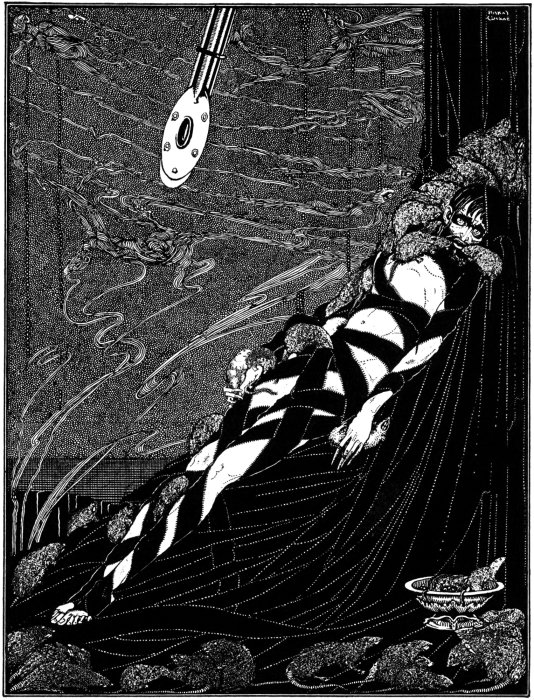
The Masque of the Red Death (Wikipedia)

The Monk cover (Arukiyomi)

Jan Švankmajer's Castle of Otranto (in Czech, with Russian subtitles)

Friday, January 09, 2015

[book] James Young "Nico: Songs They Never Play On The Radio"

This is a memoir of the author's time he playing keyboards in Nico's last touring band, a period in which he also did arrangements for Camera Obscura, her last album. I read it first years ago but recently bought another copy to give as a present to a friend, giving it a quick re-read before doing so. It is a fascinating tale of life at the bottom of the musical ladder, a world away from the tales of fame and fortune you usually get in musicians' memoirs. Nico and the dodgy types hovering around her (including the author, her manager, and most of the people playing in her band) make for fascinating characters. The book is also surprising in its willingness to dish the dirt on living people, with John Cale in particular coming across as a particularly unsavoury individual. Nico herself remains an enigmatic and unknowable figure, her heroin-addiction contributing to a near-total self-absorption.

The book made me listen again to her wonderful records, particularly The End, Desertshore and The Marble Index (Chelsea Girl has its moments but its sunny production marks it out as False Nico). The best tunes marry her infinitely sad voice to a dirge-like harmonium accompaniment, creating sounds of terrible sadness which somehow never sound like indulgent mopiness. Reading the book made me think about her aesthetic and her creativity. So much of her work seems to have been thrown together to put out some product so that she can get some money together to score some smack, yet from that such great music has been made.

I would like to hear again the record that James Young plays on. I had a copy years ago and did not like it so much. I remember finding it a bit 80s, with synthesisers and the like burying the harmonium on too many of the tracks. But reading the book again makes me want to give it another go.

Anyway, I encourage anyone who likes music or fun stuff to have a look for this book. It was going for cheap in Fopp last time I looked. Even if you have no interest in Nico's music I think you would enjoy this vision of the less glamorous side of the music business.

Image sources:

book cover (Goodreads)

Nico at her last concert (from Nico IcoN, 1988 concerts)

Nico performing 'Valley of the Kings' in 1986:

Thursday, May 22, 2014

A Gothic Book Club?

I have been thinking for a while that what I really want to do is read more gothic novels. Two things have convinced me that I really must approach this more seriously. Firstly, there was the engaging piece in the Guardian, How to tell you're reading a gothic novel – in pictures. And then, just the other day, I was at the launch of issue 3 of The Green Book, an Irish journal on the gothic and macabre.

What I am thinking of doing is picking books and setting myself two months to read each one (two months being a long time, but I am a slow reader and I also have other reading commitments). Some other people have expressed interest in this project so if there are the numbers I will try and turn it into some kind of book club. I may not be able to start this until the autumn, as the immediate future sees me consumed by the horrors of having to find a new place to live and also my Important Project, plus July is a busy time in work and I am going away for some of August etc. etc.

I have put some thought into compiling a list of books to read. There are a lot of gothic novels, but some of them are more key than others. I think the 12 books below constitute a reasonable enough A-list of the gothic over a period of more than a hundred years, presenting the work of authors from a reasonably wide spread of countries.

Horace Walpole The Castle of Otranto (1764) - This is usually credited with being the first gothic novel, though there are of course some earlier candidates. The book caused a sensation on its first appearance.

Ann Radcliffe The Mysteries of Udolpho (1794) - Mrs Radcliffe was a highly successful imitator of Mr Walpole's work.

Matthew Lewis The Monk (1796) - Behind the pious face of the eponymous monk lurks the soul of a man who has given himself over to every kind of depraved vice.

Jan Potocki The Manuscript Found in Saragossa (AKA The Saragossa Manuscript) (1815) - The Polish Count Potocki's narrative presents a series of nested and interlinked stories supposedly told to the main narrator or read by him as he travels through the Sierra Morena mountains en route to Madrid.

E.T.A. Hoffman The Devil’s Elixirs (1815) - I do not know too much about this but Hoffman is an important figure in the development of the gothic (or so I have read). The novel apparently bears some similarities to The Monk.

Mary Shelley Frankenstein (1818) - This was the product of the famous night in the Villa Diodati where Shelley, Lord Byron, her future husband and others competed to produce the most original and terrifying horror story.

Charles Maturin Melmoth the Wanderer (1820) - Melmoth has sold his soul to the Devil in return for an unnaturally long life, but he can save himself from damnation if he finds someone to take on the bargain. He travels the world on an increasingly desperate quest for someone who will trade life for salvation.

James Hogg The Private Memoirs and Confessions of a Justified Sinner (1824) - This strange novel of madness and demonic possession concerns a Scottish gentleman convinced that as one of the Elect he is predestined for salvation, regardless of whatever acts of depravity he might commit.

Edgar Allan Poe [an anthology of short stories] (1832- 1849) - There are lots of anthologies of Poe stories and it would probably be difficult to get everyone in a book club reading the same one, but anything featuring the likes of "Ligeia", "William Wilson", "The Masque of the Red Death", "A Cask of Amontillado", "The Fall of the House of Usher", "The Tell-Tale Heart", "The Premature Burial" etc. would do the job.

Emily Bronte Wuthering Heights (1847) - The demonic yet charismatic Heathcliff and the terrible revenge he works on those he feels have wronged him make for one of the greatest of gothic narratives.

J. Sheridan Le Fanu In A Glass Darkly (1872) - This short story collection is most famous for the endlessly fascinating vampire story "Carmilla", but it also includes other noteworthy tales of the macabre, including one that would be of particular interest to anyone familiar with the city of Dublin. [An alternative to this would be Le Fanu's novel Uncle Silas (1864), the dark tale of a teenage heiress on whose fortune various sinister figures have nefarious designs]

Robert Louis Stevenson Doctor Jekyll and Mister Hyde (1886) - There is probably no one in the world who does not know what is going on here, but try reading it while imagining yourself a late Victorian picking up the book for the first time, aghast at the thought of what could link the apparently saintly Dr Jekyll with the sinister and bestial Mr Hyde.

H. Rider Haggard She (1887) - In a remote and unexplored corner of Africa, a beautiful and immortal but indescribably cruel sorceress rules over the ruins of a lost civilisation and waits.

In picking the above I have been guided by my own sense of what would constitute a representative tour through the gothic canon. I am open to suggestions as to books that could be added or subtracted from the list, but in the mode of a truly obsessive gothic antihero I must insist on making the final decision myself.

The one truly key gothic novel I have left off the above list is Vathek (1786), by William Beckford. Beckford is a fascinating figure and the book was influential and important in the history of the form, but it is also a not particularly impressive work to modern readers.

I suspect that many people with a passing interest in the gothic or in English literature will have read some of the above books already. I have read several, some of them quite recently. But I think for a proper exploration of the gothic we should be willing to read them again, or at least skim the plot summary on their Wikipedia page.

Those 12 books would keep me (and anyone joining me) going for two years. Perhaps by then we would be sick of the fetid swamp of the gothic, or perhaps we would be desperate for more. One possibility would be to read (or re-read) Jane Austen's gothic parody Northanger Abbey and then approach the Seven Horrid Novels mentioned by name in it, before moving on to later gothic or gothic-tinged novels like Great Expectations, Dracula, À Rebours, The Picture of Dorian Gray, The Case of Charles Dexter Ward, Titus Groan, and so on. But these would be questions for the future.

Links:

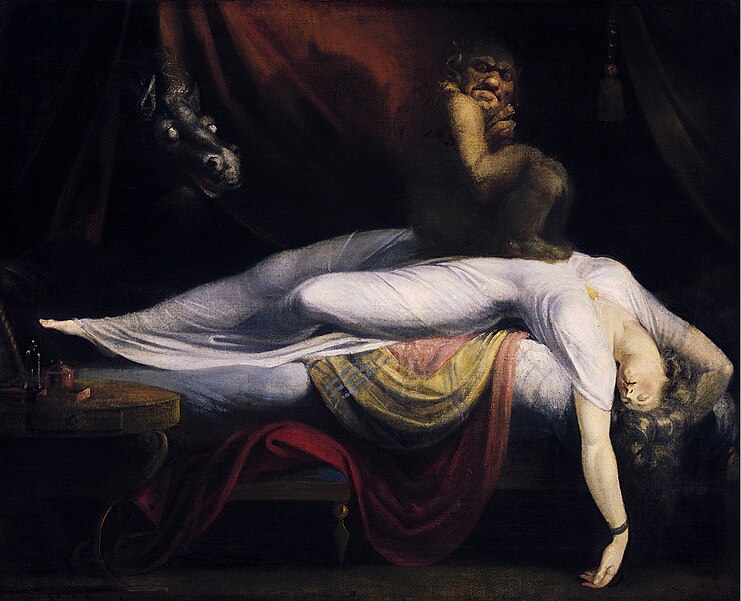
The Nightmare

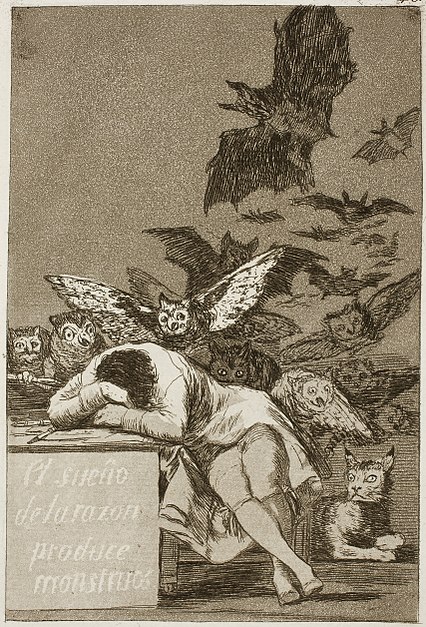
The Sleep of Reason brings produces monsters

The Green Book

Friday, May 09, 2014

Are you reading a gothic novel?

A bolt of lightening briefly illumined the chamber more brightly than anything achievable by the dim candle's faint glow, followed by the terrible crash of thunder that momentarily drowned out the persistent and depressing sounds of the rain battering against the window, causing Carlotta to avert her eyes from the book she was reading, from which they fell on the open page of an article in a news periodical that purported to reveal whether the book she was reading - the terrible, forbidden tome that she could not abandon for all that she longed to cast aside its ghastly leaves - was that most ghastly and obscene of literary works: a gothic novel.

How to tell you're reading a gothic novel – in pictures (Guardian)

image source

Monday, January 28, 2013

Things I bought in the UK

Books:

Rick Geary Lovers' Lane - the Hall-Mills Mystery. From Rick Geary's Treasury of XXth Century Murder series. I am fond of Rick Geary's comic books about American murder but I fear that this will lack the bizarre gothic qualities of The Bloody Benders or The Bears of Chicago

Simon Reynolds Retromania: Pop Culture's Addiction to its Past. Man, I remember when this classic came out, it is so much better than the music books of today. The edition I picked up is also pretty collectible.

Clifford D. Simak City. This is a second hand copy of the classic weirdo SF novel that has maybe crept back into print thanks to Gollancz and their SF Masterworks series.

Jean-Pierre Filiu & David B. Best of Enemies: A History of US and Middle East Relations. Comics and international relations, together at last.

Peter Haining (ed.) Beyond the Curtain of Dark. A New England Library collection of classic horror stories from the great anthologist Peter Haining.

CDs:

The Keelers Farewell to the Master: Sea Shanties. I bought this from one of the Keelers. Yarrrrr.

The Unthanks Diversions vol. 2: The Unthanks with Brighouse and Rastrick Brass Band. | am interested in the combination of Unthanks and brass.

v/a American Murder Ballads: 50 Vintage Murder Ballads. A three quid impulse purchase from Fopp.

v/a Sailor's Songs & Sea Shanties: A Classic Collection of Sea Songs and Shanties. Another impulse purchase from Fopp. It was either this or another collection of sea songs, let's hope I did not get the wrong one.

Image sources (with reviews):

Beyond the Curtain of Dark

Lovers Lane

Best of Enemies

Sunday, December 23, 2012

My Big Reading Plans for 2013

I have been thinking about what big old books I want to read in 2013, to fill in the embarrassing gaps in my reading of the classics. These are the ones I have come up with, which I propose to read in a yet-to-be-decided order:

Wuthering Heights, by Emily Bronte. Apart from me, everyone in the world has read this. Even I have absorbed a lot of what this book contains from film adaptations (in particular, Andrea Arnold's fascinatingly grotty version from 2011), Kate Bush, and the ether generally. When I mentioned this book some time ago, I was struck by how many people I know hate it. Maybe when I read it I will hate it too, but I want to have enough knowledge of the book to feel that I am entitled to express an opinion on it myself.

Lord Jim, by Joseph Conrad. This is another one of those books I feel like I know a lot about without ever having read, though I did read the first couple of pages some years ago (and they are stunning - the only reason I did not continue was that some other book was making demands on me at the time).

The Collected Tales, by Nikolai Gogol. I like any Gogol I have come across, which may be why my beloved bought me this fine collection. In 2013 I hope to actually read it.

Bleak House, by Charles Dickens. I feel that by this stage in my life I should have read more novels by Charles Dickens, so I hope to have got through this porker by the end of 2013.

Phineas Finn, by Anthony Trollope. Lots of people love Trollope. I have never read anything by him and am actually open to the possibility that he is priggish and boring rather than actually entertaining, but I would like to have read something by him on which to base an opinion. The appeal of Phineas Finn is its setting in the world of 19th century politics, which I think could be rather interesting.

The Iliad, by Homer. That's right, I have never read the Iliad, though I have read a re-telling of it for kids. I want to read this as part of a programme of reading epic poetry, starting with this and going on to the Odyssey and maybe continuing with the Aeneid (or maybe skipping that) before finishing up with Paradise Lost. My interest in the Iliad has partly been rekindled by my current taking of a class in ancient Greek, through which I have been able to read the first couple of lines in the language of the ancients. That has made me excited about reading all of the Iliad (in English, obviously), but has made me a bit wary of all the available translations.

So that is it. I know what you are thinking - "a whole year to read six books???". In my defence I can say a number of things. I am a slow reader, easily distracted away by other things. I also have any number of other demands on my time. And these are not all the books I plan to read in 2013 - as well as these I hope to keep up with SF book club, make progress on eliminating the Panda Mansions book mountain, and possibly even tackle some of the books that my friends in classic and modern book club are reading.

One other thing I am still undecided on is the Romance of the Three Kingdoms by Luo Guanzhong. As you know, I have been reading War & Peace a chapter a day this year. We have found this a most enjoyable experience, with the grand scale of the book suiting the slow reading we have given it. Some of my friends are looking to chase the buzz next year, by reading another porker of a book over the same time scale. From a list of longest books ever, this 14th century Chinese novel looked like it has a similar kind of epic sweep to Tolstoy's masterpiece so my friends are opting to read it over the whole of 2013.

I have not fully committed to this myself yet, as it seems like a big commitment (Romance of the Three Kingdoms is a good bit longer than War and Peace) and I do not want to compromise my general reading. But the book does seem intriguing, giving an account of a vicious struggle for supremacy between the three warring states into which China was divided in the second and third centuries AD. It is fiction, but it is based on real events, and real events in a period I know little about, making it very tempting to a history lover like myself. It also seems like every chapter ends on a cliffhanger, which would suit reading it in a drawn out manner.

Or I may plough a lonely furrow and read Victor Hugo's Les Misérables a chapter a day next year. It has the advantage of having exactly 365 chapters (one reason we read War & Peace this year was that it has 366 chapters). However, one thing that proved very enjoyable with War & Peace was reading it with other people and trading comments on each chapter with them in our Facebook group. So I think if I was to read anything over the whole of 2013, it would be better to read something with other people. And I have learned through bitter experience that French novels are rubbish, so I suspect that in 2013 it will be Romance of the Three Kingdoms or nothing.

Some links:

A list of longest books ever

Facebook War and Peace readers group

Facebook group for people reading Romance of the Three Kingdoms in 2013

Reading Panda

Saturday, May 19, 2012

Natasha's Dance

I have been reading War and Peace since January, a chapter a day. The book has three hundred and sixty six chapters, and 2012 has three hundred and sixty six days, so it seemed like a good idea. And it is, the book is among the greatest things ever, and the chapter a day pace suits it really well. I think at the start maybe reading only five pages a day seemed a bit restricting, but as you go along you get into the rhythm of it

Before reading the book, I did not too much about it. I knew, obviously, that it was set during the Napoleonic Wars and made a big deal of Napoleon's invasion of Russia. And I suppose from the title I could deduce that it featured stuff relating to people's peace-time lives as well. And that really was it – or almost it. I did have one other piece of advance knowledge, thanks to a partial reading of Orlando Figes' book Natasha's Dance: A Cultural History of Russia. When I first approached that book I took it that the "Natasha's Dance" bit of the title was metaphorical, but it turned out to be a layered metaphor – it refers to a scene in War and Peace where a character called Natasha does a dance, the dance and the scene being metaphorical. That gave away two spoilers – firstly that there is a character called Natasha who will do a dance and secondly that this Natasha is somehow important to the book as a whole, something that would not immediately have been apparent when she first appears in the novel (and something which is only beginning to become apparent now that she has done her dance).

But what is the dance thing all about? Well, Natasha is from a minor noble family whose menfolk are all fuckwits who are bringing the rest to the brink of ruin with their feckless and incompetent ways. Like all of the nobility, their lives are focussed on the cities, either Moscow or St. Petersburg, and the jockeying for position there. They speak French rather than Russian and are disdainful of the plain countryfolk and their way of life. But in this chapter, Natasha and her brother (amiable fuckwit Nicholas) find themselves back in the house of a very minor noble neighbour of their country estate, a man so barely noble at all that he lives on terms of easy familiarity with his serfs in his ramshackle house. He serves a simple meal (featuring pickled mushrooms, which sound like the best thing ever) and some drink to his guests and then his serfs play some music on a balalaika, and then Natasha is invited to dance – and she does, but she does not do one of the poncey French dances that she would have been thought in the cities, but a true Russian peasant dance whose steps she somehow just knows from the depths of her being. I think this says something about the Russian national character, or Tolstoy's view of it.

It is a lovely scene, independently of whatever meaning Tolstoy wants to communicate in it, with a lovely sense of unbuttoned joie de vivre very much at odds with the uptight lives of so many of the characters. It is one of the moments in this book that brings home what a great writer Tolstoy is and why so many people say that War and Peace is the greatest book ever written.

A review of Natasha's Dance

and another

image source

Later – oh great, trying to find a YouTube video of Natasha's Dance from one of the book's many adaptations I have come across a BIG SPOILER.

An inuit panda production

Saturday, February 11, 2012

War and Peace 2012

War and Peace is the famously porky novel by Leo Tolstoy. It concerns Russian society in the time of the Napoleonic Wars. This year I am reading it a chapter a day. Why? Well, it is one of those books that I have always meant to read sometime, but its size has previously proved off-putting. However, a chapter a day is a very manageable way of digesting such a big book in bite-sized portions. This is also an ideal year in which to read a chapter of War and Peace each day. The book has 366 chapters (in some editions; others combine them in such a way that it has less), and this is a leap year, so the fit is perfect. Also, 2012 is the 200th anniversary of Napoleon's invasion of Russia, the central event of War and Peace.

So, I encourage you to join me in reading Tolstoy's classic a chapter a day. Now, I know what you are thinking. Given that we are now well into February, you are thinking that it is too late to start on War and Peace, that you will not be able to catch up. Well, you would be wrong. The chapters in War and Peace are pretty short, so much so that it would be no great hardship to read two or one-and-a-half a day until you have caught up. I urge you, therefore, to seize this once in a lifetime chance to read this great novel that people are always meaning to read sometime.

If you are reading the book, then why not check out the awesome Facebook group for those of us reading it this year? Words cannot describe how amazing this group is.

Image source

An inuit panda production

Thursday, October 20, 2011

Summer in London – part 1: Museums

Join me, gentle reader, as I take you with me on my recent trip to London, capital city of the British Empire. Eschewing the variable charms of the Bloomsbury guesthouses, my beloved and I planted ourselves in Kensington, where Imperial College lets out student accommodation over the summer to holidaymakers like ourselves. The facilities here proved most agreeable, and I would recommend any readers from outside London looking for a more cost-effective accommodation in the big city during the summer months to seek out this place.

RIOT
We were in London the week after the city was torn apart by rioting. I had been a bit worried that feral youth would once more rise up against The Man while we were in the city, but this was not to be. In any case, we would have been able to sleep soundly in our beds, as it seemed like half of South Yorkshire's police force were billeted in Imperial College.

We were not in London just to hang out with men in uniform. A variety of cultural activities were on our agenda. Using our membership, we visited the British Museum to look at the exhibition there on mediaeval reliquaries (objects used to store relics of saints, said relics being anything from bits of their clothes to chips of their skull). Compared to some of the other British Museum things I have been to, it was surprisingly quiet – maybe people are more interested in exotic foreign religion and stuff than in the Christian heritage of Europe's past.

The reliquaries exhibition more or less ended with the Reformation, when the emerging Protestants took against relics big time and shamed the Catholics away from the more lurid excesses of reliquary reverence*. You can see the point of the Protestants, but they did come across like a load of kill-joys – religion may have become a bit less crazy but it also seemed to have had a lot of the fun kicked out of it.

We also made two visits to the exhibition on science fiction in the British Library – more or less a journey through the form's history using book covers as a means to throw out discussion points. It also had some fascinating audiovisual input, of which my favourites would be the snippet from Orson Welles' radio drama of The War of the Worlds, a clip from the recent silent and faux expressionist film of 'The Call of Cthulhu', and a short clip from the 1950s TV version of 1984. That last one seemed to have been a hoedown of British talent of the time – Nigel Kneale wrote the script, Winston Smith was played by Peter Cushing, and Syme (the guy who shites on about newspeak to Smith) was played by Donald Pleasance. No wonder Prince Phillip liked it so much. It is a great pity that the holders of copyright on this work have deliberately kept it from public view.


*unless they are living in Naples.

An inuit panda production

Monday, September 20, 2010

Stephen Baxter - "Ark"


I read this for Science Fiction book club. It is the sequel to Flood, the book in which the world is drowned (over the course of several decades) by water erupting out from subterranaean reservoirs. Or it is kind of a sequel – Ark begins before the other book ends, though it goes on for decades afterwards. Each book could be read independently of the other, more or less.

In Flood the narrative followed quite a few characters and jumped around the world. With this one, though, things are a bit more focussed. The main thrust is on these youngsters being trained up to take part in a spaceflight that should hopefully allow enough humans to escape the drowning world to ensure the survival of our species. These people – the candidates – live largely in a bubble of privilege and comfort as the rising sea levels cause the wider world to go to shit. We get occasional glimpses of that wider world through the eyes of people guarding the space programme's facilities from people trying to flee the rising waters. Like with the first book, Baxter seems very adept at painting a grim picture of a world falling apart. Maybe because of the more precise geographical focus (pretty much all of the earthbound stuff takes place in Colorado), the effect is maybe even more disturbing than in Flood - the book communicates a vivid sense of the horror of the endless retreat from the rising waters and the loss of human decency that this brings with it.

The second half of the book follows the spaceship (called, amazingly, Ark) after its launch into space. Because near future humans have handily managed to develop a warp drive, it is able to travel to the stars in less than centuries, but it still ends up taking decades to get anywhere interesting. And of course a relatively small group of people on a cramped spacecraft is a perfect recipe for an unpleasant hothouse of human emotions, with things getting almost a bit Batavia's Graveyard at one point.

I think maybe the earthbound stuff was the best part of the book, but the space travel stuff still cracks along. The dysfunctional internal politics of the space crew is rather fascinating, but it might have been more interesting if the characters were better drawn. Like a lot of SF writers, Baxter seems more comfortable with the sciencey stuff than in convincing characterisation, and it does seem like the deterioration of one character in particular into a monster is a bit two-dimensional.

Purely as a matter of taste, I found the use of a predatory paedophile as a plot device in the first half of the book a bit distasteful – more for somewhat over-graphic description of a nonce-crime episode. It could just be me, but maybe this is one situation where tell is better than show.

As with Flood, I am a bit ambivalent as to whether Ark is *that* good, but there is no denying the effect Baxter's description of the drowning world has been – I have been having intermittent nightmares about floods since I started reading these works. I suppose that counts as a result.

And in case you are wondering what our next SF book club is, then wonder no more – it is Stranger In A Strange Land by Robert Heinlein. I look forward to seeing whether Heinlein is as bad as his reputation suggests. Join us in the ILAC Library on the second Tuesday of October to discuss it.

image source

you could click here to help victims of flooding in Pakistan

An inuit panda production

Friday, September 17, 2010

Classic Book Club: "Tristram Shandy" AND Exciting News For All Readers

Sirs! Those of you who came along to talk about Laurence Sterne's Tristram Shandy will recall how hard to read we all found it. I managed to get 52 pages out of the way but cannot see myself finishing the book in any realistic timeframe. The book became this chore hanging over me, keeping me from other things – I began to think of all the lovely non-fiction books I could storm through in the time I was taking to read (or to not read) Laurence Sterne's opus.

What I find difficult about Tristram Shandy was its lack of any clear narrative thread. The book* seems to be just an endless series of digressions and rambling asides. I suspect that when you get into the book you learn to love the endless tangential moves, but I was finding that nothing about the book was making me go back to it or keep reading it – it was almost completely lacking in any unfolding plot that would call you back to see what happens next or how the characters develop. So I have given up.

One book this reminds me of, and one that has been compared to Tristram Shandy, is Flann O'Brien's At Swim Two Birds. That's another book I gave up on, as it just seemed to an endless rambling series of narrative meanders rather than anything resembling a true novel. Still, I found what I read of At Swim Two Birds to be more enjoyable, maybe because I could make more direct connection with what he was writing about.

Still rambling digression is not all bad – Jerome K. Jerome's Three Men In A Boat is almost all digression, with only the most shadowy connection to anything resembling a plot. But it is also a work of comic genius. Tristram Shandy feels like it is meant to be funny, but in the first 50 pages I was not feeling the roffles.

So to the next book. First things first – from now on, I am only going to send out notifications of classic book club stuff by e-mail. If you want in, drop me a line. This is the last book I announce here, and the book is… Dead Souls, by Nikolai Gogol. When I first floated Classic Book Club, some people expressed an interest in reading this, but then dropped out of our fold. Maybe putting this on the agenda will bring them back again.

image source

*or, at least, its first 52 pages seem

An inuit panda production

Monday, August 16, 2010

"Flood" by Stephen Baxter


This was our most recent SF book club book. There is not really much to it conceptually. Its single idea is to imagine what would happen to the world if the level of the seas started to rise at an ever increasing and implacable rate. The book follows a number of characters as they scramble for higher ground and try to make sense of what is going on. One of the characters is an incredibly rich can-do entrepreneur type who serves as patron to the others, so they get to see more of things than they would if they were just moving between a succession of refugee camps.

Although you might think this is a global warming book, it is established fairly early on that the sea level rise is happening independently of any melting of the polar ice caps. It is also happening faster than even the most alarmist projections of global warming science. The somewhat outlandish explanation that is eventually outlined is that the floor of the ocean has shattered at a number of points, causing some huge sub-oceanic reservoirs of water to spurt forth. There is apparently some scientific evidence to support the existence of these vast bodies of water stored somewhere in or below the earth's crust. It struck me as a bit outlandish, however, that they would all burst out simultanaeously for no obvious reason, or that the rate of flow from them would keep increasing. But the book is more about the depiction of a drowning world than the science.

That depiction of the drowning world is very vivid. Baxter has a great eye for visual detail and telling vignettes, and much of this book will live on in my mind forever – the mobile city of the Seminole, the roofs of the National Gallery covered in pigeons as Trafalgar Square floods (the whole sequence in which the Thames Barrier is overwhelmed and London floods is a tour de force), the cannibalistic gulag into which the Tibetan plateau is transformed, and many more. The character stuff is maybe not so great, with some odd leaps in behavioural logic needing to be swallowed by the reader. But that is just flim-flam compared to the big picture story of the world we know disappearing beneath the waves. The depiction of that horror is done very well, and I must salute Stephen Baxter as a writer of great talent.

However, I cannot really recommend this book. There is something soul-destroying about a work that begins with London flooding and ends with people on rafts watching the sea rise over Mount Everest. Nothing the human characters do can stop or even slow the rising sea levels. Maybe the efforts of the aforementioned entrepreneur and some others will lead to the human race surviving, but it does seem like a pretty marginal existence for the various boat peoples.

There is nevertheless a sequel to Flood, a book with the evocative title of Ark. And it is the next book for SF book club! If you fancy reading it, you can probably pick up a copy from the Dublin Central Library in the ILAC (you may need to ask at the counter for it). It looks like it exists at least somewhat independently to Flood, so you would not have to have read that first. We will be discussing it there on the 14th September.

I should mention that Flood is not the first inundation-themed novel to pass through SF book club. Some time back we read The Drowned World, by J.G. Ballard. That is a very different kind of work. Ballard's characters have a languid detachment that is very different from the desperate energy of Baxter's people. In some ways it seems like Baxter's book is the more realistic while Ballard's has a certain visionary quality to it. Then again, maybe if the world was falling apart around you, your response might just be to kick back with a large gin and tonic.

image source

An inuit panda production

Sunday, August 08, 2010

"Under the Dome" by Stephen King

I read this for SF book club. It is the first book by King I have read. He is an author I always had down as being primarily for teenagers and have long had the idea that there is something a bit deficient about anyone over the age of 20 who is still reading him. Was I wrong? Read on and see.

The first thing to bear in mind about this book is that it is a total porker – 877 pages worth of Stephen King action. Long books by established authors are always a bit off-putting. The fear must always be that the author has become too powerful to edit, with no one able to stop the fruits of their creativity bloating up in a most unwholesome manner. With Under the Dome I was very much afraid that this would be not so much a book as a sprawling monstrosity bearing only the most passing resemblance to a work of literature. The first question with the book really has to be whether its length is a strength or a weakness.

But first let me outline the novel's premise. What happens is that for no obvious reason the small town of Chester's Mill in Maine finds itself sealed off from the outside world by an invisible dome. It rapidly gets a bit Batavia's Graveyard, particularly once Big Jim Rennie (the local Boss Hogg character) sets up a reign of terror after drafting various thuggish friends of his psychopath son onto the local police force. An Iraq war special forces veteran, conveniently in town when the dome descends, finds himself in a race against time to discover the source of the dome and prevent Big Jim from doing all kinds of bad stuff. The book cuts between loads of characters as events unfold from their point of view.

So, back to the length. It does not start so well. As one of my book club pals points out, the first hundred or so pages just seem to be people crashing into the dome. It is hard not to think that King could have got over that in just a couple of pages. After that, though, it picks up the pace. You sometimes hear books described as page-turners. This is one of those – once it got going, the narrative momentum carried me along and I stormed through the book. The length does seem to work, as it allows the story of the town to be unrolled in great detail and from many points of view. I felt ultimately that the book was long because it ought to be, not because no one can edit Stephen King.

I found myself admiring the authors' technique with this, wondering what writing qualities make a book engaging and hard to put down. For all that, this is not really that good a book. A lot of the characters are a bit thin (though not all of them, by any means), the central premise is never really explained that convincingly, and it does feel a bit like he just has nearly everyone die in a huge explosion because he cannot think of any other way to end things. As it rolls along you maybe do not notice these shortcomings, but they are very obvious once you start reflecting on things.

I would not recommend this book, for all that I enjoyed it far more than I expected to. It has however made me interested in maybe reading something else by King. His ability to draw the reader into a compelling story is impressive and would go well with a book where he had thought through things a bit better. There were also a couple of places in the book where he seemed to really up his game, making me feel like I really was in the presence of something other than a skilled hack-writer*. If this were a first novel I would say, "It's not that great, but aspects of it show real promise". I suppose that might mean that his earlier books are better. What say you?

One final pedantic criticism - this book is barely SF! What is it doing in SF book club?

And the next SF book club is on in the Central Library in the ILAC this coming Tuesday at 6.30 pm. The book is Flood by Stephen Baxter. I have not started reading it yet, so you could get a head start on me.


*if you have read the book yourself, I am thinking firstly of the bit where two of the women cops go snooping around the radio station – there is an almost tangible air of non-specific menace throughout that whole section. Secondly there is the "Feeling It" section about women's netball.

Saturday, August 07, 2010

Tristram Shandy deadline change

SIRS!

I can reveal that it is taking me longer to get started on Tristram Shandy than I had expected. I propose, therefore, to put back the deadline for this to the weekend of the 28th and 29th of August.

Is anyone else reading this with me?

Monday, July 19, 2010

"The Private Confessions and Memoirs of a Justified Sinner" by James Hogg

In case you have not guessed, I read this book for classic book club.

This 1830 novel is one of many 19th century novels that are hailed as a forerunner to the modern novel. It gives us such modernist delights as a split narrative, an unreliable narrator, a profoundly dislikeable protagonist, and a plot that retains ambiguity right to the end. For all that, the book is also of its time in its gothic nature and sense of religious doom. The book purports to contain the memoirs of one Robert Wringham, a man born in late 17th century Scotland, together with an introduction and commentary by an unnamed editor. The editor begins by telling us some facts about the life of Mr Wringham that can be objectively determined, with Wringham's own narrative casting these events in an entirely new light.

The book hangs heavily on the Calvinist idea of predestination. In the most hard-line version of this doctrine, God chose a small minority of people for salvation, not on the basis that they were righteous and morally upright, but more or less at random. These Elect – the chosen of God – are predestined for Heaven, while the rest of us are damned. Nothing anyone does can change their destiny – no matter how righteously one chosen for damnation behaves, he is still doomed to the fiery pit of Hell, while the Elect will sit at God's right hand no matter what sins they commit.

The editor's narrative reveals Wringham to have been brought up believing in this doctrine by his mother. Convinced that he is one of the Elect, he seems capable of any action as nothing he does can stop him from entering heaven. He murders his brother, and is later overheard plotting the death of his mother.

Wringham's own narrative, though, is where it really kicks off. Although a committed believer in predestination from the off, and a thoroughly nasty piece of work, it is only when he makes friends with an odd individual calling himself Gil-Martin that starts following the doctrine to its extreme conclusions. Gil-Martin persuades him that as he is one of the Elect, he can do anything without compromising his own salvation. Wringham embarks on a series of ever more ghastly crimes.

Gil-Martin's nature is ambiguous, with his precise status arguably being the key to the book. It is easy to see him as the Devil, using scripture and the reformed church's doctrine to lead Wringham to damnation. His seeming ability to change his shape supports the idea of him as some kind of supernatural agent. Yet he seems also to be a projection of Wringham's will, or of the dark side of his nature. Given how much of Wringham's narrative is fragmentary and semi-delusional, one could slip into seeing Gil-Martin as a product of his imagination, a hallucination conjured up to voice his own dark thoughts. Yet that does not fully work, as the editor's narrative has Wringham's familiar seen with him on two occasions (in different form each time).

As the book continues, Wringham's sense of himself starts to break down. At one point, he describes feeling like he has two selves, but that neither of these are his real self. Later on again, he starts suffering from lapses in memory, with terrible crimes (rape, more murder, matricide) having apparently been committed by him during these blackouts. The reader is again at something of a loss as to what exactly is going on here. Is Wringham committing these crimes and then forgetting them? Is he lying to us when he says he cannot remember them? Is he under some kind of demonic possession? Is Gil-Martin taking on Wringham's form to have him take the blame for terrible acts he has not committed? Hogg leaves these and many other questions open.

In its unwillingness to tie up all the loose ends and explain everything clearly, this book reminds me of Joseph Sheridan Le Fanu's In A Glass Darkly. Like this book, the stories in Sheridan Le Fanu's volume purport to be papers relating to the investigation of actual events. The inconsistencies and things that remain unresolved resemble the untidy descriptions we get of real events, enhancing the power of the works.

Anyway, this is a most enjoyable book, one that has got me thinking about reading some more gothic novels. Melmoth, The Monk, Vathek, The Saragossa Manuscript, The Castle of Otranto - that lot. You will be relieved to hear that if I ever indulge my desires in this area it will probably be away from Classic Book Club.

Have you read The Private Confessions and Memoirs of a Justified Sinner? What did you think of it?

An inuit panda production

Sunday, July 18, 2010

In which I make an important announcement

SIRS! I can reveal that the next book that those of us who are taking part in my society for the reading of classic novels is none other than The Life and Opinions of Tristram Shandy, Gentleman, by Laurence Sterne. Let us have this great work read by the weekend of the 21st and 22nd of August.

An inuit panda production