Showing posts with label Octocon. Show all posts

Sunday, December 11, 2022

Octocon 2022: two months on

Octocon is the Irish national science fiction convention, which takes place each year in October. After an interlude as an online con, Octocon resumed as an in-person event this year, with fans of science fiction and related genres gathering in a Croke Park conference facility. Others joined us online, as this was a hybrid convention. I have already written about some of the programme items that I unfortunately missed, so now it is time to look back at some things that I was lucky enough to witness or even in some cases take part in.

After a brief stint on the Octocon information desk (where I fear that every piece of information I gave out was incorrect), I found myself moderating a panel entitled Crafting Non-Human Worlds and Societies, with the panelists all being people who had created non-human societies in their own works. This was my first time moderating an in-person panel, so obviously there was the fear that angry attendees would take a dislike to the way in which discussion progressed, blame me for their disappointment, and then chase me from the venue with threats of violence. Fortunately the panelists (Máire Brophy, Michael Carroll, Peadar Ó Guilín, and Jo Zebedee) were all dream programme participants: the kind of people who could talk knowledgeably on the subject, illustrating points both from their own works and those of other writers (including Jack Vance, Piers Anthony, R. Scott Bakker, Adrian Tchaikovsky, & Ted Chiang (in particular for "Story of Your Life", which was adapted into the film Arrival). Discussion of animals that a writer might usefully adapt into an alien civilisation naturally turned to cats but also to the octopus and rabbits (with Richard Adams' Watership Down receiving a favourable mention).

Subsequently I sat in the audience for Movie Monster Mash, which looked at cinematatic monsters. I liked the discussion of how some monsters go through cycles of being seen as irredeemably terrifying before shifts present them as either sympathetic or comical before they go back to being terrifying again, with vampires being an obvious example here. I also agreed with those panelists who argued that the 1992 Bram Stoker's Dracula is an absolutely terrible film. I was not sure what to make of the revelation that there is now a revival of interest in werewolves, those most rubbish of monsters.

I missed the start of Fictional Words to Live By, a panel on the way in which fictional works of science fiction and fantasy can contain philosophical nuggets that gestate in our brains. I was interested by the point that much of SFF has now become contemporary myths, with superhero comics & films and Trek Wars being specifically referenced here; given that all of these have gone on far too long and fallen into cosy self-plagiarism I'm not entirely convinced of the quality of myth we are bequeathing to future generations.

And then two readings, firstly by RB Kelly and Jonny Nexus. Kelly's was from the recently published On the Brink, in which the characters are on a Dutch space station. Science fiction usually imagines US or sometimes Chinese controlled space programmes, so it was nice to see some of the smaller nations getting their go (I feel like I should go away and cobble together a series in which some technological breakthrough leads to Ireland colonising the moons of Jupiter). Nexus's first reading also gave us the space programme of a small-ish nation, in this case the United Kingdom in an alternate history where it somehow managed to get an exciting space programme going much earlier than anyone else did in the real world. The setting reminded me of Ministry of Space (by Warren Ellis & Chris Weston), though it felt tonally different, as befits his description of the setting as Dan Dare meets James Bond. The excerpt had an appealing retro-future ambience. Nexus also read a snippet from a work about the Olympian gods playing a table top roleplaying game, which was every bit as bizarre as that sounds.

That took me to the end of Octocon's first day. There was a social event in the evening sponsored by the 2024 Glasgow Worldcon, but I couldn't face the prospect of trying to socialise while wearing a mask (unlike the rest of society, Octocon sees the Covid pandemic as very much still with us). Also I had a cat to feed. And I had to get up early in the morning, as I was appearing on a 10.00 A.M. online panel Monarchy and Nepotism in Fact and Fiction, looking at the fondness of SFF for narratives based around monarchy. Ably moderated by Cheryl Morgan, this saw Jean Bürlesk, Aliette de Bodard, Gillian Polack and myself grumbling that creators all too often misunderstand what they are bringing from the real world into their history, in this case tending to present absolute monarchies and never considering the kind of constitutional or constrained monarchy seen in Europe past and present (to say nothing of monarchies further afield). And while the panel generally felt that the absolute monarchies of SFF are generally not great, it didn't really turn into republics-are-best panel either, for all that I lean that way myself. Jean Bürlesk even went so far as to argue the case for constitutional monarchies, though maybe if I lived in the world's only grand duchy I might do similar. The History of Irish fandom
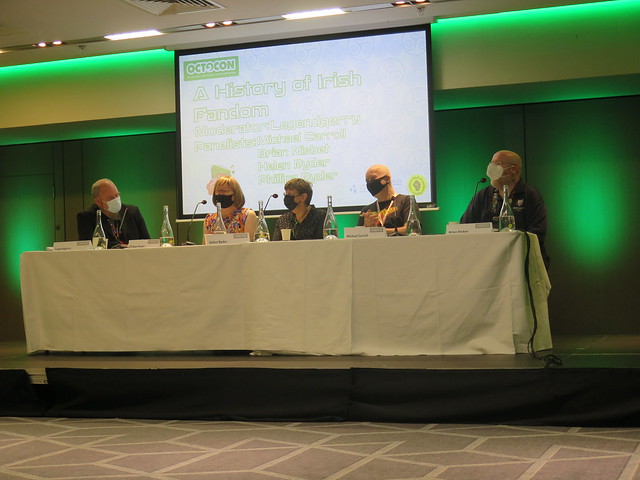
After that I made the relatively short journey from my home to Croke Park, and somehow managed to miss all programme items until a post-lunch panel entitled A History of Irish Fandom. This to some extent turned into a history of Irish SFF cons, with zines and the like receiving relatively short shrift. There was a bit of talk about the now moribund Irish Science Fiction Association and how it performed a useful role, with Philippa Ryder suggesting that it would be great if someone were to revive it. Having an organisation for science fiction fans sounds amazing — I am imagining membership books, badges, secret codes, possibly uniforms — but I didn't really get much sense from the panel of what ISFA actually did. I should perhaps have a look at FANAC and see if there are any scans of ISFA publications there.

It was fun hearing about the cons of yore though, with the mention of the 1992 Trincon being a particular highlight for me as that was my first (and for a long time only) experience of organised science fiction fandom. One thing I don't think the panelists really touched on is that there was a definite arrogant Trinity student aspect to Trincon, which might have jarred with the wider SF community. It's been a long time but I remember there being panels at Trincon that you would never get at Octocon today (I can't imagine Octocon ever running panels on how Star Trek is stupid or how film science fiction is mostly just a facile dumbed down version of what appears in print). But the Trinity students got their comeuppance in 1997 with Trincon 2, which attracted so few attendees that there was one guest of honour for every five paying punter.

I arrived slightly late to Comics Is Literature, discovering subsequently that the cavalier approach to subject-verb agreement in the panel's title references an internet controversy. This explored the recurring SFF question: "why don't the squares in the literary establishment take our genre stuff seriously?" One thing I did like was the mention of how comics have always been a somewhat disposable medium, with the transition from print to online distribution not necessarily changing this: previously people bought monthly comics that had a tendency to fall apart, now they often view them on a website that might well disappear in the morning. There was also discussion of how comics have long been seen as primarily a medium for children, which undermines their acceptance as something adults can unproblematically enjoy or take seriously. Subject verb agreement

I was struck though by how the comics panel only really talked about comics in the anglophone world, as my understanding has long been that on the European continent and in Japan it is far less the case that comics are seen as things exclusively for the kids. It would be interesting to look at why there might be that divergence. Also, given that the kids' comic market has now largely disappeared (apart from The Beano), the idea that the problem with comics is their association with children might be something that will no longer hold in the future.

One other point made by the panelists interested me, the idea that comics are a form, not a genre. That is obviously true, with comics covering a range of subject matters, even if ones about guys in funny costumes punching each other are still rather dominant. But I think there is still an extent to which people who like comics and people who create them do kind of see them as effectively a genre. Even the fact that you can have a comics is literature panel without panelists saying "I've nothing in common with you guys because I write romance comics while you are writing crime comics" suggests a certain collective appreciation. There is something a bit circular here of course: regardless of genre, comics are sold in comics shops or in the comics section of bookshops, which reinforces the idea that they are a thing apart from true literary works like the latest Andy McNab tome.

For me though a gap in the comics panel was any discussion of what constitutes literature. Is literature anything with written text? Or is literature a qualitative term (something only becomes literature if it is… literary)? If you take the first approach then any comics that have text are literature, but there is a certain so-what quality to this as the same would be true of a shopping list. If you go down the second road then it becomes possible to argue that some comics are literary enough to be classed as literature, but this also implies that there will be some comics that will not make the grade.

The panel also has me thinking that it is really time I got back into buying monthly comics. It further reminded me that I should be checking out IrishComics.ie on a more regular basis.

I then took a break from panels to attend Half a Man in a Trenchcoat: Network Theory and Storytelling. This was a talk by Harun Šiljak, who took ways of modelling real-life human interaction and then applied them to works of fiction. He began with such mythic works as Beowulf and the Táin Bó Cúailgne, noting that the networks between the characters are statistically similar to those observed in real life networks, once the main characters are excluded (this had me wondering if real life social networks might look a bit unrealistic if mapped from one person's point of view). He then went on to the core of his talk, applying network theory to the first season of Twin Peaks. There was a lot to unpack here — the change in the way the character interactions work once Dale Cooper appears in the first episode (which in turn sees about half of the main characters appearing before and after Cooper first hits the screen), and then the way Cooper and Sherif Truman frequently appearing together skews the network in a way that can be resolved by treating them as one person. The thing I found myself wondering was whether in a show with a whodunnit element like Twin Peaks do the character networks provide clues to the killer's identity.

And then the closing ceremony saw the announcement that Sakura is stepping down as chair, with the new occupant of the hot seat being Paul Carroll. Onward and upward. Things I bought at Octocon I should also mention the trade hall at this year's Octocon, which was perhaps in a smaller space than the last in-person con but which felt like it was completely jam-packed with product. I came home with a pile of stuff. And I should note that I missed the non-appearance of the Golden Blasters and the Vault of Horror. The Golden Blasters was a short film competition and festival that always featured some amazing stuff, while the Vault of Horror saw John Vaughan playing clips from terrible films while drawing attention to their awfulness (this was way more entertaining than I am making it sound). Good things cannot last forever.

One great thing that was back at Octocon was the Lally Wall. This a wall featuring hand-drawn posters by Dave Lally outlining ways people can travel to other conventions happening in Britain and Ireland (and sometimes further afield). No online con has ever managed to replicate these successfully. How to go from Ireland to Glasgow

So that was that. It was great being back at an in-person science fiction con. Croke Park felt like the nicest venue I've experienced Octocon in (the right size, useful layout, convenient location), with the one caveat about the pretty terrible catering options (for vegetarians: the options were cakes of various kind (all of which ran out by Sunday afternoon), chocolate bars, crisps, manky pre-made sandwiches, and potato wedges (which rapidly ran out); I don't think the meat people did much better.

If you've got this far you might have noticed another thing about Octocon: everyone was wearing masks. This was mandated by the conrunners as an anti-Covid measure, to protect vulnerable attendees. That it was enforced for programme participants was non-ideal for attendees with hearing impairments. The mask requirement seemed a bit strange to me, as by the time Octocon took place almost nothing else in society was enforcing a mask mandate. Was Octocon being excessively cautious, or is the rest of society insanely reckless? I'm not sure how we could answer this question.

For another view of Octocon, check out this report on File 770 by James Bacon: Octocon 2022

More of my Octocon pictures (inessential)

Saturday, October 29, 2022

Octocon: things I did not go to

Some things stopped during the Covid pandemic, but not Octocon, Ireland's national science fiction convention. It just went online for a couple of years, but earlier this month it made its triumphant return as a live in-person event in Croke Park. Or rather, a hybrid event, for as well as the programme items taking place in Croke Park there were ones taking place online, and some of the in-person events were also streamed for the benefit of the folks at home.

I was there in Croke Park and I attended programme items, even taking part in one or two. But I'm not going to start with those. Instead join me as I look at some of the programme items whose descriptions intrigued me but which I had to miss for one reason or another.

Abandoned Landscapes: As a secret goth I thought this panel sounded fascinating, whether it would be looking at ruined castles or crew-less spaceships orbiting dead planets. But alas, I was serving a stint on the Octocon information desk.

Colonialism in Science Fiction: In science fiction the idea of humanity expanding into space and establishing itself on other worlds is such a staple that it is hard to step back and wonder whether this kind of interstellar settler colonialism is perhaps a bit problematic. I'm not sure if the panel was actually going to look at this kind of issue (the programme notes suggested that it was more likely to be an emo panel in which people pondered their own place in the sinister history of terrestrial colonialism); it would nevertheless have been interesting to see what roads the panelists went down. Sadly this online panel also occurred while I was on the information desk (and while it was recorded and is available to watch online, I'm a great believer in never going back).

Unreliable Narrators and Other Tricks: Unreliable narrators are one of the great tricks of modernist literature (for all that they go back long before the 20th century), though I'm not sure they have been used that much in science fiction, so it would have been interesting to hear how the panelists talked about how this kind of device might be used in our genre fiction. But I was moderating another panel and so missed this.

The Storytelling Legacy of Science Fiction and Fantasy Television: There is something heroically ambitious about attempting to cover the entire 84 year corpus of TV science fiction in one 60 minute panel, for all that I suspect in practice it probably featured a lot of yap about Star Trek and Doctor Who. I was lunching while it was on.

Glasgow 2024 Book Club — Walking On Glass: I would have gone to this if I had read the book. I probably should read some of Iain Banks' non-Culture books sometime.

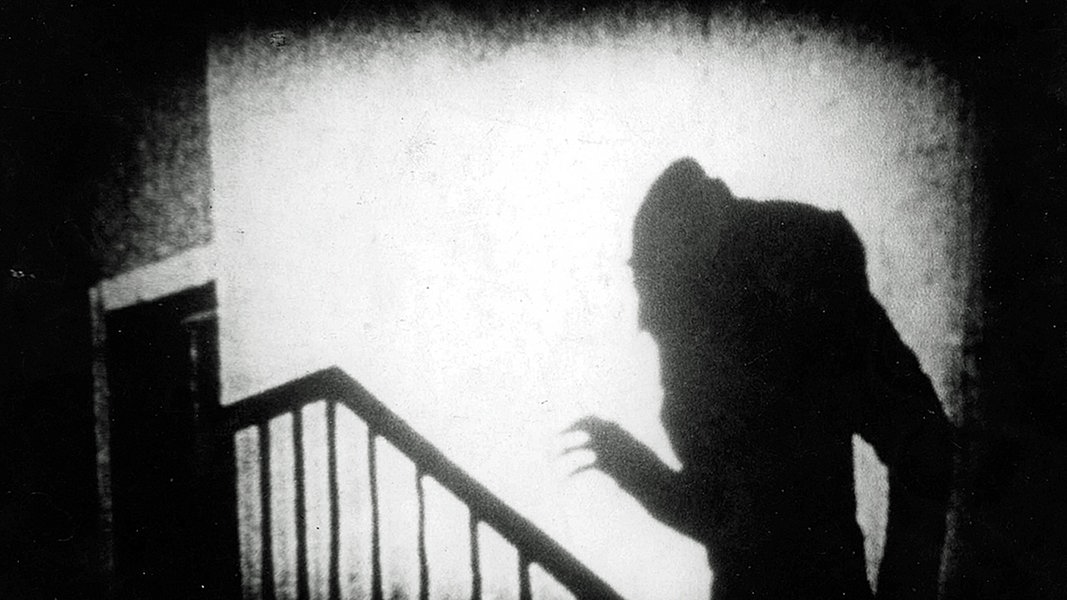
Nosferatu Watch Party & Zoom Social: I love Nosferatu, F. W. Murnau's brilliant but unauthorised 1922 adaptation of Dracula, the first film to bring a version of the popular count to the screen. In fact Nosferatu may even be the film I have seen the most as I rarely turn down an opportunity to view it. But I was a bit *tired* when it was being streamed and I had a sneaking suspicion that the Zoom social aspect of the screening might feature a lot of people chortling at the 1920s visual effects. Irish Horror Films: This panel sounded like it was right up my alley and I understand they did talk about Sea Fever (very good) and You Are Not My Mother (initially very good) as well as various other films. They probably didn't mention The Eliminator (very very good). I missed this in-person panel because it was on too soon after an online panel I appeared on from the comfort of my home.

Reading: Gareth Ryder-Hanrahan: I am fascinated by Gareth Ryder-Hanrahan's work on Cthulhu City and The Dracula Dossier, two next-level roleplaying game supplements, but I was lured away by the cheap thrills of a panel on the history of Irish fandom. I was nevertheless sorry to miss this and all the others I failed to attend, as readings are always one of the best things at SF cons.

Dead dog: This was basically people who had been at Octocon going to the pub on the day after the con finished, presumably taking off their mandatory masks and coughing in the face of Octocon's strict Covid rules. But I was doing an Irish class that afternoon and somehow convinced myself that the event would be over by the time my class finished.

Join me real soon for an account of some programme items I managed to actually attend.

images:

In the zone (Guardian: "The powerful resonances of Andrei Tarkovsky's Stalker")

1938 BBC production of Karel Čapek’s R.U.R.: Rossum’s Universal Robots (Den of Geek: "The Legacy of Rossum’s Universal Robots")

A symphony of shadows (NDR: "Nosferatu - das Original")

Sunday, September 13, 2020

Join Our Book Club

For my considerable sins I have this year found myself serving on the programme team of Octocon, the Irish science fiction and fantasy convention. This will be Octocon's 30th year and, because of the unpleasantness, its first as an online rather than in-person event. There will be the usual panel discussions, author readings, and fan chats, all accessible from the comfort of your own home. And this year Octocon is free to virtually attend. Octocon always runs a book club, but this year we are going mad and running two. The first book is the Hugo-award nominated novella To Be Taught, If Fortunate by Becky Chambers. Taking its title from the opening speech by the UN Secretary General on the Voyager probe's golden record, the novel deals with space exploration by a team of astronauts searching for new planets for humanity to live on. I have not read anything by Chambers myself but I understand her to be good on human relationships and a writer who generally presents an optimistic vision of the future and our place in it, which could be something of a tonic in these troubled times of ours.

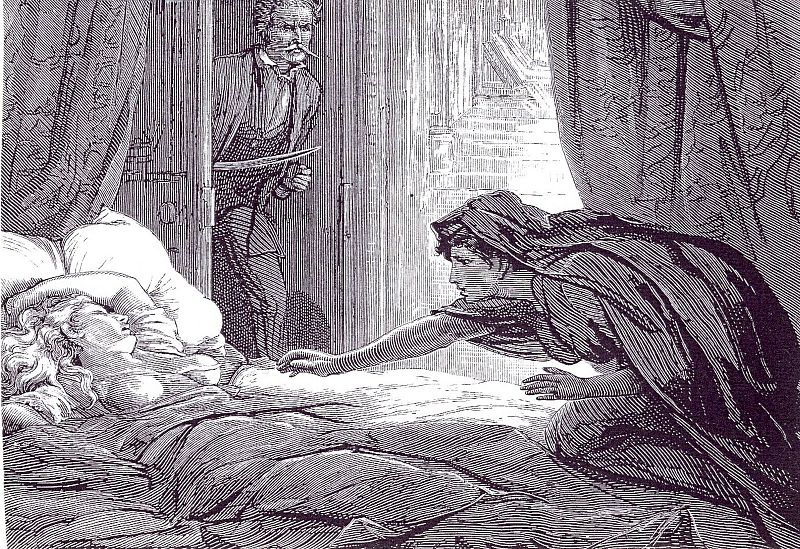
The other book is the anthology In A Glass Darkly by Joseph Sheridan Le Fanu (with the suggestion that if people are are stuck for time they just read "Carmilla"). In A Glass Darkly was first published in 1872 and presents a series of macabre stories loosely linked together as coming from the papers of one Dr. Hesselius. Octocon is running a number of Gothic-themed panels this year and having a bookclub for In A Glass Darkly allows us to look back at a classic foundational text of the genre. I have read these before and aside from "Carmilla" (a key influence on Bram Stoker's Dracula) I also recommend "Green Tea" (a warning against over-consumption of that stimulating beverage) and "The Familiar" (evocative of Le Fanu's native Dublin in the late 18th century), but all of them are good.

Both of these books are readily available in bookshops. In A Glass Darkly can also be found on Project Gutenberg.

For more on the Octocon bookclub, click here.

images

To Be Taught, If Fortunate cover (Goodreads)

David Henry Friston "Carmilla" illustration (1872) (Wikipedia)

Tuesday, December 04, 2018

Octocon Day 3

Readers, apologies for the delay in bringing my Octocon write-up to a conclusion. In my defence let me say that I was very busy with my amazing World War 1 blog in the run up to the centenary of the Western Front armistice and then was away in Utrecht attending the Le Guess Who music festival. I also had my v important day job to attend to, but let's be honest, the real reason this is so late is that I am a slack-ass and have spent my time in dissipation when I should be blog-writing.

If the time-lag is so long that you have completely forgotten what previously happened at Octocon then let me refer you to part 1 and part 2. And if you are too busy refer back to those, a quick reminder: Octocon is the Irish national science fiction convention, which this year took place in the Crowne Plaza hotel in Blanchardstown.

Sunday morning, I made it out to Blanchardstown too late to catch the Sunday Service, at which John Vaughan talked further about the worst films he has seen this year (possibly featuring further unsound comments on Hereditary) and rofflin’ James Brophy talked about television. I did however make it to Janet O’Sullivan’s interview with comics creator Colleen Doran, Octocon’s other guest of honour. A lot of fascinating stuff came up here, not least regarding the materiality of the craft, with Doran drawing attention to the non-durable nature of the original comics art from a surprising number of artists, which is often drawn onto paper that falls apart over time with paint that will degrade even if the art is kept in a cupboard. Although she does write comics (both for other artists and herself), Doran works primarily as an artist and I was taken by her praise for writers she has worked with like Alan Moore, Warren Ellis and Neil Gaiman; she mentioned how when Alan Moore writes very detailed instructions to artists it is because he has thought very deeply about how the comic should look, which is sadly not the case with some other writers who have also taken to providing artists with ponderously descriptive scripts.

However, the Colleen Doran interview really ramped up towards the end when the subject of Comicsgate and online harassment. I have not been paying attention to comics in recent years but it appears that all those Gamergate Sad Puppy dipshit man-babies have moved on to comics and taken to harassing comics creators. Doran noted that harassment is something she has had to deal with from the earliest days of her time in comics but that it has escalated of late as the dipshits use social media to swarm their enemies. At the same time she reports that it is somewhat easier to deal with now because the targets are able to talk amongst themselves, thereby realising that they are not being singled out for dipshit attention. It also appears to be the case that male comics creators are now receiving their own share of targeted harassment, making them suddenly aware of what their female colleagues have had to put up with for years. What is still a bit problematic about all of this is that the comics companies are pushing (sometimes requiring) the creators to establish social media presences but are being a bit slack about assisting them when they start attracting attention from the arseholes.

An unfortunate consequence of attending the wonderful Colleen Doran interview was that I missed a session on the new season of Doctor Who, but I did make it to a live recording of the CinePunked podcast by Robert JE Simpson and Rachael Kelly, at which they discussed the mid-1970s sudden and possibly coincidental appearance of three Frankenstein-related films in a short period, Frankenstein and the Monster from Hell (1974), The Rocky Horror Picture Show (1975) and Young Frankenstein (1974). The last two of these are obviously homages to vintage horror and SF films while the first one was the last film of old Hammer, making it almost a homage to itself (and featuring David Prowse, subsequently of Darth Vader fame, as the Monster). I have somehow never made it to a podcast recording before and have a surprisingly limited exposure to podcasts themselves (if I wanted to hear people talk I would turn on the radio or pay attention to the people at work) so I was fascinated by the process, in particular the completely and preternaturally fluid nature of the conversation between Mr Simpson & Dr Kelly. I was also struck by their comment on how much the 1931 Boris Karloff film defined how we think of Frankenstein and the Monster, introducing tropes like the hunchbacked assistant and the Monster being stitched together from corpses (Shelley herself never describes the monster thus and is deliberately oblique as to how the Monster was created or indeed what he looks like). The problematic sexual consent issues raised by all three of these films added to a troubling and recurring theme for the weekend. That said, for me the panel never really grappled with the question of whether the roughly simultaneous appearance of these three Frankenstein-related films was merely coincidental or whether there was something in the air that caused these three works to appear in a short period (and if so what that something was). The fact that roughly the same period also the Frankenstein-themed Doctor Who story, The Brain of Morbius (1976), so maybe there genuinely was something in the Zeitgeist. But what?

Much of the rest of my time at Octocon was taken up with the Golden Blasters, which is a science fiction short film competition run by none other than John Vaughan. This year previous winners were competing for the most golden blaster of them all, with winners of the Silver Blaster (the audience award) also thrown into the mix. This allowed me to see again films I had seen at previous Octocons in 2017 and 2015 as well as some works that were new to me. Olga Osorio's Einstein-Rosen, the winner of both Golden and Silver Blaster in 2017 once again one both prizes. It is an entertaining tale of two kids who discover a wormhole to the future outside their apartment block, an amusing mix of just about credible funny science and some disarming performances from the child actors (the author-director's sons), it was a worthy winner. I know, you're thinking, "A cute kids film? I think not", but there is a genuine charm to the two boys' performances.

Nevertheless, with my own taste for darker fare made me prefer Sleepworking by Gavin Williams, a creepy tale about a future in which people can earn extra money by renting themselves out while they sleep to perform menial tasks as somnambulists. The creepiness comes in when two of the sleepworkers start remembering flashes of their slumbering labours, with the whole thing being very evocative of the confused state of those who are never quite sure whether they are awake or dreaming. On a lighter note, I was happy to renew my acquaintance with Andrew Chambers' The Detectives of Noir Town, a film that manages in its short length to be more than just Roger Rabbit with puppets. I was also intrigued by John Kim's Steadfast Stanley, an animated film about a good dog in the midst of a zombie apocalypse, and found Simon Cartwright & Jessica Cope's steampunk stop-motion The Astronomer's Sun to be both mysterious and poignant.
The call of a pint and convivial chit chat after the Blasters meant that I missed the last proper panels and the ever-interesting round-up of upcoming cons, but I did make the closing ceremony of the convention at which Chair Janet O'Sullivan revealed two pieces of amazing news. Firstly, even though Worldcon is coming to Dublin next year, there will also be a mini-Octocon, probably a one day event taking place once more in the Crowne Plaza Hotel in Blanchardstown. The reasoning here was that for various reasons some people will not be able to go to Worldcon but will still want to get together with other science fiction fans at a smaller, shorter and more intimate event. The other piece of sensational news was that Raissa Perez (this year's volunteer coordinator) is joining Janet as co-chair, putting Octocon into another pair of safe hands.

That was pretty much it. Some people found a way of watching the third episode of the current Doctor Who series (the one about Rosa Parks). I was one of these people. The experience reinforced my view that the current Doctor Who series represents something of a levelling up by the series. Perhaps more of that anon. It also reminded me of how much fun is to be had with shared viewings of good things. And then we were off first to enjoy a meal with houseguest Nicholas Whyte and then home to feed our hungry cat.
For another view of Octocon day three, see this post by SaraWIMM.

Monday, October 29, 2018

Octocon Day 2

Octocon is the Irish national science fiction convention, which ran in the Blanchardstown Crowne Plaza hotel from 19 to 20 October this year. I have already written about what I encountered there on the Friday here.

Saturday morning saw me first of all working on the Octocon reception desk, where we dealt with registering convention attendees as they arrived. If you arrived at Octocon on Saturday morning then maybe mine was the friendly face that greeted you (or the surly jobsworth who couldn't find your reservation). I made friends with some pandas who had come to the convention to examine Octocon's Hugo trophy.

The morning also saw me make my debut as an Octocon panellist. As part of my efforts to promote the World Science Fiction Convention that is coming to Dublin next year I took part in a panel intended to drum up enthusiasm for volunteering at Worldcon. It turned out we were rather talking to the converted as almost everyone present was already volunteering for Worldcon, but this did allow us to gang up on the others. If anyone reading this is not a Worldcon volunteer then I encourage you to get involved, as volunteering is fun, a way of meeting people, a way of giving something back to science fiction and a way of seeing the inside of what will be the biggest science fiction event to ever come to Ireland.
More time on the reception desk and then my own interest in lunch meant that the next event I attended was the guest of honour interview by Octocon chair Janet O’Sullivan with Pat Cadigan, an American science fiction writer who now lives in England. I was not previously familiar with her work (which is more a reflection on me than on her as I am a slow reader and am unfamiliar with most writers). I found the interview fascinating, as any question would set Cadigan off on a stream of anecdote that would lead very far from the initial starting point. I particularly liked her favourable recollection of Robert Heinlein, someone who now is perhaps unfairly and simplistically pigeon-holed as a right-wing ultra, but whom she recalls as a very generous character. I was also touched by the particularly star-struck question from a member of the audience and Cadigan’s gracious response.

Cadigan also mentioned having previously attended some class of event called a relaxacon. I don't know what these are but I want to go to one.
As you know, this is the 200th anniversary of the publication of Mary Shelley’s Frankenstein and with it the birth of science fiction. Octocon had an entire programming strand engaging with Frankenstein’s legacy and I now found myself attending a panel discussion on the Monster’s perspective. This got a bit “could it be that we are the real monster?” but I was struck by the discussion of consent issues (e.g. Frankenstein’s Monster badgering him to create a Lady Monster for him, taking for granted that she will want to be his mate). More general discussion of how a simple shift of perspective can make monsters appear like victims led to an interesting recollection by one panellist of a story they read once about people in the remote past fighting Trolls, where the reader realises that the Trolls are the last Neanderthals being hunted to extinction; it occurs to me now that another work of this kind is I Am Legend, the 1954 novel by Richard Matheson, where the book ends with the protagonist’s realisation that he is a monster to the vampiric new humans (I wish I had thought of this at the panel and established my remembering-things-about-books-I-have-read credentials by mentioning it). I was also reminded of various works in 2000 AD by Pat Mills, where his writing was very evocative of the non-human mindset of dinosaurs and other monstrous creatures.

Of the panellists' own works, Sarah Maria Griffin's take on Frankenstein, in which a brainy teenage girl attempts to build herself a boyfriend, sounds like it might have a Christmas present date with my niece.

The last programme item I made it to on the Saturday was the Vault of Horror. This is always a highlight of Octocon but it is also an event that is hard to describe in a way that does not make it sound a bit rubbish if you have never experienced it. The Vault sees John Vaughan playing snippets from a terrible film and drawing attention to the film's awfulness. He does this in a way that is actually funny rather than being some smug guy making fun of other people's attempts at making films. This year he reported that he has almost run out of terrible films but then he had found a terrible Gerard Butler vehicle called Geostorm with which to delight us. He also provided us with the sad news that due to a progressive illness he will not be in a position to continue serving up the Vault indefinitely into the future, but he will next year be bringing the Vault to Worldcon and presenting one of the most terrible of the films with which he has previously charmed Octocon. Are you coming to Worldcon? Then you will come to the Vault, you will.

I sadly ate so much food for dinner at this point (a recurring theme for me at Science Fiction conventions) that I was too disgustingly full to enjoy the Monsters Ball and left early, thinking that next year is definitely the one where I find some kind of easy cosplay outfit to wear.

Octocon day 3 report coming soon.

Putting the 'Irish' into An Irish Worldcon panellists image source (@jc_ie on Twitter)

See also:

Octocon website

Another view of Octocon Day 2, from blog name of Not Another Book Blogger.

Saturday, October 27, 2018

Octocon Day 1

I recently attended Octocon, the exciting Irish national science fiction convention. Octocon is the other extreme to huge conventions like Worldcon, being an intimate affair taking place over a weekend rather than a five-day event involving thousands of attendees. If you have been to more than one Octocon you will recognise a lot of the attendees and panellists, with there being considerably more overlap between these two categories than might be the case elsewhere. The programme is multi-tracked but not massively multi-tracked. So Octocon is basically a boutique convention and would suit people who like neither crowds nor a surfeit of choice in the programming.

Due to unpleasantness Octocon this year has moved to the Crowne Plaza Hotel, just beside the Blanchardstown Shopping Centre. The location suits it as Blanchardstown Shopping Centre is itself a strangely artificial place, like something out of a JG Ballard novel; in the near future, we will all live in Blanchardstown Shopping Centre. The hotel meanwhile felt like a pretty swish spot, with well-appointed function rooms and a large open space that served as a light and airy dealers’ room. I don’t know what the two birds in the lobby made of the Octocon attendees but they probably see all sorts.

A cat issue meant that I was late out on the Friday and missed the opening ceremony. I did however catch The Trance Mission Diaries, which was a performance piece by O.R. Melling with electronic music by Cha Krka. This was something of a work in progress as the goal is for it ultimately to include considerably more advanced elements like holograms and singing as well as the projected visuals and electronic music accompanying Melling’s narration. I enjoyed it but found the narrative difficult to follow, which I think was as much down to my own tiredness and it being the first thing I encountered at the con. Nevertheless, the narration and music worked well together and I look forward to seeing how this work develops.

Following that I attended a film-related panel featuring John Vaughan and Robert JE Simpson comparing and contrasting the 1960s gothic horror films of Hammer with the contemporary oeuvre of Blumhouse. The contention was that the business model of the two companies is similar: spewing out somewhat trashy films made on relatively modest budgets but hoping for at least some mainstream success, perhaps throwing in an occasional more serious film to gather some critical respectability. I was at something of a disadvantage here being almost entirely unfamiliar with the works of Blumhouse, and the big unanswered question for me was whether that studio has developed any kind of consistent aesthetic in the way that Hammer did. I was also left reeling by the panellists’ anti-Hereditary comments, which did remind me of some reviews that suggested it was a horror film for people who are not true horror fans.
For me Friday ended with a panel on how we as fans deal with things we like that have changed, particularly when the change moves things on from what we liked about them in the first place. This kind of thing is sometimes framed negatively (i.e. discussions of butt-hurt racists saying that they will never watch a Star Wars film again now that an Asian actor has appeared in one or people moaning about the Doctor becoming female). However, I think that there are times when fans are right to abandon a property (while obviously being wrong to harass persons involved in its production); e.g. two of the three Star Wars prequels were completely terrible and anyone who saw them and decided that they were done with Star Wars was making a reasonable decision, while no true Trek fan should waste their time with the recent Star Trek films. Also, people do just grow out of things sometimes.

The changing canon panel also had me thinking about how much a thing has to change before it is no longer the same thing. The panel discussed whether the character of Iron Fist should have been portrayed by a white or Asian character in the recent adaptation of the comics (in which Iron Fist is white but playing a character that in our enlightened times might perhaps be more appropriately presented as Asian). I have no familiarity with Mr Iron Fist but I was reminded of the periodic discussion of whether James Bond could be played by a black or female actor; my own view on this matter is that in this case such changes would so far deviate from the core of the character as to essentially make it an entirely different one with the same name (though I must add that I do not give a shit about James Bond and his misogynist antics and would be happy for the character to be played by Leslie Jones, edgily re-imagined as an American ophthalmologist).

For me though the most fascinating thing that came out of the canon panel was C.E. Murphy mentioning the Kirk-Drift theory, this being the idea that the popular conception of original series Star Trek's Captain Kirk as an alpha male dipshit shagger is essentially a mass delusion. Further investigation brought me subsequently to Erin Horáková's development of this idea and its consequences in a piece she wrote for Strange Horizons, which I encourage all readers to investigate.

That was my Friday evening at Octocon… come back soon to see what I experienced on the Saturday. For another view of Friday at Octocon, see this post on the Not Another Book Blogger blog.

image sources:

Whose Canon Is It Anyway panel (@Frazerdennison on Twitter)

James T. Kirk (Wikipedia)