After a brief stint on the Octocon information desk (where I fear that every piece of information I gave out was incorrect), I found myself moderating a panel entitled Crafting Non-Human Worlds and Societies, with the panelists all being people who had created non-human societies in their own works. This was my first time moderating an in-person panel, so obviously there was the fear that angry attendees would take a dislike to the way in which discussion progressed, blame me for their disappointment, and then chase me from the venue with threats of violence. Fortunately the panelists (Máire Brophy, Michael Carroll, Peadar Ó Guilín, and Jo Zebedee) were all dream programme participants: the kind of people who could talk knowledgeably on the subject, illustrating points both from their own works and those of other writers (including Jack Vance, Piers Anthony, R. Scott Bakker, Adrian Tchaikovsky, & Ted Chiang (in particular for "Story of Your Life", which was adapted into the film Arrival). Discussion of animals that a writer might usefully adapt into an alien civilisation naturally turned to cats but also to the octopus and rabbits (with Richard Adams' Watership Down receiving a favourable mention).
Subsequently I sat in the audience for Movie Monster Mash, which looked at cinematatic monsters. I liked the discussion of how some monsters go through cycles of being seen as irredeemably terrifying before shifts present them as either sympathetic or comical before they go back to being terrifying again, with vampires being an obvious example here. I also agreed with those panelists who argued that the 1992 Bram Stoker's Dracula is an absolutely terrible film. I was not sure what to make of the revelation that there is now a revival of interest in werewolves, those most rubbish of monsters.
I missed the start of Fictional Words to Live By, a panel on the way in which fictional works of science fiction and fantasy can contain philosophical nuggets that gestate in our brains. I was interested by the point that much of SFF has now become contemporary myths, with superhero comics & films and Trek Wars being specifically referenced here; given that all of these have gone on far too long and fallen into cosy self-plagiarism I'm not entirely convinced of the quality of myth we are bequeathing to future generations.
And then two readings, firstly by RB Kelly and Jonny Nexus. Kelly's was from the recently published On the Brink, in which the characters are on a Dutch space station. Science fiction usually imagines US or sometimes Chinese controlled space programmes, so it was nice to see some of the smaller nations getting their go (I feel like I should go away and cobble together a series in which some technological breakthrough leads to Ireland colonising the moons of Jupiter). Nexus's first reading also gave us the space programme of a small-ish nation, in this case the United Kingdom in an alternate history where it somehow managed to get an exciting space programme going much earlier than anyone else did in the real world. The setting reminded me of Ministry of Space (by Warren Ellis & Chris Weston), though it felt tonally different, as befits his description of the setting as Dan Dare meets James Bond. The excerpt had an appealing retro-future ambience. Nexus also read a snippet from a work about the Olympian gods playing a table top roleplaying game, which was every bit as bizarre as that sounds.
That took me to the end of Octocon's first day. There was a social event in the evening sponsored by the 2024 Glasgow Worldcon, but I couldn't face the prospect of trying to socialise while wearing a mask (unlike the rest of society, Octocon sees the Covid pandemic as very much still with us). Also I had a cat to feed. And I had to get up early in the morning, as I was appearing on a 10.00 A.M. online panel Monarchy and Nepotism in Fact and Fiction, looking at the fondness of SFF for narratives based around monarchy. Ably moderated by Cheryl Morgan, this saw Jean Bürlesk, Aliette de Bodard, Gillian Polack and myself grumbling that creators all too often misunderstand what they are bringing from the real world into their history, in this case tending to present absolute monarchies and never considering the kind of constitutional or constrained monarchy seen in Europe past and present (to say nothing of monarchies further afield). And while the panel generally felt that the absolute monarchies of SFF are generally not great, it didn't really turn into republics-are-best panel either, for all that I lean that way myself. Jean Bürlesk even went so far as to argue the case for constitutional monarchies, though maybe if I lived in the world's only grand duchy I might do similar.
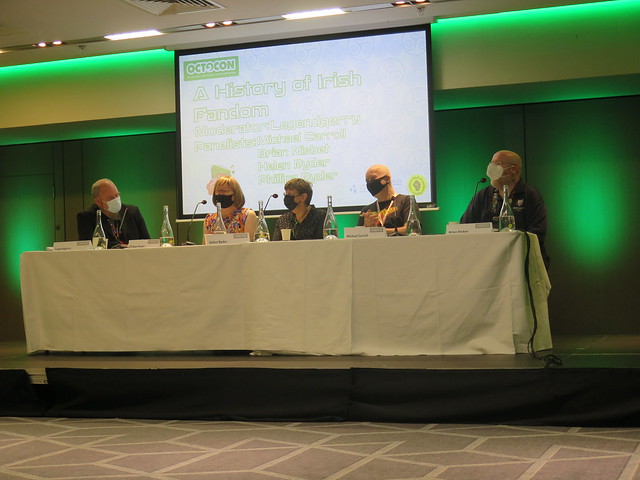
After that I made the relatively short journey from my home to Croke Park, and somehow managed to miss all programme items until a post-lunch panel entitled A History of Irish Fandom. This to some extent turned into a history of Irish SFF cons, with zines and the like receiving relatively short shrift. There was a bit of talk about the now moribund Irish Science Fiction Association and how it performed a useful role, with Philippa Ryder suggesting that it would be great if someone were to revive it. Having an organisation for science fiction fans sounds amazing — I am imagining membership books, badges, secret codes, possibly uniforms — but I didn't really get much sense from the panel of what ISFA actually did. I should perhaps have a look at FANAC and see if there are any scans of ISFA publications there.
It was fun hearing about the cons of yore though, with the mention of the 1992 Trincon being a particular highlight for me as that was my first (and for a long time only) experience of organised science fiction fandom. One thing I don't think the panelists really touched on is that there was a definite arrogant Trinity student aspect to Trincon, which might have jarred with the wider SF community. It's been a long time but I remember there being panels at Trincon that you would never get at Octocon today (I can't imagine Octocon ever running panels on how Star Trek is stupid or how film science fiction is mostly just a facile dumbed down version of what appears in print). But the Trinity students got their comeuppance in 1997 with Trincon 2, which attracted so few attendees that there was one guest of honour for every five paying punter.
I arrived slightly late to Comics Is Literature, discovering subsequently that the cavalier approach to subject-verb agreement in the panel's title references an internet controversy. This explored the recurring SFF question: "why don't the squares in the literary establishment take our genre stuff seriously?" One thing I did like was the mention of how comics have always been a somewhat disposable medium, with the transition from print to online distribution not necessarily changing this: previously people bought monthly comics that had a tendency to fall apart, now they often view them on a website that might well disappear in the morning. There was also discussion of how comics have long been seen as primarily a medium for children, which undermines their acceptance as something adults can unproblematically enjoy or take seriously.

I was struck though by how the comics panel only really talked about comics in the anglophone world, as my understanding has long been that on the European continent and in Japan it is far less the case that comics are seen as things exclusively for the kids. It would be interesting to look at why there might be that divergence. Also, given that the kids' comic market has now largely disappeared (apart from The Beano), the idea that the problem with comics is their association with children might be something that will no longer hold in the future.
One other point made by the panelists interested me, the idea that comics are a form, not a genre. That is obviously true, with comics covering a range of subject matters, even if ones about guys in funny costumes punching each other are still rather dominant. But I think there is still an extent to which people who like comics and people who create them do kind of see them as effectively a genre. Even the fact that you can have a comics is literature panel without panelists saying "I've nothing in common with you guys because I write romance comics while you are writing crime comics" suggests a certain collective appreciation. There is something a bit circular here of course: regardless of genre, comics are sold in comics shops or in the comics section of bookshops, which reinforces the idea that they are a thing apart from true literary works like the latest Andy McNab tome.
For me though a gap in the comics panel was any discussion of what constitutes literature. Is literature anything with written text? Or is literature a qualitative term (something only becomes literature if it is… literary)? If you take the first approach then any comics that have text are literature, but there is a certain so-what quality to this as the same would be true of a shopping list. If you go down the second road then it becomes possible to argue that some comics are literary enough to be classed as literature, but this also implies that there will be some comics that will not make the grade.
The panel also has me thinking that it is really time I got back into buying monthly comics. It further reminded me that I should be checking out IrishComics.ie on a more regular basis.
I then took a break from panels to attend Half a Man in a Trenchcoat: Network Theory and Storytelling. This was a talk by Harun Šiljak, who took ways of modelling real-life human interaction and then applied them to works of fiction. He began with such mythic works as Beowulf and the Táin Bó Cúailgne, noting that the networks between the characters are statistically similar to those observed in real life networks, once the main characters are excluded (this had me wondering if real life social networks might look a bit unrealistic if mapped from one person's point of view). He then went on to the core of his talk, applying network theory to the first season of Twin Peaks. There was a lot to unpack here — the change in the way the character interactions work once Dale Cooper appears in the first episode (which in turn sees about half of the main characters appearing before and after Cooper first hits the screen), and then the way Cooper and Sherif Truman frequently appearing together skews the network in a way that can be resolved by treating them as one person. The thing I found myself wondering was whether in a show with a whodunnit element like Twin Peaks do the character networks provide clues to the killer's identity.
And then the closing ceremony saw the announcement that Sakura is stepping down as chair, with the new occupant of the hot seat being Paul Carroll. Onward and upward.
 I should also mention the trade hall at this year's Octocon, which was perhaps in a smaller space than the last in-person con but which felt like it was completely jam-packed with product. I came home with a pile of stuff. And I should note that I missed the non-appearance of the Golden Blasters and the Vault of Horror. The Golden Blasters was a short film competition and festival that always featured some amazing stuff, while the Vault of Horror saw John Vaughan playing clips from terrible films while drawing attention to their awfulness (this was way more entertaining than I am making it sound). Good things cannot last forever.
One great thing that was back at Octocon was the Lally Wall. This a wall featuring hand-drawn posters by Dave Lally outlining ways people can travel to other conventions happening in Britain and Ireland (and sometimes further afield). No online con has ever managed to replicate these successfully.

So that was that. It was great being back at an in-person science fiction con. Croke Park felt like the nicest venue I've experienced Octocon in (the right size, useful layout, convenient location), with the one caveat about the pretty terrible catering options (for vegetarians: the options were cakes of various kind (all of which ran out by Sunday afternoon), chocolate bars, crisps, manky pre-made sandwiches, and potato wedges (which rapidly ran out); I don't think the meat people did much better.
If you've got this far you might have noticed another thing about Octocon: everyone was wearing masks. This was mandated by the conrunners as an anti-Covid measure, to protect vulnerable attendees. That it was enforced for programme participants was non-ideal for attendees with hearing impairments. The mask requirement seemed a bit strange to me, as by the time Octocon took place almost nothing else in society was enforcing a mask mandate. Was Octocon being excessively cautious, or is the rest of society insanely reckless? I'm not sure how we could answer this question.
For another view of Octocon, check out this report on File 770 by James Bacon: Octocon 2022
More of my Octocon pictures (inessential)