A thing people do sometimes is write novels where the main character is a minor character in another novel, usually one that is out of copyright, telling the story of that minor character. I suppose the most famous example of this might be Tom Stoppard's Rosencrantz and Guildenstern Are Dead (which is not a novel, but you get the idea). I wonder if you could do something similar with the likes of War and Peace, perhaps with someone like… Mademoiselle Bourienne.
As readers of Tolstoy's classic will recall, the French Mlle Bourienne lives with Old Prince Bolkonsky and his daughter Marya and is described as the latter's companion for all that their relationship is rather fraught. She also seems to have no first name. Mlle Bourienne is a fairly minor character, painted rather unsympathetically as a coquette and a gold-digger whose behaviour towards Marya can be a bit nasty, whether it is trying to cop off with some shifty character who has come to propose to the wealthy Marya or, later, preventing Marya from having a true tête-à-tête with her brother's fiancée. And of course she later seems to shack up with the Old Prince and assist him in his cruel behaviour towards his daughter.
Still, now that I have reached the part of War and Peace where Napoleon is invading Russia, I have found myself thinking of how things must look from Mlle Bourienne's position. She is a Frenchwoman in a country that is becoming rabidly anti-French. She seems to have no independent means of support and is entirely dependent on the generosity of the Bolkonskys, in particular that of the Old Prince. Given how erratic he has become, she could find herself cast out into destitution at any moment. I wonder, therefore, could you write an interesting book from her point of view? It could focus on her precarious life and her ever-present fear of finding herself without a roof over her head.
A first person narrative might work well for such a book, particularly if you made Mlle Bourienne a self-serving and not-entirely reliable narrator. She might be at pains to make her actions seem more honourable than Tolstoy does. So, perhaps, her dalliance with the shifty Anatole Kuragin was designed so that Marya would discover it and be spared the horror of marriage into that sinister clan. Her apparent taking up with the Old Prince becomes not the action of a gold digger, but an abusive relationship forced on a vulnerable woman, with her subsequent actions towards Marya being forced on her by the sadistic Old Prince.
I am not sure how this could develop. With War and Peace little over half way through, it is not yet clear how Mlle Bourienne's story will play out. She might not even be in a position to write her memoirs by the time the book ends. We will see.
An inuit panda production
Showing posts with label War and Peace 2012. Show all posts
Showing posts with label War and Peace 2012. Show all posts
Sunday, July 15, 2012


Wednesday, June 13, 2012
From Jazz to Tchaikovsky
I am listening to The Thing play their album "Mono" on my iPod. I suppose I should really say something about it but anything I say will probably be along the lines of "It sounds a bit jazzy and forward thinking, with a lot of distraught parping", not really the kind of thing that would get me a spot as a guest-reviewer in Jazz Express. Likewise for the record I have by Tim Berne's Snake Oil (which is called Snake Oil). So maybe I will skip on to something else. Like my recent visit to the National Concert Hall.
I was there with my beloved and another mysterious lady for a performance of a number of pieces by the RTE National Symphony Orchestra. First up were some excepts from Swan Lake by Pyotr Ilyich Tchaikovsky. Everyone knows this music to at least some extent, with the music used for the grand finale being particularly famous now thanks to popular film The Black Swan. So I will not bother saying too much about. However, I was struck by a short interlude of quiet and peaceful music just before the end - not so much the music itself, but what it reminded me of, which was one of those special moments you get in songs by SCOOTER, where it all goes quiet and you imagine that you are at some monster rave and everyone is hands in the air, feeling the vibe, and then HP Baxter comes in with a "Yeah" and the beats kick in again and everyone goes mental. Well, HP Baxter did not come in with a "Yeah" in the National Concert Hall but the sudden return to the loud music of the finale was nevertheless a bit reminiscent of Germany's finest.
Then there was the world premiere of a piece called The Binding of the Years, by Irish/Northern Irish composer Deirdre Gribbin. I am not familiar with Ms Gribbin and her work, but the piece she composed was both interesting and entertaining. It was based on some kind of funny religious practice thing they had in the empire of the Aztecs. It was all a bit discordant (in a good way, obv.), calling to my mind The Rite of Spring without at any time sounding like it. Ms Gribbin received some enthusiastic applause from the audience (unlike the other composers on the bill she is still alive and thus able to take her bows) and I was happy that great contemporary music was being performed on the main stage of the concert hall, on a prime music night.
Third on the bill was Leos Janácek's 1926 Sinfonietta. It is a five movement piece, with each bit having something to recommend itself before they all join together in the grand finale. For spectacle, the first 'Allegretto' piece was hard to beat, with a row of brass instruments up in the choir balcony blasting out a fanfare to us. This sounded almost proto-Laibach to me, for all that the Slovenian sensations are maybe more associated with percussion than wind. The brass sat out the second movement, which to me seemed almost like proto-minimalism - there were parts of it that could easily have been passed off as work by Philip Glass or Steve Reich. The fourth movement actually sounded familiar - it relied heavily on the brass again, though not as relentlessly as the first movement, and after racking my brains I worked out where I heard it before - when I was a little lad, it used to be the theme music for Crown Court, the TV programme where scripted court cases were acted out before an actual jury taken from the general public. And then at the very end, the mass brass attack was back and everyone played at once, very exciting.
Janácek is someone I often think of engaging more with. I have a great CD of some string quartet music he did, acquired as a souvenir on a trip to Prague. But when I more recently acquired a recording of his Glagolithic Mass I had to conclude that it was a bit boring and I gave it away. This Sinfonietta, though, it was all that.
And then to the reason why we had come along - a performance of Tchaikovsky's 1812 Overture. This piece of popular schlock appealed to us because of its connections with our reading War & Peace a chapter a day in this 200th anniversary year of Napoleon's invasion of Russia. Sadly this was not one of those productions were the orchestra dress up as members of the Imperial Guard, the conductor is Napoleon, and they have actual cannons blasting out when things get a bit rorty snorty towards the end, but it was still all very exciting. I gather that Tchaikovsky himself hated the Overture and the notes give the impression that it is not really held in that high regard by advanced lovers of music, but the audience lapped it up and I think even the musicians enjoyed playing it. Top marks also to conductor Alan Buribayev.
In real "ME AM BRANE" action, I would also like to mention the pianist Finghin Collins, who was very memorable, except that I cannot remember which of the four pieces he played on. I should take better notes.
An inuit panda production
I was there with my beloved and another mysterious lady for a performance of a number of pieces by the RTE National Symphony Orchestra. First up were some excepts from Swan Lake by Pyotr Ilyich Tchaikovsky. Everyone knows this music to at least some extent, with the music used for the grand finale being particularly famous now thanks to popular film The Black Swan. So I will not bother saying too much about. However, I was struck by a short interlude of quiet and peaceful music just before the end - not so much the music itself, but what it reminded me of, which was one of those special moments you get in songs by SCOOTER, where it all goes quiet and you imagine that you are at some monster rave and everyone is hands in the air, feeling the vibe, and then HP Baxter comes in with a "Yeah" and the beats kick in again and everyone goes mental. Well, HP Baxter did not come in with a "Yeah" in the National Concert Hall but the sudden return to the loud music of the finale was nevertheless a bit reminiscent of Germany's finest.
Then there was the world premiere of a piece called The Binding of the Years, by Irish/Northern Irish composer Deirdre Gribbin. I am not familiar with Ms Gribbin and her work, but the piece she composed was both interesting and entertaining. It was based on some kind of funny religious practice thing they had in the empire of the Aztecs. It was all a bit discordant (in a good way, obv.), calling to my mind The Rite of Spring without at any time sounding like it. Ms Gribbin received some enthusiastic applause from the audience (unlike the other composers on the bill she is still alive and thus able to take her bows) and I was happy that great contemporary music was being performed on the main stage of the concert hall, on a prime music night.
Third on the bill was Leos Janácek's 1926 Sinfonietta. It is a five movement piece, with each bit having something to recommend itself before they all join together in the grand finale. For spectacle, the first 'Allegretto' piece was hard to beat, with a row of brass instruments up in the choir balcony blasting out a fanfare to us. This sounded almost proto-Laibach to me, for all that the Slovenian sensations are maybe more associated with percussion than wind. The brass sat out the second movement, which to me seemed almost like proto-minimalism - there were parts of it that could easily have been passed off as work by Philip Glass or Steve Reich. The fourth movement actually sounded familiar - it relied heavily on the brass again, though not as relentlessly as the first movement, and after racking my brains I worked out where I heard it before - when I was a little lad, it used to be the theme music for Crown Court, the TV programme where scripted court cases were acted out before an actual jury taken from the general public. And then at the very end, the mass brass attack was back and everyone played at once, very exciting.
Janácek is someone I often think of engaging more with. I have a great CD of some string quartet music he did, acquired as a souvenir on a trip to Prague. But when I more recently acquired a recording of his Glagolithic Mass I had to conclude that it was a bit boring and I gave it away. This Sinfonietta, though, it was all that.
And then to the reason why we had come along - a performance of Tchaikovsky's 1812 Overture. This piece of popular schlock appealed to us because of its connections with our reading War & Peace a chapter a day in this 200th anniversary year of Napoleon's invasion of Russia. Sadly this was not one of those productions were the orchestra dress up as members of the Imperial Guard, the conductor is Napoleon, and they have actual cannons blasting out when things get a bit rorty snorty towards the end, but it was still all very exciting. I gather that Tchaikovsky himself hated the Overture and the notes give the impression that it is not really held in that high regard by advanced lovers of music, but the audience lapped it up and I think even the musicians enjoyed playing it. Top marks also to conductor Alan Buribayev.
In real "ME AM BRANE" action, I would also like to mention the pianist Finghin Collins, who was very memorable, except that I cannot remember which of the four pieces he played on. I should take better notes.
An inuit panda production
Saturday, May 19, 2012
Natasha's Dance
 I have been reading War and Peace since January, a chapter a day. The book has three hundred and sixty six chapters, and 2012 has three hundred and sixty six days, so it seemed like a good idea. And it is, the book is among the greatest things ever, and the chapter a day pace suits it really well. I think at the start maybe reading only five pages a day seemed a bit restricting, but as you go along you get into the rhythm of it
Before reading the book, I did not too much about it. I knew, obviously, that it was set during the Napoleonic Wars and made a big deal of Napoleon's invasion of Russia. And I suppose from the title I could deduce that it featured stuff relating to people's peace-time lives as well. And that really was it – or almost it. I did have one other piece of advance knowledge, thanks to a partial reading of Orlando Figes' book Natasha's Dance: A Cultural History of Russia. When I first approached that book I took it that the "Natasha's Dance" bit of the title was metaphorical, but it turned out to be a layered metaphor – it refers to a scene in War and Peace where a character called Natasha does a dance, the dance and the scene being metaphorical. That gave away two spoilers – firstly that there is a character called Natasha who will do a dance and secondly that this Natasha is somehow important to the book as a whole, something that would not immediately have been apparent when she first appears in the novel (and something which is only beginning to become apparent now that she has done her dance).
But what is the dance thing all about? Well, Natasha is from a minor noble family whose menfolk are all fuckwits who are bringing the rest to the brink of ruin with their feckless and incompetent ways. Like all of the nobility, their lives are focussed on the cities, either Moscow or St. Petersburg, and the jockeying for position there. They speak French rather than Russian and are disdainful of the plain countryfolk and their way of life. But in this chapter, Natasha and her brother (amiable fuckwit Nicholas) find themselves back in the house of a very minor noble neighbour of their country estate, a man so barely noble at all that he lives on terms of easy familiarity with his serfs in his ramshackle house. He serves a simple meal (featuring pickled mushrooms, which sound like the best thing ever) and some drink to his guests and then his serfs play some music on a balalaika, and then Natasha is invited to dance – and she does, but she does not do one of the poncey French dances that she would have been thought in the cities, but a true Russian peasant dance whose steps she somehow just knows from the depths of her being. I think this says something about the Russian national character, or Tolstoy's view of it.
It is a lovely scene, independently of whatever meaning Tolstoy wants to communicate in it, with a lovely sense of unbuttoned joie de vivre very much at odds with the uptight lives of so many of the characters. It is one of the moments in this book that brings home what a great writer Tolstoy is and why so many people say that War and Peace is the greatest book ever written.
A review of Natasha's Dance
and another
image source
Later – oh great, trying to find a YouTube video of Natasha's Dance from one of the book's many adaptations I have come across a BIG SPOILER.
An inuit panda production
Saturday, February 11, 2012
War and Peace 2012
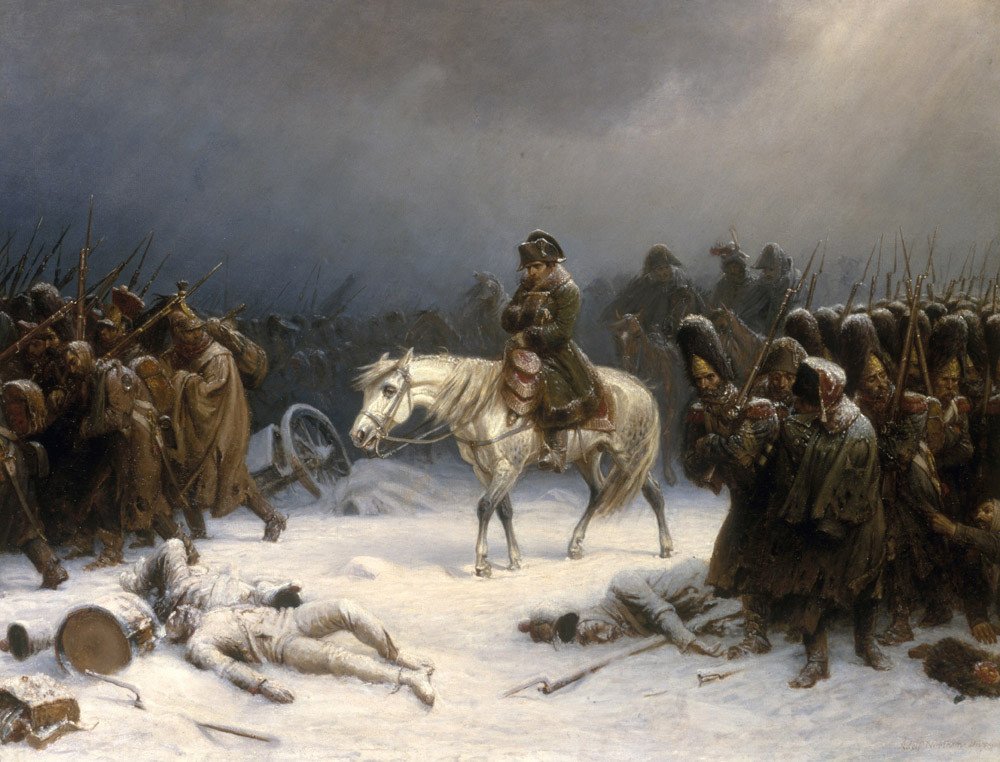 War and Peace is the famously porky novel by Leo Tolstoy. It concerns Russian society in the time of the Napoleonic Wars. This year I am reading it a chapter a day. Why? Well, it is one of those books that I have always meant to read sometime, but its size has previously proved off-putting. However, a chapter a day is a very manageable way of digesting such a big book in bite-sized portions. This is also an ideal year in which to read a chapter of War and Peace each day. The book has 366 chapters (in some editions; others combine them in such a way that it has less), and this is a leap year, so the fit is perfect. Also, 2012 is the 200th anniversary of Napoleon's invasion of Russia, the central event of War and Peace.
 So, I encourage you to join me in reading Tolstoy's classic a chapter a day. Now, I know what you are thinking. Given that we are now well into February, you are thinking that it is too late to start on War and Peace, that you will not be able to catch up. Well, you would be wrong. The chapters in War and Peace are pretty short, so much so that it would be no great hardship to read two or one-and-a-half a day until you have caught up. I urge you, therefore, to seize this once in a lifetime chance to read this great novel that people are always meaning to read sometime.
If you are reading the book, then why not check out the awesome Facebook group for those of us reading it this year? Words cannot describe how amazing this group is.
Image source
An inuit panda production
Subscribe to:
Posts (Atom)