Showing posts with label Art. Show all posts

Wednesday, January 04, 2023

Le Guess Who 2022: Saturday

My account of the amazing 2022 Le Guess Who festival enters its third day. See part one here and part two here.

It was this morning that we registered that our hotel was offering unlimited quantities of cava with breakfast (in particular we noticed the Swedish rockers at a nearby table who were consuming unlimited quantities of cava with or instead of breakfast). However we decided to set a good example to the world and chose for now to abstain. What we did do after our post breakfast nap was head back to the Centraal Museum to catch a screening of Everybody in the Place: an Incomplete History of Britain 1984-1992. This is a documentary by artist Jeremy Deller, possibly best known for his re-enactment of the Battle of Orgreave from the 1984 Miners' Strike and We're Here Because We're Here, a commemoration of the 19,240 British soldiers killed on the first day of the Battle of the Somme. Everybody in the Place is a film about acid house and early rave culture in Britain, situated in the context of the social changes taking place in the country at the time. It features plenty of archival footage but its real stroke of genius is its framing device, which sees Deller delivering a lecture about acid house to a bunch of students in a London secondary school. Now, I understood from the introduction to the film by the museum's artistic director Bart Rutten that the school scenes were a reconstruction of an actual lecture to school kids that Deller had previously delivered: i.e. that what we were watching was essentially scripted even if it was in some sense based on real events. However, no one else I talked to appears to have taken that inference from the director, so maybe we were watching footage of a live event and the unscripted response of bemused kids to a cultural phenomenon long predating their birth.
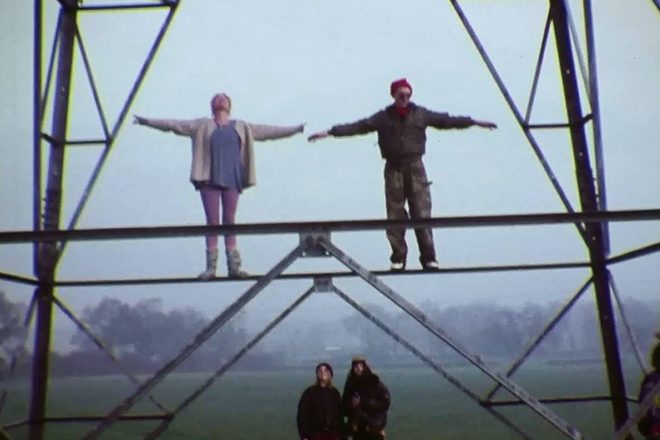
Some of the film follows the usual trajectory followed by discussions of house music's history, with the music's origins in Detroit and Chicago receiving some interesting attention. One insight I hadn't heard before was that in the 1980s the local radio stations in Detroit were used to test audience reaction to a wider range of material than was generally the case in the USA, with the result that the locals had been exposed to a lot more weirdo European music than was the case elsewhere; he felt this factored into the mindsets of the people there who went on to make hard electronic music. It's also good on the influence Kraftwerk had on black American musicians, on the face of it one of the more bizarre features of historical cross-pollination.

When the narrative moves to the UK Deller positions acid house as a reaction to the Thatcherite crushing of working class power, as epitomised by the defeat of the miners' strike. There is also some interesting footage relating to new age travellers, where he deliberately confounds expectations by playing news footage of pensioners, who instead of saying "lock up the crusties!" are complaining about how Britain is becoming too authoritarian. Deller sees it as significant that they are of the generation that went through the Second World War, which ties into something I remember reading about the 2019 Brexit referendum: although pensioners generally voted for Brexit, the oldest pensioners (i.e. the ones who would have actually remembered the horrors of the mid 20th century) voted strongly against it.

When it came to acid house and rave itself, I was struck by how Deller underplayed the London-centric narrative that normally dominates here. Shoom and Spectrum were only mentioned in passing and he talked a good bit about how warehouse parties in the north of England had paved the way for mass acceptance of a new mode of musical enjoyment. But it does hop back to the south east when he gets into talking about the orbital raves. He is generally not hostile to the entrepreneurial types who took acid house from tiny clubs to huge rave sites, though he does pretty much state that Paul Staines (later the founder of the Guido Fawkes website) is a cunt from central casting. Sadly there was no mention of my own favourite of the rave-entrepreneurs, Tony Colston-Hayter, who went from professional gambler to rave promoter, to more recently serving stints in jail for a electronic fraud offences.

What I was struck by was how coy the film was about drugs. I'm not sure Ecstasy was even mentioned by name, even when we were being shown footage of obviously mashed ravers gurning away. I can see why Deller might have wanted to focus on the community aspects of rave culture, but it did seem like an odd lacuna to ignore the role played by MDMA in binding that community. In fact I think he only really mentioned drugs late in the day as fundamentally a bad thing, on the basis that they brought the attention of criminals and the cops onto the rave scene.

Anyway, at time of writing the film is available in full on YouTube. I recommend checking it out. If you want to get a taste, here is a trailer:

After a return visit to Double Act (see previous post) I think we may have sourced sustenance of some kind (perhaps a pizza) and then it was time for more music, in particular Colombian electronic music sensation Lucrecia Dalt, who was playing in the Ronda as a surprise late addition to the bill. Last year her set had been relatively austere but this time round we were treated to something a bit more all-singing and dancing, probably based on her recent album, on which she draws from the Colombian song-based music of her youth. As well as treating us to her singing she also had a bemulleted live drummer who really gave it socks. All pretty enjoyable but perhaps foolishly I left early to head to the Grote Zaal for another act. Cate Le Bon

Who was I going to see? Why none other than Cate Le Bon. When it comes to the popular Welsh singer I feel like I am suffering badly from the sunk cost fallacy, gripped by the idea that because she did one great album years ago I should keep listening to her in the hope that she will return to that kind of music. I've largely given up on her on record as she has moved away from what I liked about her, but I keep being drawn to her concerts in the hope that the old magic will return (sometimes it does). Anyway, with this concert I was struck by how full the Grote Zaal was: it's a big venue and I thought maybe her appeal was a bit selective so there would be just me and some rolling tumble-weed there, but no, there were loads of people. Moving away from the key Ian demographic has obviously paid dividends.And the set started well, with "Miami", the opener from 2019's Reward. After that though it all got a bit ploddy, with the unimaginative and overly high in the mix drumming causing me particular annoyance. Cate Le Bon's big strength is her voice but since Me Oh My she has continued to not give it free rein. This way to Pandora

Now, the big thing I wanted to see this evening was Goat, but there was a bit of time before they came on so to kill it we went up the mysterious Pandora venue to see Cheikha Rabia & Esraa Warda. These are two Algerian women, Rabia a veteran singer of the 200 cigarettes a day variety and Warda a younger dancer. Warda also was the one with enough English to talk to the crowd (no one ever addresses LGW audiences in Dutch), and they were joined by two musicians (an older guy on some kind of small drum and a young lad on keyboards). The show saw Rabia sing while Warda shook her stuff, all very impressive, but sadly we had to leave early for Goat.

Now you know the way at festivals when there is one act you really really want to see properly, you resolve to make sure to get in early enough to where they are playing so that you get a good spot? Well Goat were like this for me. They were basically the LGW act I most wanted to see over the weekend. And we did leave Cheikha Rabia & Esraa Warda in reasonably good time. But then we fell in with some of our buds, which necessitated some quick toilet breaks and then suddenly it seemed like a good idea to queue for drinks which then of course took ages to arrive, and with the hares and the hounds by the time we made our way into the Ronda it was only a few minutes before Goat were due to come on, plus the venue was completely rammed. A clever ruse saw us leap towards the front but way over on one side, and it was still unpleasantly crowded, but we had to make the best of our bad lot.

But who you may ask are Goat? Well, that is a good question. They appear to be from Sweden, though doubts have been raised on this front. What we can say for definite is that they play live wearing robes and masks. Their music is of a broadly psychedelic nature, with some suggesting that it incorporates "tribal" elements (with further people wondering if this makes them problematic). They have two singers, both of them apparently women, with these two also working as dancers and crowd molesters. As spectacle they are unbeatable. The music is pretty hot too.

I was struck by how the two singer-dancers were relatively uncoordinated with each other — while they were both wearing masks and crowns, they were not wearing matching masks and crowns, while the rest of their clothes shared an aesthetic without being in any way identical. They did not seem to have jointly coordinated dance moves either. Yet their dancing was not completely random. I noticed that a couple of times they exchanged places on the stage, swapping which microphone they were basing themselves at when resuming their vocals; and they managed to do this without bumping into each other or getting into scuffles over who was going to be using a mic. Fascinating.

So yeah, Goat deliver. They are GOAT. África Negra

And thence to the Grote Zaal, where África Negra were doing their thing. They are from Sao Tome and Príncipe, one of those countries Europeans dread coming up in Worldle. They played good time uptempo music drawing on various influences, and their frontman is known as The General and dresses accordingly (his precise military status has not been confirmed). I had originally planned to relax through their set, being a bit worn out by Goat, but even I ended up dancing away to them.

We then thought of sticking our heads into the Ronda then to see what Kokoko!, an electronic fellow from Kinshasa was up to, but everyone else had the same idea, so we decided that enough was enough. And so to bed.

The next post will conclude my account of the 2022 Le Guess Who festival.

images:

Typical ravers (Mixmag: "Jeremy Deller explores '80s UK rave culture in new documentary")

Jeremy Deller warns the kids to be wary of Paul Staines (Four Four: "Watch: Jeremy Deller's documentary on Acid House in 1980s Britain")

Kids making their own acid house music (Cast: "Jeremy Deller - Everybody in the Place")

Other images

Tuesday, January 03, 2023

Le Guess Who 2022: Friday

My account of the amazing 2022 Le Guess Who festival continues. See part one here.

On Friday we tried to go to a screening of a film about the Chelsea Hotel. Unfortunately so did everyone else, as this was one of very few festival events taking place during the day, and we were unable to squeeze into the small cinema auditorium. I hope the more organised people enjoyed themselves. So instead we trekked down to the Centraal Museum to catch a LGW-associated exhibition called Double Act, which combined video art stuff with paintings from the 17th century. Video art is a bit hit and miss and, truth be told even some of that 17th century stuff is not all that, so there was no guarantee that this was going to deliver the goods. It turned out however that there were some real corkers here. The video of the guy scooting around Puerto Rico on a moped with a trumpet attached to the exhaust pipe (there was parping) was amusing, even if I did not really buy it as a commentary on how imperialism is bad. I was also struck by how quite a few of the other video pieces just featured people walking purposefully.
The actual hit of the show for me though was Irish artist Richard Mosse's The Enclave, which presented footage shot in the east of the Democratic Republic of Congo during one of their wars there. This was shot on some kind of infrared sensitive film that renders green colours as pink, giving the landscape a strangely alien look. And the way the images were projected was deliberately disorienting, with this exhibit using six screens, four arranged in a rectangle and two diagonally outside. Sometimes the same images were projected on screens facing each other, and sometimes not, with the viewer always having the sense that they are missing something. The images themselves showed soldiers moving around, people in a small town or refugee camp, and sometimes the aftermath of violence (dead soldiers triggering the mild curiosity of their former comrades and/or non-combatants). But there was no narration or explanatory text, indeed no soundtrack of any kind, leaving the actions of the people in the footage (and indeed the choices of the filmmakers) largely inscrutable.

A key sequence for me was the long section inside some kind of village hall, where initially it seems like a large group of civilians have gathered for entertainment, until you realise that the event seems to be mainly taking place for the bunch of guys in military fatigues sitting at the front. First we have music and dancing, then kids jumping through flaming hoops of burning petrol, and then a woman with the most amazing presence strides in from the back of the hall and marches up to the stage, only before we get any sense of what she is about the lead army guy gets up and leaves, with the camera following him out. This to me embodied the whole baffling incomprehensibility of the piece and, by extension, the confusion that must come with living in a conflict zone. Playing the Klappermobile in the Speelklok Musuem

We also popped in to the Speelklok Museum, where they had some things available for LGW attendees. As you will recall, the Speelklok is a museum for mechanical musical instruments, and the big thing they had for us this year was the Klappermobile. This was like what you would get if John Carpenter's The Thing ate a load of bicycles and then turned them into a musical instrument. It required at least two people to operate: one person to wind a handle and keep the contraption going and then another to press keys that depressed baffles against spinning bicylce wheels designed to rotate at different speeds and so create noises of different pitches. My beloved was able to make it play something approximating to "Raglan Road".

The first musical performance I saw on the Friday was Noori and His Derpa Band, who were playing in Janskerk (which is a church). They had played previously in the Grote Zaal and I think that might have been a better place for them, as this was uptempo good time music (albeit with something of an edge, as Mr Noori is from Sudan's downtrodden Beja community). Alison Cotton

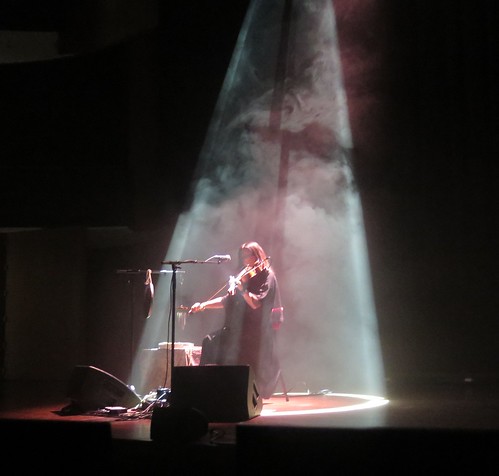
Back in the Tivoli's very comfortable Hertz venue we then saw Alison Cotton, a spooky folky gothy lady. She played violin, did stuff with electronics, and used her voice to create a distinctly eerie atmosphere, to the extent that friend Brian was afraid that she might accidentally summon something from another plane of existence. I was struck by how she covered Syd Barrett's "Golden Hair", but it was the tunes where her vocals were almost completely non-verbal that sent shivers down my spine.

We were then faced by a dilemma. Dry Cleaning were playing in the Ronda, and while I am unfamiliar with their work I have heard of them and was interested in checking out this big name band. Also my friend Mr B—'s repeated comments about how the Dry Cleaning singer is great while the rest of the band's music is rather plodding had me curious as to how bad it could really be, especially when you consider the eccentric nature of Mr B—'s tastes. But they were playing at the same time as Širom, whose programme description as weirdo avant folkies from Slovenia made them sound like a hard to resist option. And we could not resist, climbing up to Cloud Nine (and successfully accessing it) to see most of their set. A blurry picture of the amazing Širom

And basically Širom, gave good weirdo avant folk, with an added side order of drone. They played a variety of strange acoustic instruments while also providing us with some vocals, though whether these were of the Slovenian or non-verbal variety remains an unsolved mystery. They also had a carpet on stage and I understand from other reports that they might have thrown lentils at people. It all sounded a bit like those Finnish Fonal people (who may or may not still be going). And they appear to be from the Karfeit and Carso areas (possibly called something else in Slovenian), sites of the famous 11 battles of the Isonzo in the First World War. Clipping

But then we did go to the Ronda to see Clipping (who may actually call themselves "clipping." but it's not my fault if they don't understand punctuation and capitalisation). You have heard of this trio: two blokes on productiony stuff and one on rappy vocals. The music is pretty glitchy and the overall effect is a bit like if you had someone rapping over a record by Squarepusher. I think a lot of the appeal here comes from Daveed Diggs's rapping, with his quickfire vocals carrying the music along. Great as it was though, I did find myself wondering if this might be hip hop for white people (though as a white person myself maybe this is not a problem). Nancy Mounir

And thence to Hertz to see Nancy Mounir's Nozhet El Nofous. She is an Egyptian musician and like Nadah El Shazly her work involves a certain interrogation of the musical past of her country. As a performance, Nozhet El Nofous was an odd beast. Mounir herself played both violin and theremin, but she was joined by a gang of local classical musicians. And she had a man and a woman projecting photographs of Egyptian singers of yore (less famous ones than Um Kalthoum) and explanatory text. The musical also combined samples of the old singers with the music being played live, to create a sound that might be described as hauntological. It was all rather fascinating and strange, with the frequency with which the olde singers seem to have played against gender roles being an intriguing aspect of their biographies. I found myself thinking that this could do with being released as a nicely packaged CD set with an accompanying book containing all the details of the singers, as there was too much to otherwise remember. Nancy Mounir's Nozhet El Nofous

As with the first night I was by now too tired to go on to BASIS so I made my way instead to BED.

Images from Richard Mosse's The Enclave (National Gallery of Victoria)

More terrible Le Guess Who photos

More Le Guess Who action real soon.

Sunday, December 15, 2019

Derek Jarman corner: one exhibition, two films

Derek Jarman died some time ago but there is currently a retrospective exhibition of his work on in the Irish Museum of Modern Art, and I think it is worth your time. I somehow found myself at the opening, where there was free beer, which meant I had a quick viewing but will need to go back to examine it in more detail. The exhibition has considerable audio-visual elements to it, with various of his film work being shown there, including Super8 classics like A Journey to Avebury and the various pop videos he directed (the latter sadly being shown in non-ideal circumstances - a monitor in a corridor at a small-child's eye level).

The Irish Film Institute has been showing a season of his feature films. Last week I caught his Caravaggio from 1986, which deals impressionistically with the painter's life, focussing in particular on his relationship with a Roman bruiser (who becomes his model) and the bruiser's wife, played by Sean Bean and Tilda Swinton respectively; this was one of Bean's first screen roles and he starts as he means to go on. Caravaggio himself is played by Nigel Terry while various other stars of the British stage and screen show up in a variety of roles. The film looks stunning, despite its all having been filmed indoors in some bunker complex, with the lighting deliberately mirroring the chiaroscuro effect of Caravaggio's art. It is in some respects impressionistic rather than plot based, but that is not a criticism.Caravaggio is rather focussed on the artist's homosexuality, with one particularly memorable and homoerotic scene being the one where the painter throws gold coins to the topless bruiser, who takes them in his mouth. Nevertheless, the film is somewhat restrained in its depiction of homosexuality: although Jarman was keen to push the envelope, there was only so far it could be pushed in 1986. In other respects the film sanitises Caravaggio's life, downplaying the extent to which he was always killing people in drunken brawls. But it remains a classic of arthouse cinema that I recommend to all readers. If stuck for time the Pet Shop Boys video for 'It's A Sin' is the redux version. Yesterday I saw Jarman's Edward II, from 1991. Adapted from Christopher Marlowe's play (from 1594 or thereabouts). This film is more focussed on narrative than Caravaggio, but it similarly rejects realism, being shot entirely in what seems to be a concrete bunker with anachronistic elements deliberately embraced. It tells the story of that unfortunate king, whose love for another man shocks the establishment, ultimately leading to his overthrow and murder. Tilda Swinton plays the Edward's queen, whose neglect by her husband drives her into the arms of Mortimer, his main enemy (played in turn by Nigel Terry). I felt a bit like the king's enemies got the better roles here, with Swinton and Terry shining over Steven Waddington as Edward, though I was also impressed by Andrew Tiernan as Gaveston, the king's lover. In contrast to Caravaggio, this film really goes for it in terms of gayness, with the opening scene being Gaveston learning that he is free to return to England while two sailors get it on in the bed he is sharing with them. Jarman tries to present Edward as some kind of gay rights martyr, with at one point his army being a load of protesters waving Outrage banners, but I remained somewhat unconvinced - Edward still comes across as a weak figure and the author of his own misfortunes, who is unwilling to subordinate his private fancies to the needs of the state (compare with Shakespeare's Henry V and his renunciation of Falstaff on his accession to the throne). Nevertheless, the film is a fascinating piece of work, which left me eager to investigate further both the work of its director and the playwright on whose work it is based.

images:

Derek Jarman (The Quietus)

Title page of 1594 printing of Christopher Marlowe's Edward II (Wikipedia: Edward II of England)

Thursday, July 18, 2019

Finding the other Retro Hugo finalists online

In Dublin this August the Hugo Awards for the best science fiction and related stuff from 2018 will be awarded. Dublin will also be awarding Retro Hugos for material from 1943. In a previous post I linked to where most of Retro Hugo finalists in the novel, novella, novelette, and short story categories can be found online. But what of the other categories? Sadly here things seem to be a bit more difficult, but there is still more than nothing that can be looked at online for free.

Best Graphic Story

Readers will I think struggle to find some of the finalists in this category. Jack Cole's Plastic Man #1: The Game of Death is available in full on the Digital Comics Museum for online reading and downloading, but that seems to be the only finalist readily available in full online. The blog The Wonders You Can Do has an interesting post summarising and analysing Wonder Woman #5: Battle for Womanhood (by William Moulton Marsden and Harry G. Peter), complete with some illustrations. The Black Gate blog meanwhile has an illustrated summary of Alex Raymond's Flash Gordon: Fiery Desert of Mongo. Hergé's The Secret of the Unicorn is available in many libraries and all good bookshops; a summary with sample illustrations can be seen on Tintin.com. That seems to be it. Libraries and bookshops may also have reprints of the other finalists.

Best Dramatic Presentation, Long Form

Heaven Can Wait and Münchhausen are both available in full on YouTube. The Internet Archive meanwhile appears to have Batman, Cabin in the Sky, and Phantom of the Opera. And OK.RU has A Guy Named Joe.

Better quality versions of these films may be available from commercial streaming services.

Best Dramatic Presentation, Short Form

The Ape Man, Frankenstein Meets the Wolfman, Der Fuehrer’s Face, and Super-Rabbit are all available on YouTube. The Seventh Victim is on Dailymotion.

That leaves I Walked With a Zombie, for which YouTube has just a trailer. It might be available from commercial streaming services.

Best Professional Editor, Short Form

Here are links to what the Internet Speculative Fiction Database lists the finalists as having edited in 1943. Have a look at each issue's table of contents and see if it tickles your fancy. If you have infinite time, consider popping over to the Internet Archive to skim some of these issues.

John W. Campbell Jr.: Astounding Science Fiction & Unknown Worlds

Oscar J. Friend: Thrilling Wonder Stories

Mary Gnaedinger: Famous Fantastic Mysteries

Dorothy McIlwraith: Weird Tales

Raymond A. Palmer: Amazing Stories & Fantastic Adventures

Donald A. Wollheim: The Pocket Book of Science Fiction

Best Professional Artist

Samples of Hannes Bok's art can be seen here on the blog Monster Brains. Readers can also check out his illustrations to Robert W. Chambers' "The Yellow Sign" in the September 1943 issue of Famous Fantastic Mysteries.

While primarily famous for her saucy covers for Weird Tales, Margaret Brundage appears to have had a fairly quiet year in 1943, producing just the one somewhat tame cover then. A Google image search gives a broader look at her career.

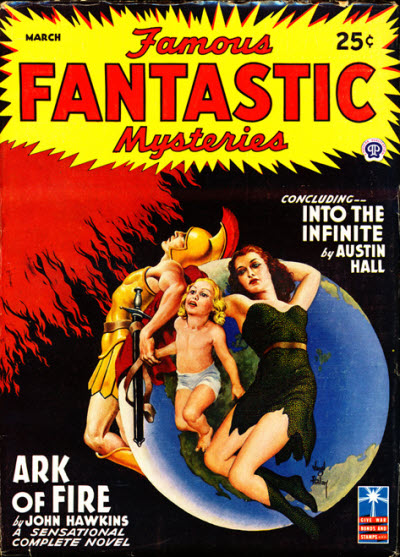
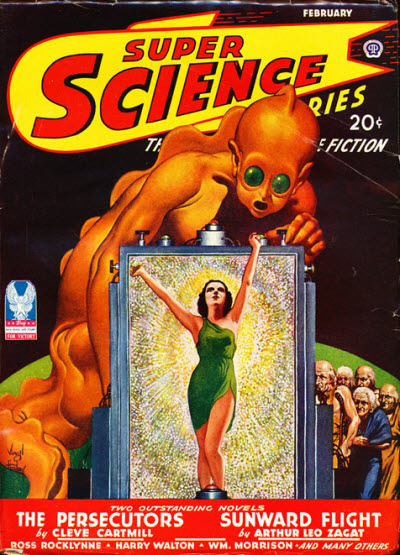
Virgil Finlay's work can be seen on the covers of the March 1943 issue of Famous Fantastic Mysteries and the February & May 1943 issues of Super Science Stories.

Unless you have been living under a stone you almost certainly are broadly familiar with the illustrations Antoine de Saint-Exupéry created for his own book The Little Prince, but if you need a refresher check out this post on the blog Faena Aleph.

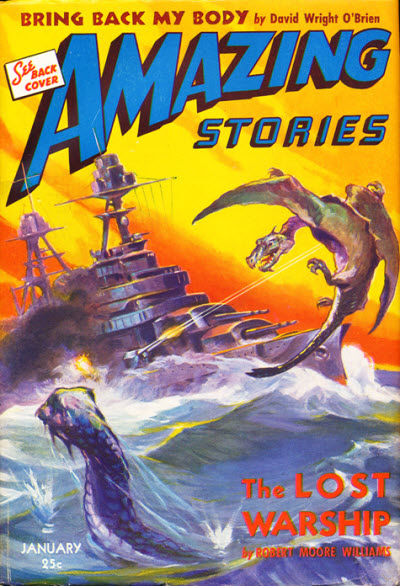
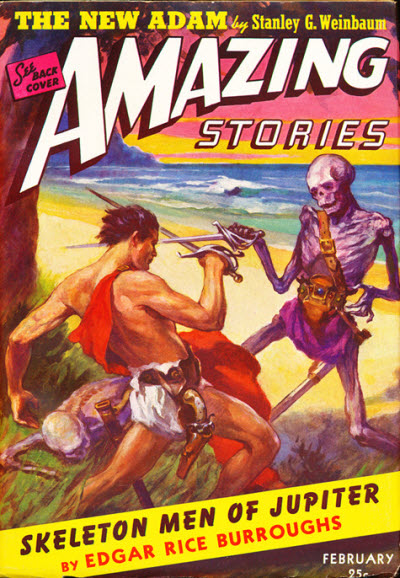
J. Allen St. John's work can be seen on the covers of the January and February 1943 issues of Amazing Stories.

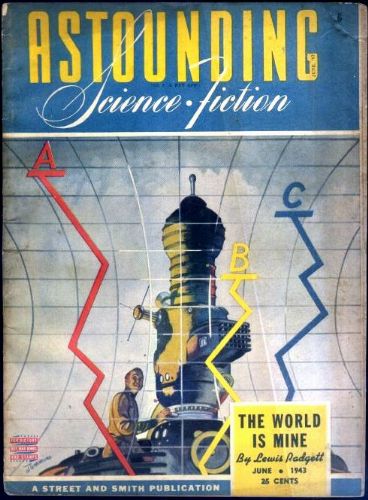
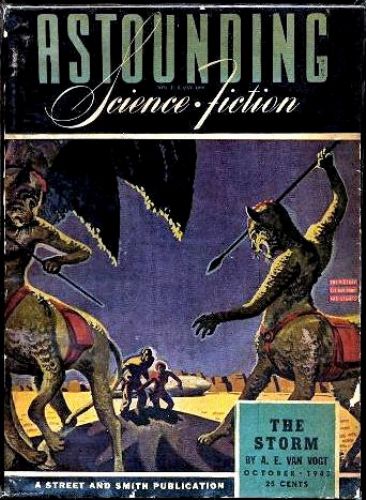
The art of William Timmins can be see on the covers of the February, June, and October 1943 issues of Astounding Science Fiction.

Fanzine and Fanwriter

FANAC.ORG is an amazing archive of fan stuff of yore. The people that run it created a portal page for fanzines from 1943 there, and there you will find links to scans of the finalists in both of the fan categories.

In case you can't remember, the best fanzine finalists are:
Fantasy News, editor William S. Sykora
Futurian War Digest, editor J. Michael Rosenblum
The Phantagraph, editor Donald A. Wollheim
Voice of the Imagi-Nation, editors Jack Erman (Forrest J Ackerman) & Morojo (Myrtle Douglas)
YHOS, editor Art Widner
Le Zombie, editor Wilson “Bob” Tucker 

The Best Fan Writer finalists are:
Forrest J. Ackerman
Morojo (Myrtle Douglas)
Jack Speer
Wilson “Bob” Tucker
Art Widner
Donald A. Wollheim
 
So there you go. With voting in the Hugos and Retro Hugos closing on 31 July, this does not leave much time to research your ballot.

In the meantime, here is another picture of my cat, with SF books in background:
More cat action

Monday, October 05, 2015

[film] "Containment" [2015]


Do not destroy these markers. These standing stones mark an area used to bury radioactive wastes. Do not drill here. Do not dig here. The rock and water in this area may not look, feel, or smell unusual but may be poisoned by radioactive wastes. When radioactive matter decays, it gives off invisible energy that can destroy or damage people, animals, and plants.

I saw the film Containment in an exhibition in the Project Arts Centre called Riddle of the Burial Grounds. The film is a documentary by Peter Galison & Robb Moss. It is about the containment of nuclear waste, in particular the spent fuel of nuclear reactors. Much of the film is about WIPP, the Waste Isolation Pilot Plant in New Mexico. This was set up as a secure storage site in which nuclear waste could be dumped and forgotten about.

A problem with nuclear waste is that it will remain dangerously radioactive for a very long time, longer in fact than the entire span of human history so far. It was decided by US federal authorities that WIPP would have to be marked in such a way that in the far future people would be deterred from digging there and inadvertently releasing the radiation. This is a bit difficult as the people who must be warned away may have no memory of our culture and have no language in common with us. An interdisciplinary team of scientists, linguists, science fiction writers, and various other types (sadly no First World War bloggers) were recruited to try and come up with something that stood a convincing chance of warning off the people of the future. You get the sense that at the end of their efforts they are not really that convinced that they have anything will definitely or even probably work, but still they feel that they owe it to future generations to try.

The film is not just about WIPP, it also looks at where nuclear waste is currently stored. Typically the highly radioactive spent fuel of nuclear reactors is stored at the nuclear sites themselves, cooled in tanks of water to stop them catching fire and spreading fallout all over their surrounding areas. If a typical one of these sites were to lose its cooling waters then the spent fuel would probably render a vast area around the site uninhabitable. The film looks at one site where this almost happened, the Fukushima Daiichi nuclear power plant. The power plant there was severely damaged in the 2011 tsunami and did release radiation; the film shows a farmer whose irradiated cattle cannot be eaten and also looks at trees whose wood is too contaminated to be used in construction. However, the spent fuel rods in Fukushima did not lose their coolant, though at one stage it looked as though the water would boil off and expose the rods. The prime minister of Japan at the time of the tsunami is interviewed in the film; he says that if the coolant had boiled off and the rods had ignited then they would have released so much radiation that an area of Japan in which some 20 to 40 million people live would have become uninhabitable. He likened that outcome as being akin to losing a major war and said that it would have brought an end to Japan as an independent state.

The film also looks at some nuclear sites in the US, in particular the Savannah River Site, a huge complex of reactors and temporary storage sites in South Carolina. This lies on the Savannah river in an area of fascinating swampy wilderness. There is a lovely scene in the film with a camera panning along the lush tree-lined border of the river before a nuclear plant rears up through the vegetation. It is a fascinating juxtaposition of nature and a human construct of destruction.

The Savannah River Site seems to be a bit leaky. The film has a nice sequence showing a place where they keep wild turtles that have absorbed too much radioactive and so have to be taken away from people who might catch and eat them. There were also a couple of radioactive alligators swimming around. One of the locals interviewed bemoans the fact that the signs on the river tell people not to fish but do not say why, so people just assume it is some kind of proprietorial thing and catch the radioactive fish anyway. A thoughtful local clergyman bemoans the presence of the SRS on his doorstep but is powerless to do anything about it.

At WIPP, on the other hand, the locals appear to be quite excited about the prospect of the nation's nuclear waste stored nearby. Simple economics explains this: there is not really much going on in the area and until WIPP opened the local community was in steep decline. People further afield in New Mexico, through whose areas the waste would have to be transported, are a bit less keen on the project, but you can't make an omelet without setting off a chain reaction.

The problem with trying to communicate the warning to people in the future is a difficult one. Think of something like the hieroglyphic inscriptions on the walls of an Egyptian temple: but for the chance discovery of the Rosetta Stone in 1799 they would be completely incomprehensible to us. It is quite possible that in the future there will be no cultural continuity with our civilisation, so any kind of warning based on writing is potentially unreliable. Warnings based on pictures may also fail as different cultural norms would leave them open to misinterpretation. Another fear is that by marking the site and saying "Do not dig here" they run the risk of creating a gold rush as people rush to find whatever amazing stuff the ancient ones have buried. The suggested marking of the site with structures designed to conjure up unease also looked like they could backfire, as to me they looked like they would be fun places to explore. One proposal in particular may have been modelled on the Memorial to the Murdered Jews in Berlin, a structure whose design invites people in for inappropriate games of hide and seek or chasing, so that might not be so good for the land above WIPP.

The project involved some people involved in one of humanity's few other attempts to communicate with those lacking any cultural points of similarity with ourselves: the images and sounds of Earth contained on the Voyager probes. I think the Voyager probes are unlikely ever to be found by alien life, but if they are it will be so far in the future that humanity will in all likelihood no longer exist. The Voyager golden records will be all that is left of our civilisation and culture. It is appropriate therefore that they attempt to present a good face of us to whoever or whatever finds them. As one of the people in the film says, the markers at WIPP are more to do with something shameful and shortsighted of our species: the production of nuclear waste with no thought for the danger it would pose to the future. Yet the project is still a noble one, as the team tries to create something that will protect people living so far in the future that they may no longer be human in the way that we are.

I have talked more of the content of this film than the form. The film features plenty of talking heads but also atmospheric shots of the desert landscape above the WIPP site. We also have the swampy wildness of the Savannah River Site and the irradiated landscape around Fukushima. In the latter we see the abandoned towns and houses of humans but again more fascinating is the countryside, a landscape that is beautiful and peaceful in appearance but so contaminated that people are not allowed stay overnight within the zone.

Although the film covers a serious subject, it has a light tone. I particularly liked the animations illustrating scenarios the futurology people came up with for likely future incursions into WIPP, with a succession of jaunty looking people or robots realising too late that they have released the radioactive death contained at the site. I also liked the animation of a suggested attempt to create cultural awareness of the WIPP site through a proposed cartoon character called Nicky Nuke, who would have an associated theme park (Nukeland or something like that), which reminded me of the Mickey Eye Park in the comic Seaguy, in that it was clearly a deranged rip-off of Disneyland.

All in all the film leaves the viewer with a sense that something will have to be done with nuclear waste and that the waste already produced cannot be expected to remain in water cooled tanks for the hundred thousand or more years it will take it to become harmless. That something is probably burying it somewhere like WIPP, in a remote and geologically stable location. Warning future generations not to excavate the site is difficult or impossible to do effectively, but there is no real option but to attempt it.

I also left the film thinking that if the USA has all that waste and is having problems working out what to do with it and how to store it safely in the meantime, what about more ramshackle countries that have also decided to go down the nuclear road. I'm thinking of Pakistan in particular here, but you would also have to worry about the long term safety of nuclear waste in the likes of Kazakhstan, Russia and Iran. And when you are talking of stuff that takes over a hundred thousand years to become safe you do have to think of the very long term.

Containment Trailer 1 from Robb Moss & Peter Galison on Vimeo.


image sources:

Spikes (Containment film website)

nuclear power plants map (Maps on the Web)

Voyager Golden Disc (Wikipedia)

Memorial to the Murdered Jews of Europe (Wikipedia)

Monday, March 09, 2015

A Trip to London Part 1: Poppies

Back in November I paid a visit to London, mainly to attend a concert in the Barbican celebrating the life of the musician Lindsay Cooper. I had time for a small number of other things.

After checking into my hotel, I paid a trip to Pudding Lane, where the famous Great Fire of London began. I then strolled on to Tower Hill to have a look at what was left of that poppy exhibit they had in the moat of the Tower of London. This was a First World War commemorative event by artist Paul Cummins and designer Tom Piper. The exhibit filled the Tower's moat filled with artificial poppies, one for every British soldier killed in the conflict (not sure if that was just soldiers from Britain or if it included also Irish soldiers and ones from the Empire). I am interested in the First World War (as anyone following my amazing First World War live blog will already know) and in monumental public art, so this touched all my bases.

By the time I got there they had mostly dismantled the exhibit. There were still poppies in one corner of the moat but the rest was bare. What was left looked a bit forlorn, but one could still imagine how the whole exhibit would have appeared. It must have been stunning, a theory supported by surviving photos of the poppy filled moat.

There is a lot of talk about how best to commemorate the First World War (or even if it should be commemorated at all) and many quite rightly decry the creepy enforced conformism of poppy-wearing in Britain. Regardless of that, seeing the huge moats of the Tower as a sea of red would have been incredibly striking and must have made anyone who saw it think about the losses suffered during the war. Whether they would then think that the dead soldiers were all brave lads doing their duty or the victims of a warmongering elite in a pointless conflict would be another question entirely.

After looking at the poppies I walked up to Rough Trade East off Brick Lane, a haunt I am always drawn to. This is one of those places that some Londoners I know are very dismissive of, but I think perhaps they would be less so if they did not have other record-selling emporiums. I am conscious of having too many CDs and was also trying to not spend loads of money on this trip (ha!) while also foreseeing that I would probably end up buying something at the concerts I was going to later, so I limited myself to just one CD here, a Sublime Frequencies release of proto-Rai music. One day the so-called powers that be will let you see my review of this record.

Come back tomorrow when I will describe the Barbican concert for Lindsay Cooper.

Sunday, October 20, 2013

Fragmentary Memories of a Hunters Moon Fundraiser

Back when it was still sunny I went to fundraiser organised for the benefit of the Hunters Moon festival in The Joinery. I took notes that were grossly inadequate and have reached that stage of my life when I can no longer remember things, but I can say a number of things about this event:

(a) I somehow missed Cat Piss Brain Rot, who clearly have the best name of any band ever.

(b) Many of the other performers also had great names, like Feral Barbershop Quartet, School Tour, and Luxury Mollusc.

(c) A highlight was this guy called Boris Belony who just read excerpts from his book of short fiction. He turned out to be a bit weird, albeit in a quirky manner. My beloved bought a copy of his book, and I should have a look at it to see if it is as entertaining as he is.

(d) Sea Dog did not sound as much like an avant garde version of Thin Lizzy as previously, but they do still rock, weirdo style.

And next week we have the final Hunters Moon festival in Carrick on Shannon, at which some of the above artists are performing, and also other people. More details here.

You may have read my review of the 2012 Hunters Moon festival (see here), where I greatly praised the joint performance of Jennifer Walshe and Ludo Mich. Some of that turns out to be on YouTube.


See also:

Boris Belony

School Tour

Luxury Mollusc

Sea Dog

The Joinery

image source

An inuit panda production

Monday, September 10, 2012

"1395 Days Without Red"

I saw this in the Irish Museum of Modern Art rather than in a cinema, so maybe it does not count as a proper film. It was also shorter than a normal feature length piece. Before talking about the film itself, I will talk about an odd event related to it I attended. IMMA's home is the Royal Hospital in Kilmainham, a nice venue but one a bit remote from anywhere. It is currently being refurbished, so IMMA has temporarily moved into the bit of the Earlsfort Terrace building that the Dublin Contemporary thing was in last year - former lecture theatres and offices for the engineering and medical faculties of University College Dublin.

As a Friend of IMMA I went along to the opening of their exhibitions in the Earlsfort Terrace venue and went along to a talk by some artists about work they were exhibiting. The talk was strange and fascinating, largely because they did not begin by directly stating what their artwork was, instead leaving it to the audience to infer this important information (or maybe everyone else had read the programme notes in advance). Anyway, it turned out that their work was indeed this oddly named film, 1395 Days Without Red.

The film has a split narrative. One strand shows some musicians who appear to be rehearsing a piece of music. The other shows a woman walking through a city. I kept thinking it would end with her joining the musicians and saying "sorry I'm late, the commute is a nightmare", but it did not, so the relationship between the two strands is unclear to me.

The woman walking through the city was the more interesting part of the two strands. At first she is walking along at a brisk pace. Then she comes to pedestrian crossing across a street where people are standing waiting to cross. There is no traffic, but the people are just standing there. Then one person jumps from their position and runs across the road. The others stand there and then another crosses in the same way. Finally the woman runs across the road and heads along her way. This kind of thing is repeated several times at subsequent junctions.

Now, if you had not read about the film in advance you might be wondering what is going on here. Rather than tell you I will describe a bit more. After a while we get a view up one of the streets the woman is crossing. There is no traffic on it but the road heads away off and in the distance we can see hills. But a little bit up the road large sheets of material are hung across it, obscuring the view along it.
Maybe at this point we have heard at least one noise that sounds rather like a gunshot.

As the woman's journey takes her on she seems increasingly nervous. She starts humming music to herself as though doing so will give her the strength to continue. The music is in fact the same as that which the musicians are rehearsing, Tchaikovsky's Pathétique. She then has to cross a very open area and she is clearly bricking it as she does so, but she makes it across without incident.

So what is going on? Well, the film was filmed in Sarajevo and set during the 1395 day long siege of the city by Serbian extremists. The woman is making a routine trip across town, but one that involves having to cross streets visible to enemy snipers. I do not know why it is called 1395 Days Without Red - maybe people avoided red clothes to make themselves less conspicuous to the snipers.

It was interesting to imagine how different this film would be if it had been made by Hollywood. As is, we only hear a handful of gunshots in the film, we never see anyone shot, and no bullet lands near the woman. No one shoots at her and it may well be that no one is aiming at her either. In a Hollywood film, though, I bet you would see people being shot at every junction and the woman would be literally dodging bullets every time she crosses the road. Who knows which approach makes for better films? As is, this film was an interesting window into the humdrum reality of living in a war zone, but it was rather repetitive and lacking in narrative structure.

Poster (see also)

Crossing

An inuit panda production

Sunday, July 22, 2012

Nicola Cox Memorial

Memorial to Nicola Cox
Just south of the Baggot Street bridge, on the west bank of the Grand Canal, there is a memorial to a woman called Nicola Cox. I discovered it by chance a while ago and have been fascinated by it ever since. I have taken a number of photographs and posted them on Flicker. You can see them here.

Nicola Cox memorial
Originally I had no idea who Nicola Cox was. I think other people may also have been perplexed, as I notice a lot of people coming to my pictures of the memorial after searching on Google for things like "Nicola Cox Canal" and the like. Two comments eventually provided some information. One said that the memorial had been created by a man called Paul, partner to the late Nicola Cox (though note comment below from Samantha Cox saying otherwise). Another comment was posted by Nicola Cox's brother, saying that she had met her end through unresolved foul play.

Wind Chimes
Nicola Cox has had a beautiful memorial created to her. My pictures do not really do it justice, so I encourage you to go and see it yourself. An otherworldly peacefulness to be had when looking at the decorations on the tree, listening to the sounds of the canal and the faint ringing of the wind chimes above.
Memorial to Nicola Cox

An inuit panda production

Sunday, May 06, 2012

Art v. Puppies


Germany took another step towards a return of fascism this week, when a court in Berlin stepped in to ban a show by an unnamed performance artist. The show was to have featured the live strangulation of puppies by the artist, as part of a protest by him or her against the strangulation of puppies. The artist had argued that the German Basic Law guarantees artistic freedom, but the court told him to "Gehen Sie weg und scheißen Sie!", pointing out that the harming of animals on stage is illegal.

More

unrelated puppies picture

An inuit panda production

Thursday, February 09, 2012

Manchester After Man


James Chadderton presents these photographs taken of Manchester in the future, after the coming apocalypse has left it empty of people.

The pictures can be inspected in detail at the Incognito Gallery, in the city's northern quarter. After seeing them you should flee for your very life.

errrr, that exhibition has closed now… I wrote the above post ages ago, but then forgot to post it. Life is hard.

Source

An inuit panda production

Tuesday, November 15, 2011

Dublin Contemporary

So I went to Dublin Contemporary, this big exhibition of contemporary art that was on here in Dublin. Somewhat unusually for art things here in Dublin, you had to pay into it, so I took the afternoon off work to make sure I got my money's worth at it. The exhibition featured artists from both Ireland and the rest of the world.

Chessboard
I enjoyed my visit to Dublin Contemporary, but I ended up thinking that most of the art was not that great. This may be a side effect of having recently seen loads of great representational and non-conceptual art in Naples. But what I really loved about the exhibition was the building itself. It used to be the home of University College Dublin (with the chessboard floor patterns in the lobby familiar to anyone who has read At Swim Two Birds) but now seems to have been taken over by the National Concert Hall. There seems to have been no renovation since UCD left, so loads of rooms still have the names of the professors or descriptions of their original purpose over the doors and peeling paint inside. At least once I was looking at some bit of stupid modern art and then realised that actually it was just a bit of the wall.

The whole place went very well with the Chernobyll piece, as the Earlsfort Terrace itself feels like it was hurriedly abandoned 20 years ago.

Library Art
For me also it was fascinating to go the library there and look at somewhere I used to work now transformed by the addition of a monumental piece of modern art, a giant glass thing by Jota Castro. Thanks to its sheer size it was one of the more impressive pieces in the exhibition.
Library Issue Desk
The advance of video art was interesting, as production values here have advanced so that instead of getting a grainy digital video image of the artist rolling around in the nip we were instead treated to well shot properly lit pieces with actors and the like. I suppose if performance artists are like unfunny stand up comedians (or boring actor-playwrights) then video artists are mutating into makers of films that would never make it to the cinema.

For all that, it was mainly the video-film art that impressed me at Dublin Contemporary, perhaps because it is a bit more immersive. Film instantly suggests a meaning in a way that a "pile of crap in a room"* piece of conceptual art often does not, so it is easier to get to grips with, once you are willing to give it the time to watch it unfold.

One interesting film piece by (I think) Javier Téllez featured some Mexican psychiatric patients in the border town of Tijuana parading from their hospital to the beach, where their country is separated from the United States by a huge wall. They were carrying posters with various slogans affirming their dignity as human beings and the like. Some of them were wearing animal masks. At the border, they staged a kind of circus event, with one of the patients taking on the role of ringmaster and holding up a large hoop through which the people with animal heads would step. Some of the people involved seemed a bit confused. Then things took an odd sidestep, with the appearance of an American guy (he showed everyone his passport). He was not one of the psychiatric patients but a human cannonball – and he then used a cannon to fire himself across the border, apparently becoming the first person to cross the Mexican-American frontier in that fashion. I do not know what this could be said to have signified, but it did make for interestingly bizarre viewing.

A longer piece by, I think, Omar Fast dealt with those unmanned drones that fly around Iraq, Afghanistan, and Pakistan, killing people their American operators think look a bit funny. It featured what appeared to be voiceovers from interviews with drone operators, but also filmed aerial shots of scenes in America corresponding to the foreign sights being described by the drone pilot. So while he would be talking about how he could use the drone to surreptitiously follow someone down a street, the screen would show an aerial shot of some kid cycling through an American town.

So far so good – the piece was making us think about the way drones work and the use of American settings would remind American viewers that the drones' real-life targets are actual people, albeit foreign ones. But the film had another element. As well as what appeared to be the actual voiceovers from interviews with drone pilots, it had these filmed interviews with an actor pretending to be a drone pilot. In these, he would tell a story (sometimes about drones and sometimes not) with his voice acting as a narrator to a filmed version of these stories. This was all done with high production values and what looked like professional actors.

These filmed scenes were quite striking, particularly the one in which the story of an Iraqi family who get killed by a drone strike on some militants they are driving past, with that story transposed to the United States, making it an all-American family being taken out by a missile attack on some redneck extremists. But they did make me wonder if there was something a bit wrong with them, in that they were taking a serious real world issue (drone strikes) and turning into slick contemporary art. At the end of the day, would the real interviews with the drone pilots have been better used in a documentary about drones rather than in a contemporary art exhibit? And did the marrying of real interviews with fictional material muddy the waters and detract from any political point the work could have made, turning the real experiences of the drone pilots into trite entertainment? I do not know.

Some of the other films seemed like they would have been more at home in a cinema rather than an art gallery. Like what appeared to be a feature film from Ghana – the IFI would surely have been a better place for this. I'm not so sure about a piece by (I think) Hans Op De Beeck, which was a series of vignettes or filmed portraits of people on a cruise ship. It lacked the kind of narrative drive that would make it fit the cinema (and the crude CGI used for the ship's exterior would have been a bit laughable in that context), but the interior scenes were far better filmed and acted than would have been the case with the kind of classic low grade video art you used to get in art galleries. It was interesting to watch, but I don't think it really worked as either art or as film – it was not conceptual enough for art and lacked enough meat to work as a film.

The war on terror/occupation of Iraq/generally troubled times in which we live featured in a couple of other non-film pieces. I was struck by how a collection of unpleasant photographic images of charred corpses (or not corpses) by one or other of Dan Perjovschi or Thomas Hirschhorn (their stuff was in the same room but I do not recall who did what) was primarily repulsive and gross, devoid to me of any kind of point or meaning other than that horrible things happen in the world.

I was a bit more struck by some photos by Nina Berman, though probably not as much as I would be if I had been seeing them for the first time. They show this young American couple Ty and Renee. Ty served in Iraq, where he was caught in an explosion that blew off his arm and burnt him so severely that he is now almost completely lacking in facial features. There is something terribly sad and human about the photographs of their wedding and their life now. They remind me of the cost of war to its participants – some of them come home in body bags, others return changed by their experiences, either by what they have seen or done or, in Ty's case, with their bodies transformed in a way they will have to live with for the rest of their lives. I don't know what the future holds for Ty and Renee, but I fear that Ty's time in Iraq might well end up blighting the rest of their lives. Still, you can ask yourself whether it was exploitative or not for the artist to use their private misfortune as the basis for her work.

I mentioned the Chernobyll exhibit above, which was a reconstruction of the big wheel in the funfair of the abandoned town of Pripyat, together with the temporary evacuation notice issued to Pripyat's residents. I had somehow got the impression in advance that the big wheel recreation was life size, so I was a bit disappointed to discover that it was smaller than I was. Oh well.

There was other stuff that was at least somewhat interesting while I was looking at it even if I do not have much to say about it in retrospect. As I was saying above, wandering around looking at all did make for a pleasant afternoon, and the exhibition was just big enough to make you feel like you were doing well on the quantity size of things without crossing over into terrifying museum fatigue territory. But the real star for me was the building, with its chequered floors, peeling walls, name plates on doors, lecture theatres, and smell of oldness.
Library Issue Desk

*I am indebted to my colleague Mark Winkelmann for this useful phrase

more pictures

An inuit panda production

Saturday, September 26, 2009

A Long Post About Conceptual Art

Have you ever been to London? If so then maybe you have been to Trafalgar Square. It has a statue of Lord Nelson on top of a pillar, and it also has some other statues there. The other statues are on plinths, as is often the case with statues. The square has four plinths, so you would think that there would be four statues – but no. Only three of the plinths have permanent statues. The fourth plinth lies vacant, or is used for temporary exhibits.

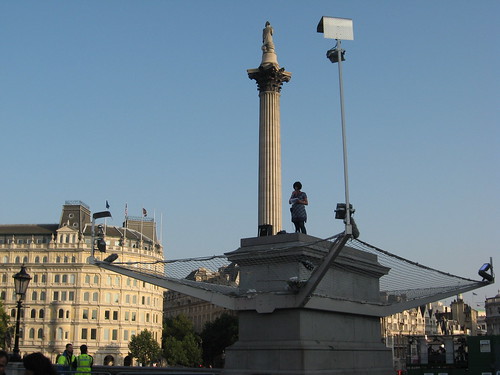
At the moment, the fourth plinth is hosting Antony Gormley's One and Other. Gormley is perhaps best known for monumental wrought iron sculptures like The Angel of the North, but One and Other is different. Gormley has basically let random punters apply to appear for an hour on plinth and do… whatever they want.

One of my pals from the internet got a slot on the plinth and decided that what she was going to do was read out letters from people. I decided to send a letter to Lord Nelson, and she read it out, which was very exciting – I feel like I am a foot soldier in conceptual art history.

I happened, coincidentally, to be in London on the day Tricia was plinthing, and made it along to see her read many other letters (semi-accidentally missing my own being read). It was an interesting business. Some of the other letters were very impressive. One of the most striking being one that some guy wrote about his estranged parents (they have disowned him for repudiating their religion), a powerful and affecting piece of writing. In complete contrast, I also loved the letter written by some fellow to a local pub, complaining about the unsatisfying meal he received from them. She also read a letter from that blog that reprints famous letters from the past (can't find the URL for this, can anyone help?).

So yes, deadly fun. Over the time I was in the big smoke, I drifted over to the Fourth Plinth a couple of times, and it was very striking how far above the average Tricia was in her endeavours. The other plinthers seemed generally not to really have any idea what they were doing up there, just passing the time waving at their friends or taking photographs. This does of course beg the question of what I would do if I was up there. Mmmm. I suppose one obvious thing would be to adopt a succession of human statue poses.

Anyway, should you want to watch Tricia reading her letters, you can do so here, and you can watch random other people plinthing here. You can also look at more of my Trafalgar Square pictures here. If for some reason you want to read my own letter to Lord Nelson, scroll on.

"To: Lord Horatio Nelson

"Sir!

"I am writing to you care of Miss Stubberfield, the lady you should see in the square below you reading this letter to you. I must confess to having had certain difficulties finding an appropriate subject for correspondence to you, and for finding the best words to use. I was going to discuss the differing sentiments towards you felt by people in this country and my own (Ireland), drawing a contrast between the relative fortunes of your great column here and the pillar upon which you once stood in the main street of my country's capital. However, a discussion in that area seemed to yield no great insights, for it is hardly surprising that Irishmen and women are less than fond of a man whose signal victory over Napoleon's fleet arguably served to bind Ireland to England for another hundred years.

"Instead, perhaps, it would be better to discuss a more human subject, and one closer to your own personage. No one can doubt the great service that you gave your country. We all know that your greatest victory was also your last, that you led your fleet against the enemy in a manner calculated to destroy them utterly while at the same time exposing you to mortal peril. But while your last battle saw you lose your life, we should remember that in earlier engagements you suffered various other losses. As you lost more of your body in each battle, you must surely have known that sooner or later an engagement with the enemy would claim your life. At Trafalgar, did you calculate in advance that your audacious plan would see your greatest victory crowned with your own life blood?

"That someone should choose glory at the price of their own death is something very alien to me. More credible is the idea that someone would choose to die for some great ideal. Was that the case with you? The standard picture is that you died for England (or Britain, or King and Country, whatever). If so, what were you dying for? A land of rotten boroughs and semi-feudal deference to the gentry and nobility, but in a land where creeping industrialisation was creating new forms of misery and despair – was that your England?

"These are unanswerable questions – even if you were able to reply to this letter I suspect that you would find it difficult to explain your own motivations. Still, I would love to know whether, as you lay dying, did you feel that your death was worth the glory you had won or the nation you had saved, or did you silently curse the roll of the cosmic dice that had seen you take a fatal wound?


"I remain,

"your obedient servant.

"Ian Moore, esq."

Monday, April 27, 2009

More Orientalist Action

A while back I mentioned seeing the exhibition of Orientalist art in the Tate Britain in that London. Now the BBC reports the exhibition has travelled to Sharjah in the United Arab Emirates, where the locals can see how crazy Victorians imagined their lives. Interestingly, the BBC also reports that vintage Orientalist art is carrying ever increasing prices in the art markets of the world - you can never really go too wrong with eroticised pictures of dusky native ladies.

Friday, April 17, 2009

A Trip to the Niland: Part Two

What am I talking about? Maybe you should read Part One

Upstairs the exhibition had a sudden attack of non-video art – a couple of posters and models depicting crazy conspiracy theory stuff. I like the mysteriously true end of conspiracy theories (you know, Bohemian Grove, Gladio, that kind of thing). This promiscuously mixed in all that kind of thing with more outlandish stuff about secret rulers of the world and so on. That is maybe the problem with reading about this kind of stuff in an art gallery rather than a book – artworks typically do not feature footnotes.

They did have some video pieces upstairs. One that I liked was people in Baghdad making the noise that Tomahawk cruise missiles make when they fly by and then explode in the distance. They should have sold CDs of this, it was great. There was also a conceptually interesting piece in which separate interviews of an Israeli tank crews were shown in screens laid out to show where they would be relative to each other in a tank. It was conceptually interesting, but once you got the idea it was too difficult to really engage with what they were saying, so I left them to it.

The last piece I looked at was again more like a film than an artwork, but it was pretty interesting. It dealt with Auschwitz, and told the story first of all of the first people to break the story of the death camp. They were two inmates who had something to do with the gas chambers (I missed the intro, but they might have been the guys who checked the bodies for valuables; the Nazis disposed of these people every couple of months to keep word of the gas chambers to as few people as possible). They escaped from the camp, and after an arduous journey they were able to get word to the allies, who then basically did nothing about it. Various prominent Jewish figures begged the allied leaders to have the gas chambers or railways into Auschwitz bombed, but Churchill et al. took the line that the best way to help the Jews was to end the war as fast as possible. The film implies that not bombing the camps was Wrong; I believe that this is a more morally ambiguous question. Whatever about that, the aerial photos of the camp (taken by a reconnaissance plane that had no idea what it was flying over) showing the gas chambers with a line of people about to be murdered marching to them was rather affecting.

The lay out of the exhibition is such that it was only by chance that I ended up with Auschwitz, but it works well as an end-point. It maybe also works well that (for me) the exhibition ended with a fairly straight film on this awful subject. It got me thinking also about the whole business of visiting Auschwitz, a place that is now a major tourist attraction in Poland. I am interested in history, even bad history, and I could imagine the camp being a fascinating place to see. But I could imagine two possible downsides to going there. First of all, the place could be so depressingly awful that a trip there would feel like immersion in the pornography of horror – a place you visit not to learn more about the past, but to get a vicarious thrill from contemplating the terrible things that people can do. Or, contrariwise, it could turn out to be a case of Holocaust kitsch, a packaged experience so tacky that it becomes a theme-park of death, distancing the visitor from any understanding of the events that took place there. Has anyone reading this ever been to Auschwitz? What did you make of it?


One final thing - I did not take notes on which artists produced which pieces in the exhibition. The exhibition's website gives the following names of the artists:

Maja Bajevic (Bosnia)
Bureau d'etudes (France)
Paul Chan (USA)
Köken Ergun (Turkey)
Harun Farocki (Germany)
Omer Fast (Israel/USA)
Kendell Geers (South Africa)
Johan Grimonprez (Belgium)
Jamelie Hassan (Canada)
Kristan Horton (Canada)
Abdel-Karim Khalil (Iraq) 
Anri Sala (Albania)
Sonja Savic (Serbia)
Sean Snyder (USA/Germany)
Ron Terada (Canada)

See if you can match them to the described artworks.

Wednesday, April 15, 2009

A Trip to the Niland: Part One

The Model Arts & Niland Gallery is this place in Sligo where they show modern art stuff. In all my time visiting Sligo I somehow managed to miss its existence until very recently. Now a trip to the Niland is one of the highlights of any visit to Ireland's north west.

At the moment, the Niland's normal location is in the middle of a renovation, but the institution is showing stuff in other locations. Their current show seems to be some kind of touring exhibition based on war, terrorism, and that kind of thing. Most of the exhibition is video work of one sort or another. The first piece you see is four screens showing footage taken at two big events in Turkey. One is some kind of army passing out parade, featuring loads of soldiers marching around and declaring their intention to kill anyone who opposes a certain narrowly defined vision of Turkishness. The other is some kind of youth congress, at which a series of cute as a button small children make similarly blood-thirsty promises. Happy is he who is a Turk!

The second piece was by a Bosnian artist. She filmed herself making a series of emphatic statements while in a voice-over the artist repeats the same statements. Sometimes the voice-over is in phase with the on-screen comments, sometimes not. The statements range from the ominous (“I kill people who think differently from me” or “I like to rape women”) to the surreal (“During Ramadan I do not smoke or drink alcohol, but I take ecstasy”) to the somewhat banal, all delivered in more or less the same tone. There are obvious resonances here with the troubled history of Bosnia, the various references to sexual violence or exploitation of women gaining an extra frisson through being said by a woman, albeit one at that point speaking in the persona of a man.

The Bosnian's piece was refreshingly short, unlike the nevertheless fascinating piece that followed, which was a series of three films by another artist. Actually, I only saw part of one of these films, as it was too long to watch all of. It was a series of everyday scenes shot in Baghdad on the eve of the US invasion, a poignant vision of people living lives of a normality that would soon be shattered. The footage was fascinating; shots of two sisters dancing was an image that will live with me for some time. As an art piece it was however a bit problematic. The footage might have been better used as the raw material for a TV documentary rather than something to be shown in an art gallery. I strongly suspect that no one who chanced across this piece stood there to watch the whole 51 minutes, let alone hung around to watch the other long films by the artist that were showing.

The next room had a big sign telling you in English and French that you are now leaving the American Sector, set up so that it was visible through glass windows to people in the street. Although it looked like something you would see in divided Berlin, it was actually placed initially on the border between the USA and Canada. It stood there for just under a week, until complaints forced its removal.

That room also housed a piece by another artist, the accompanying notes for which indicated a certain ambivalence on his part about the theme of the exhibition. The exhibition's broadly post-11-9 sensibility irritated him, as it is not as though extremism and political violence was conjured into the world on that 2001 day – in much of the world people have long had to live with the fear of sudden violent death. This is, surely, an agreeable sentiment, but I am not so sure I liked the art-work that went with it – footage from apartheid-era South Africa of a suspected informer being tortured to death, sound-tracked by Magritte (or was it Matisse?) talking about art.

The next piece was another video piece, consisting of cut together news footage of various terrorist events, intercut with all kinds of funny stuff. The gang was all here – the Mogadishu rescue, Sadat's assassination, lots of footage of planes blowing up, and so on. I was particularly struck by footage of an airplane coming into land, missing the run way, flying into trees, and then (just when you thought that just maybe they might have made a hard landing that some people would get away from) exploding, sound-tracked by disco classic 'Do The Hustle!'. Again, though, it went on a bit, but an art gallery was probably the best place for it, as it was plainly too weird and tasteless for TV. And I now find myself singing 'Do The Hustle' to myself whenever I take a plane.


THUS ENDS PART ONE. PART TWO TO FOLLOW

Friday, December 12, 2008

Art in Cork

Yes, it exists. On my trip to the Southern Capital last week, I paid a visit to the Glucksmann Gallery. This lies in the grounds of University College Course, in an imposing neo-brutalist edifice that somehow manages to look closed even when it is open. There was some great stuff inside. The exhibit of artworks relating to the Irish troubles was interesting, with Robert Ballagh's picture of the Miami Showband* (a photograph of the band overlaid with glass made to look like bullets have been fired into it) being eerily evocative of one of Northern Ireland's more unpleasant events. Another impressive piece is the much older Men of the West by Sean Keating, a picture from the early 20th century of some men from the West of Ireland who are clearly ready to answer Ireland's call. Sean Keating (an associate of William Orpen) is a fascinating artist, kind of like an Irish Socialist Realist in the iconic and propagandistic nature of his work. Another great work by him is Men of the South (veterans of the war of independence pose heroically shortly thereafter) and The Dockers, with the latter visible to Dublin readers in the Hugh Lane Gallery.

It was the foreign art, unrelated to the Troubles, that ultimately proved the most memorable.. One favourite was this video installation by Carey Young where the artist, dressed in a smart suit, went to Speakers Corner and delivered a well-prepared speech on public speaking techniques, while around her people milled around and various nutters ranted away about stuff in an over-excitable manner.

Another piece of complete genius was the Mao-Hope march, a film recording of a march through New York by some Öyvind Fahlström fellow in the late 1960s. They were carrying giant photographs of Bob Hope and Mao Tse-Tung, and asking passers by if they were happy. The responses they received can be read here (that's also the image source). I particularly liked the guy who thought that it was a sign that Bob Hope was going to become US president, or the various people who got very defensive when asked whether they were happy.


*younger readers may not heard of these fellows. They were one of those showbands you hear about, and their career was cut tragically short by the Ulster Volunteer Force, who stopped their van and massacred them in the mid-1970s.

Monday, September 29, 2008

ME AM CULTURE

Yesterday I went to the Hugh Lane Gallery to see some art. There is a long and complicated story about the Hugh Lane Gallery's collection – its original core collection of Impressionist and Post-Impressionist works were part of a bequest from collector Hugh Lane, but ownership of these is shared between the Hugh Lane Gallery and some museum in London. The paintings tend to flit backwards and forwards across the Irish Sea, with some always being in each of the museums. For a limited period ending today, however, the whole bequest was in Dublin, and I popped down to see the lot in its entirety.

The stars of the collection are probably Renoir's Les Parapluies and Monet's Waterloo Bridge. The Renoir piece is a particular favourite, one I am always happy to see again. With it, I always remember not so much the umbrellas as the little girl on the right, and the attractive black clad woman on the left (and the leering bearded bloke behind her). All human life is here.

There were some striking other paintings I had not noticed before. Many of these were by some fellow called Antonio Mancini. His pictures were odd, in that when first seen they often looked a bit meh, but they would be very impressive when seen across a room rather than in close up. This was especially true of a portrait of Hugh Lane's sister and another of Lady Gregory. Close up, these works seemed too obviously paint on canvas, but from a distance they coalesced into strangely compelling image.

I was also struck by a picture painted by Augustus John. As you know, this painter would get up on a slow dog, and reputedly had so many illegitimate children that he would pat any child he passed on the head just to be on the safe side. The particular picture shows two women and four or five children. The women are John's wife and the woman he married after her death. The children are all John's, though the notes did not see who their mothers were. What really struck me about this was how demonic two of the children were… they looked like changelings, or the results of an obscene union between a woman and The Devil. I wonder could SATAN have been jazzing Augustus John's ladies behind his back? I think that it would be foolish to discount the possibility.

There were lots of other nice pictures, though none about which so much can be said.