Showing posts with label Retro Hugo Awards. Show all posts

Sunday, April 26, 2020

Where to find the 1945 Retro Hugo Awards finalists

Popular blog File 770 has a post by JJ on Where To Find The 2020 Hugo Award Finalists For Free Online, a useful resource for anyone wanting to start reading before the Hugo Voter Packet becomes available. But what of the 1945 Retro Hugo Awards finalists? There is unlikely to be a Voter Packet for these, so how are Hugo Awards voters to go about making an informed choice here? Fortunately, many of the works that will be on the ballot are available online, either on the Internet Archive or elsewhere. Below I have compiled links to as many of these as I could find, and provided information about whether items are in print or otherwise. If any of the links do not work, please let me know in the comments.

Best Novel
  • The Golden Fleece, by Robert Graves (Cassell & Company). Also known as Hercules, My Shipmate, this retelling of the Jason and the Argonauts story is in print and available from book stores and online retailers.
  • Land of Terror, by Edgar Rice Burroughs (Edgar Rice Burroughs, Inc.). Ebook versions of this can be purchased online. It is also out of copyright in Australia, so can be read on that country's Project Gutenberg.
  • "Shadow Over Mars", by Leigh Brackett (Startling Stories, Fall 1944). Subsequently published as the standalone novel The Nemesis from Terra, which appears to be out of print, but the magazine it first appeared in can be read or downloaded on the Internet Archive.
  • Sirius: A Fantasy of Love and Discord, by Olaf Stapledon (Secker & Warberg). In print and readily obtainable.
  • The Wind on the Moon, by Eric Linklater (Macmillan and Co.). In print and readily obtainable.
  • "The Winged Man", by A. E. van Vogt and E. Mayne Hull (Astounding Science Fiction, May-June 1944). Originally serialised in Astounding, this was subsequently published as a complete novel but appears to now be out of print. It can be read in the May and June 1944 issues of Astounding Science Fiction on the Internet Archive.

Best Novella

Best Novelette

Best Short Story
  • "And the Gods Laughed", by Fredric Brown (Planet Stories, Spring 1944). This also appears in anthologies of Brown's work.
  • "Desertion", by Clifford D. Simak (Astounding Science Fiction, November 1944). This also appears as a chapter in the novel City. If you want to read the nominated stories from City in publication order, read this third.
  • "Far Centaurus", by A. E. van Vogt (Astounding Science Fiction, January 1944). This can also be found in general anthologies and ones of van Vogt's work. For further details see its ISFDB entry.
  • "Huddling Place", by Clifford D. Simak (Astounding Science Fiction, July 1944). This also appears as another chapter in the novel City. If you want to read the nominated stories from City in publication order, read this second.
  • "I, Rocket", by Ray Bradbury (Amazing Stories, May 1944). A replica edition of this issue of Amazing Stories can be purchased online.
  • "The Wedge", by Isaac Asimov (Astounding Science Fiction, October 1944). This also appears as "The Traders" in the novel Foundation. If you want to read the two stories from Foundation in publication order, read this first.

Best Series

Captain Future, by Edmond Hamilton
Written by Edmond Hamilton (sometimes using the pseudonym Brett Sterling), the Captain Future stories appeared in the magazine of the same name. Wikipedia has an overview of the series, while the ISFDB has a listing of Captain Future stories. A selection of these are available on the Internet Archive:

The Cthulhu Mythos, by H. P. Lovecraft, August Derleth, and others
The deity Cthulhu first made its monstrous appearance in H. P. Lovecraft's 1928 short story "The Call of Cthulhu". Subsequently much of Lovecraft's and his associates' work has been grouped together under the Cthulhu Mythos label. Like many of the horrors Lovecraft deals with, the Cthulhu Mythos is somewhat amorphous and it can be difficult to fix its exact boundaries. Not all of Lovecraft's own stories are unambiguously part of the Mythos, while one can argue as to whether some of the works by his admirers are truly part of the Mythos or deviations from the true path. Wikipedia attempts a rough overview of the Mythos, while the ISFDB attempts a bibliography. Note that the Mythos remains a living tradition, with stories continuing to be published, but only those that had appeared by the end of 1944 should be considered by Retro Hugo Awards voters.

There are numerous in-print anthologies of Lovecraft's own fiction. The Internet Archive also has scans of the magazines in which some of these originally appeared, including "The Call of Cthulhu" (Weird Tales, February 1928), "The Dunwich Horror" (Weird Tales, April 1929), "The Whisperer in Darkness" (Weird Tales, August 1931), "The Music of Erich Zann" (Weird Tales, November 1934), "The Haunter of the Dark" (Weird Tales, December 1936), "The Shadow out of Time" (Astounding Stories, June 1936), "The Thing on the Doorstep" (Weird Tales, January 1937), "The Case of Charles Dexter Ward" (Weird Tales, May 1941 & Weird Tales July 1941), "The Colour Out of Space" (Famous Fantastic Mysteries, October 1941), and "The Shadow over Innsmouth" (Weird Tales, January 1942).

The Cthulhu Mythos was developed and expanded by writers associated with and inspired by Lovecraft. August Derleth co-founded Arkham House to keep Lovecraft's fiction in print; he also wrote Lovecraftian fiction of his own, including "The Thing That Walked on the Wind" (Strange Tales of Mystery and Terror, January 1933), "Beyond the Threshold" (Weird Tales, September 1941), "The Dweller in Darkness" (Weird Tales, November 1944), and "The Trail of Cthulhu" (Weird Tales, March 1944). Frank Belknap Long gave us "The Space-Eaters" (Weird Tales, July 1928) and "The Hounds of Tindalos" (Weird Tales, March 1929). Robert Bloch wrote "The Shambler from the Stars" (Weird Tales, September 1935). Robert E. Howard gave us "The Black Stone" (Weird Tales, November 1931), "The Children of the Night" (Weird Tales, April-May 1931), "The Thing on the Roof" (Weird Tales, February 1932), and "Dig Me No Grave" (Weird Tales, February 1937).

Doc Savage, by Kenneth Robeson/Lester Dent
Published under the pseudonym Kenneth Robeson, the Doc Savage stories were mostly but not entirely written by Lester Dent. Doc Savage novels appeared at a phenomenal rate, starting in 1933, with 142 having been published by the end of 1944. The ISFDB has a terrifyingly vast entry on the series, while Wikipedia has summaries of the novels. The Shadow's Sanctum is currently publishing reprints of the Doc Savage novels.

Jules de Grandin, by Seabury Quinn
Seabury Quinn wrote a lot of stories featuring his occult detective Jules de Grandin. Wikipedia has a short overview of the series, while the ISFDB entry could be cross-referenced with the Internet Archive to source scans of the issues of Weird Tales in which the stories first appeared. Here is a somewhat random selection of stories in the series, including the first one published and the only one from 1944: "The Horror on the Links" (Weird Tales, October 1925), "The House of Horror" (Weird Tales, July 1926), "Restless Souls" (Weird Tales, October 1928), "The Corpse-Master" (Weird Tales, July 1929), "The Wolf of St. Bonnot" (Weird Tales, December 1930), "The Curse of the House of Phipps" (Weird Tales, January 1930), "The Mansion of Unholy Magic" (Weird Tales, October 1933), "Suicide Chapel" (Weird Tales, June 1938), and "Death's Bookkeeper" (Weird Tales, July 1944).

Pellucidar, by Edgar Rice Burroughs
The Pellucidar stories are set inside the Earth, which in the first instalment is revealed to be hollow. At the Earth's Core, the first Pellucidar novel, appeared in 1914, while Land of Terror, the 6th,was published in 1944. Wikipedia's entry for the series links off to plot-summarising entries for the individual books. These are beginning to slip out of copyright, though the later ones are still not in the public domain everywhere. Readers can access the Pellucidar at these links:

If a whole novel of hollow earth adventure is too much, there were also three pieces of short Pellucidar fiction published in 1942: "Return to Pellucidar" (Amazing Stories, February 1942), "Men of the Bronze Age" (Amazing Stories, March 1942), and "Tiger Girl" (Amazing Stories, April 1942).

The Shadow, by Maxwell Grant (Walter B. Gibson)
Tales of this proto-superhero appeared from 1931 onwards under the pseudonym Maxwell Grant but were mostly written by Walter B. Gibson. By the end of 1944 a vast number of Shadow novels had appeared (286 if Wikipedia is to be believed). The Shadow's Sanctum is currently publishing reprints of books in The Shadow series.

Best Related Work
  • Fancyclopedia, by Jack Speer (Forrest J. Ackerman). The FANAC Fan History Project has scans of this encyclopaedia of 1944 fandom, as well as a hypertext version.
  • '42 To '44: A Contemporary Memoir Upon Human Behaviour During the Crisis of the World Revolution, by H. G. Wells (Secker & Warburg). This does not seem to be in print but readers may be able to source copies from libraries or second hand book dealers.
  • Mr. Tompkins Explores the Atom, by George Gamow (Cambridge University Press). No longer in print as a standalone book, this is available as part of Mr Tompkins in Paperback, which can be obtained from Cambridge University Press or online resellers. An edition combining the book with Mr. Tompkins Explores the Atom with Mr. Tompkins in Wonderland, another book by George Gamow, can be accessed on the Internet Archive.
  • Rockets: The Future of Travel Beyond the Stratosphere, by Willy Ley (Viking Press). This appears to be out of print, but readers may be able to source copies from libraries or second hand book dealers. It can also be borrowed from the Internet Archive.
  • "The Science-Fiction Field", by Leigh Brackett (Writer's Digest, July 1944). This was recently reprinted in Windy City Pulp Stories no. 13, which is readily available from online sellers.
  • "The Works of H. P. Lovecraft: Suggestions for a Critical Appraisal", by Fritz Leiber (The Acolyte, Fall 1944). This can be accessed on FANAC.

Best Graphic Story or Comic
  • Buck Rogers: "Hollow Planetoid", by Dick Calkins (National Newspaper Service). Originally appearing as a daily newspaper strip, this story appears not to be in print. Art Lortie has however made it available to Retro Hugo voters here.
  • Donald Duck: "The Mad Chemist", by Carl Barks (Dell Comics). Originally appearing in Walt Disney's Comics and Stories #44, this story has been reprinted but not obviously recently (see entry in Grand Comics Database). It can be read on YouTube or as uploaded by Art Lortie.
  • Flash Gordon: "Battle for Tropica", by Don Moore & Alex Raymond (King Features Syndicate). Originally a syndicated newspaper strip, this was reprinted by Kitchen Sink in Flash Gordon: Volume 6 1943-1945 - Triumph in Tropica, copies of which can be obtained relatively cheaply from online sellers. You can read William Patrick Raymond's review and summary here and the strip itself here (courtesy of Art Lortie).
  • Flash Gordon: "Triumph in Tropica", by Don Moore & Alex Raymond (King Features Syndicate). This also appears in Flash Gordon: Volume 6 1943-1945 - Triumph in Tropica and William Patrick Raymond's write-up is here. Art Lortie has again made the comic available here.
  • The Spirit: "For the Love of Clara Defoe", by Manly Wade Wellman, Lou Fine and Don Komisarow (Register and Tribune Syndicate). This story was reprinted in Volume 9 of Will Eisner's The Spirit Archives, which is available from online booksellers. Art Lortie has made it available here.
  • Superman: "The Mysterious Mr. Mxyztplk", by Jerry Siegel and Joe Shuster (Detective Comics, Inc.). Originally appearing in Superman #30, this story has often been reprinted (see the DC Comics Database), most recently in The Superman Archives Vol. 8 (which appears to be in print in expensive hardback). It also appears in Superman: The Greatest Stories Ever Told, Vol. 2, second hand copies of which can more cheaply be obtained. The amazing Art Lortie has posted it here.

Best Dramatic Presentation, Short Form
  • The Canterville Ghost, screenplay by Edwin Harvey Blum from a story by Oscar Wilde, directed by Jules Dassin (Metro-Goldwyn-Mayer (MGM)). This is available in two parts on Dailymotion, with the image inexplicably inverted from left to right. Part 1 and Part 2. It can also be watched uninverted on ok.ru or as uploaded by Art Lortie.
  • The Curse of the Cat People, written by DeWitt Bodeen, directed by Gunther V. Fritsch and Robert Wise (RKO Radio Pictures). This film can also be seen on ok.ru. Art Lortie has made it available here.
  • Donovan's Brain, adapted by Robert L. Richards from a story by Curt Siodmak, producer, director and editor William Spier (CBS Radio Network). This radio drama can be downloaded or streamed from the Internet Archive. Art Lortie has uploaded it in two parts, here and here.
  • House of Frankenstein, screenplay by Edward T. Lowe, Jr. from a story by Curt Siodmak, directed by Erle C. Kenton (Universal Pictures). This can be viewed on ok.ru or, courtesy of Art Lortie, here.
  • The Invisible Man's Revenge, written by Bertram Millhauser, directed by Ford Beebe (Universal Pictures). The Internet Archive has this available to stream or download. Art Lortie has posted it here.
  • It Happened Tomorrow, screenplay and adaptation by Dudley Nichols and René Clair, directed by René Clair (Arnold Pressburger Films). This can be viewed on YouTube.

Best Editor, Short Form
  • John W. Campbell, Jr. was the editor of Astounding Science Fiction, of which in 1944 12 issues appeared, which can be seen here: January, February, March, April, May, June, July, August, September, October, November, and December.
  • Oscar J. Friend edited Captain Future, Startling Stories, and Thrilling Wonder Stories. The Spring issue of Captain Future is available on the Internet Archive. The Spring, Summer, and Fall issues of Startling Stories can also be seen there, as can the Spring, Summer, Fall, and Winter issues of Thrilling Wonder Stories.
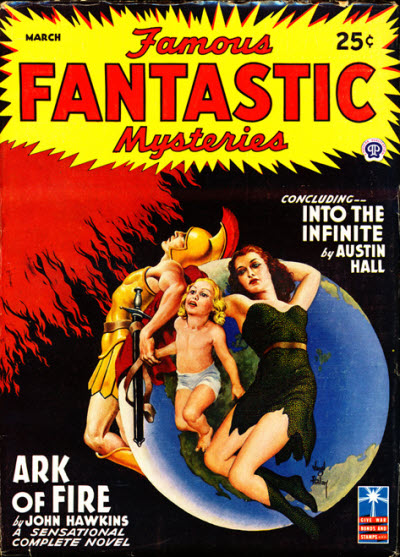
  • Mary Gnaedinger edited Famous Fantastic Mysteries, whose March, June, September, and December 1944 issues can be read on the Internet Archive.
  • Dorothy McIlwraith was in 1944 the editor of Weird Tales, whose January, March, May, July, September, and November 1944 issues can be seen on the Internet Archive.
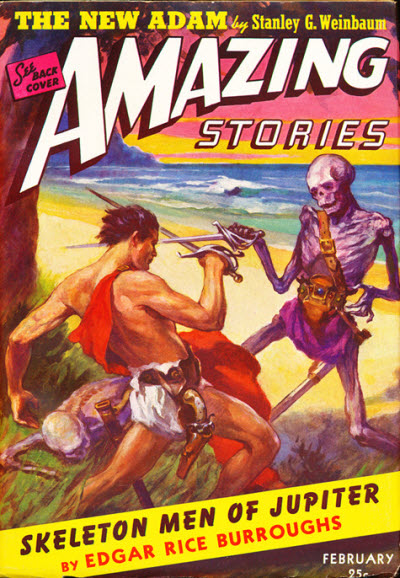
  • Raymond A. Palmer edited Amazing Stories and Fantastic Adventures in 1944. On the Internet Archive one can see the January, March, May, September, and December issues of Amazing Stories and the February, April, June, and October issues of Fantastic Adventures.
  • W. Scott Peacock edited Jungle Stories and Planet Stories in 1944. No issues of Jungle Stories are available on the Internet Archive, which may be just as well, but the site does have the Spring, Summer, Fall, and Winter issues of Planet Stories.

Best Professional Artist
  • Earle K. Bergey in 1944 provided cover art for Captain Future, Startling Stories, and Thrilling Wonder Stories. His ISFDB has links to the entries for the issues he provided covers for, where his art can be seen.
  • Margaret Brundage provided the cover art for the May 1944 issue of Weird Tales and to the story "Iron Mask" within that issue. If her ISFDB entry is to be believed then that is all she did in 1944.
  • Boris Dolgov did the cover for the March 1944 of Weird Tales. He also provided interior art for every 1944 issue of the magazine, so if you browse through the links given with Dorothy McIlwraith above you will see more examples of his work.
  • Matt Fox did the cover for the November 1944 issue of Weird Tales. He also provided interior art for the poem "The Path Through the Marsh" and story "The Weirds of the Woodcarver" in the September issue of the magazine.
  • Paul Orban appears not to have done any cover art in 1944, but he did interior art in every issue of Astounding Science Fiction that year, so check out the links given with John W. Campbell above for examples of his work, which are typically credited simply to "Orban".
  • William Timmins did all the 1944 covers for Astounding Science Fiction, apart from the July issue, so follow the links given above in Best Editor for John W. Campbell to see examples of his work.

Best Fanzine
Joe Siclari and Edie Stern of the Fanac Fan History Project have put together a Retro Hugo Awards page for Fan Hugo Materials for Work Published in 1944, with links to scanned copies of the finalist fanzines from 1944: The Acolyte (edited by Francis T. Laney and Samuel D. Russell), Diablerie (edited by Bill Watson), Futurian War Digest (edited by J. Michael Rosenblum), Shangri L’Affaires (edited by Charles Burbee), Voice of the Imagi-Nation (edited by Forrest J. Ackerman and Myrtle R. Douglas), and Le Zombie (edited by Bob Tucker and E.E. Evans).

Best Fan Writer
The FANAC Retro Hugo Awards page for Fan Hugo Materials for Work Published in 1944 also links to examples of writing in 1944 by the fan writer finalists, who are Fritz Leiber, Morojo (Myrtle R. Douglas), J. Michael Rosenblum, Jack Speer, Bob Tucker, and Harry Warner, Jr.

And that's it. I hope readers find this useful. Have fun reading and voting in the Hugo Awards.
Hugo Award Cat

Thursday, July 18, 2019

Finding the other Retro Hugo finalists online

In Dublin this August the Hugo Awards for the best science fiction and related stuff from 2018 will be awarded. Dublin will also be awarding Retro Hugos for material from 1943. In a previous post I linked to where most of Retro Hugo finalists in the novel, novella, novelette, and short story categories can be found online. But what of the other categories? Sadly here things seem to be a bit more difficult, but there is still more than nothing that can be looked at online for free.

Best Graphic Story

Readers will I think struggle to find some of the finalists in this category. Jack Cole's Plastic Man #1: The Game of Death is available in full on the Digital Comics Museum for online reading and downloading, but that seems to be the only finalist readily available in full online. The blog The Wonders You Can Do has an interesting post summarising and analysing Wonder Woman #5: Battle for Womanhood (by William Moulton Marsden and Harry G. Peter), complete with some illustrations. The Black Gate blog meanwhile has an illustrated summary of Alex Raymond's Flash Gordon: Fiery Desert of Mongo. Hergé's The Secret of the Unicorn is available in many libraries and all good bookshops; a summary with sample illustrations can be seen on Tintin.com. That seems to be it. Libraries and bookshops may also have reprints of the other finalists.

Best Dramatic Presentation, Long Form

Heaven Can Wait and Münchhausen are both available in full on YouTube. The Internet Archive meanwhile appears to have Batman, Cabin in the Sky, and Phantom of the Opera. And OK.RU has A Guy Named Joe.

Better quality versions of these films may be available from commercial streaming services.

Best Dramatic Presentation, Short Form

The Ape Man, Frankenstein Meets the Wolfman, Der Fuehrer’s Face, and Super-Rabbit are all available on YouTube. The Seventh Victim is on Dailymotion.

That leaves I Walked With a Zombie, for which YouTube has just a trailer. It might be available from commercial streaming services.

Best Professional Editor, Short Form

Here are links to what the Internet Speculative Fiction Database lists the finalists as having edited in 1943. Have a look at each issue's table of contents and see if it tickles your fancy. If you have infinite time, consider popping over to the Internet Archive to skim some of these issues.

John W. Campbell Jr.: Astounding Science Fiction & Unknown Worlds

Oscar J. Friend: Thrilling Wonder Stories

Mary Gnaedinger: Famous Fantastic Mysteries

Dorothy McIlwraith: Weird Tales

Raymond A. Palmer: Amazing Stories & Fantastic Adventures

Donald A. Wollheim: The Pocket Book of Science Fiction

Best Professional Artist

Samples of Hannes Bok's art can be seen here on the blog Monster Brains. Readers can also check out his illustrations to Robert W. Chambers' "The Yellow Sign" in the September 1943 issue of Famous Fantastic Mysteries.

While primarily famous for her saucy covers for Weird Tales, Margaret Brundage appears to have had a fairly quiet year in 1943, producing just the one somewhat tame cover then. A Google image search gives a broader look at her career.

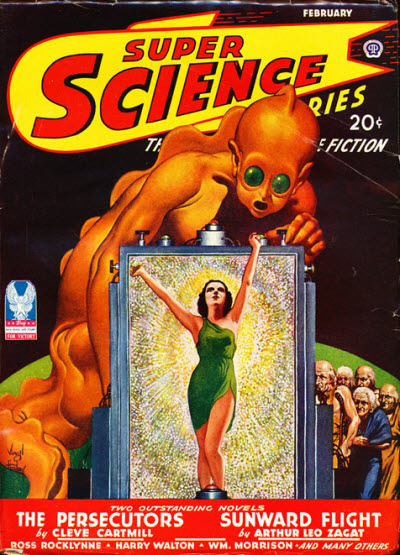
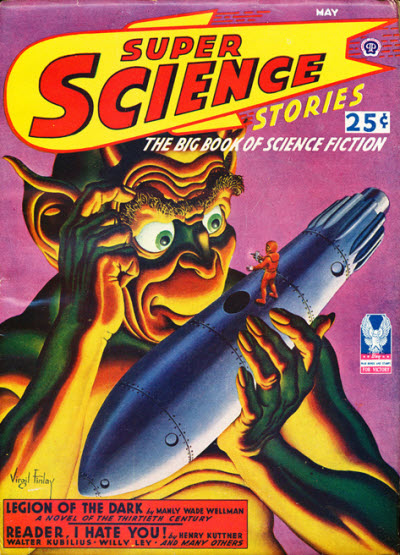
Virgil Finlay's work can be seen on the covers of the March 1943 issue of Famous Fantastic Mysteries and the February & May 1943 issues of Super Science Stories.

Unless you have been living under a stone you almost certainly are broadly familiar with the illustrations Antoine de Saint-Exupéry created for his own book The Little Prince, but if you need a refresher check out this post on the blog Faena Aleph.

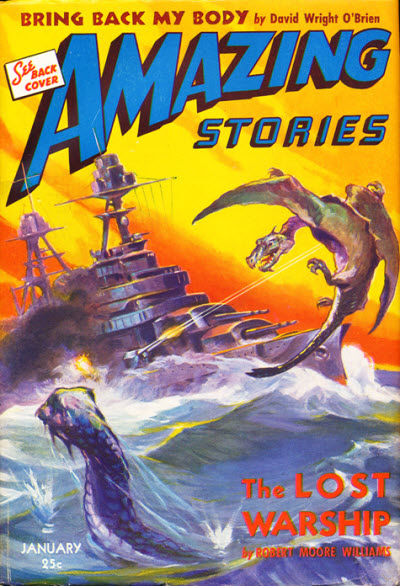
J. Allen St. John's work can be seen on the covers of the January and February 1943 issues of Amazing Stories.

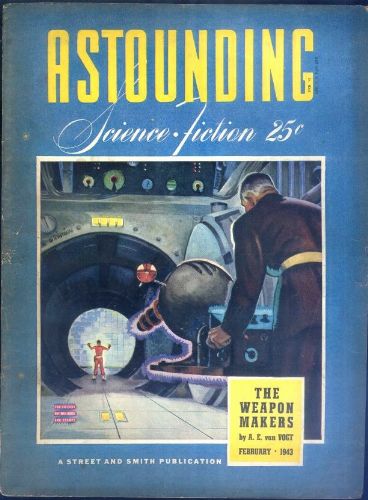
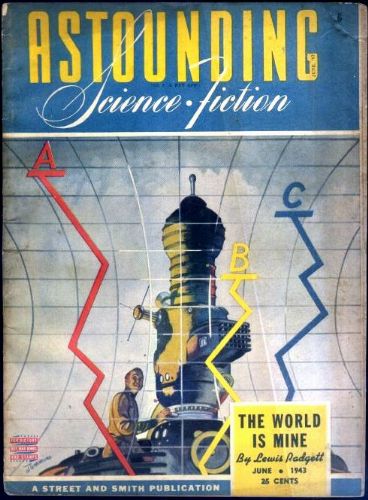
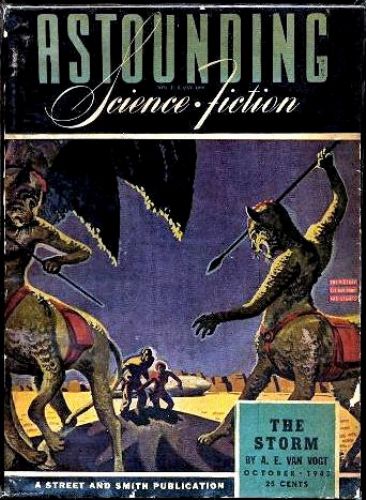
The art of William Timmins can be see on the covers of the February, June, and October 1943 issues of Astounding Science Fiction.

Fanzine and Fanwriter

FANAC.ORG is an amazing archive of fan stuff of yore. The people that run it created a portal page for fanzines from 1943 there, and there you will find links to scans of the finalists in both of the fan categories.

In case you can't remember, the best fanzine finalists are:
Fantasy News, editor William S. Sykora
Futurian War Digest, editor J. Michael Rosenblum
The Phantagraph, editor Donald A. Wollheim
Voice of the Imagi-Nation, editors Jack Erman (Forrest J Ackerman) & Morojo (Myrtle Douglas)
YHOS, editor Art Widner
Le Zombie, editor Wilson “Bob” Tucker 

The Best Fan Writer finalists are:
Forrest J. Ackerman
Morojo (Myrtle Douglas)
Jack Speer
Wilson “Bob” Tucker
Art Widner
Donald A. Wollheim
 
So there you go. With voting in the Hugos and Retro Hugos closing on 31 July, this does not leave much time to research your ballot.

In the meantime, here is another picture of my cat, with SF books in background:
More cat action

Sunday, July 07, 2019

Finding the 1944 Retro Hugo finalists online

Soon in Dublin the winners of this year's Hugo Awards will be revealed, including the winners of the Retro Hugo Awards for science fiction published in 1943. This year unfortunately there is no voters packet for the Retro Hugos. However most of the publications in which the finalists appeared are available on the Internet Archive, where they can be read online or downloaded by Hugo Award voters. See below for links to where the various works can be found. Voting closes at midnight on 31July, so get reading.

Novels

Conjure Wife by Fritz Leiber, Jr. can be found in the April 1943 issue of Unknown Worlds.

Earth’s Last Citadel by C.L. Moore and Henry Kuttner originally appeared in the April 1943 issue of Argosy, but it was subsequently reprinted in the July 1950 issue of Fantastic Novels.

Gather, Darkness! by Fritz Leiber, Jr. can be found serialised in the May, June and July 1943 issues of Astounding Science-Fiction.

Das Glasperlenspiel [The Glass Bead Game] by Hermann Hesse (originally published by Fretz & Wasmuth) is readily available from bookshops and libraries.

Perelandra by C.S. Lewis (originally published by John Lane, The Bodley Head) is also readily available from bookshops and libraries.

The Weapon Makers by A.E. van Vogt was serialised in the February, March and April 1943 issues of Astounding Science-Fiction.

Novellas

“Attitude” by Hal Clement appeared in the September 1943 issue of Astounding Science-Fiction.

“Clash by Night” by Lawrence O’Donnell (Henry Kuttner & C.L. Moore) appeared in the March 1943 issue of Astounding Science-Fiction.

“The Dream-Quest of Unknown Kadath” by H.P. Lovecraft originally appeared in the collection Beyond the Wall of Sleep from Arkham House and is now readily available from bookshops and libraries.

The Little Prince by Antoine de Saint-Exupéry was originally published by Reynal & Hitchcock and is available everywhere.

The Magic Bed-Knob; or, How to Become a Witch in Ten Easy Lessons by Mary Norton was originally published by Hyperion Press and can possibly be sourced from bookshops and libraries.

“We Print the Truth” by Anthony Boucher appeared in the December 1943 issue of Astounding Science-Fiction.

Novelette

“Citadel of Lost Ships” by Leigh Brackett appeared in the March 1943 issue of Planet Stories.

“The Halfling” by Leigh Brackett appeared in the February 1943 issue of Astonishing Stories.

“Mimsy Were the Borogoves” by Lewis Padgett (C.L. Moore & Henry Kuttner) appeared in the February 1943 issue of Astounding Science-Fiction.

“The Proud Robot” by Lewis Padgett (Henry Kuttner) appeared in the October issue of Astounding Science-Fiction.

“Symbiotica” by Eric Frank Russell also appeared in the October issue of Astounding Science-Fiction.

“Thieves’ House” by Fritz Leiber, Jr appeared in the February issue of Unknown Worlds.

Short Story

“Death Sentence” by Isaac Asimov appeared in the appeared in the November 1943 issue of Astounding Science-Fiction.

“Doorway into Time” by C.L. Moore appeared in the September 1943 issue of Famous Fantastic Mysteries.

“Exile” by Edmond Hamilton originally appeared in the May 1943 issue of Super Science Stories. That appears not to have been uploaded to the Internet Archive but the text of the story can be seen here and here.

“King of the Gray Spaces” (“R is for Rocket”) by Ray Bradbury appeared in the December 1943 issue of Famous Fantastic Mysteries.

“Q.U.R.,” by H.H. Holmes (Anthony Boucher) March 1943 issue of Astounding Science-Fiction.

“Yours Truly – Jack the Ripper” by Robert Bloch appeared in the July 1943 issue of Weird Tales.

I will do another post with links to where people can see some of the finalists in the other categories. In the meantime, Jeff Vandermeer once said that you should always include a picture of your cat in social media posts, so here is Billy Edwards.

more cats

Thursday, August 30, 2018

Worldcon comes to Dublin

Next year the World Science Fiction Convention is coming to Dublin. This is the first time Worldcon has taken place in Ireland, which makes this an exciting event. But what is this Worldcon? Well, Worldcon is a science fiction convention that takes place in a different city each year. The first Worldcon was in New York in 1939, taking its name from the World Fair of that year. After taking a few years off for the Second World War it has been running continuously since 1946. Worldcon moved outside the United States for the first time in 1948, when it took place in Toronto, and made its first trip away from North America in 1957 when the first London Worldcon took place.

The first Worldcon saw just 200 science fiction fans meet at the Caravan Hall in New York. Since then the event has expanded enormously. The 2017 Worldcon in Helsinki had an attendance of just under 6,000 while the 2016 Worldcon in Kansas City had some 4,600 people attending. There will most likely be numbers of that magnitude attending Worldcon next year in the Dublin Convention Centre.

The scale of a Worldcon can be stunning to a first time attendee and Dublin 2019 will be no different. There will be thousands of science fiction fans attending, loads and loads of authors and hundreds of multi-tracked programme items. Worldcon attendees will have a vast range of events to choose from, including panel discussions (which I think of as the real meat of the convention though others may disagree), film screenings, author interviews, readings & signings, presentations by academics (brainy people saying brainy things about science fiction and fantasy), art shows and so on. There will be dealers selling books and other items and places for attendees to eat, drink and hang out. Some people will be dressed up as their favourite characters and the Masquerade event will see the most spectacular costumes compete against each other.

A key event at any Worldcon is the Hugo Awards ceremony. The Hugos, named after early science fiction editor and publisher Hugo Gernsback, are voted by Worldcon members and are the most prestigious prizes in science fiction (do not listen to disgruntled winners of other awards who have yet to receive a Hugo). In Dublin, awards will be given for works published in 2018, which will include categories for novels, short novels, short stories, films, artworks, and other things, with both professional and fan works being honoured. The Dublin Worldcon is also taking up the option of awarding Hugos for items published in 1943, to make up for there being no Hugo Awards in 1944. If like me you are not great at keeping up with contemporary science fiction you might find you have read more of the works nominated for these Retro Hugos.

Unlike some other conventions, Worldcon has no Mr Big behind it raking in the $$$$s. Worldcon is fan-run, with a chair and organising committee that changes each year. People who attend buy membership rather than an admission ticket. In fact, apart from the guests of honour, everyone at Worldcon has bought their own membership. George R.R. Martin attends every Worldcon and is probably the biggest author of science fiction and fantasy in the world right now, but he pays more to attend than a first-time Worldcon attendee.

At time of writing, Worldcon membership is €110 for a first time attendee. That sounds like a lot, but for that you are in for the full five days of the convention and get to attend everything at it – there are no hidden extra charges. That will also get you the Hugo Awards voter packet (digital copies of all or most of the nominated works, depending on generosity of the rights holders), whose value can be considerable. It is possible to pay by instalments and there a fund to support people who would like to attend but are unable to afford to do so.

Worldcon membership is due to go up in September, so buy now at the lower rate while you can. However I understand that the price increase will be only incremental, so if you do not get round to buying membership until next week do not think that it will have increased drastically to a completely unaffordable level.

More information on the Dublin Worldcon can be found here, with it being possible to join this important event here. If you are still curious as to what goes on at a Worldcon then I have a sadly incomplete series of posts about the 2017 Helsinki Worldcon here.

I hope you decide to join us. If you have any interest in science fiction you will not want to miss this.

Monday, September 01, 2014

Loncon3 - I Was There

Being an account of my visit to the World Science Fiction Convention in London in which I describe various things I saw there and furthermore mention the controversies that surrounded the Hugo Awards of this year.
Police Box
This year the World Science Fiction Convention was held in London. As this was the third time this has happened, the event was known as Loncon 3. I was there. This was only the second science fiction convention I have ever been to. The last one was 20 years ago and had attendees in the hundreds while there was apparently something like 10,000 registered attendees of Loncon. Two things drew me to this event: my interest in science fiction and my curiosity as to what a big convention of this kind would be like.

The programme included screenings of films and SF TV episodes, performance of theatrical events, awards ceremonies, readings, book signings, talks and panel discussions. For me the talks and panel discussions were the heart of the convention, though the beauty of a large event like this is that attendees can make their own choices as to what they get up to… there probably were some attendees who spent the entire thing boozing in the Fan Village (which actually seems like a great idea, why did I not do this?).

The talks and panel discussions appealed to me because they presented at least the possibility of hearing interesting people putting across interesting ideas, almost like attending an academic conference (and many of the speakers were academics). Some of the discussions I went to were more interesting than others, such is life. Presentations by academics often turned out to be the best, simply because the format of letting the academic deliver a short paper allowed for a more structured exposition of ideas. With the talks generally it was often what they did not deal with that was most fascinating. I will do a separate post where I list all the talks I went to and make comments on them. The one big disappointment for me with the talks was the apparent cancellation of all the music related talks in the programme that I tried to go to.

The convention featured a surprising amount of theatre. I went to two things, an adaptation by Ruth Pe Palileo of The Anubis Gates by Tim Powers and The Cancellation and Re-imagining of Captain Tartan by David Wake. The Anubis Gates was performed by professional actors with high production values, while Captain Tartan seemed a bit rougher round the ages. The Anubis Gates was more like something you could imagine people paying real money to see in a proper theatre (if theatre-goers were inclined to see plays about time-travellers and body-swapping magicians). Captain Tartan was more fannish, in that it was about both science fiction and fandom rather than just having a science fiction or fantasy theme. I enjoyed them both, in different ways, and was sorry that I did not catch more of the convention's theatrical offerings.

There was a fair amount of film and TV stuff being shown at the con, which I largely avoided on the basis that I can see that kind of stuff anywhere. One thing I did go to was the 1950s BBC production of 1984, with Peter Cushing as Winston Smith. This was a great piece of work, capturing well the grotty war-damaged London of the book and the sense of everything being completely rubbish even aside from the in-your-face totalitarianism of Ingsoc. This production seemed to have every role played by the best possible actor for the part. The programme was made by the same team that produced the BBC Quatermass programmes and it made me very interested in tracking down the DVD compilation of those.

The other thing I saw was the first two episodes of The Changes, a cosy catastrophe story for older children based on the books by Peter Dickinson. In it people inexplicably turn violently against machines and technology, smashing up anything that seems even slightly modern. When I was small I was so frightened by the first episode that I had to stop watching half way through and made sure I would never see any of it again. Seeing the episodes now was like an exorcism for me. I could see why they would terrify the sensitive child I had once been but they no longer hold any fears for me. Definitely not.
Cosplayers
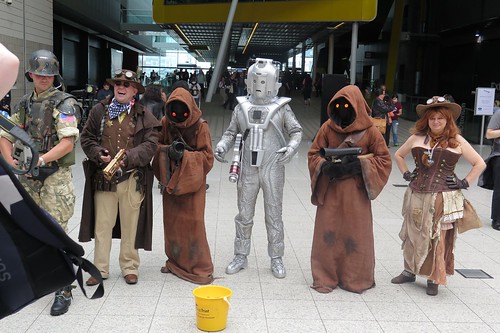
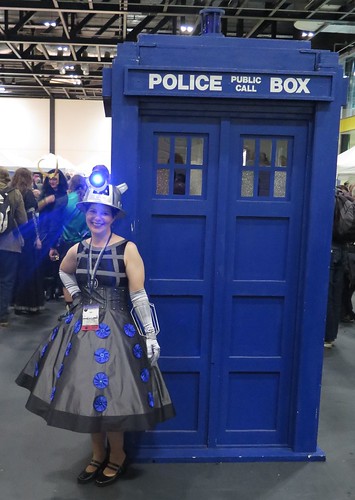
One thing non-SF fans associate with conventions is people dressing up in funny costumes. There was a bit of that at Loncon. I did not go to the Masquerade, a competition for cosplayers (as people who dress up in funny costumes are known), mainly because it threatened to go on for a lot longer than my interest in cosplay would last. But I did enjoy seeing people wandering around in costume. My favourites were probably Thor, Loki (played daringly by a woman, well I never etc.), the two Jawas (who had the actions and voices as well as the looks), or the woman who dressed as a Dalek and posed fetchingly beside the TARDIS (there was a TARDIS).
Dalek lady
A strand of the convention I should really have engaged with more were readings by authors. I stayed away from these partly because I do not know that many contemporary writers. I went to just one reading, randomly taking in a writer called Tobias Buckell who read an excerpt from a work in progress he billed as kind of a science fictional retelling of Treasure Island (one of those books I have never got round to reading). I found this work quite intriguing. I did wonder though whether someone like myself would be better off just reading Treasure Island, while someone who had read Treasure Island would not really see the point of reading a new version of the story. Mr Buckell did seem to be doing more with the transition than adding the word "space" before "ship" wherever it appeared or turning cutlasses into "laser cutlasses" and so on. I did like the wreck-tech aspect of the excerpt and will be curious to see how he progresses with it.
Passing for Retro
Loncon also featured awards ceremonies for the Hugos and Retro Hugos. I did not vote in either competition and have not yet read the items sent to me in my voter pack (though I did try to nominate things in each, notably Upstream Color, which failed to secure enough votes to be nominated for best dramatic work in the Hugos #fraudatthepolls). The Retro Hugos were for works written in 1938. This event was on the first night of the convention and was hosted by Mary Robinette Kowal and Rob Shearman. The event was done as though it was actually taking place in 1939, complete with a live swing band with which Ms Kowal sang a big number (a song called 'Retro Hugos', to the tune of 'Anything Goes', my only exposure to Filk at the entire convention). Orson Welles' War of the Worlds had been nominated for an award and they turned the awards ceremony partly into a pastiche of that radio play, with cuts off to worried correspondents reporting on a Martian invasion (that ended with the Martians dying and their war machines being mistaken for the disused cranes lurking outside the conference centre).
Oolaa
Fewer people voted in the Retro Hugos than in the real Hugos, probably because people who like SF look forward rather than backward. But the Retro Hugos were probably of more interest to me, because I had at least heard of things that were nominated for it. I was pleased to see Welles' War of the Worlds win; having listened to it for the first time recently I can confirm that it is a stunning piece of work. It was also nice to see T.H. White's The Sword in the Stone collect an award; maybe it is time I went back and re-read that much-loved book of my childhood.

The real Hugos this year were marked by Controversy. The first controversy I became aware of was that over who was going to present the awards. Earlier this year it was announced that Jonathan Ross was going to be the master of ceremonies. But then the Unpleasantness ensued, with many people getting very angry about Mr Ross being chosen, mainly out of a fear that he would leer at female award winners or make unkind comments about their appearance. As you know, the controversy forced Mr Ross to step down as the Hugos' host. In retrospect, my feeling is that the anti-Ross people over-reacted terribly and may even have made fools of themselves, though I do have some sympathy for their concerns. But the whole business is over now, as is customary with the past.

The Unpleasantness meant that at a late stage the Hugos were without hosts. It may also have made it very difficult to attract new hosts, as any prospective candidate would have feared an eruption of Twitter outrage once their selection was announced (I gather this forced Robin Thicke and Roy "Chubby" Brown to decline invitations). But in the end the event was hosted by Geoff Ryman and Justina Robson, who were so good at it that I feel bad even mentioning the Unpleasantness again here.
The Bone Chair from "Use of Weapons"
The other Hugos controversy was something I only started hearing about at Loncon itself. Apparently some grumpy people had become angry that SF fandom has been taken over by pinko feminist leftists and they decided to try and get some writers of true blue fiction onto the ballot. An organised campaign grew legs and writing by some rightwing authors was nominated in several categories. As I heard this I assumed that by rightwing, what was meant was Ayn Rand inspired libertarian bollocks, but I started hearing that in some cases we were talking about borderline far right stuff; apparently one of the nominees has been known to refer to black women as "subhuman" (though I did not hear him say this myself).

The main organiser of this rightwing slate for some reason started referring to his gang as the Sad Puppies, which must have been very upsetting to the world's many leftist puppies. My only knowledge of all this is what I heard at the convention, but the Sad Puppy people seem to have made odd choices as what they wanted to push onto the ballot. As well as fairly respectable militaristic SF (one of those genres largely beloved of neanderthals, I fear, but such neanderthals are not necessarily racists or far right gobshites), the Sad Puppy people did rather dirty their bib by arranging for the nomination of the (alleged) racist bloke. They also seem to have had to scrape the bottom of the SF barrel to find material to nominate, as in one category they had to put forward a piece of war game tie-in fiction, whose author was probably bemused at finding himself up for a Hugo.

As someone who loves chaos I was secretly hoping that the far-right guy would win an award. I imagined him sweeping up to the podium while the Imperial March played, flanked by supporters in SS uniforms, there to receive his prize and present a speech in which he thanked all born men of Aryan stock for rallying to the cause of science fictional racial hygiene. But the liberal elite who run SF fandom ensured that this did not happen and the rightwingers were drubbed out of it in all their categories. This must have made the Sad Puppies especially sad. As previously mentioned, I am very behind the curve with contemporary SF, so I knew next to none of the winning authors. I was pleased to see that Retro Hugos host Mary Robinette Kowal won in the best novelette category, but mainly because her hosting those awards had made her familiar to me.

The one bit of actual controversy at the awards ceremony was provided by Kameron Hurley, who won two awards for fan writing. I gathered from things said at the convention that she had written a piece called "We have always fought", in which llamas become a metaphor for something to do with women and gender (I have not yet read this piece myself). Ms Hurley was not present to accept her awards, but she wrote acceptance speeches delivered on her behalf by others. These speeches seemed rather combative and almost to be insulting of the Hugo Awards ceremony attendees, who were after all the people who had voted to give her the awards. I thought this a bit churlish. It contrasted with the speech given by John Chu when accepting an award for best short story; he came across as another outsider figure but one pleased at having overcome obstacles to break through rather than using the occasion to berate his audience.
"We have hanky but no panky"
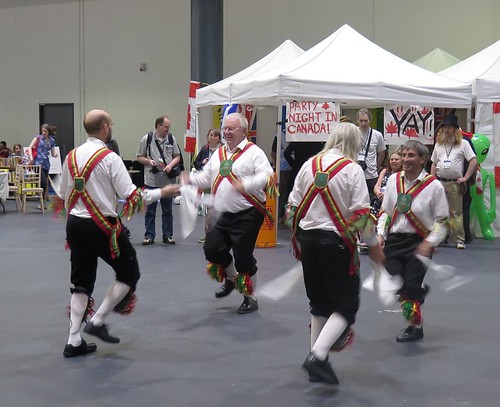
I should also mention the Chingford Morris Men (some of whom were women). I am guessing they were here to show foreign visitors a bit of traditional English culture. I love morris dancing and was very pleased to see them.
TARDIS and Robot
One final thing to mention was the other attendees. They ranged in ages from people who looked quite young to ones who have probably been going to these conventions for many many years. There were far less blokes wandering around with rucksacks than I expected. Like most things I go to, the attendees were pretty white looking. The gender balance was less skewed than might have been expected. The most amazing attendee for me was this guy who was physically at a robotics conference in the USA but was using a remote controlled robot to attend the conference.

So that really is that. I found the whole event very enjoyable and stimulating of further interest in the great literature of ideas that is science fiction. I also found myself thinking that I should really start engaging with fandom and going to conventions and stuff like that. Maybe one day I will even travel to another Worldcon happening far away in the USA or somewhere. I also note with interest that there is a bid in for Dublin to host Worldcon in 2019, which would be held in the Convention Centre. If the Dublin bid wins then this will be an event of great excitement.
Convention Centre

More of my Loncon pictures

More Loncon pictures, mostly not by me

Puppies (University of St. Andrews)

Worldcon 2015 (Sasquan. In Spokane)

Dublin 2019 Worldcon bid

Loads of other Loncon reviews