Friday, August 16, 2013

The Lion-Dog of China

Visitors to a Louhe city zoo in China's Henan province were looking into the cage labelled "African lion", perhaps thinking the beast inside was smaller than expected, when the animal astonished them by making a noise. However, instead of making a majestic roar, the cage's occupant let out a bark. Investigations revealed that it was not actually a lion, but a Tibetan mastiff, a large and hairy breed of dog, whose head hair could perhaps be mistaken for a lion's mane if you had only ever read descriptions of that fearsome feline's proud coiffure. The zoo's lion had been taken away to a breeding facility and the mastiff placed in its cage because of "safety concerns".

Elsewhere in the zoo, another dog was in an enclosure labelled as a wolf, while a leopard's cage was found to contain a fox.

For all that this is basically being presented as a comedy story, the grim-looking cage shown in the picture, coupled with the falling apart sign, suggests to me that this is one of those zoos based on earning a quick buck from animal cruelty. I hope it is shut down and its inmates moved somewhere nicer, released back into the wild (where appropriate), or else humanely killed.

More

An inuit panda production

Daft Punk "Random Access Memories" (2013) - a preliminary non-review

I bought this with a record token for Golden Discs that my sister gave me - yes, readers, Golden Discs still exists. I have listened to the whole record a bit and need to do so more to form a considered opinion. 'Get Lucky' I have already listened to a lot on my iPod. You have probably heard this too. I like its yearning vocals and its Nile Rogers guitars and feel that it will go down as the emblematic tune of 2013 even for people who hate it (kind of like the way 'Crazy in Love' was in whatever year it came out).

That said, I can see why 'Get Lucky' and the album as a whole is being seen as problematic in some quarters. Random Access Memories seems like little more than a pastiche of music from the past rather than any attempt to make anything new or contemporary. When the past music you are pastiching is disco (as opposed to, say, 1980s softie metal) this is not an entirely bad thing. Nevertheless, it lays bare how the creative well has run dry, leaving today's musicians unable to do anything but endlessly recycle the past.

There may be people in the world who have never heard 'Get Lucky'.


An inuit panda production

Thursday, August 15, 2013

New small but fierce animal discovered in Ecuador

Scientists have discovered a new fierce little animal living in Ecuador. It is the Olinguito, described by the Guardian as "a cross between a teddy bear and a house cat". The odd thing about these fellows is that they were not unknown to science - specimens have been exhibited in museums and a female Olinguito called Ringerl spent many years living in the zoo system of the United States. But scientists had previously mixed up the Olinguito with the Olingo, an entirely different animal (which explains why zoos were unable to persuade Ringerl to breed, as they kept trying to mate her with Olingos).

The Olinguito is classed as a carnivore, meaning that it belongs to the order Carnivora with dogs, bears, lions, cats and other fierce animals. However, Olinguitos primarily eat fruit, though they are still very fierce for their size.

More

An inuit panda production

Tuesday, August 13, 2013

Live Music: White Hills / Twinkranes

I mentioned that I went to see the popular film Good Vibrations. When I left the cinema, I found myself brimming over with fondness for the world of live music, so I decided to go and see the a concert that night by White Hills and Twinkranes. This was in the Grand Social. And I went alone - that's how crazy for rock and roll I am.

Twinkranes are a local band. They used to comprise two members of a previous band called The Transformers, who may have been made up by advertisers to sell some kind of product and were most famous for having funny haircuts. This time round they had lost one of the funny haircut people and now were a two piece, comprising the blond haired guy who I kind of think of as Mr Twinkranes and another guy who lacked a distinctive coiffure. The blond guy played drums and did vocals while the other fellow did stuff with what looked like pretty old-school synthesisers. The music they make is interesting, treading a strange line between avant garde nonsense and impressive musoiness. By the end of their set I found myself thinking I should make the effort to see them again sometime and perhaps even check out their album on Finders Keepers.

White Hills are a three piece - a guy on drums, another guy on guitar and lead vocals and a woman on bass. The bassist has a slightly "hello sailor!" quality to her attire, wearing a fetching red suit with a rather short skirt and high red boots, while the guitarist looks like he might have wandered in from the set of a Tolkien adaptation. Their music is of the "yeow!" variety, so they serve up lots of psych-rocky stuff to us. They are pretty good and they do rock hard (particularly the lady bassist) but I ended up thinking that maybe they are only pretty good and not the truly amazing live band they aspire to be.

White Panda

An inuit panda production

Sunday, August 11, 2013

Hunters Moon 2012

What's this, you say? Well readers, I am finally having a crack at writing some kind of review of the Hunters Moon festival of October 2012, because the tickets for 2013 are now on sale and writing about last year's might just help to drum up some interest. I am writing this in a rush, so everything is a bit sketchy, but maybe some interest will be found.

As you will recall, this festival takes place in the small town of Carrick on Shannon, a conveniently short train journey away from Dublin. Carrick is in Leitrim, a county to which many artistic types have decamped over the years. I like to think of Hunters Moon as their festival. It typically combines music and stuff to do wit the visual arts, with performances taking place in the Courthouse arts venue and also in an olde church and, this year, in a couple of coffee shops around the town.

Many of the people who had played at the 2011 Hunters Moon also played at this one. But in some of these cases, they were startlingly different, or else my opinions of them had somehow undergone a radical metamorphosis. So, Jennifer Walshe performed this year, not alone but with Ludo Mich, an old Belgian fellow who is a surviving veteran of the Fluxus art movement. You may recall that I have previously failed to enjoy Jennifer Walshe performances, but this was completely brilliant in a hard to describe way. Mich and Walshe were doing voice work, and their performance was like some kind of strange non-verbal dialogue. At times it was like Walshe was some kind of sorcerer and Mich an unruly demon being summoned and bid to work. Or maybe they were meant to be something else, but there was a lot of her holding a hand forth at him and gibbering while he gibbered in a different way and tried to break free of her spell. If that description is not very helpful then I must ask you to take my word that their performance was awesome.

As with 2011, it turned out that the mad for it weirdoes wandering around all weekend at the festival were in fact members of GNOD, who are a music group from somewhere in England. Their appearance seems a bit different this year, which matches their complete change in musical nature. In 2011 they were like a psych rock freak-out band, but this time they had ditched all the rock instruments and gone electronic. So they were more like a techno dance act of yore, only still with an acid rock freak out mindset. There were three of them on the music (and it was interesting to try and work out which of them were the least mad for it and so the most responsible for the music) and one lad on vocals, which again seemed to be of a largely non-verbal nature.

GNOD combined their set with amazing projected visuals of the conspiracy theory nutter variety (New World Order, Illuminati, Secret Chiefs, Orchestrated Money Crash, Freemason breeding programme, Zeta Reticulii Greys, etc. etc.). I love conspiracy theory nonsense, even though I do not believe it (apart from things that have been objectively proven, like the sinister role played in the world financial system by the Knights of Columbanus). So I found the visuals a great foil to the dance-tastic music, though I understand that some who are less open to THE TRUTH found them a bit challenging.

In fairness, I should add that there was one element to the crazy conspiracy stuff with which I was somewhat uncomfortable. Basically, it did seem like they were leaning a bit close to going on about evil Jewish financiers rather than evil financiers generally, and we all know where that kind of talk leads.

Some other interesting acts included the following.

Josephine Foster played in the St. George's Church venue, backed by a small band that included that drummer guy from Trembling Bells (seen by me some years ago supporting the Unthanks). They seemed to suffer a bit from the acoustics in the church not being ideal for rock instrumentation but I am not one of those people who worry about such things. For me the focus here was really on Foster herself, and it was this performance that formed my impression of her as someone who both is very serious and calculated at what she does while being somewhat reserved and possibly uncomfortable as a live performer. For all that she threw herself into her performance, she retained a certain austere detachment. The music itself was of the broadly folk-rock variety, with the tunes designed to give free rein to her soaring voice. And yet there is a loose, sinuous quality to the music that makes it more than just filler. Writing this makes me glad that I will be seeing her later this week when she plays with The Swans.

Melodica Deathship are an Irish hip-hop duo. Wait, come back! I think possibly one of them (the rapper) is actually American, but even if he was not they would still be fascinating. Their thing is that they make doomy nautical themed music that some have dubbed ship-hop. The songs all seem to be about haunted ships, murderous pirates, people cast adrift on rafts with no hope of rescue, and so on. And they play melodicas. You could imagine them making a concept album based on the Black Freighter from Watchmen. Their set accompanied by some great visuals that may have included particularly doomy images from the film of Moby Dick. They also sampled vocals from a decades old tune from Irish folk-rockers Mellow Candle, which seemed to amuse Alison O'Donnell of that band, who was herself performing at the festival.

Tarracoir
Tarracóir were billed as 'death metal jazz', though they seemed to be more freak out rock than anything else. There were three of them, and they played unbelievably loud music in a tiny café in the middle of the afternoon. It would have been great if some old dear had come in to for a nice cup of tea only to be blasted out by them, but sadly the place was filled with festival heads who all enjoyed things greatly.

Tomuttonttu is apparently the main guy from Finnish superstars Kemialliset Ystavat and may also be the fellow who runs Fonal Records. In today's guise he was largely providing us with full on electronic dance music while presenting us with a series of comedically clichéd visual images of Finland - snow, reindeers, Moomins, people wandering around in the nip, etc.

FIRETOP!
Wizards of Firetop Mountain are that great Irish post-ironic rock band. This time they played to the visual accompaniment of Hot Chick Stoner Barbecue (in which some biker ladies describe how to safely prepare a tasty barbecue while stoned on drøgs). The Wizards continue to rock hard and I hope that one day they will release a record of some sort that people can buy.

We did have a bit of a look at some of the experimental film stuff, which was of variable quality. One piece I saw seemed to be a series of very low quality images of people in the past being miserable. I made my excuses and left. Later, however, I read about its bizarre genesis in the programme and saw it again with more enjoyment. The film was called The Poorhouse Revisited, directed by Michael Higgins. All the footage, however, came from film rushes from an earlier film he found abandoned and decaying in Ringsend. The rushes were from an earlier RTÉ drama directed by Frank Stapleton and adapted from a short story by Michael Harding set during the Famine. The film stock found was apparently a load of outtakes, camera tests, and the like. With that back-story to its origin I could forgive the final film its poor visual quality and lack of any discernible narrative. Instead the decaying images seemed to evoke the horror and despair of that dark time in Irish history.

But for all that watching films about the Famine, I did not go hungry, eating take-out pizza from a restaurant in the town that made a most delicious product.

There were many other exciting people and things at the festival. And there was a noticeable lack of wankers in the audience, making this somewhat unique among Irish festivals.

It was recently announced that the 2013 festival will be taking place on the 25th to 27th of October - perhaps I will see you there? I think the "big draw" this year is Rhys Chatham, though I suspect and hope that all the Hunters Moon regulars will show up again. Further details are available at http://huntersmoonfestival.com/ .

links:

My experiences at the 2011 Hunters Moon: Part 1, 2, and 3

Hot Chick Stoner Barbecue (trigger warning: meat)

The Poorhouse Revisited

more amazing pictures (not including cat picture)

When I saw Kemialliset Ystävät

Hunters Moon store - where you can buy a copy of the Hunters Moon Drome Dome CD, making that cat somewhat happy.

An inuit panda production

The Sad History of King Henry VI

I went to York. I went to see plays. The people that run Shakespeare's Globe in London were touring performances of Shakespeare's three Henry VI plays to places in England that are significant to the action within them (including to some of the battlefield sites). York is significant because one of the big battles takes place near to it, with the loser's head ending up stuck on a pole over the city walls.

Although the plays are known to us now as Henry VI Parts 1, 2 and 3, they were not written in that order and were not conceived as a trilogy. And they were only given those titles retrospectively by some posthumous publisher of Shakespeare's plays. It seems that our Parts 2 and 3 were performed first, with titles something like The Houses of York and Lancaster and The True Tragedy of the Duke of York. Our Part 1 was written later, as Harry the Sixth, for a different theatre company, to tell the early years of the reign of Henry VI (who ascended the throne as a young child on the early death of his father). This makes it one of history's first prequels, with all that that implies.

The first play is mainly about the loss of the English empire in France as bickering nobles fail to assist the brave fighters there against the treacherous Frenchies, who have managed to enlist the aid of one Joan de la Pucelle, a young woman in league with satanic forces. The play has great bits in it (the Joan of Arc scenes, the heroic English fighters in France who are blatantly maniacal nutters, a worldly bishop, a scene where it is ponderously explained to Richard of York that he is actually the rightful king of England, etc.) but it seems to be one of those plays were loads of things happen without there being any real narrative thread. Strangely, this seems to have been the most popular of the three plays back in Shakespeare's time, with the story of the loss of the French empire and the death of heroic figures like Talbot (a blood-crazed thug) having audiences weeping in the aisles.

In the second play, the feuding of the English nobles explodes into vendetta and then open conflict. Richard of York stakes a claim for the throne, backed by some powerful nobles. He also has his sons behind him, with the thrill power ramping up considerably once this trio of badasses appears. He is opposed not so much by the King, a saintly figure a bit too prone to simpering, but by the King's wife and various other nobles. They all lay into each other in a series of battles. York, an ambiguous figure, also causes trouble by inciting a mob of revolting peasants to descend on London and murder anyone who can read, Khmer Rouge style.

It all turns into a bit of a bloodbath, with various nobles murdering each other and then being murdered themselves by their victims' friends and relations. One of the grimmer scenes is the one in which Richard of York is humiliated and tortured by the Queen and her associates, before being beheaded (it was his head that ended up on a stake on York's' walls, over a guardhouse near to where I was staying).
Gate

By the end, Richard of York's son Edward is reigning as King Edward IV, largely because everyone else is dead. Well, his two shifty brothers are still alive but one of them has changed sides so often that no one could take him seriously. And the other (Richard Jr, Duke of Gloucester) - well he is a deformed hunchback so there is no way he could be plotting to engineer everyone's death so that he can become king, right? So all is well, kind of like at the end of a game of Family Business when peace reigns because the graveyard is full.

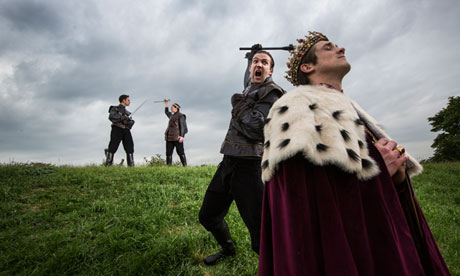
The portrayal of Gloucester, the future King Richard III, was interesting. In the Globe last year I saw a performance of Richard III, the play that depicts his final rise to the throne and brief but bloody reign. Mark Rylance played the part of this great Shakespearean villain in a manner reminiscent of Derek Jacobi in I, Claudius, someone using physical disability as a mask, in this case to hide his lust for power. In the last two parts of Henry VI, Simon Harrison plays the younger character as a creature of pure malevolence. To a modern viewer, however, the continuous jibes he receives about his twisted form are strikingly unpleasant.

With our more enlightened views of such matters, it seems hardly surprising that someone subjected to such abuse would develop a warped character and a general hostility to the human race. I think perhaps this is what makes Shakespeare's character oddly sympathetic to modern viewers. He is a violent and malevolent creature, to be sure, but with a modern mindset we can see him as made like that by society rather than cruel fate. And with the hostility he has had to endure from his fellows on account of his form, he makes for a perfect outsider anti-hero.

If you have ever been to the Globe in London you will know that music is a big part of the way their plays are presented, with musicians playing before the performance starts and then accompanying the dance of the actors that happens at the end. With these performances the music was a bit stripped down, perhaps because it was a cut-price touring production. Any music in the play was made by the actors themselves. This was either percussive (good for the military stuff) or made by scraping the edge of something to create strange disconcerting droning sounds. The latter in particular sounded almost electronic. Perhaps because the plays were being performed over one day, making them seem like one monster play, they left the actors' dance to the very end.

These plays are on over the summer in a number of places, including back in London. I encourage you to see them, ideally all in one day for the fully immersive experience. If that sounds like too much, you could skip Harry VI, and if you reckoned one would be enough then I say to make that one The True Tragedy of the Duke of York.

Seeing these plays has also got me thinking about other theatre marathons that would appeal to me. One thing I would love would be if someone could stage all eight of the Plantagenet plays (dealing with the reigns of Richard II, Henry IV, Henry V, Henry VI and Richard III) over, say, four days with two plays a day. Another obvious one would be the Oresteia of Aeschylus, the only surviving trilogy of plays from ancient Greece. That one deals with a terrible cycle of murder and vengeance within the kind of dysfunctional family that is so common in Greek tragedy. A performance of all these plays in one go would make for a fascinating theatrical experience.

Links:

These plays are being performed in the Globe and around England and Northern Ireland, sometimes in places of relevance to the occurrences depicted, including battlefield sites. See if they are playing near you here.

Shakespeare on the battlefield: the Globe theatre step out - a piece in the Guardian on the battlefield staging of these plays, with particular reference to Towton, the bloodiest battle ever fought in England. The illustration of Henry VI and the three sons of the Duke of York are sourced from here.

More pictures of York

An inuit panda production

Saturday, August 10, 2013

The Cramps "Songs The Lord Taught Us" (1980)

My beloved picked this up in London. And it is amazing in a way that would be unimaginable for any band now. As you probably know, the Cramps were this American band fronted by a couple with the delightful names of Lux Interior and Poison Ivy. Mr Interior sang and Ms Ivy played guitar and their songs were inspired by 1960s punk and rockabilly from whenever rockabilly comes from. Like Creedence Clearwater Revival, they were self-consciously retro, aiming to curate the music of the past, but they have managed to accidentally transcend their influences and become their own thing. So I would far rather listen to a Cramps record than a vintage rockabilly compilation.


The tracks are fast and slow and boast throbbing drum lines and buzzing cuts of guitar over which Mr Interior yelps and moans. They really do not make this kind of stuff any more and if you are one of those people who has never got round to exploring the magic of the Cramps then this would be a great place to start.

LATER: I was giving the record another listen when a bonus track featuring studio argy bargy came on - and I discovered that on one track popular Twitter sensation @mysmugcat seems to have travelled back in time to say his name repeatedly in the background.

Image source

An inuit panda production

Wednesday, August 07, 2013

D is for Dengue Fever

Dengue Fever are one of those bands I was fascinated by long before I actually heard anything by them. You may recall that I developed an interest in the music of Cambodia from before the rule of the Khmer Rouge, largely through one article I read in a magazine somewhere and then a Sublime Frequencies record called Cambodian Cassette Archives. It was then fascinating to learn that there was this band Dengue Fever out there who were playing this music again and I yearned to see them live and hear their records. And eventually I did.

The story of Dengue Fever is that they were formed originally by two brothers, Ethan and Zac Holtzman, who had become fascinated by Khmer Pop. In LA's Little Phnom Penh they found Chhom Nimol, an amazingly voiced star of the local karaoke scene, and so they recruited her and a load of other talented musicians into the band.

Their first album sees Ms Nimol singing covers of Cambodian classics largely unheard of in the west at the time - tunes originally sung by the likes of Ros Sereysothea or Pan Ron. On one or two tracks Ethan Holtzman lends his voice to a song by Sinn Sisamouth, the male legend of Khmer Pop. The vocals are all in Cambodian (or Khmer, or whatever language they speak out there), though the song titles are translated. The musical accompaniment is a bit more surfed up than the vintage recordings would have been (though not as much as you might think - the 1970s singers would often have been accompanied by local beat groups).

There are a couple of stone-cold classics on this. 'I'm Sixteen' is a floor-filler with a degree of call response between Nimol's lead vocals and Ethan Holtzman's backing. 'Shave Your Beard' has me wondering if the lyrics may be new, as the title would seem to reference Ethan Holtzman's amazing facial hair, but it is a slower and more contemplative tune than the floor fillers seen elsewhere. There are many other great tracks here, but the real winner for me is 'New Year's Eve', which starts slow and then turns into an irresistible explosion of frenetic energy. When I saw them live in London they saved this one till very late in their set, and the place erupted when the switch happens. To hear it is to love it.


There is also, for no obvious reason, a track called 'Ethanopium' that is basically an instrumental cover of 'Yègellé Tezeta' by Mulatu Astatqé. I guess the Holtzman's world music interests must run widely.

Links:

My review of the Cambodian Cassette Archives record

album cover image source

An inuit panda production

Sunday, August 04, 2013

Two More Sea Shanty Records

The Keelers Tyne & Tyde (2013)
Johnny Collins, Dave Webber & Pete Watkinson Songs of the Sea: a Collection of Sea Shanties (1998)

Avast there mateys, the bosun has ye well shanghaied for more shanty action.

I have previously mentioned going to see the Keelers supporting the Unthanks playing out in Bray. There my beloved bought a copy of their record Tyne & Tyde. The line-up is the same as that of Farewell to the Master but the instrumentation is a bit different - as in there is any. This time some of the songs feature concertina, whistle and tambourine, but it is mostly still just vocal.

The stand-out tracks on this are probably the same ones I mention in the live concert review. 'Old Billy Blue' (an original composition by the Keelers' Peter Wood) tells the story of Admiral William Cornwallis, who commanded the British fleet blockading Brest during the Napoleon Wars. He was so good at doing this that he acquired two nicknames - OId Billy Blue and Billy Go Tight. The song tells of how he could never be got away from his station and of how other admirals would always link up with them if they had mislaid a French high-seas fleet. It has this great chorus:

He's Old Billy Blue and he's Billy Go Tight.
He's always on station by day and by night.
What do admirals do when bitterly pressed?
They fall back on Cornwallis at Brest.


I find it hard not to join in with this one.

The other corker is a tune by one Mike O'Connor called 'Carrying Nelson Home', in which Nelson is being carried home after Trafalgar (he was killed there by a French sniper; I have always wondered whether the sniper survived the battle). The song imagines Nelson in his bucket of rum still giving orders to the sailors on his last voyage home, and is very poignant, for all that Nelson is not my national hero.

The other tunes are not entirely nautical, including ones about building railways (the trad. arr. tune 'New Railroad'), emigration and nostalgia ('Black and White') and that universal theme, lusting after the daughters of pub landlords ('The Landlord's Daughter', not the tune from The Wicker Man). George Unthanks' 'Tar Barrel in Dale' also makes its way onto record, so if you want to be extra ready for joining-in at an Unthanks concert then buy this album.

I should also menton the production on Tyne & Tide. Shanty records generally sound like they had no production at all on them and they are not obviously the worse for it. This one, though, was produced by Adrian McNally (Rachel Unthank's husband and the Unthanks' keyboardist). The production is great - it was recorded in a church and makes great use of the place's acoustics to give us a most atmospheric sound. And at no point does Mr McNally go down the bad producer's road of deciding to add in a bit of piano or Hammond organ to songs that are best left as unadorned as possible. But it still sounds produced, and produced well, thanks to the adroit sound engineering and sue of the sound qualities of the recording venue.

Songs of the Sea (by Johnny Collins, Dave Webber and Pete Watkinson) is a record I have had for ages, but my sudden burst of shanty interest caused me to dig it out and add it to iTunes. It is a somewhat un-curated collection, barely naming the artists involved and providing little or no supporting information. I had rather assumed that it was a collection of tunes sung by fairly anonymous singers. But not so. While using Google to spell-check the name of Jim Mageean from the Keelers, I found a YouTube recording of a young Mageean singing with Johnny Collins of this record in a context suggesting that Collins is someone known for knowing his shanties (and if Mageean is deferring to him then this really must be the case).

The record features more hot shanty action, mostly or entirely without instrumentation. 'Blood Red Roses' makes its obligatory appearance, but what is most striking to me now is the closer - the 'Farewell Shanty', a tune about sailors getting ready to sail away, and a tune that I remember from the last session at the Unthanks singing weekend.

Some links:

The Keelers and the Unthanks live in Bray

Tyne and Tide image source

Wikipedia page for the late Johnny Collins

Thursday, August 01, 2013

Two Sea Shanty Records

The Keelers Farewell to the Master (1993)
v/a Sailors' Songs and Sea Shanties (2004)

Ahoy there shipmates! Cast off and join me aboard the good ship Shanty. Little Jim the cabin boy is ready to make you right welcome. So splice the mainbrace, cut loose the port sheet, and up the lanyard for the masted doubloon.

I have always had some interest in sea shanties and songs of the sea, but going to the Unthanks singing weekend in January pushed into overdrive. As you will recall, Jim Mageean of the Keelers introduced us to a load of nautical tunes, both work songs and songs that seemed more like the kind of thing sailors would sing for entertainment. There were CDs being sold as we were leaving the weekend, so I picked up a copy of Farewell to the Master, an album of shanties presented as a tribute to one Stan Hugill, an old sailor who collected shanties during his many years at sea and was the last living shanty man of the Royal Navy. It begins with a tune composed by Alan Fitzsimons of the Keelers specifically to honour Mr Hugill, before launching into a succession of shanties sun acapella. They are here grouped by type, with halyard shanties followed by cotton trade shanties, maindeck capstan shanties, pump shanties, and so on.

One recording decision listeners might or might not take issue with is the grouping together in single tracks of several different tunes - so the halyard shanties track goes on for over 8 minutes and features all three of 'Shin-O', 'Tiddy High-O' and 'Blood Red Roses', the last a song that by law must appear on all shanty records. This grouping business does not bother me while listening to the record but it might annoy me in the future if I wanted to include anything from here on an end of year compilation.

Some of the songs feature lyrics that are a bit ribald. I get the feeling that some of the sailors in the songs have intentions towards ladyfolk that are not entirely honourable.

In Edinburgh we went record shopping and found in Fopp a couple of old sea shanty records. Rationing myself, I went just for a collection called Sailors' Songs & Sea Shanties: A Classic Collection of Sea Songs and Shanties. This features songs sung by A.L. Lloyd, Stan Kelly, Ewan MacColl and some others. There are sleevenotes describing the history of the songs and explaining nautical terms and the like, but there is nothing saying when they were recorded, which is a bit annoying.

Unlike the Keelers record, this does feature instrumental accompaniment, generally of the squeezebox type. It ends up being a bit reminiscent of the music in Bagpuss, which is not surprising given the folkie chops of that programme's musicians.

Two songs stand out on this for me. First of all there is 'Away Haul Away', sung by Stan Kelly, which sounds like a tune the musical family of one of my mother's friends used to sing. Another is 'Do Me Anna', sung by A.L. Lloyd. On one level this is another saucy sailor song in which a sailor impersonates a rich townie in order to shag his lady friend (something that in our politically correct era would get you sent to jail and put on the sex offenders register for life), but what makes it appeal to me is the mournful and almost otherworldly tone of the piece - it keeps sounding like it is about to turn into a ghost story or some such, even though it never does. Perhaps it needs new lyrics.

Links:

Sailors' Songs & Sea Shanties (an interesting website on this record)

Stan Hugill

Farewell to the Master cover image source (with opportunity to buy this record)

Keep coming back to Inuit Panda for more shanty action soon!