Being an account of my visit to the World Science Fiction Convention in London in which I describe various things I saw there and furthermore mention the controversies that surrounded the Hugo Awards of this year.
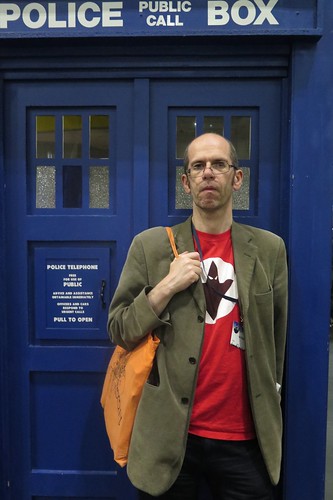
This year the World Science Fiction Convention was held in London. As this was the third time this has happened, the event was known as Loncon 3. I was there. This was only the second science fiction convention I have ever been to. The last one was 20 years ago and had attendees in the hundreds while there was apparently something like 10,000 registered attendees of Loncon. Two things drew me to this event: my interest in science fiction and my curiosity as to what a big convention of this kind would be like.
The programme included screenings of films and SF TV episodes, performance of theatrical events, awards ceremonies, readings, book signings, talks and panel discussions. For me the talks and panel discussions were the heart of the convention, though the beauty of a large event like this is that attendees can make their own choices as to what they get up to… there probably were some attendees who spent the entire thing boozing in the Fan Village (which actually seems like a great idea, why did I not do this?).
The talks and panel discussions appealed to me because they presented at least the possibility of hearing interesting people putting across interesting ideas, almost like attending an academic conference (and many of the speakers were academics). Some of the discussions I went to were more interesting than others, such is life. Presentations by academics often turned out to be the best, simply because the format of letting the academic deliver a short paper allowed for a more structured exposition of ideas. With the talks generally it was often what they did not deal with that was most fascinating. I will do a separate post where I list all the talks I went to and make comments on them. The one big disappointment for me with the talks was the apparent cancellation of all the music related talks in the programme that I tried to go to.
The convention featured a surprising amount of theatre. I went to two things, an adaptation by Ruth Pe Palileo of
The Anubis Gates by Tim Powers and
The Cancellation and Re-imagining of Captain Tartan by David Wake.
The Anubis Gates was performed by professional actors with high production values, while Captain Tartan seemed a bit rougher round the ages.
The Anubis Gates was more like something you could imagine people paying real money to see in a proper theatre (if theatre-goers were inclined to see plays about time-travellers and body-swapping magicians).
Captain Tartan was more fannish, in that it was about both science fiction and fandom rather than just having a science fiction or fantasy theme. I enjoyed them both, in different ways, and was sorry that I did not catch more of the convention's theatrical offerings.
There was a fair amount of film and TV stuff being shown at the con, which I largely avoided on the basis that I can see that kind of stuff anywhere. One thing I did go to was the 1950s BBC production of
1984, with Peter Cushing as Winston Smith. This was a great piece of work, capturing well the grotty war-damaged London of the book and the sense of everything being completely rubbish even aside from the in-your-face totalitarianism of Ingsoc. This production seemed to have every role played by the best possible actor for the part. The programme was made by the same team that produced the BBC
Quatermass programmes and it made me very interested in tracking down the DVD compilation of those.
The other thing I saw was the first two episodes of
The Changes, a cosy catastrophe story for older children based on the books by Peter Dickinson. In it people inexplicably turn violently against machines and technology, smashing up anything that seems even slightly modern. When I was small I was so frightened by the first episode that I had to stop watching half way through and made sure I would never see any of it again. Seeing the episodes now was like an exorcism for me. I could see why they would terrify the sensitive child I had once been but they no longer hold any fears for me. Definitely not.
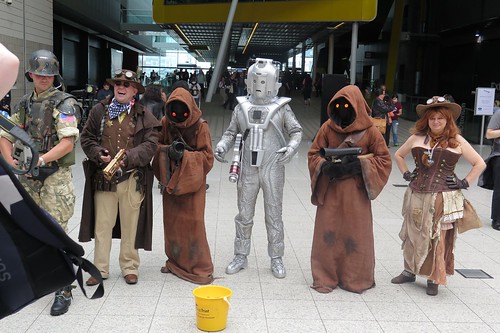
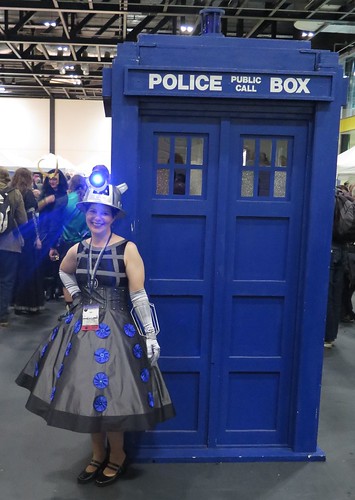
One thing non-SF fans associate with conventions is people dressing up in funny costumes. There was a bit of that at Loncon. I did not go to the Masquerade, a competition for cosplayers (as people who dress up in funny costumes are known), mainly because it threatened to go on for a lot longer than my interest in cosplay would last. But I did enjoy seeing people wandering around in costume. My favourites were probably Thor, Loki (played daringly by a woman, well I never etc.), the two Jawas (who had the actions and voices as well as the looks), or the woman who dressed as a Dalek and posed fetchingly beside the TARDIS (there was a TARDIS).
A strand of the convention I should really have engaged with more were readings by authors. I stayed away from these partly because I do not know that many contemporary writers. I went to just one reading, randomly taking in a writer called Tobias Buckell who read an excerpt from a work in progress he billed as kind of a science fictional retelling of
Treasure Island (one of those books I have never got round to reading). I found this work quite intriguing. I did wonder though whether someone like myself would be better off just reading
Treasure Island, while someone who had read
Treasure Island would not really see the point of reading a new version of the story. Mr Buckell did seem to be doing more with the transition than adding the word "space" before "ship" wherever it appeared or turning cutlasses into "laser cutlasses" and so on. I did like the wreck-tech aspect of the excerpt and will be curious to see how he progresses with it.
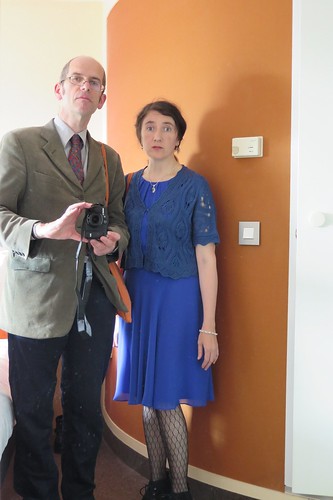
Loncon also featured awards ceremonies for the Hugos and Retro Hugos. I did not vote in either competition and have not yet read the items sent to me in my voter pack (though I did try to nominate things in each, notably
Upstream Color, which failed to secure enough votes to be nominated for best dramatic work in the Hugos #fraudatthepolls). The Retro Hugos were for works written in 1938. This event was on the first night of the convention and was hosted by Mary Robinette Kowal and Rob Shearman. The event was done as though it was actually taking place in 1939, complete with a live swing band with which Ms Kowal sang a big number (a song called 'Retro Hugos', to the tune of 'Anything Goes', my only exposure to Filk at the entire convention). Orson Welles'
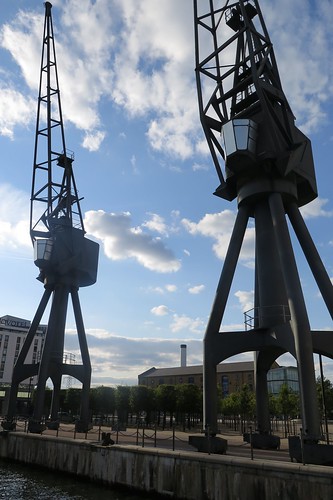
War of the Worlds had been nominated for an award and they turned the awards ceremony partly into a pastiche of that radio play, with cuts off to worried correspondents reporting on a Martian invasion (that ended with the Martians dying and their war machines being mistaken for the disused cranes lurking outside the conference centre).
Fewer people voted in the Retro Hugos than in the real Hugos, probably because people who like SF look forward rather than backward. But the Retro Hugos were probably of more interest to me, because I had at least heard of things that were nominated for it. I was pleased to see Welles' War of the Worlds win; having listened to it for the first time recently I can confirm that it is a stunning piece of work. It was also nice to see T.H. White's
The Sword in the Stone collect an award; maybe it is time I went back and re-read that much-loved book of my childhood.
The real Hugos this year were marked by Controversy. The first controversy I became aware of was that over who was going to present the awards. Earlier this year it was announced that Jonathan Ross was going to be the master of ceremonies. But then the Unpleasantness ensued, with many people getting very angry about Mr Ross being chosen, mainly out of a fear that he would leer at female award winners or make unkind comments about their appearance. As you know, the controversy forced Mr Ross to step down as the Hugos' host. In retrospect, my feeling is that the anti-Ross people over-reacted terribly and may even have made fools of themselves, though I do have some sympathy for their concerns. But the whole business is over now, as is customary with the past.
The Unpleasantness meant that at a late stage the Hugos were without hosts. It may also have made it very difficult to attract new hosts, as any prospective candidate would have feared an eruption of Twitter outrage once their selection was announced (I gather this forced Robin Thicke and Roy "Chubby" Brown to decline invitations). But in the end the event was hosted by Geoff Ryman and Justina Robson, who were so good at it that I feel bad even mentioning the Unpleasantness again here.
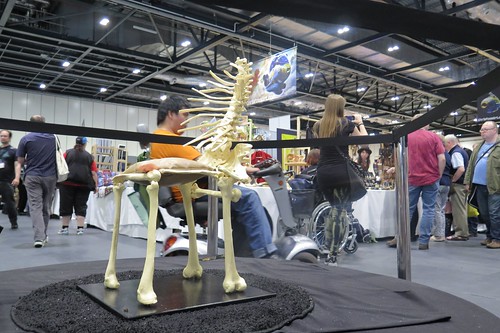
The other Hugos controversy was something I only started hearing about at Loncon itself. Apparently some grumpy people had become angry that SF fandom has been taken over by pinko feminist leftists and they decided to try and get some writers of true blue fiction onto the ballot. An organised campaign grew legs and writing by some rightwing authors was nominated in several categories. As I heard this I assumed that by rightwing, what was meant was Ayn Rand inspired libertarian bollocks, but I started hearing that in some cases we were talking about borderline far right stuff; apparently one of the nominees has been known to refer to black women as "subhuman" (though I did not hear him say this myself).
The main organiser of this rightwing slate for some reason started referring to his gang as the Sad Puppies, which must have been very upsetting to the world's many leftist puppies. My only knowledge of all this is what I heard at the convention, but the Sad Puppy people seem to have made odd choices as what they wanted to push onto the ballot. As well as fairly respectable militaristic SF (one of those genres largely beloved of neanderthals, I fear, but such neanderthals are not necessarily racists or far right gobshites), the Sad Puppy people did rather dirty their bib by arranging for the nomination of the (alleged) racist bloke. They also seem to have had to scrape the bottom of the SF barrel to find material to nominate, as in one category they had to put forward a piece of war game tie-in fiction, whose author was probably bemused at finding himself up for a Hugo.
As someone who loves chaos I was secretly hoping that the far-right guy would win an award. I imagined him sweeping up to the podium while the Imperial March played, flanked by supporters in SS uniforms, there to receive his prize and present a speech in which he thanked all born men of Aryan stock for rallying to the cause of science fictional racial hygiene. But the liberal elite who run SF fandom ensured that this did not happen and the rightwingers were drubbed out of it in all their categories. This must have made the Sad Puppies especially sad.

As previously mentioned, I am very behind the curve with contemporary SF, so I knew next to none of the winning authors. I was pleased to see that Retro Hugos host Mary Robinette Kowal won in the best novelette category, but mainly because her hosting those awards had made her familiar to me.
The one bit of actual controversy at the awards ceremony was provided by Kameron Hurley, who won two awards for fan writing. I gathered from things said at the convention that she had written a piece called "We have always fought", in which llamas become a metaphor for something to do with women and gender (I have not yet read this piece myself). Ms Hurley was not present to accept her awards, but she wrote acceptance speeches delivered on her behalf by others. These speeches seemed rather combative and almost to be insulting of the Hugo Awards ceremony attendees, who were after all the people who had voted to give her the awards. I thought this a bit churlish. It contrasted with the speech given by John Chu when accepting an award for best short story; he came across as another outsider figure but one pleased at having overcome obstacles to break through rather than using the occasion to berate his audience.
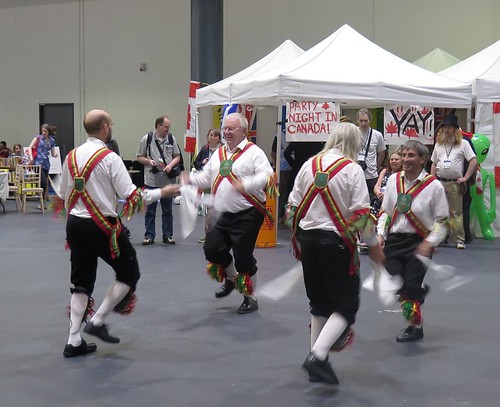
I should also mention the Chingford Morris Men (some of whom were women). I am guessing they were here to show foreign visitors a bit of traditional English culture. I love morris dancing and was very pleased to see them.
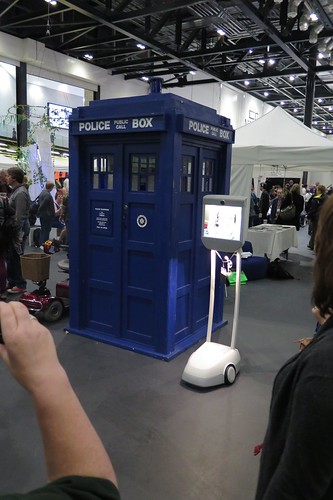
One final thing to mention was the other attendees. They ranged in ages from people who looked quite young to ones who have probably been going to these conventions for many many years. There were far less blokes wandering around with rucksacks than I expected. Like most things I go to, the attendees were pretty white looking. The gender balance was less skewed than might have been expected. The most amazing attendee for me was this guy who was physically at a robotics conference in the USA but was using a remote controlled robot to attend the conference.
So that really is that. I found the whole event very enjoyable and stimulating of further interest in the great literature of ideas that is science fiction. I also found myself thinking that I should really start engaging with fandom and going to conventions and stuff like that. Maybe one day I will even travel to another Worldcon happening far away in the USA or somewhere. I also note with interest that there is a bid in for Dublin to host Worldcon in 2019, which would be held in the Convention Centre. If the Dublin bid wins then this will be an event of great excitement.
 More of my Loncon pictures
More Loncon pictures, mostly not by me
Puppies
More of my Loncon pictures
More Loncon pictures, mostly not by me
Puppies (University of St. Andrews)
Worldcon 2015 (Sasquan. In Spokane)
Dublin 2019 Worldcon bid
Loads of other Loncon reviews

 More time on the reception desk and then my own interest in lunch meant that the next event I attended was the guest of honour interview by Octocon chair Janet O’Sullivan with Pat Cadigan, an American science fiction writer who now lives in England. I was not previously familiar with her work (which is more a reflection on me than on her as I am a slow reader and am unfamiliar with most writers). I found the interview fascinating, as any question would set Cadigan off on a stream of anecdote that would lead very far from the initial starting point. I particularly liked her favourable recollection of Robert Heinlein, someone who now is perhaps unfairly and simplistically pigeon-holed as a right-wing ultra, but whom she recalls as a very generous character. I was also touched by the particularly star-struck question from a member of the audience and Cadigan’s gracious response.