I am writing a series of posts about some horror things I have experienced in the recent geological past. In part one I talked about The Exorcist. Join me as a I discuss some other films I have seen that explore the the world of fear and terror.
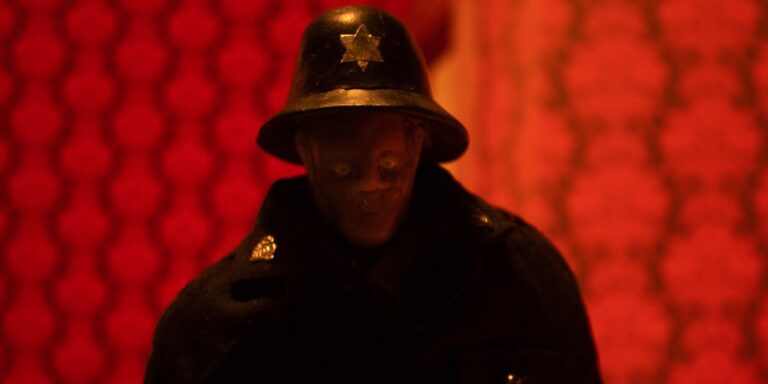
The Tell-Tale Heart is a 2023 short film that I have mentioned in passing previously, first when listing the best short films I saw last year and then when I was outlining what I was going to be nominating for this year's Hugo Awards (and like almost everything else I nominated, it failed to make the ballot). Directed by Max Hendrickson, It is a stop-motion animated adaptation of the Edgar Allan Poe story of the same name, the one narrated by a guy who describes a murder he has committed while being at pains to deny his insanity. I saw it in the Stoneybatter Film Festival last year, and it is stunningly atmospheric piece of work, all the more impressive considering Hendrickson was still in school when he made it. It is on YouTube, so check it out (and if you like it, have a look at his other films too).
Lust for a Vampire is a 1971 Hammer horror that was on television when I was away last year. I did not see all of it, but I saw enough. It is a sequel to The Vampire Lovers, Hammer's previous adaptation of Sheridan Le Fanu's "Carmilla" (the story that pretty much launched the important sexy lesbian vampire subgenre). This one is largely set in a finishing school for young ladies: the kind of place where at bedtime they have to help lace up each other's nightdresses to put away their ample bosoms. An English ne'er-do-well inveigles his way into a teaching job (he comes across as the type who likes assisting in the education of young ladies); he soon becomes convinced that new student Mircalla might be legendary vampire Carmilla resurrected. Despite this he falls in love with her. Various things happen but I got bored and went to bed before it all concluded. It did rather put the ham into Hammer.
The Omen (1976) is one of those famous films I have been aware of since it came out but somehow had not seen until it showed up in a horror film season in the Lighthouse. People often talk of the unholy trinity of folk horror films: The Wicker Man, Witchfinder General, and Blood on Satan's Claw. I think of The Omen as forming a second trilogy with The Shining and The Exorcist, a trilogy of big budget mainstream horror pictures that were event films when they came out. And you know what? It's not that great and is a far inferior film to the other two of my imaginary trilogy. It suffers from being excessively camp and lacking the sense of mounting dread that the other two films successfully create.
I was struck by one scene that seemed to be deliberately echoed in The Shining. At one point we see little Damien (the child of Satan [/spoiler]) zooming around in a peddle car before charging down a corridor to do something dramatic. I found this highly reminiscent of the very different scenes in The Shining, in which Danny zooms around the hotel's corridors in his own peddle car. This observation does not make this film worth going to see, but it is perhaps worth having seen in the past.
image source:
A threatening policeman (Utah International Film Festival: "The Tale-Tale Heart" — Max Hendrickson)
I saw some interesting short films in 2023 and these are the ones that impressed me the most. Most of these were shown by the IFI in their Archive at Lunchtime strand of free screenings, while two came up in the Stoneybatter Short Film Festival.
The War Game (Peter Watkins, 1966) Shown as part of the IFI's nuclear season, this was made for the BBC in 1966 but not broadcast for reasons. The most effective parts of the film are the faux documentary scenes looking at the lead-in to and aftermath of nuclear strikes against Britain. As can be imagined, it is pretty intense, with the most troubling scenes for me being the child screaming after being blinded by the flash of a hydrogen bomb exploding 20 miles away or policemen shooting patients a hospital has deemed untreatable.
The Family (Bob Quinn, 1979) This was made for RTÉ but not broadcast until the 1990s. It looks at the Atlantis community in Donegal, who were better known as the Screamers, for reasons that rapidly become apparent. It is fascinating but some of it makes for hard viewing.
The Unusual Inventions of Henry Cavendish (Andrew Legge, 2005) Around the time LOLA was out the IFI showed some earlier shorts by the same director. This one is done in the style of an early 20th century silent film and follows the travails of the titular inventor.
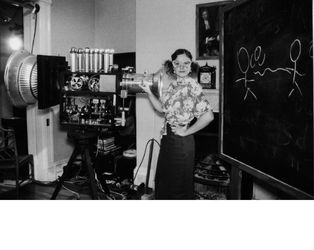
The Chronoscope (Andrew Legge, 2009) In LOLA the heroines invent a device that allows them to see the future. The 1930s inventress in this short creates a device that allows her to see the past, with disastrous consequences. This highly effective faux documentary presents a mix of talking heads, doctored footage, and filmed segments.
Meet the Quare Fella (Fred O’Donovan, 1960) 2023 was the centenary of Brendan Behan's birth and the IFI marked this by showing various films associated with the writer. In this one Eamonn Andrews interviews Behan, in a pub. It's funny and engaging, not least because the two men have a clear rapport. But there is an undercurrent of sadness. At one point Behan talks about how he will be viewed when he is in his 70s; he was dead four years later, just 41 years old.
Brendan Behan's Dublin (Norman Cohen, 1966) Made after Behan's death this presents the writer's Dublin, with a posthumous voiceover purporting to be from Behan himself, delivered by Ray McAnally. Aside from the Behan content is is an interesting look at the city just before I started to become familiar with it.
Flips (Luke Corcoran, 2020) A man gets into an argument with his brother at the funeral of his wife. A two-hander with strong performances.
The Tell-Tale Heart (Max Hendrickson, 2023) An impressive animated adaptation of the Edgar Allan Poe story, all the more so because the director was only 16 or so when he made the film. I look forward to nominating this for a 2024 Hugo Award.
Andrew Legge's alternate history science fiction film LOLA can still be seen in the IFI and Light House. The IFI is also showing three of Legge's short films as part of their Archive at Lunchtime strand: The Unusual Inventions of Henry Cavendish (2005), The Girl with the Mechanical Maiden (2013), and The Chronoscope (2009). They are free to see (just pick up a ticket from the box office) and are being screened in two programmes on Monday, Wednesday, and (possibly) Friday this week. They're worth seeing on the big screen and would appeal to anyone who liked LOLA as the aesthetic is quite similar (altered archive footage and newly shot material features). For someone curious about LOLA they would also serve as useful tasters.
Two of the three films are actually available to view on YouTube (though I still recommend seeing them in the cinema if at all possible). The Unusual Inventions of Henry Cavendish is a steampunk adventure set in 1895, in which the eponymous inventor seeks to win the heart of a beautiful heiress with his fantastic inventions while battling against a caddish rival. There is a cat.
The Chronoscope meanwhile is effectively proto-LOLA, only with a device that allows people to view the past rather than the future. Like LOLA, it features a lady inventor in the 1930s and is also presented as a documentary.
Readers, apologies for the delay in bringing my Octocon write-up to a conclusion. In my defence let me say that I was very busy with my amazing World War 1 blog in the run up to the centenary of the Western Front armistice and then was away in Utrecht attending the Le Guess Who music festival. I also had my v important day job to attend to, but let's be honest, the real reason this is so late is that I am a slack-ass and have spent my time in dissipation when I should be blog-writing.
If the time-lag is so long that you have completely forgotten what previously happened at Octocon then let me refer you to part 1 and part 2. And if you are too busy refer back to those, a quick reminder: Octocon is the Irish national science fiction convention, which this year took place in the Crowne Plaza hotel in Blanchardstown.
Sunday morning, I made it out to Blanchardstown too late to catch the Sunday Service, at which John Vaughan talked further about the worst films he has seen this year (possibly featuring further unsound comments on Hereditary) and rofflin’ James Brophy talked about television. I did however make it to Janet O’Sullivan’s interview with comics creator Colleen Doran, Octocon’s other guest of honour. A lot of fascinating stuff came up here, not least regarding the materiality of the craft, with Doran drawing attention to the non-durable nature of the original comics art from a surprising number of artists, which is often drawn onto paper that falls apart over time with paint that will degrade even if the art is kept in a cupboard. Although she does write comics (both for other artists and herself), Doran works primarily as an artist and I was taken by her praise for writers she has worked with like Alan Moore, Warren Ellis and Neil Gaiman; she mentioned how when Alan Moore writes very detailed instructions to artists it is because he has thought very deeply about how the comic should look, which is sadly not the case with some other writers who have also taken to providing artists with ponderously descriptive scripts.
However, the Colleen Doran interview really ramped up towards the end when the subject of Comicsgate and online harassment. I have not been paying attention to comics in recent years but it appears that all those Gamergate Sad Puppy dipshit man-babies have moved on to comics and taken to harassing comics creators. Doran noted that harassment is something she has had to deal with from the earliest days of her time in comics but that it has escalated of late as the dipshits use social media to swarm their enemies. At the same time she reports that it is somewhat easier to deal with now because the targets are able to talk amongst themselves, thereby realising that they are not being singled out for dipshit attention. It also appears to be the case that male comics creators are now receiving their own share of targeted harassment, making them suddenly aware of what their female colleagues have had to put up with for years. What is still a bit problematic about all of this is that the comics companies are pushing (sometimes requiring) the creators to establish social media presences but are being a bit slack about assisting them when they start attracting attention from the arseholes.
An unfortunate consequence of attending the wonderful Colleen Doran interview was that I missed a session on the new season of Doctor Who, but I did make it to a live recording of the CinePunked podcast by Robert JE Simpson and Rachael Kelly, at which they discussed the mid-1970s sudden and possibly coincidental appearance of three Frankenstein-related films in a short period, Frankenstein and the Monster from Hell (1974), The Rocky Horror Picture Show (1975) and Young Frankenstein (1974). The last two of these are obviously homages to vintage horror and SF films while the first one was the last film of old Hammer, making it almost a homage to itself (and featuring David Prowse, subsequently of Darth Vader fame, as the Monster). I have somehow never made it to a podcast recording before and have a surprisingly limited exposure to podcasts themselves (if I wanted to hear people talk I would turn on the radio or pay attention to the people at work) so I was fascinated by the process, in particular the completely and preternaturally fluid nature of the conversation between Mr Simpson & Dr Kelly. I was also struck by their comment on how much the 1931 Boris Karloff film defined how we think of Frankenstein and the Monster, introducing tropes like the hunchbacked assistant and the Monster being stitched together from corpses (Shelley herself never describes the monster thus and is deliberately oblique as to how the Monster was created or indeed what he looks like). The problematic sexual consent issues raised by all three of these films added to a troubling and recurring theme for the weekend. That said, for me the panel never really grappled with the question of whether the roughly simultaneous appearance of these three Frankenstein-related films was merely coincidental or whether there was something in the air that caused these three works to appear in a short period (and if so what that something was). The fact that roughly the same period also the Frankenstein-themed Doctor Who story, The Brain of Morbius (1976), so maybe there genuinely was something in the Zeitgeist. But what?
Much of the rest of my time at Octocon was taken up with the Golden Blasters, which is a science fiction short film competition run by none other than John Vaughan. This year previous winners were competing for the most golden blaster of them all, with winners of the Silver Blaster (the audience award) also thrown into the mix. This allowed me to see again films I had seen at previous Octocons in 2017 and 2015 as well as some works that were new to me. Olga Osorio's Einstein-Rosen, the winner of both Golden and Silver Blaster in 2017 once again one both prizes. It is an entertaining tale of two kids who discover a wormhole to the future outside their apartment block, an amusing mix of just about credible funny science and some disarming performances from the child actors (the author-director's sons), it was a worthy winner. I know, you're thinking, "A cute kids film? I think not", but there is a genuine charm to the two boys' performances.
Nevertheless, with my own taste for darker fare made me prefer Sleepworking by Gavin Williams, a creepy tale about a future in which people can earn extra money by renting themselves out while they sleep to perform menial tasks as somnambulists. The creepiness comes in when two of the sleepworkers start remembering flashes of their slumbering labours, with the whole thing being very evocative of the confused state of those who are never quite sure whether they are awake or dreaming. On a lighter note, I was happy to renew my acquaintance with Andrew Chambers' The Detectives of Noir Town, a film that manages in its short length to be more than just Roger Rabbit with puppets. I was also intrigued by John Kim's Steadfast Stanley, an animated film about a good dog in the midst of a zombie apocalypse, and found Simon Cartwright & Jessica Cope's steampunk stop-motion The Astronomer's Sun to be both mysterious and poignant.
The call of a pint and convivial chit chat after the Blasters meant that I missed the last proper panels and the ever-interesting round-up of upcoming cons, but I did make the closing ceremony of the convention at which Chair Janet O'Sullivan revealed two pieces of amazing news. Firstly, even though Worldcon is coming to Dublin next year, there will also be a mini-Octocon, probably a one day event taking place once more in the Crowne Plaza Hotel in Blanchardstown. The reasoning here was that for various reasons some people will not be able to go to Worldcon but will still want to get together with other science fiction fans at a smaller, shorter and more intimate event. The other piece of sensational news was that Raissa Perez (this year's volunteer coordinator) is joining Janet as co-chair, putting Octocon into another pair of safe hands.
That was pretty much it. Some people found a way of watching the third episode of the current Doctor Who series (the one about Rosa Parks). I was one of these people. The experience reinforced my view that the current Doctor Who series represents something of a levelling up by the series. Perhaps more of that anon. It also reminded me of how much fun is to be had with shared viewings of good things. And then we were off first to enjoy a meal with houseguest Nicholas Whyte and then home to feed our hungry cat.
 The Tell-Tale Heart is a 2023 short film that I have mentioned in passing previously, first when listing the best short films I saw last year and then when I was outlining what I was going to be nominating for this year's Hugo Awards (and like almost everything else I nominated, it failed to make the ballot). Directed by Max Hendrickson, It is a stop-motion animated adaptation of the Edgar Allan Poe story of the same name, the one narrated by a guy who describes a murder he has committed while being at pains to deny his insanity. I saw it in the Stoneybatter Film Festival last year, and it is stunningly atmospheric piece of work, all the more impressive considering Hendrickson was still in school when he made it. It is on YouTube, so check it out (and if you like it, have a look at his other films too).