Tuesday, March 10, 2015

A Trip to London Part 2: celebrating Lindsay Cooper

The event that drew me to London was taking place in the Barbican. This was the Henry Cow and Friends Salute the Magic of Lindsay Cooper concert. My knowledge of the music of Henry Cow and Lindsay Cooper is limited, mainly based on a piece one Mr Dave Berry wrote about them in the pages of Frank's APA and a compilation of music featuring Dagmar Krause put together by Emily K., a star of the Internet. With that limited initial exposure you would think that I would not really be the target audience for this event, yet there I was in the audience. I think it must be Fear of Missing Out that made me not miss this memorable occasion: in my old age have I finally become an Event Person?

Some background for readers who know even less about Lindsay Cooper than I do. Ms Cooper was a composer and musician who played bassoon and oboe with Henry Cow and other acts in the 1970s and thereafter. She also composed music for film and television and so on. She appears to have straddled the worlds of composed and improvised music, being also involved in the Feminist Improvising Group (who sound like the best thing ever). She died in 2013 after suffering for many years from multiple sclerosis.

In format this concert was divided up into segments representing different aspects of Cooper's career, but with more or less the same musicians playing on everything. The musicians included such star names as Chris Cutler on drums and Fred Frith on guitar (the others are probably also star names too but I live under a stone and so did not recognise them), while vocalists included Dagmar Krause, Sally Potter and Phil Minton. The overall musical lineup was like a meld of standard rock formatting with more outré instruments, so you got various keyboards as well as brass and wind instruments.

The concert began with a run of pieces Cooper had composed for Henry Cow, mostly instrumental. Right at the beginning of this there was a bit of false start, where a tune began and then had to be halted because someone had not come in properly or something. Depending on your perspective, this was either a disturbing suggestion that things can go very wrong with live music or an indication that this was going to be an evening of exciting edginess in which things were going to be kept real. Either way the Henry Cow material was a bit rough around the edges, but I liked it.

It is hard for me to produce reference points for the Henry Cow segment, because the instrumentation and the style of music made it sound rather different to most things I am familiar with. One thing that did come to mind was Peaches en Regalia, the orchestral jazz album by Frank Zappa. The kind of soundtracks Michael Nyman used to do for Peter Greenaway also sprang to mind.

The following segments were a performance of music written for a group called News From Babel that Cooper had formed with Chris Cutler, a series of film music she had made with a group called Music For Films and then as a closer music she had composed for a song cycle called Oh Moscow, about the Cold War. The different segments largely blurred into each other, with the music in broad terms being of a roughly similar type. There was more in the way of vocals after the Henry Cow section. Dagmar Krause's contribution was relatively limited. As she was the main draw for me this could have been a major disappointment except that the other vocalists were most excellent and the music generally of a very high standard.

If I was to start handing out prizes to the musicians then it would probably be Frith and Cutler who would be receiving medals from me, though again it might just be prior awareness that had me noticing their work more (and also latent rockism, perhaps, that would cause me to favour them over any of the people on non-rock instruments). The musical highlights were probably the songs from Oh Moscow. The Cold War lyrics went over my head but the music stuck in it, perhaps because it was a bit different to that of the rest of the evening (more piano driven and less rock). Vocals here were by Phil Minton (who is apparently an interesting player in the world of improvised music etc.) and Sally Potter, who had written the lyrics. I was surprised to discover that she is the same Sally Potter who directed Orlando.

I think maybe the Oh Moscow music was the hit of the evening and the segment that was the least familiar to attendees. Certainly the merch stand ran out of copies of that album afterwards. If you are interested in Oh Moscow, there is great footage on YouTube of a piece from it being played in 1991 in Volgograd (with scenes filmed on the streets of that town more famous to the world as the site of the memorable Battle of Stalingrad).

Aside from the members of Frank's APA and our loved ones, there were loads of famous people knocking around at this concert. I saw Thurston Moore queuing for coffee at the interval while there were reports of popular comedian Stewart Lee also being present. And when, after the show, one of my friends said "Oh look, there's Steve Davis", it took me a while to register that he was not talking about some mate of his called Steve Davis but the star of snooker; apparently Mr Davis is a big fan of progressive and forward thinking music, hosting a radio programme on this very subject.

And then eventually we made our way into the night. Getting out of the Barbican proved surprisingly difficult, as the place is huge and maze-like (two of my friends got lost and are still there to this day) but in the end we emerged into the darkness of a foggy London night.

Lindsay Cooper image source (Northern Soul interview with Chris Cutler)

Lindsay Cooper obituary (Guardian)

Monday, March 09, 2015

A Trip to London Part 1: Poppies

Back in November I paid a visit to London, mainly to attend a concert in the Barbican celebrating the life of the musician Lindsay Cooper. I had time for a small number of other things.

After checking into my hotel, I paid a trip to Pudding Lane, where the famous Great Fire of London began. I then strolled on to Tower Hill to have a look at what was left of that poppy exhibit they had in the moat of the Tower of London. This was a First World War commemorative event by artist Paul Cummins and designer Tom Piper. The exhibit filled the Tower's moat filled with artificial poppies, one for every British soldier killed in the conflict (not sure if that was just soldiers from Britain or if it included also Irish soldiers and ones from the Empire). I am interested in the First World War (as anyone following my amazing First World War live blog will already know) and in monumental public art, so this touched all my bases.

By the time I got there they had mostly dismantled the exhibit. There were still poppies in one corner of the moat but the rest was bare. What was left looked a bit forlorn, but one could still imagine how the whole exhibit would have appeared. It must have been stunning, a theory supported by surviving photos of the poppy filled moat.

There is a lot of talk about how best to commemorate the First World War (or even if it should be commemorated at all) and many quite rightly decry the creepy enforced conformism of poppy-wearing in Britain. Regardless of that, seeing the huge moats of the Tower as a sea of red would have been incredibly striking and must have made anyone who saw it think about the losses suffered during the war. Whether they would then think that the dead soldiers were all brave lads doing their duty or the victims of a warmongering elite in a pointless conflict would be another question entirely.

After looking at the poppies I walked up to Rough Trade East off Brick Lane, a haunt I am always drawn to. This is one of those places that some Londoners I know are very dismissive of, but I think perhaps they would be less so if they did not have other record-selling emporiums. I am conscious of having too many CDs and was also trying to not spend loads of money on this trip (ha!) while also foreseeing that I would probably end up buying something at the concerts I was going to later, so I limited myself to just one CD here, a Sublime Frequencies release of proto-Rai music. One day the so-called powers that be will let you see my review of this record.

Come back tomorrow when I will describe the Barbican concert for Lindsay Cooper.

Sunday, March 08, 2015

[film] "Mr Turner" (2014)

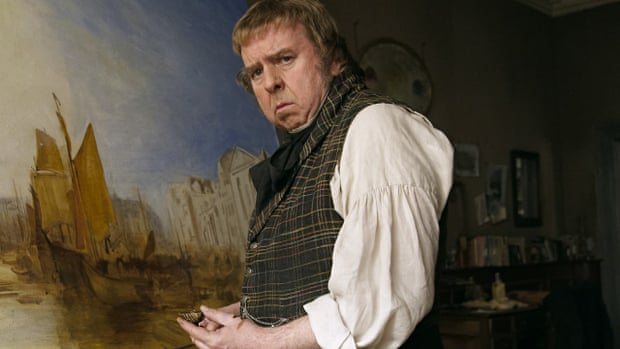
This is a Mike Leigh film in which Timothy Spall plays the well known 19th century artist J. W. M. Turner. It tells the story of the latter part of his life. It looks great and has some great scenes and performances but overall it is not brilliant. It lacks a narrative thread and seems to be just a sequence of events. Turner's inner life is largely unexplored. Instead we see him being casually exploitative of his housekeeper and needlessly cruel to the mother of his daughters (born out of wedlock), yet he is capable of genuine tenderness with another woman he ends up forming an attachment to.

I find with the less successful Mike Leigh films I end up wishing the entire film had been about one of the minor characters. With Happy Go Lucky I wanted an entire film about the uptight driving instructor (even if "uptight driving instructor" is something of a lame cliché), while with Career Girls it was the Welsh flatmate who needed to have his story told. In this one, it was the personally difficult and unsuccessful other artist whose story seemed more interesting (if also more miserable) than that of Turner himself. Or perhaps a film about Ruskin, who appears briefly here with the actor capturing the man's strange mix of punchable ponciness and impressive critical sensibility.

Still, the film has much to recommend it. You do get a sense of how mid-19th century art did seem to be moving towards stylised and abstract forms that were then abandoned until the 20th century. The evocation of the period generally is very vivid. And as noted above, there are great performances here. Spall shines as Turner, even if the man remains a mystery. Also impressive are Dorothy Atkinson as his housekeeper and Marion Bailey as the widow with whom he strikes up a relationship. And although she only appears in a short scene and has almost no lines, I was struck by Kate O'Flynn as a prostitute Turner visits and sketches in a brothel; her face was wonderfully communicative of a sense of contempt for her clients, though she may also have stood out in a film otherwise mainly featuring older actors.

Sound design corner: the film-makers lavish great attention on the correct depiction of Turner's derisive snort.

I was also amused by how every time we saw the exterior of Turner's house, the same gentleman was walking by with his dog.

image source (Guardian)


Saturday, March 07, 2015

[film] "The Babadook" (2014)

This is an Australian horror film. It is about a widowed mother and her troubled young son, who is obsessed with the idea that monsters are going to come and get him while he sleeps. His fears keep his mother awake at night and for much of the film she is in a sleep-deprived state. As someone blessed by an inability to sleep properly I empathised with her.

The film undergoes a transition when the son finds a storybook in the house about the Babadook, some kind of monster that comes for people when they sleep. The book has no author information but the illustrations seem to be about the mother and her son. And the book seems to change, with more text and illustrations appearing on hitherto blank pages. Nevertheless the film preserves an ambiguity as long as it can as to whether the whole business is just the woman suffering a breakdown triggered by sleep-deprivation or whether they are actually being stalked by a strange monster (spoiler: they are).

As a horror film, this is very effective. Without the use of jumps or things leaping out at you, it manages to communicate a sense of terrible dread and unease. At one point the film had me so on edge that I was genuinely wondering why I was putting myself through this kind of wringer. Light, sound, and a suburban house that mutates into a gothic mansion all work together to create an atmosphere of palpable evil. The ending is unusual, though. Without revealing the terrible secret, it does not end with the horror defeated or the horror triumphant; rather there is a strange accommodation reached with the demonic force.

Babadook book (New York Times)


Friday, March 06, 2015

[Film] '71 (2014)

Directed by Yann Demange, this is a film about a British squaddie (played by Gary Hook) sent to Belfast in 1971. You get the sense that like most of his unit, he had never previously heard of Belfast; their officer has to explain to them that they will still be in the United Kingdom. While out in West Belfast he becomes separated from his unit and has to try and get back home while being hunted by an IRA hit squad. I first became aware of it when I saw a poster for it while attending a folk horror conference in Belfast and it struck me that the concept has some similarities with all that folk horror business. The protagonist is an outsider in a location where things are strange, the locals unfriendly and alliances shifting. The urban setting is perhaps a new twist.

Because the film is told very much from the point of view of the soldier, there is relatively little sense of the politics and background of the Northern Ireland conflict. The viewer has to infer as much as they want to from conversations and things observed. While the best bits of the film might be the relatively few scenes in which the soldier is being chased around West Belfast, the film is nevertheless more than being a straight high octane actioner. By the end of it you do have a sense of the murky world of the struggle at that time, with undercover soldiers supplying bombs to (incompetent) loyalist paramilitaries and running double agents in the IRA factions.

The film begins with scenes in which the soldier is undergoing basic training in Britain. I was struck by how different these were to the training scenes in Full Metal Jacket, say. While the trainers were shouting at the trainees, a gratuitously abusive element seemed to be lacking and there was a sense that the training was about imparting skills that would keep soldiers alive rather than just breaking them mentally. Apart from the shifty undercover soldiers, the army is portrayed relatively positively, at least towards itself. The soldier's unit is headed by a dimwitted Rupert from central casting, but his heart does at least seem to be in the right place, and with the rank and file soldiers and NCOs there is a sense of them looking out for each other. The undercover soldiers and the more senior officers are different: they seem to have been morally corrupted by their role.

On Twitter I read Graham Linehan saying of the film that it suffers from having the main character becoming essentially inactive in the second half of the film. After actively seeking to stay alive in the first half he becomes almost entirely reactive, with his life and welfare relying on the decisions of others. In some ways that criticism is valid though it perhaps misses that by the second half the soldier has been through one incident of an extremely traumatic nature (physically and mentally) and is not really in a position to do very much. The change also works in plot terms as it allows for a widening of point of view, to the various British Army actors, to IRA cadres in West Belfast, and to the ordinary people of the city into whose lives he descends.

I have also heard one or two people grumbling about a film set during the Northern Ireland conflict taking the point of view of a British soldier (rather than, say, heroic members of the struggle for Irish freedom). They may have a point, in that it will be a while before anyone makes a film portraying the Lads as the heroes. But this film is too wise to the ambiguities of the Northern Ireland conflict to be a British equivalent of John Wayne's The Green Berets. And a film about a soldier lost alone in hostile territory is always going to be more interesting than one about people making bombs out of fertiliser in their attic.

The music is by David Holmes, who is himself from Northern Ireland, and is very impressive in context.

image source (Recent Movie Posters)


Thursday, March 05, 2015

Where do you listen to music?

How do you listen to music? Where do you listen to music? Answers to these questions are key to our relationship with music. These days I listen to a lot of music on my iPod, but what I listen to is very constrained by the situations in which I listen. When I am walking to work, I want up-tempo music that is going to encourage me walk briskly and not dawdle. When I am listening to music before going to sleep I want relaxing sounds that will not challenge my brain. I have created playlists to cater to these two situations. When I add music to iTunes, if it gets into a playlist for one of these situations then it will get listened to. Otherwise not so much, at least not on the iPod.

In Panda Mansions we have the stereo set up in one room, but I tend to spend a lot of my time in the library-study, working away on my Important Project. We talk sometimes of rigging up speakers in the library-study, but it has not happened yet, so if I am sitting there I sometimes listen to music on an iPod (though not so much, as I find headphones a bit distracting if I am working), sometimes I play the radio on my computer (RTE Lyric or one of the BBC music stations), and sometimes I play nothing. My beloved does not feel the need for ambient music in the same way that I do, so often the only accompanying sound is the tapping of my fingers on the keyboard or the sound of the street outside. Other times I can hear the sound of Georgian music wafting from the other room, either as my beloved gives the Basiani record another listen or plays songs on her computer that she is trying to learn.

It bothers me sometimes that I have all this recorded music that I ostensibly like but do not seem to listen to that much. I am always talking about taking steps to deal with this.

And you? Where, when and how do you listen to music?

Panda Twin Birthday (Giant Panda Zoo)

Wednesday, March 04, 2015

[record] U2 "Songs of Innocence" (2014)


This is that U2 album that Apple gave away for free, annoying billions of people around the world who had not worked out how to delete things from iTunes. The extreme reaction to this whole business in some quarters did rather surprise me, as it seemed akin to throwing a massive strop because you find a CD you don't like cover mounted on a magazine.

The record itself… well I have listened to it a couple of times. It is alright, in that when it is on I do not think "Jesus Christ turn this shite off" but I would not go as far as to say it is actually good or anything like that. I certainly cannot see myself listening to it again much. I have long been a sneaking regarder of U2, for all that they are not particularly popular in the circles I move in. With this record I find it hard not to conclude that whatever spark U2 once had is now gone. Still, they had a good innings and few are the bands who have produced so much great work.

Sneaking Red Panda

Tuesday, March 03, 2015

[film] "Maps to the Stars" (2014)

I saw this David Cronenberg directed film recently. It is scripted by Bruce Wagner and contains many allusions or parallels to the Wild Palms comic he wrote in the early 1990s, including:

hallucinations
Maps to the Stars
creepy child actors
disturbing family dynamics
Carrie Fisher
'Nana Nana hey hey (Kiss him good bye)'
general dark side of Hollywood vibe

and so on.

The story is multi-stranded, though the strands of course come together: people who seem only to have tenuous links to each other turn out to have much closer connections than might initially be apparent. Cronenberg has reached that stage of his career where he can get good actors to appear in anything he does, so you get some stunning performances here. I particularly liked Evan Bird as the spoilt teenage actor. Julianne Moore as a disturbed actress and Mia Wasikowska as a new arrival in Tinseltown also impressed me.

Cronenberg might have gone off the boil a few years back but lately he has really got his mojo back again. Maps to the Stars does not fall into the kind of strange genre film territory that alienates respectable audiences, but it had enough creepiness and body horror to feel like a proper Cronenberg film.


Bruce Wagner's Wild Palms

Monday, March 02, 2015

I IS FOR… INSPIRAL CARPETS


In the pages of Frank's APA we are running through the letters of the alphabet.
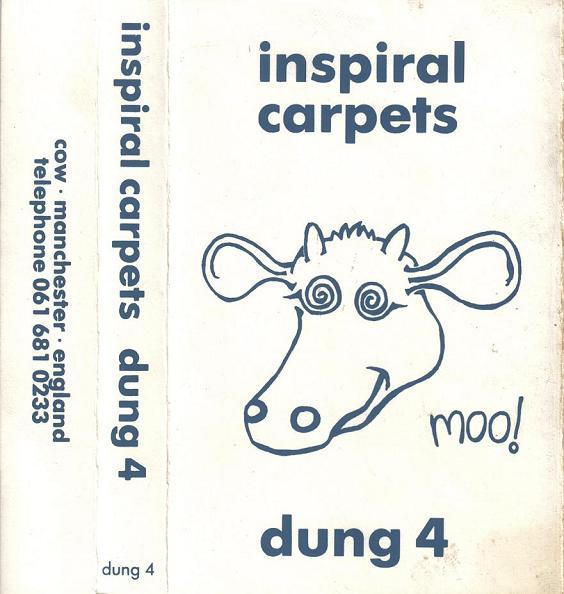
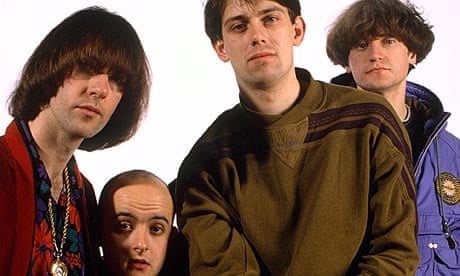
Possibly the same summer (1988, 1989?) that I went to see Hawkwind with Mr W— in the Brixton Academy I also caught Inspiral Carpets playing in some venue in Camden (Dingwalls?). They were an up and coming band at the time. My memory is that all that Manchester stuff was on the way up round then, and as they were from Manchester they were riding that wave. By the time I saw them they had moved on from their cassette only first album and had changed lead singer to the one who would sing on all their hit records, but the basic template sound was in place. They had beaty tunes with the organ sounds of Clint Boon prominently featured.

Before the concert a looped voice played over the PA saying something like "Tonight… in Manchester… two hundred people came to see… Inspiral Carpets… the biggest bunch of wankers… ever". It was hypnotic and vaguely amusing. I think Mr W— and I kept saying it to each other for years afterwards. This was in the pre-Internet age; we had to make our own entertainment.

Inspiral Carpets were on the way up at that point and they did go on to some success, having hit singles and seeing one of their tunes used as the theme music to a Saturday morning kids TV programme. But I think the real prize eluded them and they remained a second string band. When I saw them again some years later in Dublin, they were still a a great live band and able to draw a reasonable crowd, but the sense was that they were a band on the slide. I remember liking the album they were pimping at time, and also the lead single 'I Want You' on which Mark E. Smith guested, but I do not think it overly excited the record buying public.

History has not been kind to the Inspiral Carpets. They seem to show up in books about the music of the era to be dismissed as the kind of rubbish band who acquires a certain following simply by association with other, better outfits. That seems a bit unfair. I would not make any claims for Inspiral Carpets being one of the great bands of the late 20th century, but they are a good solid mid-level outfit.

Or so I thought before I started writing this piece. Putting it together for the web I checked out some Inspiral Carpets tracks on YouTube and have been struck by what earworms they are. It might be that two unfortunate things counted against the Carpets. One was being associated with all the Madchester ravey stuff when they were basically a 60s revival outfit (which was the basic template of all indie bands pre-Madchester, except that they were a lot better than the others). As a non-ravey band they are always going to be remembered as not really a proper Madchester band and so will always be a bit marginal in histories of that scene. The other problem is that their biggest hit was something of a lovely song ballad; that is never good in retrospect. If they are to be remembered it should be for the likes of 'Two Cows', 'I Want You' or 'She Comes In The Fall'. Or this.

Dung 4 (Plain or Pan)

1988 band photo (Guardian)

Sunday, March 01, 2015

[theatre] "Ganesh versus the Third Reich" in the O'Reilly Theatre

I theoretically love going to the theatre but never seem to do so in practice. This is one of just two things I saw in the Dublin Theatre Festival last year. What I picked up from the programme was that this play was about Ganesh (you know, elephant headed Hindu deity) coming to the Third Reich in order to reclaim the ancient symbol of the swastika from the Nazis, which was enough to make it sound like it would be worth seeing. I also registered that it was being performed by Australians.

When the play started, though, I had a slight moment of "where's the fucking Nazis?", as there were neither Nazis nor Hindu deities on stage but two fellows not dressed in 1940s garb. When they started talking I was further confused, as their speech was a bit hard to understand. My first thought was that they were speaking with incomprehensible Australian accents or else that some incompetent had taken over the theatre's sound. But something else soon became apparent: the two actors onstage were both people with intellectual disabilities.

It turned out that the play had three actors with intellectual disabilities and two without. And it was a bi-level thing, partly about Ganesh trying to take the swastika from the Nazis and partly about a theatre company featuring people with intellectual disabilities trying to put together a play about Ganesh trying to reclaim the swastika from the Nazis; the narrative about the actors was probably the dominant one here.

Split narratives often suffer from the problem that one of the narratives is a lot more interesting than the other. In this, though, they both seemed to work well enough together. In the Third Reich narrative Ganesh teams up with an intellectually disabled Jewish lad he rescues from Auschwitz, which of course reminds us that the Nazis were not exactly friends of people with intellectual disabilities.

Each strand of the narrative had at least one great scene. The Third Reich story had a great train carriage episode in which an over-familiar black marketeer starts trying to sell tights to the escaped Jew (who is in disguise, obv), asking an endless series of questions about his girlfriend, her sisters, his sisters, his mother and so on, all potential purchasers of nylons, with the questions forcing the invention of ever more outlandish details about all these non-existent people. It was a scene of the kind of building menace you get in Quentin Tarantino films (think in particular of that opening scene in the farmhouse in Inglorious Basterds).

The outer narrative, meanwhile, has a wonderful extended scene in which the increasingly unhinged actor-director is trying to get one of the ID actors to die properly when shot. It too builds and builds, from a physical comedy of frustration to a deeply uncomfortable episode of rage, to actual theatrical violence.

The ID actors were interesting, in that they were all really good albeit within a limited range. I don't think any of them would be able to convincingly play a character who was not intellectually disabled, but they very much came across as playing roles rather than just being themselves onstage.

There is a scene where the actor-director addresses the audience (or imagines addressing the audience when the play is being staged), accusing them/us of having come along for an evening of "freak porn". I think we were meant to shuffle uncomfortably in our seats at that, but it washed over me. I had no advance awareness that the play featured intellectually disabled actors and this must have been the case for many other people present, as the theatre festival programme did not mention it. Even if you had come along to this expecting something of that type you would probably leave a bit disappointed. The acting is too good and the play too tight to have any kind of freakshow aspect.

So all in all this made for an enjoyable if strange night of theatre.

image source (Sydney Morning Herald)