
Wednesday, April 08, 2009

Japan: the world's greatest country

Have you ever found yourself thinking that it would be brilliant if cafés laid on cats for you to play with? I know I have. Apparently there are loads of these cat cafés in Japan. I am so there.

hat tip

Ergodos Festival: Off Grid

One interesting thing I heard about from the website of the Journal of Music is this Ergodos Festival, a nine day festival of weirdo music running from the 17th to the 25th April in Dublin. It features a variety of events, from gamelan music in the National Concert Hall to a performance by forward thinking fiddler Caoimhín Ó Raghallaigh in the Unitarian Church. In the post budget financial nightmare that is today's Ireland, you may be too po' to afford the cost of tickets, in which case you could enter a competition to win a pass to all events in the festival. I'm so fly that I have already bought my own ticket to the whole thing.

Tuesday, April 07, 2009

Portishead "Third"

This is of course Portishead's third album, the one that came out last year. I saw it in a two-for-fifteen sale in HMV and decided to give it a go. I have, sadly, only managed to listen to it once or twice. This is not a reflection of this record's quality, more on the extent to which I am being swamped by new music at the moment. Initial listenings suggest that Third is a total classic – if you like doomy and claustrophobic music.
People had said that this was influenced by the likes of Sunn-O)))) and all the crazy metal that Geoff Barrow releases on his own label. I do not really set this myself. A more obvious context for this would be Massive Attack's Mezzanine, but without in any way sounding like a retread of that work. Whatever its influences, this is a very engaging record, one I can see myself listening to this a lot over the coming year.

Image source

Sunday, April 05, 2009

Steve Reich "Phases"

Basically, this is more Steve Reich than you can shake a stick at – five CDs worth of stuff recorded on the Nonsuch label, being sold in a small box for €19.99. If this is not a bargain then I do not know what is. The two biggies I recognised by name are Music for 18 Musicians & Different Trains, though I bet that people who know about these things would know of many of the other tunes here. There is so much stuff here that I have only managed to listen to everything once, but it is all great. I was particularly struck by Different Trains, both the locomotive rhythms that Reich conjures up and the subject matter it evokes. The latter becomes apparent the moment you see the titles of the piece's subsections: 'America -Before the War', 'Europe – During the War', and 'After the War'. You don't have to be a genius to work out to where the European trains are going and whom they are carrying there.

When Steve Reich was approached to be the subject of the Living Music festival in 2007, he agreed to come along as guest of honour on condition that no music by Phillip Glass was included in the programme[citation needed]. I suppose Reich and Glass are probably the two giants of 20th century Minimalist music, but my thinking now is that Reich is a far more interesting composer. Listening to the tracks here, there seems a much broader range to his musical palette. With Glass, on the other hand, everything really does kind of sound the same*, so had the two gone back to back the comparions would very much have been in Reich's favour.

While this Reich collection is very extensive, it does not quite include everything noteworthy the great man has composed. There is no 'Clapping Music' or 'Street Life', but in 'New York Counterpoint' it has the tune that The Orb sampled to produce 'Little Fluffy Clouds'. Famously, when this was played to Reich by The Wire for Invisible Jukebox he said "Who was that again? I'll have to get my lawyers onto that one".


* Although, bizarrely, the radio has just played some Glass organ piece that did not sound that much like what I think of as classic Glass (i.e. it does not sound like anything from Koyaanisqatsi)

Saturday, April 04, 2009

One City, One Voice

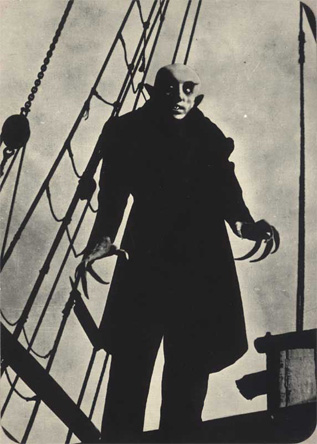
The Dublin City Library Service has been doing this One City, One Book thing over the last couple of years, where they gamely try to get everyone in the city to read the same book over the course of April. This year the book is Dracula, by Bram Stoker. Dracula is so associated with the cinema that it is easy to forget that it is based on a novel written by a Dubliner.

I am hoping to re-read Dracula this month, though the City Library Service are a bit short of copies. Dracula is an odd book, a strange mix of genuinely unsettling horror and pulpish action. Its attitude to sexuality, particularly female sexuality, is the kind of thing you could base an entire academic career on. While it has its ups and downs, there is something memorably creepy about its best passages; I am thinking in particular of the opening chapters, where the English lawyer finds himself gradually learning the truth about his Transylvanian host, or the various entries in the log of the ship that is carrying the vampire to England. That last section ends with the unforgettable image of a storm-blown ship crashing to shore, the captain lashed to the wheel, a dead man with a crucifix round his neck.

The IFI is getting in on the act by hosting a Gothic film weekend from the 17th to 19th of April. Some of the films they are showing look unmissable. Aside from Murnau's Nosferatu a film that repays endless viewings*, they are also showing Countess Dracula, with Ingrid Pitt (easy tiger) playing Erzebet Bathory, the Blood Countess. They may perhaps have sensationalised the story somewhat, but it is still based on an actual historical noblewoman who actually did bathe in the blood of virgins – can this be sensationalised? The other fascinating film on the programme is Blacula, a blaxploitation horror film; what's not to like?

One somewhat annoying feature of One City, One Book this year is that the Dublin libraries seem to be a bit short on copies of Dracula. Maybe this is the curse of picking a book that people might actually want to read, but there never seem to be any available for borrowing when I go looking for them. Oh well.

More details on One City, One Book

image source

*bizarrely, this has become the film that I have seen the most number of times, largely because I never turn down an opportunity to see it.

Friday, April 03, 2009

City Hall Wants Your Badge: Sunday Morning with Ensemble Avalon

You know the way my beloved and I sometimes go to those free midday concerts on Sundays in the Hugh Lane Gallery? Well you would, if you read my blog and the various pieces we have written for Frank's APA. For reasons that are still mysterious, these concerts have been moved form the Hugh Lane to City Hall, much closer to where we live. I don't know if you have ever been to Dublin's City Hall – as a building, it reminds me of that Onion article about the stoner architect who designed a building consisting entirely of foyers. City Hall seems to be one big foyer, and it is not at all clear from it where the good folk of the Corporation do their important city government work.

That odd feature is not particularly relevant to the concert we attended, which was by this lot called the Ensemble Avalon. They were playing pieces by a number of composers, all of which seemed to be about nautical or marine themes. These were not particularly Eno-esque tunes evoking an oceanic world of polymorphous absorption. Instead, Lizst's Hero & Leander, about two lovers separated by the Hellespont, features a terrible storm that drowns one of the lovers, while Rachmaninov's Etudes-Tableaux op.39 starts off by evoking a seagull (a sinister omen of ill-fortune) only to progress also to a musical recreation of a storm's terrible fury. All of this was accomplished by three musicians playing violin, cello, and piano, and accompanied by the usual fidgety children to which had been added the extensive noise of traffic (City Hall, unlike the Hugh Lane, is on a main thoroughfare, and being an all foyer building, the concert area is much closer to the outside).

Thursday, April 02, 2009

Journal of Music...

You may have known the Journal of Music in Ireland. This publication is no more, having mutated in the all-new Journal of Music. Whereas the original publication looked at brainy music in Ireland (or looked brainily at music in Ireland), the relaunched Journal of Music is adopting a more international perspective. My big worry with this is that this could mean a loss of focus and lead to the journal needlessly replicating the work of other publications. We'll see. Anyway, the relaunched journal is out this month. It is already available online, presumably with the print issue hitting the shops soon. The issue appears to come with a CD compiled by the Improvised Music Company, showcasing the current state of Irish jazz.

edit: see comment for further information on the CD that comes with the Journal of Music, as well as a concert next week to promote it and a jazz-related radio show.

I say, Young Man!


The BBC reports that the fellow on the right is "claiming to be injured". More bizarre, perhaps, is the sudden outbreak of formation dancing by the cops on the left.

see more pictures

Wednesday, April 01, 2009

NCH Action: Leos Janácek's "Glagolithic Mass" & Ludwig van Beethoven's "Eroica" Symphony

Our pal Leedy was singing in the Glagolithic Mass – not on her own, but as part of a choir. But what is a mass when it is being glagolithic? That I cannot tell you. Oh wait, no, the programme says it is derived from the Latin word for the Old Church Slavonic language in which Janácek decided to render the text of his mass, as a way of making it doubly incomprehensible. The programme helpfully gives translations (in English) of all the Old Church Slavonic stuff the choir are singing, so I now know that Bog seems to be the Old Church Slavonic for God, while Gospod is the word for Lord. But what does Sabaoth mean? It is helpfully translated here as… Sabaoth. Now, you might wonder why I am fixating on this one word, but it is one I have seen before – in the works of Howard Phillips Lovecraft. In his short novel The Case of Charles Dexter Ward, the villainous wretch who has, from his essentiale saltes, been resurrected at one point mutters "Per Adonai Sabaoth – " when trying to protect himself from being turned back into a pile of saltey nuggetes. Could it be that Janácek was himself a servant of dark forces, that his Glagolithic Mass is a sacrament not of Good, but of Evil?

Whatever about its possible status as a portal into our universe for obscene deities from outside time and space, the Glagolithic Mass is also interesting in how little mileage it gets from its lead vocalists. One of the lady singers barely sang anything at all, while the other leads did not really do that much, making the achievements of the main choir that bit more noticeable. The other fascinating feature of the piece was its wonderful false ending. I mean, it's a mass, so when they reach the The Mass is over, go in peace – amen bit you do rather think "Well that'll be that then", even if the Mass is being sung in Church Slavonic or Aklo or whatever they call it. What you do not expect is a crazy organ solo. I cannot but think this might prove the solution to the problem of falling church attendance. Eroica symphony of Beethoven, meanwhile, is a very famous piece of classical music, so famous that I was surprised not to recognise it from an ad or film score. Famously, it was originally meant to be dedicated to the French general Napoleon Bonaparte, seen at the time as a hero of the Enlightenment and a man who was sweeping away the dark forces of illiberalism that had been holding back Europe; but then, when Bonaparte declared himself Emperor Napoleon, Beethoven tore off the dedication from the score. The music is very impressive, though at first I was having some problems getting to grips with it. The last section, though, is astonishing. Beethoven seems to really know how to build to a finish, and the musical spectacle was well counterpointed visually by Andreas Delfs giving us loads of crazy conductor action.

Q: Are We Not Men?

I've just been to see Il Divo, the exciting Paolo Sorrentino film about Giulio Andreotti, a shady Italian politician. I may talk about it at greater length in the future, but for now let me say that I recommend it highly. I don't think you would need to know anything about Italian politics to enjoy it – I thought it was excellent, and had never heard of anyone in it apart from Andreotti himself (and Aldo Moro, but he is not in it that much). The film is on in the IFI till the 9th of April. I reckon the lush cinematography would make this one worth seeing on the big screen.