Showing posts with label Irish films. Show all posts

Tuesday, April 30, 2024

Journeys into Darkness Part 4: "Lies We Tell"

I have been writing about some horror things I have experienced over the last while, starting with The Exorcist, then some other films, and in my last post some horror audio dramas, including a BBC adaptation of Wilkie Collins' The Woman in White. Now we reach Lies We Tell, which is like The Woman in White in that it is a gothic shocker but not one featuring supernatural terror. In fact, it is an adaptation of Sheridan Le Fanu's novel Uncle Silas, another heiress-in-peril novel.

When Le Fanu originally pitched the book, he wanted to set it in his native Ireland. His publisher said that no one wanted to read Irish books, so Le Fanu moved the locale to Derbyshire. For this film, director Lisa Mulcahy and screenwriter Elisabeth Gooch have brought the story back to the Emerald Isle. Agnes O'Casey plays Maud Ruthyn, a recently orphaned heiress who is yet to come of age. The film begins with the executors of her father's will suggesting that she might want to contest being left in the care of her Uncle Silas, a man of bad reputation who is suspected of murder. Despite not knowing her uncle, Maud insists on following her father's wishes and points out that although her uncle was suspected of causing a man's death, the coroner reached a verdict of suicide.

Uncle Silas arrives in Maud's mansion with his rakish son, idiot daughter and a French governess, and takes Maud into his care. While initially amiable, it becomes apparent that he has designs on Maud's wealth and is not entirely interested in her welfare. The film becomes increasingly claustrophobic as Maud finds herself trapped in her home, unable to seek help outside it and forced to rely entirely on her own resources. This sense of the domestic environment as a trap is of course a recurring gothic trope.

I think the title change from the book is partly designed to draw the focus away from Silas to Maud. In conversation after the film, Mulcahy talked about how she and screenwriter Elisabeth Gooch to some extent wanted to subvert the novel and give Maud more agency. I found this somewhat curious; while I have not read the novel myself yet, my understanding is that Sheridan Le Fanu's Maud is more active and determined than some gothic heroines and that the book is a first person narrative that foregrounds Maud's thoughts, experiences, and actions, for all that it is named after her antagonist. Either way the film remains very focussed on Agnes O'Casey's Maud, who appears in pretty much every scene. David Wilmot's Silas nevertheless remains a formidable presence, affable, charming, and sinister, sometimes all at once. He is very much a villain in the Count Fosco mode.

One thing I was struck by was how unsympathetically Maud is presented, at least initially. This is despite the fact that we see everything from her point of view and never stop rooting for her to escape her peril. Yet at the start of her film we see her imperiously bossing around her servants and then curtly dismissing the concerns of her executors. She is also short with Silas's daughter Emily, someone who could otherwise have been recruited as an ally given the nastiness Silas displays towards her. I did find myself wondering if the servants' later lack of helpfulness is a reaction to their earlier treatment.

And I suppose another thing to mention is that while this is based on a gothic sensation novel, it is not even slightly camp. Once we gain a sense of the danger in which Maud finds herself we never lose sight that it is very real and potentially visceral. There is one particularly intense scene that in another film would have played very differently but here remains a horrible presentation of Maud's vulnerability. That scene in particular is not an easy watch and I could imagine it being particularly upsetting to some viewers. Lies We Tell is nevertheless a film I recommend highly, and I hope that we see more from both Agnes O'Casey and Lisa Mulcahy.

image:

Agnes O'Casey in Lies We Tell (Image: "Meet Agnes O’Casey, star of psychological thriller Lies We Tell")

Sunday, April 23, 2023

Dublin area films: North Circular and Ghosts of Baggotonia

You wait years for a black and white film focusing on an area in Dublin and then two come along at once. They are actually very different films, but I am still going to lump them together here.

Directed by Luke McManus, North Circular is a documentary about the North Circular Road, a winding route that runs from Phoenix Park almost all the way to the Five Lamps junction on Amiens Street. The film expands its remit to look at Phoenix Park itself at one end and Sheriff Street on the other, with the latter basically a continuation of the road towards Dublin's docks. Interesting locations near but not on the road feature, with one notable scene taking place in the UN veterans' place at the end of my road; sadly neither Billy Edwards nor the Patriotic Chonker put in an unscheduled appearance. There are also some nice musical sequences in the Cobblestone pub. The tone is pretty heart of the rowl and there is an amusing bit near the beginning where former residents of the now demolished Devaney Gardens flats reminisce about the great community spirit of the place ("At Halloween the chisellers used to burn out cars on the green, it was great crack almighty" etc.). At the other end there are some great sequences with Gemma Dunleavy, local pop star in the making; I was particularly struck with the live sequence that showed her being accompanied by actual harps while doing her R&B/garage/grime influenced stuff.

If I had a criticism of North Circular, it is the extent of its heart of the rowl focus. The film acknowledges that many people live along or near the North Circular who have moved there from elsewhere: other parts of Dublin, other parts of Ireland, even other countries. Some of these people are shown on screen but we almost never hear their voices, which seemed to mark the long meandering street out as a domain where only the true inner city Dub can really feel at home: a local street for local people. But that does not stop the film being a fascinating journey through Dublin's north inner city.

Alan Gilsenan's Ghosts of Baggotonia is a good bit more impressionistic. It begins for some reason with footage of allied bomber planes from the Second World War but then moves on to its true focus, the area around Baggot Street. In the post-war period became a bohemian milieu in which various struggling writers eked out a living from flats and bedsits; some of them are still well known writers, in Ireland at least (I'm thinking in particular of Brendan Behan and Patrick Kavanagh), others less so. The film also uses a collection of street photographs by Neville Johnson to evoke the era (though his photography ranges far beyond the Baggotonia enclave). And it is worth noting that some of the writers covered (e.g. Flann O'Brien) did not actually live near Baggot Street: Baggotonia was a state of mind rather than a place. The film presents an allusive portrait of the time, using archival footage, drone photography and voiceover to hint at an era that seems almost unimaginably ancient for all that it hovers at the edge of living memory. I recommend the film to anyone interested in that cohort of writers or in bohemian life generally.

images:

North Circular still (The Journal: "Lockdown took me on a journey to film life along Dublin's North Circular Road")

Patrick Kavanagh and Anthony Cronin arrive at Davy Byrne's on Duke Street after a Bloomsday trip to Sandymount (Irish Times: "Ghosts of Baggotonia: D4 as you have never seen it before")

Ingenious Inventions: short films by Andrew Legge, director of LOLA

Andrew Legge's alternate history science fiction film LOLA can still be seen in the IFI and Light House. The IFI is also showing three of Legge's short films as part of their Archive at Lunchtime strand: The Unusual Inventions of Henry Cavendish (2005), The Girl with the Mechanical Maiden (2013), and The Chronoscope (2009). They are free to see (just pick up a ticket from the box office) and are being screened in two programmes on Monday, Wednesday, and (possibly) Friday this week. They're worth seeing on the big screen and would appeal to anyone who liked LOLA as the aesthetic is quite similar (altered archive footage and newly shot material features). For someone curious about LOLA they would also serve as useful tasters.

Two of the three films are actually available to view on YouTube (though I still recommend seeing them in the cinema if at all possible). The Unusual Inventions of Henry Cavendish is a steampunk adventure set in 1895, in which the eponymous inventor seeks to win the heart of a beautiful heiress with his fantastic inventions while battling against a caddish rival. There is a cat.

The Chronoscope meanwhile is effectively proto-LOLA, only with a device that allows people to view the past rather than the future. Like LOLA, it features a lady inventor in the 1930s and is also presented as a documentary.

image:

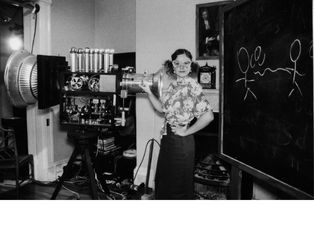
Serena Brabazon as Charlotte Keppel, inventor of the chronoscope (IFI)

Monday, April 10, 2023

"LOLA" (2022)

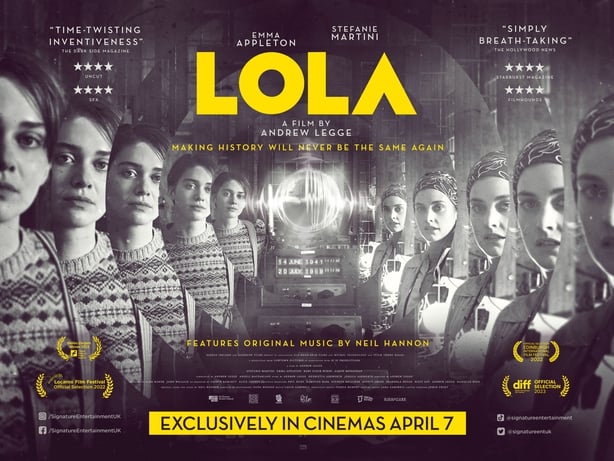
Directed by Andrew Legge, this is an Irish-made found footage film combining material shot on 16mm film with digitally manipulated archive footage. It follows Mars and Thom, two sisters who in the late 1930s develop a machine that can receive radio and TV signals from the future (the first signal they receive is David Bowie performing "Space Oddity"). When the Second World War starts they use the machine (christened LOLA) to help the British war effort. At first LOLA provides the British with such an edge that they look increasingly invincible, but then things start to go wrong.

I think it is staple of time manipulation stories that foreknowledge becomes a curse. Either people discover that the future has a terrible fate in store for them and in attempting to escape it they cause their doom to happen, or their acting on information from the future causes that future to change. LOLA goes down the second of these roads, and the moment when the sisters realise that things are going wrong is a very striking one. The film is drenched in music, with it initially being the crazy sounds of future pop that attracts the sisters to exploring the future. There is an amazing sequence in which they introduce the Kinks' "You Really Got Me" to the 1940s, with the song becoming a massive hit and a kind of anthem for the British war effort. But then, after another use of LOLA-derived information to thwart a German attack, Mars tunes LOLA into the mid-1970s, expecting to hear and see David Bowie. Instead she gets some other guy singing a song about how he loves the sound of marching feet, with a TV announcer mentioning his other big hit, "To the Gallows", about how he loves seeing traitors being brought to the gallows. Part of the weird unease these songs engender derives from how Bowie-esque they sound. Viewers will of course be aware of Bowie's own mid-1970s flirtation with far right thinking, something that adds a certain frisson to the catchy tunes. Credit must go to the Divine Comedy's Neil Hannon for creating the Nazi pop tunes, and it is shame that their problematic but appropriate (in context) lyrics means they are unlikely to be released as singles.

While this is a film that touches on big themes, it was made during the pandemic with a pretty small cast, so it feels almost like a chamber piece. Stefanie Martini and Emma Appleton are great as the sisters, evoking well the hermetic world of young women who have grown up alone together after the death of their parents. Extra praise is due to Martini for doubling up as a camera operator, for she shot much of the film's 16mm material, for reasons relating to the story (the footage is meant to have been shot by her character) and to the pandemic and perhaps budget (one less person on set). Rory Fleck Byrne is solid as their liaison with military intelligence, the only other character in the film with significant screen time. But what stops the film being a couple of people sitting in a room is the use of doctored archival footage, which goes into overdrive when we have the Nazis invading England and Hitler leading a victory parade through London. Credit is also due to whoever designed the LOLA machine itself, as it is an amazing piece of retro-futurist technology. Nevertheless the film retains its human scale and feels like something of a cross between low-budget time travel film Primer and the disturbing but relatively obscure Nazi Britain picture It Happened Here. It does not get lost in its alternative history narrative, instead focussing on the sisters' attempt to undo the horror unleashed by their faustian pact with LOLA.

images:

Emma Appleton & Stefanie Martini with LOLA (Irish Times: "Lola: Impressive debut film from Irish director destined for cult status")

Lost in time (RTÉ: "LOLA is a uniquely strange alternative history tale")

Sunday, February 26, 2023

As Gaeilge, le do thóil: "An Cailín Ciúin", "Róise agus Frank"

Is maith liom dul go dtí an phictuirlann. Tá mé freisin ag foghlaim Gaeilge san obair. Mar sin de, chuaigh me chuig na dhá scannáin Gaeilge An Cailín Ciúin agus Róise & Frank. If you don't live in Ireland then An Cailín Ciúin is the one of these you are most likely to have heard of, though you will probably have heard of it under its English title, The Quiet Girl. Written and directed by Colm Bairéad, it is a finalist in this year's Academy Awards in the Best International Film category and is based on Foster, a novella by Claire Keegan. The eponymous girl is a child of neglect, her father a deadbeat piece of shit from central casting (so well played by Michael Patric that I can imagine the actor having to wear a paper bag over his head to prevent random strangers hurling abuse at him when he is out in public) and her mother completely ground down and mired in the slough of despond.

But then she goes on an extended stay with distant relatives (an older and apparently childless couple, the woman warm and affectionate, the man initially more gruff and reserved) and experiences the kind of parental affection hitherto denied to her. We learn things and so do the characters, but not in a "And you have learned how to make a good bagel!" kind of way. It's all pretty subtle, with many things remaining unspoken or implied. But it puts you through the emotional wringer, not least because there is no Hollywood transformation in the film's end; he viewer left wondering how the poor girl's childhood and life pans out, with various non-ideal outcomes looking entirely possible. The three central actors (Catherine Clinch as the girl and Carrie Crowley and Andrew Bennett as the fosters) give incredible performances and it is hard not to recommend this film. My beloved did however feel that the girl is a bit talkative for someone supposedly defined by her quietness.

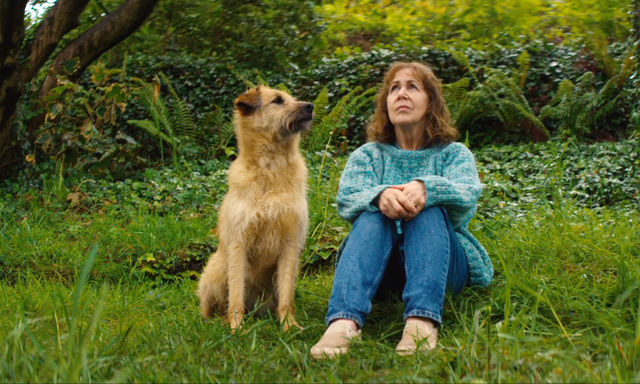
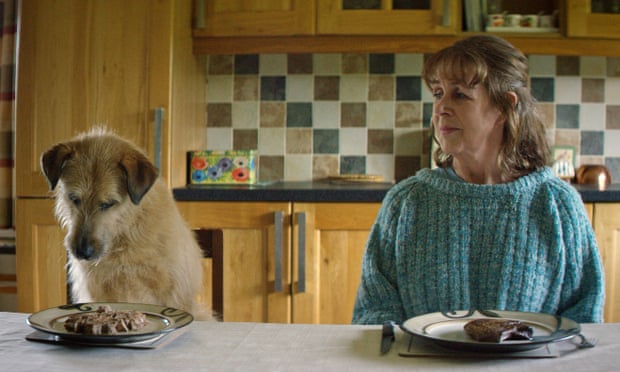
Rachael Moriarty and Peter Murphy's Róise & Frank meanwhile is about a widow who is struggling to deal with her grief when a mysterious dog shows up at her house and refuses to go away. Soon she realises (or concludes) that the dog is in fact the reincarnation of Frank, her late husband. Frank was a keen hurler in his human life and the dog too shows an affinity for the noble sport, soon helping a local school team to advance to the finals (he does not actually play in the games, because that would be insane, but he helps with coaching). Róise's son is less convinced that the dog is his late father returned, but he cannot deny the positive transformation "Frank" has wrought on his mother.

It would be easy to dismiss Róise & Frank as a kitsch feelgood film, but I think there is more to it than that. There are some deeply moving scenes in it and I think the film will resonate with anyone who has ever lost a loved one or suspects that they may do so at some point in the future. It is also worth reporting that "Frank" is a very good dog. He is played by Barley, an English dog who had to learn Irish for the film. He appears to have greatly enjoyed making Róise & Frank, as he got to eat a lot of sausages and even some steak (I can imagine him deliberately fluffing some of the dining scenes as a way of getting more sausages in the re-take). The human actors (Bríd ní Neachtain as Róise and Ruadhán de Faoite as the main kid hurler are also pretty memorable, as is Lorcan Cranitch as the neighbour who resents the arrival of "Frank" as a blocker on his making moves on Róise).

Interestingly, both of these films are (mostly) set in the same part of the country, the Ring Gaeltacht in County Waterford. In both cases I think the choice is fairly deliberate. When most people in Ireland think of Irish speaking parts of the country they imagine bleak windswept places in the west of Ireland, but setting films there means the landscape takes over the story and you start having to deal with themes of isolation and remoteness, together with an association of the Irish language with being far away from modernity. Ring is a mostly rural area but in neither of these films does it look like a land that time forgot or somewhere that remained Irish-speaking because it was too far away from the centre of imperial power and too poor to be worth bothering with. So that lets the stories of the films speak for themselves: these are films in which the characters speak Irish but they are not really films about the Irish language.

íomhanna

Catherine Clinch agus Carrie Crowley san Cailín Ciúin (Meath Chronicle: "An Cailín Ciúin breaks box office records")

Andrew Bennett agus Catherine Clinch san Cailín Ciúin (BBC News: "An Cailín Ciúin: Irish language film shortlisted for an Oscar")

Barley agus Bríd ní Neachtain san Róise & Frank (Entertainment.ie: "Róise & Frank is anything but a dog's dinner")

Barley agus Bríd ní Neachtain san Róise & Frank (The Guardian: "Róise & Frank review – a shaggy-dog story with easy Irish charm")

Barley ag foghlaim a línte Facebook: Róise & Frank)