Showing posts with label film noir. Show all posts

Tuesday, February 22, 2022

Killer Couples: "Double Indemnity" (1944) and "The Getaway" (1972)

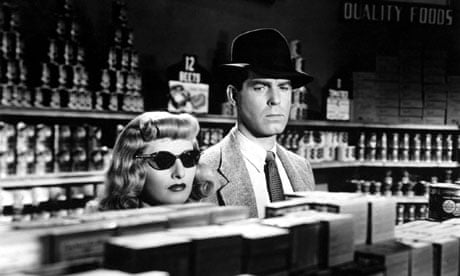
I saw these in the before time as part of an IFI season of films about couples who kill. Double Indemnity, directed by Billy Wilder, is a definite noir classic about a guy who thinks he is pretty smart (Fred MacMurray) and a dame (Barbara Stanwyck) who is playing him for a chump. If you have not seen it, the title comes from a term in life assurance policies whereby the insurer pays out double for particularly unlikely events, in this case a fatal accident on a train. As can be imagined, the plot involves a life assurance policy with just such a clause and a murder made to look like a fall from a train. The film is a masterful depiction of obsession leading to folly and delusion, with a typically noir inversion of the moral code through making the murderous insurance salesman the protagonist.

Billy Wilder made a lot of films and I don't know to what extent he is seen as making films with recurring themes, but there are definite elements here that find echoes in his other work. William Holden in Sunset Boulevard appears to have taken over the insurance salesman's apartment; in certain other regards the protagonists of both films follow a similar trajectory. The closing scene between the salesman and his loss adjustor colleague (Edward G. Robinson) recalls the ending of Some Like It Hot with its faint suggestion of homosexual attraction (though I could be reading too much into what is actually a more traditional paternal relationship). And similar to those other films, there is an air of loucheness to this one. In the opening it is presented as entirely normal that an insurance salesman would engage in lewd banter with the wife of a potential client, while later a minor character talks about how much he is looking forward to seeing a visiting "osteopath".

The Getaway meanwhile is a Sam Peckinpah directed film about a crim (Steve McQueen) who has to make a getaway after a heist goes wrong when other crims try to double-cross him. He is aided and abetted in this endeavour by his lovely wife (Ali McGraw). The film starts well with largely wordless scenes showing the crim in jail, the machinery of the jail juxtaposed with the mechanistic tasks pursued by the prisoners. It goes downhill once he gets out. The whole heist-gone-wrong plot is a bit plodding and predictable while the film as a whole has a tiresome air of macho blokey bollocks to it (see also: all other Sam Peckinpah films).

Peckinpah films are sometimes like artefacts from an era of unreconstructed offensive sexism and The Getaway is no exception in this regard. The scenes in which for reasons a rival crim kidnaps another couple and then starts shagging the woman, who turns out to love getting some good lovin', leaves a nasty taste, particularly as it is all largely played for laughs.

The various scenes where Steve McQueen's character slaps Ali McGraw around are also quite distasteful, not least because they were in a real-life relationship at the time that was reputedly characterised by domestic violence. Some of the other quirks of the Peckinpah style also grated with me. The slow-motion arcs of blood in the death scenes were a bit comedic; these may once have seemed ground-breaking but now (and perhaps already by the time this film was made) they are little more than Peckinpah cliché.

But for all that, the film has a strong visual sense. As previously noted, the images of jail life are stunning. Another scene that gives rise to some striking images is one where McQueen & McGraw escape emerge in a dump having escaped from the cops in a garbage truck's trash compartment. Neverthelss the film remains fundamentally not that good but might be of interest to film history types or fans of domestic violence. Otherwise don't bother with The Getaway: watch (or rewatch) Double Indemnity instead.

images:

Double Indemnity (Guardian: "My favourite film: Double Indemnity")

The Getaway (Basement Rejects: "The Getaway (1972)")

Sunday, April 27, 2014

[Film] "Lift to the Scaffold" / "L'Ascenseur pour l'Échafaud" (1958)

The IFI was showing this old Louis Malle film from 1958. The plot is an odd one. One Julien Tavernier (played by Maurice Ronet) murders his shady industrialist boss but then becomes trapped in a lift as he tries to make his escape. A small time crook and a flower girl (played by Georges Poujouly and Yori Bertin respectively) then steal his car, driving off to have an adventure of their own. As they go they drive by Florence Carala, the industrialist's wife (played by Jeanne Moreau), revealed as Tavernier's lover and his co-plotter in the murder of her husband. She sees the flower girl in the car and assumes that her lover has betrayed her.

For much of the rest of the film Tavernier is stuck in the lift, trying to get out, trying not to get killed when he does so, and trying not to be found there. Meanwhile the crook and the flower girl head off to the countryside to spend his money and live the highlife while Florence trawls the city looking for her lover. Although we feel that Tavernier and Florence are the primary protagonists here, far more things actually happen to the delinquent young folk. Things go horribly wrong for them, leading to repercussions for Tavernier and Florence.

So in some ways, not too much happens in the film. Instead it is about mood and atmosphere, with Tavernier making his endless attempts to escape his trap and Florence roaming the city in her futile quest for him. Her journey is a fascinating one, taking her to an endless series of dive bars and low-life hang-outs. The youths' adventure switches from being one of carefree abandon to one of disaster, with them ending up consumed by fear at the consequences of their actions (for all that their fear seems as over-dramatic and detached from reality as their initial quest for adventure). The generally alienated atmosphere is partially brought into being by the soundtrack, a selection of moody jazz pieces performed for it by Miles Davis.

There are hints here to a political subtext. The industrialist is an arms manufacturer, someone who is profiting out of the war then raging in Algeria. In the scene between him and Tavernier at the start of the film, there seemed a suggestion that he might also have been operating a spy ring, with Tavernier the traveller who collects intelligence from field agents and assets. Tavernier is a veteran of the wars in Algeria and Indochina, and his carrying a gun seems to be unremarkable. In some ways the film ends up with the kind of Crime Does Not Pay message common to films of that era, but there did seem a suggestion that the victims and killers all somehow deserved their fate. And there is a very non-Hollywood sense of playing with guns being dangerous and not fun.

This film is apparently seen as hovering on the frontiers between film noir and the French nouvelle vague. Either way it is a most unusual work and something that I recommend to all readers.

Trailer for reissued version of film:


The ponderous original French trailer:


See also:

Derek Winnert's review (Jeanne Moreau image source)

Ascenseur Pour L'Èchafaud (Lift To The Scaffold) : Original Soundtrack (Miles Davis image source)

An inuit panda production