At last I review the album everyone has been talking about. But first a quick recap for readers who have not been paying attention. Wet Leg were founded by two women from the Isle of Wight (of all places), Rhian Teasdale and Hester Chambers, who recruited a bunch of blokes to pad out the sound. On the back of two brilliant singles last year (the languid pervathon "Chaise Longue" and the truly epic "Wet Dream") they garnered a lot of attention, leading to a considerable build up of anticipation before the release of this, their debut album.
So, what's it like? If you've watched YouTube videos of Wet Leg playing live you'll have this sense of Teasdale and Chambers as rofflers, and this comes across on record too, mostly in Teasdale's vocal delivery. But the odd point of comparison in her singing style for me is with Cate Le Bon, with tracks like "Oh No" displaying a particular debt to the Welsh siren.
I have seen it suggested that the album is in one respect reminiscent of Elastica's debut, in that there is a good bit of filler once you get away from the big tunes. Aside from being offended by this calumny towards the wonderful Elastica album, I'm not sure it is entirely true of this one either. Definitely it is the big tunes that gather my attention here, to the extent that it is hard not to just keep playing "Wet Dream" over and over, but the other tunes have a heft to them too. I particularly like "Loving You" as a sad lovesong of the "I am so not over a terminated relationship" variety.
But for me this is the "Wet Dream" album. God that is such a tune. I think the song would be a hit on the back of the music alone, with its propulsive rhythm, call-response vocals, handclaps, and mega drumming driving things forward, but the vocals really hit it out of the park, both Teasdale's lyrics and her delivery. Again for the benefit of people who have been living under a stone, this sees her describing in lurid detail an erotic dream that the listener has been having about her, in tones suggesting an ever increasing level of shock and disgust at what the listener has been imagining her doing and having done to her. The positioning of her authorial perspective as somehow looking in on someone else's private imaginings is wonderfully meta.
Overall this is a fun record that I love listening to. It leaves me with a sense of what could be magically achieved if more no-hoper indie bands were to suddenly develop killer tunes and topnotch production.
TenniscoatsTan Tan Therapy (2008)
Readers will recall that I liked Tenniscoats when I saw them at Le Guess Who last November. My beloved liked them too, so I decided to get something by them for her as a Christmas present. The problem with this plan is i) Tenniscoats have a lot of records and ii) no shop in Ireland stocks anything by them. Having to embrace the horror of online ordering meant also that I had to seek some straight dope on the best introductory Tenniscoats record from a friend who knows about these things. He also checked out with a bud who is some kind of Tenniscoats superfan. They both included this album in their key recommendations list. And so I came to order this CD all the way from Japan. And despite my leaving it very late to order, it still arrived in time for Christmas. Well done Japan.
In case you've never heard any Tenniscoats music, this is basically collection of quiet gentle tunes that make for a perfect antidote to the hustle and bustle of the world that surrounds us. It is not solely the product of Tenniscoats' own labours, being a collaboration with a band called Tape who are apparently from Sweden. However I know so little about Tape that I cannot really say where Tenniscoats end and Tape begin. I think the vocals are all Saya Ueno from Tenniscoats but I can't really tell with the music. I think Takashi Ueno from Tenniscoats only really plays guitar, so perhaps the drums and advanced keyboards are by Tape. Anyway, it's all good, give it a listen, you may like it. "Uta ga Nainoni" [Like no songs], the album's second last track is a bit of a stand-out, Saya's non-verbal vocals appearing over music that flows like a river.
A bit of an odd impulse purchase this one, except it was free because Mr Davidson is so against capitalism that he makes it impossible to pay him any money for his wares. I downloaded this from Bandcamp because Bernard Clark was bigging it up on Lyric FM's Blue of the Night. Blue of the Night is an odd programme, appearing on the classical music station of our national broadcaster. Bernard Clarke is the presenter of Blue of the Night. He previously presented Nova, a contemporary classical music which was not to everyone's taste. It was denounced in the Irish Senate as "an hour or two of unmerciful, thumps, bangs, whistles, squelches, belches and God Almighty knows what" and ultimately the show was cancelled.
Blue of the Night is a more gentle kettle of fish. It runs from 9.00 pm to midnight Monday to Thursday and is meant to be a gentle wind down programme, except that Clarke can be a bit wayward, having a tendency to go off on one by serving up a Led Zeppelin triple play or else treating listeners to some reggae tunes. Anyway, one evening he was going on about how amazing this Ethan Daniel Davidson guy was and being really impressionable I went and downloaded this album from Bandcamp (where it is available for free, as previously mentioned). And you know, it's fine, broadly blues based, but not really my thing and frankly I can't see why anyone would get that excited by it either, though of course listening to it as I write this I am thinking "Mmmm, that 'I See Satan Fall Like Lightning' song has a good beat".
This year the World Science Fiction Convention (i.e. Worldcon) is taking place in Chicago. I am not going, but because I voted in site selection I have a supporting membership of the convention, which means I get to vote in this year's Hugo Awards. That means I receive the voters packet: digital copies of most of the works that made it onto the ballot. But before the packet was distributed I went and read all the finalists in the short story category, as these are all available to read online. To be honest, not all of these are great, but one really stood out for me, that being Sarah Pinsker's "Where Oaken Hearts Do Gather". This is presented as though it were the talk page of Lyricsplainer, one of those websites like Mudcat where people discuss the lyrics of folk songs. In the story the people are discussing the obscure folk tune "Where Oaken Hearts Do Gather", whose lyrics can also be found in both the Child and Roud collection of ballads. The song tells of a man and woman meeting together for a tryst in the woods, where oaken hearts do gather (that line is repeated throughout the song). There is an element of foreboding, with the reader perhaps fearing that the man will have less than noble intentions, but things take an unexpected turn and it is the man who suffers a terrible fate. The lyrics go on to suggest that his fate is a ritualistic one and that these events will be repeated when other men find themselves lured into the woods, where oaken hearts do gather. What exactly is happening here remains oblique, but that only adds to the sense of unease the lyrics generate.
Meanwhile, in the Lyricsplainer comments people there are discussing the song and making the case for particular variants of the words. We also see the kind of feuding and trolling that bedevils the online world. But buried in among all the chatter one of the commenters starts talking about how he thinks the song is set in a specific place in England, which he decides to find for himself. As the discussion progresses he posts again about how his inquiries are progressing. What happens next may not surprise you; in the best tradition of folk horror, the reader twigs where the story is going a good bit before the protagonist does. That does not stop the ending from packing a considerable punch.
You can read the story for yourself on the website of Uncanny magazine here:
https://www.uncannymagazine.com/article/where-oaken-hearts-do-gather/
Sarah Pinsker meanwhile is a musician as well as a writer. Her band The Stalking Horses have recorded their own version of the song. It would not spoil your enjoyment of the story if you listened to this first, or vice versa.
image source (Guardian: "Getting back to nature: how forest bathing can make us feel better")
Previously I wrote about my favourite new tunes of 2021. Now let me talk you through some tunes from before 2021 that first crossed my orbit in that year. I originally compiled this as a CD-R and now I have made YouTube and Spotify playlists for these, though not all of these tracks are available on those platforms.
Here are some quick notes on the tunes, with information on where I heard them.
Silver Apples "Oscillations" (1968) [Silver Apples' untitled album]
I feel the most guilty about including this one as it is not completely completely new to me: I have heard it around and possibly even seen a version of Silver Apples live. But I had not previously owned a copy of the album and so had not had a chance to listen to this odd piece of music that seems to prefigure all kinds of cool later music from later years. Ironically I still have not listened to it that much as cat name of Billy Edwards does not like it.
The Silver Apples album is available in all good record stores.
Annette Peacock "Pony" (1972) [v/a Cafe Exil: New Adventures In European Music 1972-1980 (2020)]
I do not know very much about Annette Peacock and would not have heard this track if I had not finally knuckled under and bought the Café Exil compilation. It is an enjoyable piece of 1970s weirdo music, somewhat electronic but only round the edges.
Café Exil is available from all good record stores. I have yet to see an Annette Peacock album in the wild.
Camizole "Camizolemania" (1975) [Camizole 1975]
This is the product of a French electronic prog outfit. I am unclear as to whether they are actually famous or just well-known in the pages of Frank's APA, the journal of record for sonic explorers. The music is faintly ominous and lacking in vocals. In an alternate universe these guys are massively successful and no one has heard of Tangerine Dream.
Lynsey De Paul "Sugar Shuffle" (1976) [v/a Bob Stanley Presents 76 In The Shade (2020)]
This is from Bob Stanley's compilation of songs evoking the scorchingly hot summer of 1976. Ms De Paul's languid sounds conjure up a dance floor of couples fearing that their erotic heat might lead to a mass outbreak of spontaneous human combustion.
76 in the Shade is available from all good record shops.
More funny electronic music from days of yore, this sees Glenn-Copeland in a relaxing mystical mode. It's a bit "hello trees hello sky" but nevertheless makes for a relaxing listen.
The whole Keyboard Fantasies is worth a listen. Beverly Glenn-Copeland did one of those Tim's Twitter Listening Parties for it.
Klimperei "Le Chat du Cheshire" (2000) [Alice Au Pays Des Merveilles]
Klimperei "Qui A Derobé les Tartes?" (2000) [Alice Au Pays Des Merveilles]
I had to get the Alice Au Pays Des Merveilles record after one of my Frank's APA buds reported a daughter describing it as "disturbing". Conceptually this is like something from the 1970s, when releasing an album of songs based on Alice's Adventures in Wonderland would have seemed like a perfectly normal thing to do, but instead it is from 2000 and is in French. It has a certain sing-song quality to it, like it is music for children, except this is what you play to children if you want them to grow up to become serial killers.
Damon & Naomi "A Second Life" (2005) [In the 21st Century (2019)]
Some people tell me that Damon & Naomi's post Galaxie 500 work is fundamentally inessential. Listening to this gently likeable tune suggests otherwise.
The Anchoress "One for Sorrow" (2016) [Confessions of a Romance Novelist]
I started to explore The Anchoress's back catalogue, with this poppy number from 2016 being one of the more striking tunes from her album of that year. The lyrics share concerns with some of the more striking tunes from 2021's The Art of Losing.
The Sisters of Mercy "Jolene" (1983) [BBC Sessions 1982-1984 (2021)]
Another false entry as I previously had this on a cassette, but as that obsolete device long ago made its way to landfill it seemed reasonable to pick up an officially released collection of the songs the early Sisters played for various BBC radio programmes. This is of course a cover of the Dolly Parton classic, either played straight or with tongue so firmly in cheek that it makes no difference.
Available from all good record stores.
Maria ja Marsialaiset "Kirjoita Postikorttiin" (2017) [Pysy Hereillä]
"Are these people friends of yours?" one might ask, in this case receiving a partial "Yes", in so far as one of these Finnish ladies is in fact one of buds from the long defunct Bowlie forum. The tune is a cover of the Shocking Blue classic "Send me a postcard", but with more rock.
Confidence Man "Try Your Luck" (2018) [Confident Music for Confident People]
It can't be long before I get sick of Confidence Man but I aim to enjoy the ride as long as possible. This opener to their 2018 debut album sets down the template for what I think of as the Confidence Man sound: Janet Planet singing about how amazingly cool she is over dance floor beats.
Gemma Dunleavy "Up De Flats" (2020) [Up De Flats]
Gemma Dunleavy is an Irish pop music person. Here she sings about her pride in her origins in the Sherrif Street flats.
Death Valley Girls "Under the Spell of Joy" (2020) [Under the Spell of Joy]
This songs comes from the album of the same name that was an impulse purchase following a Twitter listening party where they gave good tweet. This is ritualistic psych-influenced music from their album about turning positive thinking into arcane magic.
The Anchoress "Wicked Game" (2020) [Bandcamp download]
Ms the Anchoress sings one of the saddest of all love songs. But it's no longer on Bandcamp and is also not available in any shop or streaming platform, though there is a short excerpt on Facebook.
Ennio Morricone "Un Uomo Da Rispettare" (1972) [Crime and Dissonance (2005)]
People were telling me that Ennio Morricone's music is worth exploring beyond the Spaghetti Western soundtracks, so I picked up a digital copy of this highly recommended compilation. The album features various tunes from Italian crime films of the Bastardo Policia variety, with Un Uomo Da Rispettare being a crime drama starring Kirk Douglas (I have not seen it myself but I am guessing they dubbed his dialogue (because it is an Italian film from the 1970s, when they dubbed everyone's dialogue)). It's a monster tune, 11 minutes of intermittent trumpet and ominous shuffles based around a plaintive piano sequence. God only knows how they use it in the film (I can imagine it being a bit on the long side for film viewers) but it makes for an amazing listen on record.
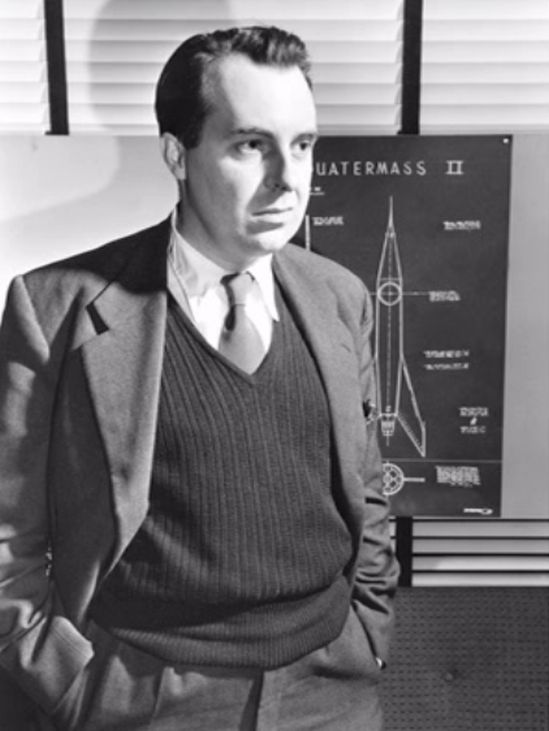
I went to London for a celebration of the centenary of the birth of screenwriter Nigel Kneale. Organised by Jon Dear, with the glamorous assistance of Toby Hadoke, Howard David Ingham, and Andy Murray, this was a day of screenings and panel discussions in the Crouch End Picturehouse.Nigel Kneale is not a household name by any means, but in his long career he produced striking work for television and cinema. He started writing for television in the 1950s, when TV drama was starting to become a thing, and while he initially wrote all kinds of stuff it is his science fiction and horror writing that he is remembered for. His best known works probably being the three 1950s series of Quatermass (a kind of proto-Doctor Who, except for grown ups), though he was still writing into the 1990s.
The first panel looked at Kneale's early work with the BBC, which started with literary adaptations and then moved on to The Quatermass Experiment in 1953 and its follow-up serials in 1955 and 1958, as well as his adaptation of Nineteen Eighty-Four in 1954. These were the event television of their time, with questions being asked in parliament about Nineteen Eighty-Four and the streets reportedly emptying when Quatermass was on, though of course this was also a time when there was only one British TV channel. The details of television's early years brought up the panelists were fascinating. At that point television, even drama, was still mostly broadcast live; pre-recording was only used for material shot outside, which was still a bit of a novelty. Drama was also conceived in very theatrical terms, with Reginald Tate, the actor playing Quatermass in the first series, taking a bow at the end of the last episode.
One of the panelists had looked up what was actually shown on the BBC on the day the first episode of The Quatermass Experiment was shown. Initially there was alternating coverage of Royal Ascot and Formula One motor racing, then a short piece of children's programming, more Ascot and motor racing, and a news reel, all interspersed with interludes when nothing was being shown. And then a warning from the announcer that the following programme might not be suitable for children or those of a nervous disposition, before the ominous tones of Holst's "Mars" brought us into the world of Professor Quatermass and his experiment.
Another point made by the panelists (and one repeated through the day) was that for all Nigel Kneale's best remembered work dealt with science fiction and horror themes, he never thought of himself as a genre writer and was indeed very dismissive of science fiction. Partly that derived from his having a somewhat limited sense of what constituted science fiction, seeing it as something characterised by the US pulp tradition and screen material inspired by it. Science fiction fans will rightly grumble that the genre has so much more to offer. And yet if you look at what passes for screen science fiction now you see that it is dominated by films in which people in stupid costumes punch each other or by formulaic Trek Wars crap that is cosily familiar rather than in any way challenging. It's like the pulp tradition has taken over science fiction, so maybe Kneale was right to dismiss the genre entirely.
This discussion preceded a screening of "Contact has been established", the first episode of The Quatermass Experiment. Professor Quatermass is the director of a British space programme that has sent a manned rocket into orbit, but something has gone wrong. Eventually the rocket crash lands in south London, but inexplicably there is only one of the three astronauts left inside the capsule.
One thing that struck me with this episode was how the shadow of the Second World War hangs over Kneale's early work. After the rocket lands on a residential street displaced locals reference the Blitz, with one confused woman seeming to think that the V2 rockets are back. The later Quatermass and the Pit sees people finding something during tunnelling that they initially think is an unexploded German bomb (that drama's nightmarish climax sees people consumed by an urge to exterminate the different, which also evokes the horrors of the Third Reich). And Kneale's Nineteen Eighty-Four feels very much like it is set in a world where the Second World War never stopped (which I think was Orwell's intention but it is maybe less obvious to us when reading his book). I suppose in the 1950s the war was still very recent, with some food rationing still in place when the first Quatermass episode was broadcast. That the war, or something like it, could start up again must have been a fear forever lurking below the surface. The depiction of a street destroyed by a rocket must have triggered uneasy memories on the part of many viewers (and for all the studio bound nature of the first Quatermass episode, the ruined house set is surprisingly effective).
"Contact has been established" was followed by Tom Baker reading Kneale's short story "The Photograph"; the story is from much further back but this was broadcast in 1978, when Baker had only recently departed from Doctor Who (ironic in that Kneale thought Doctor Who was rubbish but also resented how its producers lifted his plots and themes). After a short break Jon Dear talked to Douglas Weir of the BFI about the restoration of Kneale's Nineteen Eighty-Four (out now (finally) on DVD and Blu-Ray); having seen that some years ago at Loncon I am looking forward to catching it again in all its restored glory.
Then we had a panel on Nigel Kneale in the 1970s. This was Kneale's folk horror period, with ancient evils supplanting the dangers of science gone wrong in his work (though arguably the danger of chthonic terrors from the past was also a theme appearing in some of his earlier work, notably Quatermass and the Pit, while the 1970s still saw Kneale engaging with science fiction themes in the likes of The Stone Tape and the final 1979 Quatermass series). By now of course television was a much more mature medium, broadcast in colour with drama no longer going out live. And there were more channels in Britain (three, to be precise). TV was also edgier: for all that Mary Whitehouse was clipping its heels, much more could be shown now than in the 1950s. There was an interesting point made by Una McCormack about how not all of this lack of inhibition in the 1970s was necessarily great, with the television and cinema of the era sometimes seeing sexism slide into outright misogyny (think about how common sexual assault of women is in notable works of the decade); she talked of Kneale acknowledging this and reacting against it in the likes of Murrain or the Beasts episode "Special Offer". You could see something similar in The Stone Tape, where Jane Asher plays almost the only woman in a drama otherwise featuring a lot of often boorish men.
That was followed by a screening of Murrain, originally broadcast by ITV as part of the Against the Crowd anthology series. The film is based on two conflicts: the young vet representing science and modernity versus the superstition of the country folk, and then same superstitious country folk versus the eccentric old woman they believe to have cursed them. It makes for disconcerting viewing as it is never quite clear where your sympathies are meant to lie. Well, the vet is always operating with the most noble of motives, but beyond that it gets more complicated. Are the countryfolk bad because they are persecuting an old woman for no crime other than being a bit odd? Or is the old woman actually an evil witch who has brought a curse down on her neighbours? Or is she a woman of power who is merely striking back against her neighbours' persecution? The drama also retains an ambiguity as to whether the old woman is actually possessed of sinister powers, or whether the various ailments afflicting those who have slighted her are psychosomatic (which could be the case even if the old woman thinks she has cursed them). On the other hand, the farmer's pigs are actually suffering from a mysterious sickness (the murrain of the title), something that for them is unlikely to result from a belief in witchcraft.
Murrain is also surprisingly funny. Not funny all the time, but it has its moments. Like when the vet is in the village shop trying to buy stuff for the old lady. He asks the shopkeeper if she has any olives or chorizo; she gives him a look suggesting there is not much demand for such fripperies in these parts.
Murrain also gives us the great phrase from the vet, "We don't go back", with which he asserts his confidence that science will always provide the answers and that the old ways of superstition have nothing to offer us. The phrase gave Howard David Ingham the title for their book on folk horror, because the whole genre is largely based on the idea that maybe we will go back actually. By the end of Murrain even the vet's confidence in science seems to be shaken, for all that the drama's climax remains ambiguous.
That was followed by a panel on Kneale on film. For all that he wrote primarily for television, there are a good number of films based on his work or else scripted by him. Hammer made films of the three 1950s Quatermass series, the first two in the 1950s while Quatermass and the Pit (the best by a considerable margin) did not appear until 1967. He wrote some other films for Hammer (Abominable Snowman and The Witches) as well as an adaptation of H. G. Wells' The First Men in the Moon (which seemed to be always on television when I was a child). And he did some non-genre work (including, surprisingly to me, adaptations of John Osborne plays). But it was hard to escape the feeling that film was not really his medium, with his writing for the big screen being littered with projects that were stillborn or ended up as compromised failures (e.g. Halloween 3). Cinema is a more difficult medium for writers, with the amount of money riding on a picture meaning that someone like Kneale was never going to be given the kind of free rein he had on television.
And then we had a short clip from The Quatermass Xperiment [sic], the 1955 Hammer film adaptation of the first Quatermass series. A little girl playing on her own meets what we know to be a man transforming into something else, in a scene that cannot but evoke a disturbing counterpart in the 1931 film of Frankenstein. The girl was played by Jane Asher, who started out as a child actor. We then had the excitement of Jon Dear interviewing Jane Asher (Jane Fucking Asher!) as an introduction to a screening of The Stone Tape, in which she played the leading role.
Asher lent the day an air of star quality and was an engaging and entertaining interviewee. I was particularly amused by how one of her anecdotes pivoted to "He was a lovely man" when she discovered that its subject (a Stone Tape collaborator) was still alive. I had to admire her making a long round trip to attend the event, particularly given that she did not stay for the screening (she mentioned hating seeing herself on screen, something which I understand is not uncommon among actors). I was also struck by how there was an accidental echo of The Stone Tape in her appearance in the Picturehouse. In the TV drama she plays almost the only female character, isolated in a world of blokey blokes, while the Nigel Kneale Centenary event was also a pretty male-dominated affair, both in terms of the audience and the programme participants (there were several manels and no panel with more than one female participant); hopefully this event went better for her than The Stone Tape did for the character she played.
And so to The Stone Tape itself. As with almost all the screenings, this was my first time seeing this, though it is something I have heard discussed at folk horror online events. It is a feature length TV play first broadcast on BBC 2 in 1972. It mixes science fiction and horror, being in part a ghost story but also attempting to offer a scientific explanation for hauntings (the idea that places can somehow record events that have taken place in them, now often referred to as the Stone Tape theory, for all that the idea preceded the drama). And the play itself is about recording, as its premise is that a team of recording engineers are setting up in a country house to research new audio technologies. The house being haunted presents some challenges, but when they hit on the Stone Tape theory they start thinking that this could maybe be harnessed into a revolutionary new audiovisual recording medium. But this is horror so things do not entirely work out.
I mentioned that Jane Asher plays (almost) the only female character in The Stone Tape, a computer programmer. The sexism of the era is a bit of a theme to this one, with the married head of the project in a problematic relationship with her, while she often finds herself patronised by her colleagues. But what is really striking about the drama is the racism. The researchers are in competition with Japanese rivals, and every time they are mentioned (usually as "The Japs") the characters switch into the kind of parody Asian accent and facial contortions that would disbar you from public office if a recording of you doing it were to surface. And also the company they work for, Ryan Electrics, is owned by an Irishman; he never appears but whenever he is invoked the characters switch into stage Irish accents. Yet it is hard not to see all this as signs of weakness rather than confidence. It must gall these arrogant Englishmen to be taking orders from the scion of one of their former colonies. And for all their mocking of the Japanese, it is stated fairly explicitly that unless the team achieve their sonic breakthrough the British audio industry will be soon wiped out by its East Asian competitors. The sexism might also mask a blokey unease that women are now moving into the workforce and occupying roles that would previously have been the preserve of men.
I should also mention that The Stone Tape features an amazing BBC Radiophonic Workshop soundtrack.
I was talking after the screening to one of my neighbours about how Ireland and the Irish people are a bit of recurring theme for Kneale. As well as Ryan, he mentioned how in Quatermass II the revolt against the alien invaders begins on St. Patrick's Day and is spearheaded by Irish labourers. And there is an Irish drunk in The Quatermass Experiment. Irish names show up throughout Kneale's work. I'm not sure what the significance of this might be. Kneale was not from Ireland and as far as I know he did not have ancestors from here; he may never have visited the island. But maybe this is not so remarkable: there are lots of Irish people in Britain after all, and they are an easy kind of slight other to represent.
And then we had an odd thing, a live performance of You Must Listen a lost Nigel Kneale radio play broadcast in 1952. Again it combined technology and hauntings, with an initially comical tale of crossed telephone lines becoming more macabre as the intruding voice is revealed to be that of a dead person. It had a lot of characters, who were performed by programme participants and a few professional actors (these were not mutually exclusive categories). I was impressed by how Mark Gatiss, probably the most famous participant, took a relatively minor role.
You Must Listen reminded me somewhat of Robert Presslie's short story "Dial 'O' for Operator", in some respects a similar tale of crossed wires and temporal distortion, though in other ways rather different. Presslie's story did not appear until 1958, so it is possible Kneale's drama planted the seed in his brain.
The final panel looked at Kneale's legacy. Stephen Gallagher compared Kneale to Stephen King, in that both writers revolutionised horror by placing it in everyday contemporary settings (sadly no one noted that we were attending an event in Crouch End, setting and title of one of King's most effective short stories). There was also reference to the disturbing prescience of his late 1968 TV play The Year of the Sex Olympics, which prefigures much of the reality television that blights our age, with something like Naked Attraction almost looking like it took Kneale's play as a template. Mark Gatiss mentioned that at the peak of The League of Gentlemen's success, he tried to push the BBC's controller to commission a new series from Kneale, still living at the time. However, he was told that there was no place on the BBC for someone whose career started before the invention of the remote control.
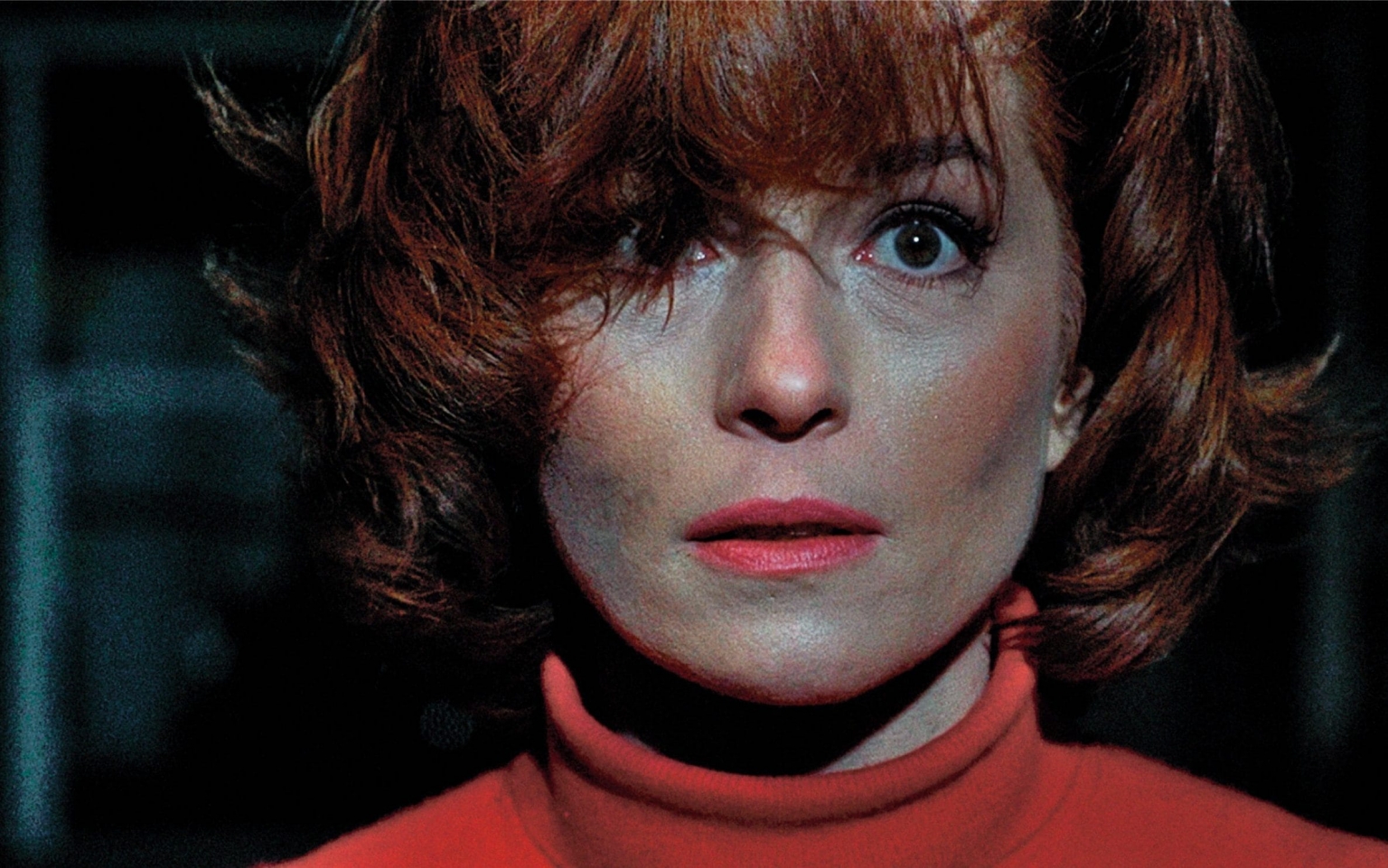
And then the day closed with a screening of Quatermass and the Pit, the 1967 Hammer film version of the 1958-59 TV series. Directed by Roy Ward Baker and with a strong cast including Andrew Keir as Professor Quatermass, James Donald and Barbara Shelley as palaeontologists, and Julian Glover as an army officer. Like much of Kneale's work, this combines science fiction and horror, with Quatermass's space research interrupted by the discovery of strange hominid remains during construction work on an extension to the London Underground's Central Line; that initial find is followed by ever more disturbing revelations about the true history of humanity.
It is a stunning piece of work, with the tension building as the awful truth is gradually uncovered and the drama moves towards an apocalyptic climax. Maybe the closing section of the film is ever so slightly rushed, but Kneale nevertheless did an amazing job condensing a TV series of more than three hours into a film of 97 minutes, with the propulsive energy of the narrative carrying the viewer along without leaving them time to ponder possible logical gaps in what they are watching. Much of the horror comes from people realising things or just having an idea at the edge of their understanding: there is an astonishing scene early on where a tough policeman comes close to a breakdown merely be viewing odd graffiti marks in an abandoned house. As one of the panellists earlier remarked, The Quatermass Experiment is about an alien incursion happening now while Quatermass II has an invasion that began a couple of years ago, but in Quatermass and the Pit the alien invasion took place five million years ago and basically succeeded, profoundly altering the course of human development but not in a good way (this a year before the publication of Erich Van Daniken's Chariot of the Gods).
The film also looks amazing. It has the saturated colour of Hammer films of the era but somehow this all seems more impressive in what was then a contemporary context rather than being in some backward corner of Mitteleuropa. Like other Hammer films Quatermass and the Pit is also happy to focus much attention on the good looks of a female lead. Yet for all that Barbara Shelley appears in a succession of stunning outfits, she is never presented as the kind of sexy lady seen in other Hammer films (for comparison see her performance in the latter part of Dracula, Prince of Darkness); the film's poster is somewhat misleading in this regard.
And that I suppose was that. I enjoyed the event a lot, with the combination of programming and discussion working very well. The material shown to us was particularly well chosen, presenting a fascinating overview of Kneale's career, building like one of his works to a terrifying climax, in this case Quatermass and the Pit. The panels were full of interesting people whose insights greatly improved our enjoyment of the screenings and had me thinking of more things to watch. Overall the event had the feeling of a cosy SF con (there was even a slightly redux Lally Wall). Looking back though I found myself thinking about two things the panellists did not really touch on. The first was Kneale's non-genre work, only really mentioned in passing. There was a surprising amount of this, including an episode of Kavanagh QC (his last work according to IMDB), an adaptation of Sharpe's Gold, the previously mentioned John Osborne screenplays, and an adaptation of Wuthering Heights (which admittedly is semi-genre). What I was curious about here is whether in his work on these non-genre pieces he still somehow injected some Kneale magic into proceedings, or whether they are essentially pieces of generic hackwork that could have been written by anyone. The other thing I found myself wondering was whether Kneale ever considered moving into direction, thereby trying to become a proper auteur director rather than a writer who had to worry about how his work would be realised. Books like Into the Unknown by Andy Murray (on sale at the centenary event but sadly all copies were snapped up before I could buy one) or We Are The Martians (edited by Neil Snowdon) might provide further insights into these questions.
When my aunt was in her early teens she reported having a strange dream. Her mother, my grandmother, was concerned and questioned her closely. The answers confirmed my grandmother's suspicions: she was no longer dealing with her daughter but with a changeling who had been left in her place by the fairy folk. Fortunately my granny knew what to do. She and my grandfather borrowed a car and brought my aunt (or the changeling who looked like my aunt) to meet a man who was wise in the ways of the fairy folk. The fairy man was a Protestant living in a mainly Catholic country; this may have been significant. He did some things and then told my grandparents that the matter was resolved: their daughter would return to her normal state provided they brought her back home without talking to anyone on the way. They had probably anticipated this condition, which was why they borrowed the car in a time when people in their locality still mostly travelled by horse-drawn carriage. So they drove back home and talked to no one on the way.
The most famous Irish case involving a changeling, or the belief that someone had become one, is that of Bridget Cleary, which ended in horror and tragedy. In 1895 Michael Cleary became convinced that Bridget, his wife, had been replaced by a changeling. To recover his wife, he set fire to the "changeling", burning her to death; he seems to have been assisted in this by some of his neighbours. Michael Cleary was convicted of manslaughter, his confederates of lesser crimes. The flames did not recover the real Bridget Cleary from the fairy folk.
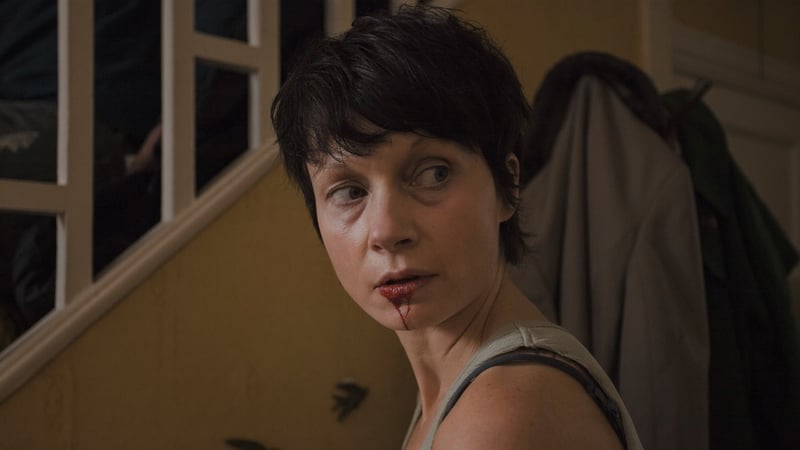
You Are Not My Mother, an Irish film directed by Kate Dolan, starts off as a film about mental illness. Teenager Char lives with her mother, Angela, and her grandmother. Her mother suffers badly from depression and is really crushed by it; she barely leaves her bedroom and declares at one early point that she can't go on like this anymore. She disappears, leaving her car abandoned on a piece of common ground in their housing estate. And when she returns she can't say where she has been but seems now to be entering some kind of manic stage, no longer crushed by depression but acting in an increasingly erratic manner. Meanwhile Char is suffering in school, where the tough kids are picking on her and making fun of her for having a crazy mother. And Halloween is approaching, a time when things get a bit strange in the housing estates in which this film is set.
So, so far so bipolar. Except Char's grandmother starts to have suspicions about Angela, suspicions she eventually reveals to Char: the person she thinks is her mother is actually a changeling, sent by the fairy folk in the hope of abducting Char herself, whom they had apparently tried to take when she was an infant.
Now, there are two ways you can go with a film like this. You could be making a film about people with funny ideas and crazy beliefs, in which case the grandmother's conviction that Angela is now a changeling becomes a mirror image of Angela's own bipolar problems. Alternatively, you could have an OMG reveal that "Angela" is actually a changeling. I'm wary of posting spoilers but the fact that You Are Not My Mother is billed as a horror film rather than a psychological drama might give readers a clue as to which way the film goes. And I think maybe this choice was a mistake.
The changeling idea works well as a metaphor or manifestation of mental health issues. Capgras' syndrome is the delusion that a loved one has been replaced by an identical double, with cultural beliefs determining whether the double is seen as a changeling, an alien, a pod person, a foreign spy, an android, or something else. Or the issue can lie with the person perceived as the changeling. I have heard it said that the idea of infant changelings might be linked to the first manifestations of autism. Severe psychiatric illness can also make it seem that a loved one has been replaced by a double. You Are Not My Mother nods to this last approach, with Angela already established as suffering from mental illness and her post-disappearance mania initially seeming like a new phase of her condition. Taking this route, the monster in the film becomes the grandmother, with her crazy idea that fire will get return true Angela in place of the false one. But the film turns its back on that approach with the sudden reveal that Angela has actually been replaced by the fairy folk.
At this point You Are Not My Mother turns into a monster film, with Char being chased by the false mother, who wants to take her away to live with the fairy folk. I would have preferred a different outcome, but your mileage may very. I was particularly uncomfortable with the way the film's ending evoked Bridget Cleary's homicide, but in a way that could be taken as justifying her killing.
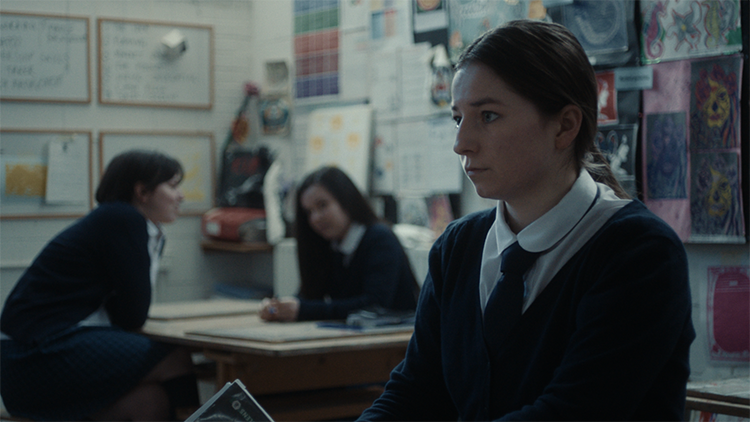
And yet for all my grumbling about a pretty fundamental turn the film took, I nevertheless really liked You Are Not My Mother. The characterisation is very strong, with Hazel Doupe as Char, Carolyn Bracken as Angela and Ingrid Craigie as the grandmother all excellent. Jordanne Jones as Suzanne, a classmate of Char, is also very impressive. The film is really stunning in its depiction of bipolarity and the confusion it engenders in the bipolar person's dependents. Char's troubles with her peer group and then her growing friendship with Suzanne (after initial hostility) is very well handled. I particularly liked how a scene where the two share a joint is presented as a bonding experience rather than a prelude to Char's descent into delinquency.
I should also mention that the film uses music very well. Die Hexen provide an eerie eerie electronic soundtrack that also evokes Irish traditional music. There is also a striking scene where Angela (or False Angela) dances in an increasingly demented manner to Joe Dolan's "You're Such A Good Looking Woman".
So there is a lot that I Iiked about this film. I just wish that the film had used the changeling myth as a way of exploring its interesting ideas further rather than going down the monster film road.
Hazel Doupe as Char (Advocate: "Out Director Kate Dolan’s You Are Not My Mother Queers Folk Horror" [This piece is worth reading. I did not talk about possible lesbian subtext between Char and Suzanne as I am wary of seeing all female friendships in films as sapphic, but it seems like the film's director did see it that way.]
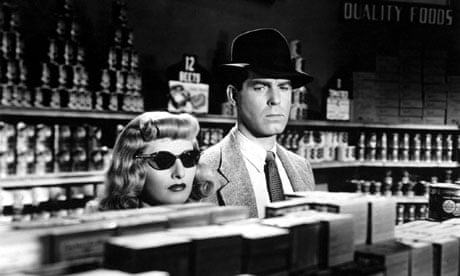
I saw these in the before time as part of an IFI season of films about couples who kill. Double Indemnity, directed by Billy Wilder, is a definite noir classic about a guy who thinks he is pretty smart (Fred MacMurray) and a dame (Barbara Stanwyck) who is playing him for a chump. If you have not seen it, the title comes from a term in life assurance policies whereby the insurer pays out double for particularly unlikely events, in this case a fatal accident on a train. As can be imagined, the plot involves a life assurance policy with just such a clause and a murder made to look like a fall from a train. The film is a masterful depiction of obsession leading to folly and delusion, with a typically noir inversion of the moral code through making the murderous insurance salesman the protagonist.
Billy Wilder made a lot of films and I don't know to what extent he is seen as making films with recurring themes, but there are definite elements here that find echoes in his other work. William Holden in Sunset Boulevard appears to have taken over the insurance salesman's apartment; in certain other regards the protagonists of both films follow a similar trajectory. The closing scene between the salesman and his loss adjustor colleague (Edward G. Robinson) recalls the ending of Some Like It Hot with its faint suggestion of homosexual attraction (though I could be reading too much into what is actually a more traditional paternal relationship). And similar to those other films, there is an air of loucheness to this one. In the opening it is presented as entirely normal that an insurance salesman would engage in lewd banter with the wife of a potential client, while later a minor character talks about how much he is looking forward to seeing a visiting "osteopath".
The Getaway meanwhile is a Sam Peckinpah directed film about a crim (Steve McQueen) who has to make a getaway after a heist goes wrong when other crims try to double-cross him. He is aided and abetted in this endeavour by his lovely wife (Ali McGraw). The film starts well with largely wordless scenes showing the crim in jail, the machinery of the jail juxtaposed with the mechanistic tasks pursued by the prisoners. It goes downhill once he gets out. The whole heist-gone-wrong plot is a bit plodding and predictable while the film as a whole has a tiresome air of macho blokey bollocks to it (see also: all other Sam Peckinpah films).
Peckinpah films are sometimes like artefacts from an era of unreconstructed offensive sexism and The Getaway is no exception in this regard. The scenes in which for reasons a rival crim kidnaps another couple and then starts shagging the woman, who turns out to love getting some good lovin', leaves a nasty taste, particularly as it is all largely played for laughs.
The various scenes where Steve McQueen's character slaps Ali McGraw around are also quite distasteful, not least because they were in a real-life relationship at the time that was reputedly characterised by domestic violence. Some of the other quirks of the Peckinpah style also grated with me. The slow-motion arcs of blood in the death scenes were a bit comedic; these may once have seemed ground-breaking but now (and perhaps already by the time this film was made) they are little more than Peckinpah cliché.
But for all that, the film has a strong visual sense. As previously noted, the images of jail life are stunning. Another scene that gives rise to some striking images is one where McQueen & McGraw escape emerge in a dump having escaped from the cops in a garbage truck's trash compartment. Neverthelss the film remains fundamentally not that good but might be of interest to film history types or fans of domestic violence. Otherwise don't bother with The Getaway: watch (or rewatch) Double Indemnity instead.
images:
Double Indemnity (Guardian: "My favourite film: Double Indemnity")
The Getaway (Basement Rejects: "The Getaway (1972)")
These are two of those compilations released by Ace Records and put together by Bob Stanley of Saint Etienne (in conjunction with Jason Wood in the case of Cafe Exil). They're both collections of music from the 1970s. In 76 in the Shade we are back in the notoriously hot summer of 1976. Thanks to England's Dreaming (Jon Savage's brilliant account of the Sex Pistols and their milieu) I think of 1976 as the year of punk, for all that 1977 was when it went overground and exploded into the living rooms of olde England. But there's none of that here. Instead the album has a collection of languid tunes that evoke a sense of being too damn hot to do anything.
It is in the nature of the music that individual tracks should not really stand out, but two tracks that really catch my brain are Lynsey De Paul's "Sugar Shuffle" and 10cc's "I'm Mandy Fly Me". With "Sugar Shuffle" I may perhaps be drawing of memories of when Lynsey De Paul used to appear on 1970s TV a lot, most notably when she competed in the Eurovision. She was a total sizzler and little me has a massive crush on her. "Sugar Shuffle" sees her seductively inviting listeners to join her doing said sugar shuffle. Sadly De Paul's style of music was swept away by punk and new pop, and she went on to go Tory, but hey, nobody's perfect and for a brief period in the mid 1970s she made perfect sense.
"I'm Mandy Fly Me" meanwhile takes its title from some innuendo laden advertising campaign where named lovely lady air hostesses would beckon businessmen to fly with their airline. The lyrics are ambiguous and could be about a plane crash or someone completely losing it, but it has an oddly disconcerting quality that brings it away from the mainstream of these heat-drenched tunes.
If the thoughts of 10cc and Lynsey De Paul providing the compilation's best tracks fills you with dread then you might want to stay away from 76 in the Shade.
Cafe Exil meanwhile is conceptually a compilation of interesting European music from the 1970s, together with tunes from some similar UK acts. Looking at the roster it is a bit krautrock (Faust, Amon Düül II, Michael Rother, Popol Vuh and Cluster all appear), but not exclusively so. The odd things is that although the acts here are all of the cool variety, unlike the mid-70s AOR and MOR terrors on the 76 in the Shade record, the overall feel of this is not too dissimilar from the other record, making it an ideal compilation for late night listening.
One Cafe Exil track that really stands out for me is Annette Peacock's "Pony", on which to an electronic accompaniment (at least partially her own) Ms Peacock sings about her fondness for her pony in an oddly strangulated tone. And then there is the Jan Hammer Group's "Don't You Know", a cheesy but laid back groover that sounds like it would be right at home on 76 in the Shade.
So yeah, two fun records. I'm looking forward to seeing what treasures Bob Stanley unearths next.
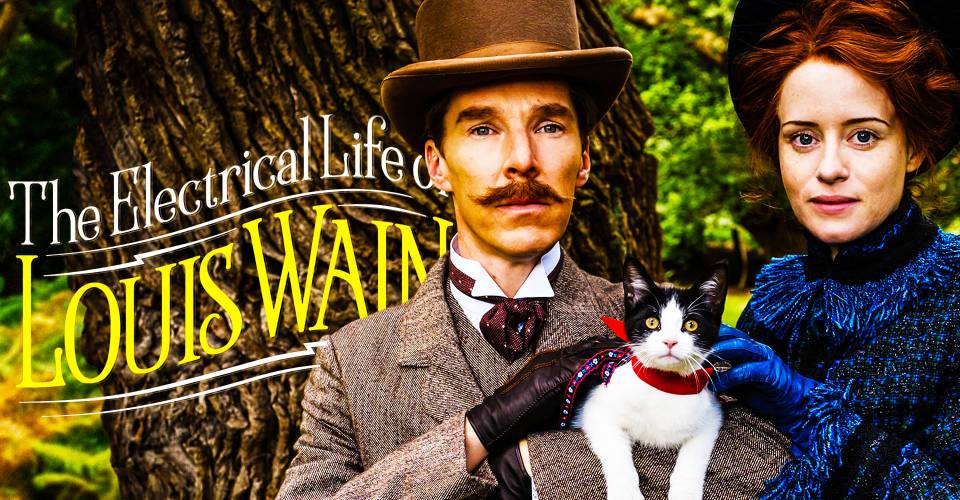
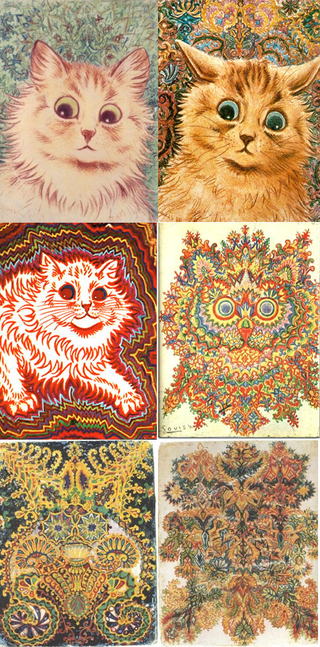
Directed by Will Sharpe, this is a biopic of that late Victorian guy who painted pictures of cats, with Benedict Cumberbatch shining in the lead role. Before seeing the film my thumbnail understanding of Louis Wain's life was that he painted pictures of cats and then went mad, with there being some debate as to whether his mental deterioration can be traced in the development of his art style (some of the cat pictures are completely bananas but it is not clear that he painted them after the more conventional ones). The film throws in a couple of other sad facts about his life, revealing first that he scandalised his family by marrying his sisters' governess (wonderfully played by Claire Foy) but was then parted from her prematurely when she died of cancer. Also one of his sisters also goes mad (before his own breakdown); as presented in the film you get the sense that oddness ran in the family, with his more sensible elder sister (played by the always wonderful Andrea Riseborough) coming across as someone permanently putting on her game face to present as normal.
And yet, it is a far less miserable film than that potted summary of Wain's life suggests. He has his ups and downs and yes he does end up permanently institutionalised, but following a fundraising appeal by his admirers he is brought to a nice asylum where he gets to both keep a pet cat and paint away to his heart's content. There are worse ways of passing your days.
This Wes Anderson film is set in an alternate universe in which for no obvious reason The New Yorker was published from a provincial French town. It's an enjoyable confection and probably best if not subjected to too much analytical thought. Anderson has settled into his own aesthetic to the extent that his films are now instantly recognisable and made in such a way that they are only going to appeal to people who already like Wes Anderson films. Oddly, the director this one most reminded me of was the USSR's Sergei Parajanov, particularly his The Color of Pomegranates, with which The French Dispatch shares a colour palette and a fondness for tableaux, combined with a disdain for anything approximating to a plot.
I have found myself thinking about whether this film would be eligible for the Hugo Awards, which recognise works in the fields of science fiction and fantasy. You would struggle to make the claim that The French Dispatch is a science fiction film, but you might be on better ground arguing that it counts as fantasy. After all, the eponymous French Dispatch newspaper never actually existed. The film is not just set in a made-up French town but in a fantasy version of France, so its connection to the real world is pretty tenuous. But I think it unlikely that it would attract so many nominations that the Hugo administrators would have to decide on its eligibility.
Everyone loves this; everyone except me, for I found it to be dull and fundamentally inconsequential. It follows an odd semi-relationship between a precocious teenage child actor mutating into a kid entrepreneur and a somewhat aimless woman in her 20s. And it's set in 1973 or 1974 with the post-October War oil crisis in the background (at one point a truck runs out of petrol and rolls down a hill, which I think might be a metaphor of some kind). It all looks great and has a great soundtrack and features great performances, not least from the principals (Cooper Hoffman and Alana Haim), but I found it really hard to care about the story or the characters. I think maybe a lot of this is down to the characterisation of Gary Valentine, the kid entrepreneur. Basically I hate entrepreneurs and having to spend time in the company of some 15 year old and his stupid business ideas was like a sojourn in hell. Alana Haim's character (also called Alana, which suggests a lack of imagination on somebody's part) was a lot more appealing but that made her association with the kid entrepreneur all the more disturbing.
But as noted, nearly everyone else in the world loved this. The only other gripes I saw focussed on the age difference between the semi-couple at the story's heart. At the start he is 15 while her age is somewhere into the 20s. There's no suggestion that they are even approximating to getting it on but that still is a whomper of an age difference; if a film featured a romance between a man in his twenties and a 15 year old girl then there would be uproar. I have to say though that the age difference did not jar so much with me while I was watching the film. Partly I was preoccupied with how boring the film was but I think also Gary's precociousness masked how young he was, while Alana's slight frame and lack of focus in her life made it easy to subconsciously think of her as younger than she was. Also I am so used to films in which women in their 20s play teenagers that the age difference was easily forgettable when they weren't ramming it down our throats.
People also did not like that there is a racist minor character in the film.
Overall though I think this film is like The Master, a previous Paul Thomas Anderson: full of strong performances and scenes that linger in the memory, but something that was an ordeal to get through when I was actually watching it.
 Wet Let [untitled Wet Leg album] (2022)
 Tenniscoats Tan Tan Therapy (2008)
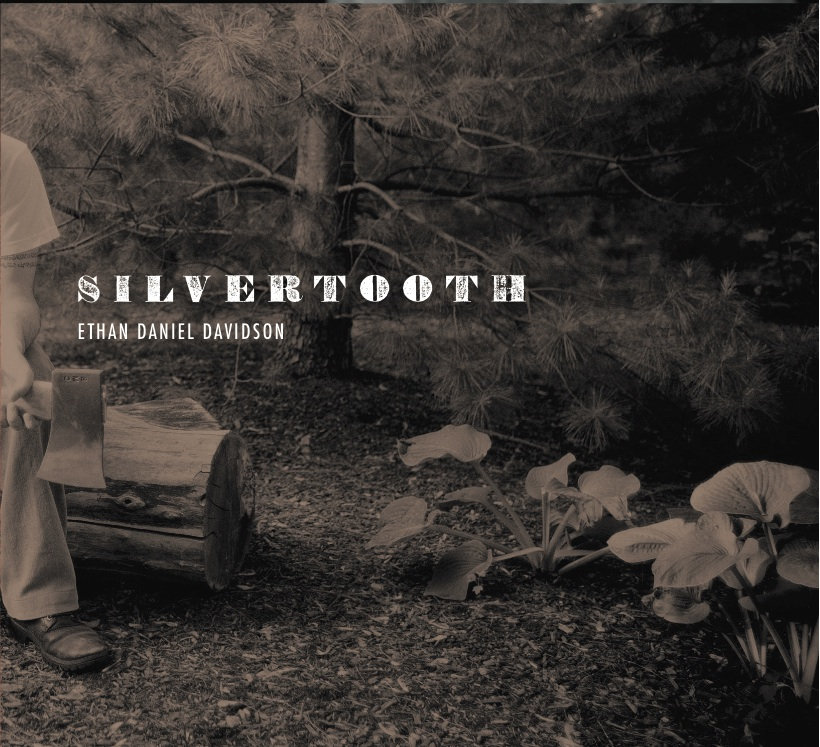 Ethan Daniel Davidson Silvertooth (2012)