Monday, March 02, 2015

I IS FOR… INSPIRAL CARPETS


In the pages of Frank's APA we are running through the letters of the alphabet.
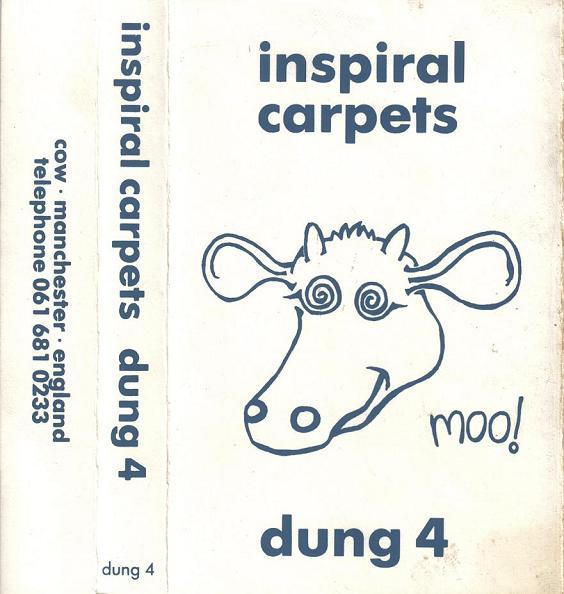
Possibly the same summer (1988, 1989?) that I went to see Hawkwind with Mr W— in the Brixton Academy I also caught Inspiral Carpets playing in some venue in Camden (Dingwalls?). They were an up and coming band at the time. My memory is that all that Manchester stuff was on the way up round then, and as they were from Manchester they were riding that wave. By the time I saw them they had moved on from their cassette only first album and had changed lead singer to the one who would sing on all their hit records, but the basic template sound was in place. They had beaty tunes with the organ sounds of Clint Boon prominently featured.

Before the concert a looped voice played over the PA saying something like "Tonight… in Manchester… two hundred people came to see… Inspiral Carpets… the biggest bunch of wankers… ever". It was hypnotic and vaguely amusing. I think Mr W— and I kept saying it to each other for years afterwards. This was in the pre-Internet age; we had to make our own entertainment.

Inspiral Carpets were on the way up at that point and they did go on to some success, having hit singles and seeing one of their tunes used as the theme music to a Saturday morning kids TV programme. But I think the real prize eluded them and they remained a second string band. When I saw them again some years later in Dublin, they were still a a great live band and able to draw a reasonable crowd, but the sense was that they were a band on the slide. I remember liking the album they were pimping at time, and also the lead single 'I Want You' on which Mark E. Smith guested, but I do not think it overly excited the record buying public.

History has not been kind to the Inspiral Carpets. They seem to show up in books about the music of the era to be dismissed as the kind of rubbish band who acquires a certain following simply by association with other, better outfits. That seems a bit unfair. I would not make any claims for Inspiral Carpets being one of the great bands of the late 20th century, but they are a good solid mid-level outfit.

Or so I thought before I started writing this piece. Putting it together for the web I checked out some Inspiral Carpets tracks on YouTube and have been struck by what earworms they are. It might be that two unfortunate things counted against the Carpets. One was being associated with all the Madchester ravey stuff when they were basically a 60s revival outfit (which was the basic template of all indie bands pre-Madchester, except that they were a lot better than the others). As a non-ravey band they are always going to be remembered as not really a proper Madchester band and so will always be a bit marginal in histories of that scene. The other problem is that their biggest hit was something of a lovely song ballad; that is never good in retrospect. If they are to be remembered it should be for the likes of 'Two Cows', 'I Want You' or 'She Comes In The Fall'. Or this.
Dung 4 (Plain or Pan)

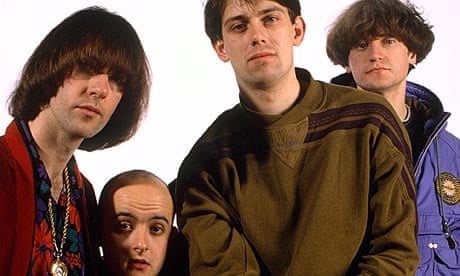
1988 band photo (Guardian)

Sunday, March 01, 2015

[theatre] "Ganesh versus the Third Reich" in the O'Reilly Theatre

I theoretically love going to the theatre but never seem to do so in practice. This is one of just two things I saw in the Dublin Theatre Festival last year. What I picked up from the programme was that this play was about Ganesh (you know, elephant headed Hindu deity) coming to the Third Reich in order to reclaim the ancient symbol of the swastika from the Nazis, which was enough to make it sound like it would be worth seeing. I also registered that it was being performed by Australians.

When the play started, though, I had a slight moment of "where's the fucking Nazis?", as there were neither Nazis nor Hindu deities on stage but two fellows not dressed in 1940s garb. When they started talking I was further confused, as their speech was a bit hard to understand. My first thought was that they were speaking with incomprehensible Australian accents or else that some incompetent had taken over the theatre's sound. But something else soon became apparent: the two actors onstage were both people with intellectual disabilities.

It turned out that the play had three actors with intellectual disabilities and two without. And it was a bi-level thing, partly about Ganesh trying to take the swastika from the Nazis and partly about a theatre company featuring people with intellectual disabilities trying to put together a play about Ganesh trying to reclaim the swastika from the Nazis; the narrative about the actors was probably the dominant one here.

Split narratives often suffer from the problem that one of the narratives is a lot more interesting than the other. In this, though, they both seemed to work well enough together. In the Third Reich narrative Ganesh teams up with an intellectually disabled Jewish lad he rescues from Auschwitz, which of course reminds us that the Nazis were not exactly friends of people with intellectual disabilities.

Each strand of the narrative had at least one great scene. The Third Reich story had a great train carriage episode in which an over-familiar black marketeer starts trying to sell tights to the escaped Jew (who is in disguise, obv), asking an endless series of questions about his girlfriend, her sisters, his sisters, his mother and so on, all potential purchasers of nylons, with the questions forcing the invention of ever more outlandish details about all these non-existent people. It was a scene of the kind of building menace you get in Quentin Tarantino films (think in particular of that opening scene in the farmhouse in Inglorious Basterds).

The outer narrative, meanwhile, has a wonderful extended scene in which the increasingly unhinged actor-director is trying to get one of the ID actors to die properly when shot. It too builds and builds, from a physical comedy of frustration to a deeply uncomfortable episode of rage, to actual theatrical violence.

The ID actors were interesting, in that they were all really good albeit within a limited range. I don't think any of them would be able to convincingly play a character who was not intellectually disabled, but they very much came across as playing roles rather than just being themselves onstage.

There is a scene where the actor-director addresses the audience (or imagines addressing the audience when the play is being staged), accusing them/us of having come along for an evening of "freak porn". I think we were meant to shuffle uncomfortably in our seats at that, but it washed over me. I had no advance awareness that the play featured intellectually disabled actors and this must have been the case for many other people present, as the theatre festival programme did not mention it. Even if you had come along to this expecting something of that type you would probably leave a bit disappointed. The acting is too good and the play too tight to have any kind of freakshow aspect.

So all in all this made for an enjoyable if strange night of theatre.

image source (Sydney Morning Herald)

Saturday, February 28, 2015

[music] Basiani "Folk Ensemble of the Georgian Patriarchy"

Basiani are from the country of Georgia. The title of this record is more an explanation of who they are. The Georgian Patriarchy referred to is the leadership cadre of the Georgian Orthodox Church and not the organised apparatus of male dominance (though of course there may be some overlap). Basiani are their folk ensemble and they sing the Georgian polyphonic music that everyone loves.

This record has been on heavy rotation here in Panda Mansions, mainly because for a while we were following something of an All Georgian All The Time listening policy, particularly in the fraught period when all the other CDs were still in boxes. This is my beloved's record rather than mine so I feel like I am not letting the side down if I say that for all that it has been played a lot I probably have not listened to it that closely. I think it may take the listener on a tour of the Georgian regions, mixing choral polyphony with people singing solo to instrumental accompaniment. The tracks with yodelling may be the best. While the Georgian polyphony is the main attraction with records like this, there are also some beautiful tunes on which solo singing is foregrounded.

Friday, January 09, 2015

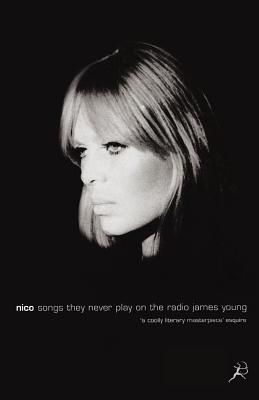
[book] James Young "Nico: Songs They Never Play On The Radio"

This is a memoir of the author's time he playing keyboards in Nico's last touring band, a period in which he also did arrangements for Camera Obscura, her last album. I read it first years ago but recently bought another copy to give as a present to a friend, giving it a quick re-read before doing so. It is a fascinating tale of life at the bottom of the musical ladder, a world away from the tales of fame and fortune you usually get in musicians' memoirs. Nico and the dodgy types hovering around her (including the author, her manager, and most of the people playing in her band) make for fascinating characters. The book is also surprising in its willingness to dish the dirt on living people, with John Cale in particular coming across as a particularly unsavoury individual. Nico herself remains an enigmatic and unknowable figure, her heroin-addiction contributing to a near-total self-absorption.

The book made me listen again to her wonderful records, particularly The End, Desertshore and The Marble Index (Chelsea Girl has its moments but its sunny production marks it out as False Nico). The best tunes marry her infinitely sad voice to a dirge-like harmonium accompaniment, creating sounds of terrible sadness which somehow never sound like indulgent mopiness. Reading the book made me think about her aesthetic and her creativity. So much of her work seems to have been thrown together to put out some product so that she can get some money together to score some smack, yet from that such great music has been made.

I would like to hear again the record that James Young plays on. I had a copy years ago and did not like it so much. I remember finding it a bit 80s, with synthesisers and the like burying the harmonium on too many of the tracks. But reading the book again makes me want to give it another go.

Anyway, I encourage anyone who likes music or fun stuff to have a look for this book. It was going for cheap in Fopp last time I looked. Even if you have no interest in Nico's music I think you would enjoy this vision of the less glamorous side of the music business.

Image sources:

book cover (Goodreads)

Nico at her last concert (from Nico IcoN, 1988 concerts)

Nico performing 'Valley of the Kings' in 1986:

Thursday, January 08, 2015

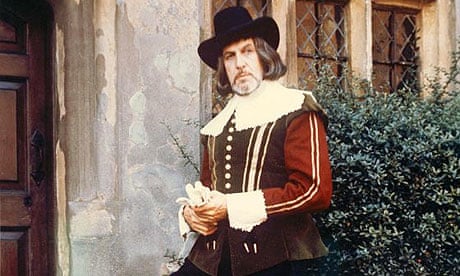
[film] "Witchfinder General" [1968]

Last September I went to a conference in Belfast on folk horror. The programme notes mentioned this film as being a key item in the folk horror canon, so I watched it on DVD beforehand. The film features Vincent Price as Matthew Hopkins, the self-styled Witchfinder General. Hopkins is a real historical figure who hunted witches in the chaotic period of the English Civil War. The film presents a lurid version of these events. It is ambiguous (at least initially) as to whether Hopkins is a sincere enemy of witchcraft or self-seeking cynic happily exploiting the superstitions of the gullible to advance himself. I gather Price was a controversial choice for the role but his odd looks and permanently ironic expression work well here. Hopkins is the villain, with Ian Ogilvy playing the protagonist, a Parliamentarian cavalryman who becomes locked in a vendetta with him.

The film was apparently controversial when it first appeared, because the violence it contains is a bit ramped up from the usual Hammer fare. I could imagine the sexual violence being problematic even now (a woman lets herself be debauched by Hopkins in a futile attempt to save her father from him and is later raped by the witch hunter's thuggish assistant). Some of the violence does seem to thrown in for voyeuristic thrills, like the completely ahistorical scene in which one of Hopkins' victims is burned to death (as far as I can make out, witches were always executed by hanging; burning at the stake was the punishment for heretics in Catholic countries and even that brutal method of execution was not used in the ridiculously elaborate manner Hopkins uses).

Yet the violence is not just for seedy thrills, as it can serve to advance the story and show the development (or atavistic regression) of character. The film ends with the cavalryman killing Hopkins (spoilers), but it is not after a brave fight. Instead the cavalryman bursts upon Hopkins and kills him with an axe in a frenzied attack. The film ends with the cavalryman's wife screaming, not because of the torture she was suffering only a few minutes before but at the sight of her husband transformed into a vengeful maniac.

Immediately after watching the film I thought it a piece of enjoyable schlock, with Price's over-the-top performance important here. But I have found that it stays in the mind and has a lingering power. For all its schlockiness and willingness to play fast and loose with history, it is a fascinating view into a world where social norms have broken down and people are happy to kill random strangers in order to advance their goals.

I do not know what the real Matthew Hopkins would have made of the film. Although there were rumours that he was murdered by someone related to his victims (as in the film) or even executed as a witch himself after failing one of his tests, it seems that he died of tuberculosis at the young age of 27. In just two years he seems to have had executed some 300 people, mostly women; some researchers estimate these as being some 60% of all the people ever executed for witchcraft in England.

image source (a piece in the Guardian by Alex von Tunzelmann, assessing the film for historical accuracy)

The film's trailer:

Wednesday, January 07, 2015

[record] Steeleye Span "The Best of Steeleye Span"

I have had this album for ages but only ripped it to iTunes recently; Rob Young's Electric Eden has rekindled my interest in all things related to English folk music. The compilation seems to have been released in 1984 and the songs are from between 1970 and 1980. They feature many of the Span's well-known folk rock tunes, like 'All Around My Hat' and 'Gaudete' (tunes that the author of Electric Eden dismisses as inconsequential tat). 'Gaudete' is an a capella tune sung in Latin, with vocal harmonies and stuff. I think it may involve god bothering. You may recall that Alan Partridge plays it in his car once to show off his sound system. After that it is all a bit more electric, with the voices of Maddy Prior and other band members being set against a rock accompaniment. Many of the tunes have Jacobite themes, which probably reflects the nature of the tradition.

One curiosity is the inclusion of a tune called 'Long Lankin', a variant of the same tune played by Alasdair Roberts on his Too Long in this Condition record. The strange thing is that I have had this Span record for what, 20 years, but have never noticed the gruesome lyrics of child murder and torture on this track, while they leaped out at me from the Roberts rendition (which uses a completely different tune and somewhat different words).

This record still leaves me with a slight sense of disappointment. There are some great tunes on it (all the ones mentioned so far, also 'Alison Gross', 'Thomas the Rhymer' and 'Cam Ye O'Er Frae France') but there does seem to be a fair bit of inconsequential filler on it. And it is clearly not the actual best of Steeleye Span, as another record of theirs I have features some truly great tracks not included here (e.g. 'The Boys of Bedlam' & 'Blackleg Miner'). I suspect record company issues.

image source (page on the record, from Mainly Norfolk: English Folk and Other Good Music

Tuesday, January 06, 2015

H IS FOR… HAWKWIND!

In the pages of Frank's APA we are running through the letters of the alphabet.

Hawkwind! As with so many things, I discovered them through my old friend and quaffing partner Mr W—, who would talk a consistently good game about them. When we were in London one summer (back in 1988 or 1989) he made going to a Hawkwind all-dayer sound like an appealing prospect, so I went with him to the Brixton Academy and saw Hawkwind supported by a load of other bands. Of the others I can only really remember Naz Nomad And The Nightmares (or something similar), who were The Damned under a different name playing 60s punk-psych stuff, and some other band who seemed to my untrained ears to be a Jimi Hendrix tribute act (or maybe I just thought that because I am RASCIST, as they had a black guitarist-vocalist).

Hawkwind themselves were amazing, their show a stunning audiovisual spectacle, the big space rock sounds combining with the stunning visual images of Elric, Stonehenge, and some kind of plant with funny leaves to great effect. I was particularly excited when Lemmy came on at the end as a special guest. To this day I do not know whether he is very tall or David Brock is very short, but the size disparity between them was astonishing.

Since then I gradually acquired Hawkwind records, probably now having more by them than by any other artist.Their recorded output is patchy. For every great album there is some shoddy compilation of badly recorded b-sides, for every great live album dozens of rough recordings of off key gigs in venues with appalling sound quality. Indeed, for such a great live band it is amazing how duff most of their live albums are.

On record their golden period ran from the early 1970s to some point in the late 1970s or early 1980s, depending on where you want to draw the line. They are perhaps unusual in that although there is one person who is indisputably the main person in Hawkwind (Dave Brock), there are an army of others who have provided services more stellar than just being the guy who plays bass. Other members of Hawkwind who would be the frontmen of any other band (and in several cases were) include saxophonist Nik Turner (fired by Dave Brock for having his own ideas), Lemmy (early bassist, fired for liking different drøgs to the rest of the band) and poet Robert Calvert. I should also mention Stacia, who enlivened their concerts with her expressive dancing, clad in little more than body paint; she is now a visual artist living somewhere in Ireland.

The big draw with Hawkwind for me was the spaciness, the sense that this was a band related to the world of Science Fiction. One hears how Michael Moorcock used to join them onstage in their early days, writing lyrics for at least one of their tunes. They had other songs referencing works of Moorcock and other SF writers, while some of Calvert's lyrics in particular have very SFnal themes. Occasionally the lyrics have utopian themes, but more usually the atmosphere is paranoid and dystopian. 'Sonic Attack' mimics a Protect and Survive type public information film, telling listeners what to do in the event of a sonic attack. 'Damnation Alley' describes a journey across a USA devastated by nuclear war. 'Spirit of the Age' has an astronaut flying away at relativistic speeds, thinking of the left-behind lover ageing rapidly while he stays the same age. Yet despite the dark future lyrics and Hawkwind's fondness for playing free festivals out in the country, they remain relentlessly technological and urban. To me they are not like hippies suggesting a retreat to some kind of pre-industrial pastoralism.

Like I said, not all Hawkwind records are good, so while they have a vast recorded output they are easy enough to approach for a novice. If you were thinking of dipping your toe in the waters of the Wind (er), try one of the following:

In Search of Space (1971) - featuring the stunning 'Master of the Universe'. The CD reissue also has Hawkwind's hit single 'Silver Machine', an enjoyable piece of fluff.

Doremi Fasol Latido (1972) - opening with the epic Nik Turner composition 'Brainstorm', the CD reissue also features 'Urban Guerilla', an edgy tune in the age of the RAF and Angry Brigade.

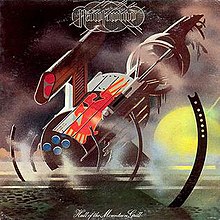
Hall of the Mountain Grill (1974) - next of the 1970s run of classic albums, possibly lacking any single track as in your face as the last two but a solid piece of work.

Warriors on the Edge of Time (1975) - more Moorcock inspired craziness. 'Assault and Battery' is a particular favourite of mine. The CD reissue features 'Motorhead' as a bonus track, recorded by Hawkwind before Lemmy took it away with him as the name for his new band.

Quark, Strangeness and Charm (1977) - probably my favourite. The opening track is a SFnal tale of love and loss set to an epic and motorik beat. It is followed by another corker, a song inspired by Roger Zelazny's Damnation Alley (and called 'Damnation Alley'). The album also features the endlessly controversial 'Hassan-i Sabbah', linking the mediaeval cult of the Assassins with the Palestinian militants who were stirring things up at the time.

Levitation (1980) - arguably the last great Hawkwind album. Features Ginger Baker on drums, though not so you would notice.

Possibly the best place to start would be with Space Ritual, a live album released in 1973. It captures this great live band at the peak of their powers and features great versions of many of their best songs (including several that never made it onto any of the albums, like 'Orgone Accumulator').

Hawkwind still play live. They are older and more grizzled now and many members of yore have fallen by the wayside. I fear they have completely gone off the boil on record, but their live shows continue to fascinate.

Hawkwind onstage (Starfarer.net)

Stacia (Rocking.gr)

In Search of Space record cover (Wikipedia)

Hall of the Mountain Grill record cover (Wikipedia)

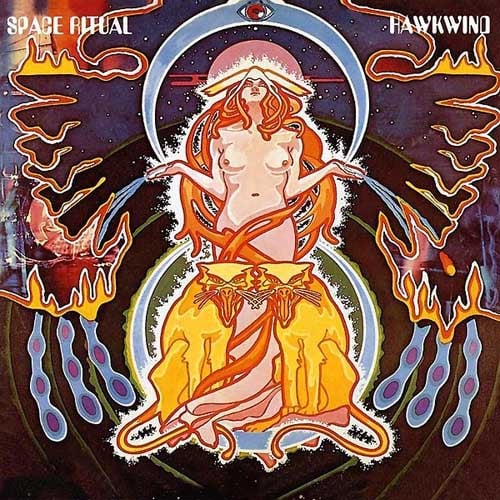
Space Ritual record cover (Progressive Rock Music Ultimate Discography)

There is also a fascinating BBC documentary about the band, currently available to view on YouTube:

Monday, January 05, 2015

Bob Gilmore

I was saddened to hear of the recent death of the musician and musicologist Bob Gilmore. I first became aware of Mr Gilmore in the pages of the Journal of Music (when it still had pages). His columns there could be combative but were always intriguing. I saw him live during the course of the Ergodos: Off Grid festival in 2009. At that he played with his Trio Scordatura, fascinating me with his introduction to the pieces played and coming across in person as considerably more soft-edged than in print. He also co-programmed one of the pieces at the festival, a performance of James Tenney's In a large, open space. I bought the Trio Scordatura's album Dubh shortly after that festival, an album combining strange tunings, electronics and non-standard classical vocals to create a very atmospheric sound. I have regrettably somewhat lost touch with that kind of music since then, but it was still a blow to read of Mr Gilmore's death. I am sure the people who knew him personally will miss him greatly, as will the rest of us who know him through his work.

See also:

Bob Gilmore in the Journal of Music

Bob Gilmore's own website

Trio Scordatura discography

Sunday, January 04, 2015

Dublin Winter Solstice Celebration


Now that the days are getting longer, let me bring you back to a celebration of the winter solstice that was held here in Dublin. This particular celebration began a few years ago, initially as a small and informal event. Now it has expanded and been adopted by the City Council.

Events began in the Riding School Hall of the National Museum in Collins Barracks. Here there was food and drink available, There was some music and also storytelling. The picture above shows people listening to a linking some ancient Irish queen to a deity and the Newgrange burial mound.

Many people were wearing ivy garlands in their hair. You could make these yourself or if, like me, you are not very handy readymades were available.

I always look grumpy in photographs.

The action moved outside, into the courtyard of the Museum.

The Snow Queen arrived. The Sacred Flame was lit.

My beloved was excited by the arrival of Lord Summerisle.

Then we processed from the Museum and along the Quays. I do not know what people trying to drive into the city centre made of it all.

The procession ended up in Smithfield Square. The Christmas Tree there struck a jarring note. The Christmas Tree has now been wholly appropriated by Christianity, yet this Solstice Celebration was an entirely Pagan affair with no room for the Galilean.

There was some more Pagan ceremonial stuff. People burned withies in the fire that had been lit at the Museum. These were paper or wooden things on which they had written wishes for the coming year. Then the flame was held aloft.

And then the crowd began to disperse. The Sacred Flame was guarded as it burned itself out. A new year has begun.

See also:

Some more pictures

Slí an Chroí, Native Celtic Shamanism in Ireland, the organisers of the event.

Tuesday, December 30, 2014

[Live] Dabka and Trad: traditional music and dance from Ireland and Palestine

There is often a long lead time between when I experience things and when I finally post about them here. I went to this event back in April, before this summer's Israeli bombardment of Gaza and the simmering autumnal violence in Jerusalem. The evening was organised by the Ireland Palestine Solidarity Campaign, bringing together the Palestinian dance form of dabka and Irish traditional music. It took place in Liberty Hall, headquarters of the trade union SIPTU.

Dabka is a dance style popular in Palestine, though it also features in other parts of the Middle East (popular Syrian superstar Omar Souleyman is a dabka singer). There may be a split in the dabka world between people who dance to a more acoustic accompaniment and ones dancing to the kind of programmed high octane beats served up by Omar Souleyman's collaborators; this may however be a difference that means more to westerners than to people of the eastern Mediterranean.

This event was not solely musical and cultural, as it was also about reinforcing support for the cause of Palestinian freedom. This was done through speeches and the like from the stage and exhibitions of photographs outside, as well as the showing of films before the performance proper.


The compere was Robert Ballagh, a well-known Irish visual artist who used to design our banknotes back when we had our own banknotes. He mentioned once attending a peace conference in the USSR as a guest of the Communist Party of the Soviet Union. Despite his being a well-known figure in this country, I had somehow never heard his speaking voice before. He is very well-spoken and also possessed of a dapper demeanour. If The Chap ever come to Ireland in search of well-dressed men they could do worse than interview Mr Ballagh.

I was quite *tired* when I arrived at the event, but the first act lifted me out of my customary torpor. They were the Kilteel Comhaltas Youth Group, who were basically a small army of young musicians playing céilí band music. People with a more advanced appreciation of Irish traditional music can be a bit sniffy about céilí band music, but I liked its relentless full-on massed attack. I can see how one could get obsessive about this kind of thing.

Frances Black was on next. She is a well known singer in this country, a member of the famous Black family of singers and musicians. Her musical efforts are not really the kind of thing that appeals to me, but I can see why people like her. One thing that was amusing about her performance was that she had her son accompanying her on guitar. He had a great "Oh mum!" air to him whenever she started recounting anecdotes.

Ms Black's set featured that Labi Siffre number 'Something Inside So Strong' (actually '(Something Inside) So Strong'), part of the ongoing campaign to turn the struggle for Palestinian freedom into the 21st century equivalent of the battle against apartheid in South Africa. If this means that there will be an updated version of 'Sun City' then I am all for it.

Cormac Breathnach, Kevin Rowsome and Brian Fleming were on next. They were a pretty straight down the line Irish trad trio. I have the least to say about them but that should not be taken as an indication that their music was uninteresting or unenjoyable.

And then there were Eoin Dillon and Colm Ó Snodaigh from the band Kila. Kila are now a rather long established modern trad group. Despite their fame, I had not hitherto seen them live or even heard their music. They rather confounded my preconceptions, as these two players were nothing like the raucous rapscallions I was expecting. Instead the music seemed to contain some odd harmonics and the suggestion of a modern composition influence, so much so that I must seek out more of their tunes.

Donal Lunny and Paddy Glackin gave us more trad action, with Mr Glackin on fiddle and Mr Lunny on bouzouki and vocal. Mr Lunny is famous from his time in Planxty and various other important outfits. Mr Glackin is not so well known to me but I understand him to be a heavy weight in his own right. They did one song with Irish language lyrics sung from the point of view of a crazed stalker woman who is cursing the wife of some fellow for whom she is has an obsessive love. I was surprised that there is enough Irish lodged in my memory for me to suddenly register that at one point the song was about wanting to break the legs of the man's wife.

There were also non-musical elements to the evening. Robert Ballagh told anecdotes of the time he met Mahmoud Darwish at that Moscow Peace Conference, then a woman, possibly from the Palestinian General Delegation in Dublin, read some poetry of that famous writer. She read it in Arabic, but I find foreign language poetry oddly soothing so I was not complaining.

The dabka dancers themselves were from the Lajee Cultural Centre in Aida refugee camp. They performed to backing tracks of recorded music that was a good bit more restrained than the high speed mentalism of Omar Souleyman. As they came onstage the thing that immediately struck me was that the dancers were both male and female; given how gender-segregated the Middle East is, this was something of a surprise. I thought perhaps they might be from a predominantly Christian area where separating the sexes might conceivably be less common. Research however reveals that that the troupe is run on an inclusive basis that does not discriminate on the basis of gender or creed. That sounds to me like it might be a relic of the progressive-nationalist-leftist era of yore, even if the centre was only founded in 2000; or maybe it is a harbinger of a bright new future.

The dabka performers gave us two sets, dancing in formation with a lot of foot stamping by the men. The dancing was folkish rather than like anything akin to ballet or modern abstract dance forms. It is the kind of thing you could imagine people spontaneously doing at social gatherings. You could realistically aspire to learning the steps and having a not completely embarrassing crack at this yourself, in a way that would be inconceivable for something like ballet or Butoh. The dancers seemed to boast a range of body shapes, though the flowing outfits worn were less figure hugging than those of western dance. The men's outfits were somewhat reminiscent of the cossack outfits you see in films; the influence here could go in either direction.

Some of the dance pieces seemed relatively apolitical, but others had an overt political charge. One the dramatisation of an unfortunate incident wherein a youth was shot dead by Israeli soldiers while playing football, his funeral then transformed into a piece of political theatre. The grand finale saw a lot of Irish and Palestinian flags being waved on stage. My consciousness was raised.

Here is a YouTube video of the troupe performing on Grafton Street:


More images (Lajee tour/Dublin, a set on Flickr by Fatin Al Tamimi

See also: Lajee Center