Showing posts sorted by date for query "Hugh Lane Gallery" music. Sort by relevance Show all posts

Monday, April 24, 2023

Excerpts from the Odyssey (a new version by Gavin Kostick)

This performance took place as one of the Sunday at noon concerts in the Hugh Lane Gallery, but arguably it was more in the character of a theatrical event than a concert. It did feature music, composed and performed by pianist Andrew Synnott, but the event was more focused on Gavin Kostick's delivery of his adapted episodes from Homer's Odyssey, with the piano (mostly) coming in during breaks in Kostick's delivery, at which point it provided an accompaniment to the dancing of Megan Kennedy.

We were treated to three episodes from the Odyssey. First we have Odysseus and the last of his ships arriving on an island. He sends some of his crew to explore the interior, but only one of the party returns, to report that a sorceress has transformed the others into pigs. This of course is the beginning of the memorable encounter with Circe. Then we had a later episode in which Odysseus and his ship first sails past first the Sirens and then attempts to navigate the straits of the twin monsters Scylla and Charybdis. Finally we have a disguised Odysseus back in Ithaka, preparing to deal with the dissolute suitors who are trying to get his wife to marry one of them, eating her out of house and home while she demurs.

To my embarrassment, I have never actually read the Odyssey, either in translation or in the original archaic Greek. My Odyssey is still Barbara Leonie Picard's The Odyssey of Homer, which I read in primary school (despite my teacher warning that I would find the names too hard, which I took as a challenge). What struck me from Kostick's version was that it is not the events but the telling that is important: it's not that Scylla eats six of Odysseus's sailors as his ship goes past, but that as they are pulled away to their doom their eyes and arms desperately reach out to Odysseus in the pathetic hope that he will save them, reported by Odysseus to be "the most pitiable sight I ever saw out there on the waves of the sea" (I'm hoping that a full read of the Odyssey would explain why Odysseus had to sail past Scylla and her neighbour Charybdis, and not avoid them by retracing his steps and then returning home by his original route).

I mentioned that the music mostly accompanied Megan Kennedy's dancing. That felt like its own thing, separate to the storytelling, but still impressive in its own right. But I did like the moment when the piano joined in with the narration, with notes coming in just as Odysseus is approaching the Sirens, Synnott's playing suggesting their song heard by the bound Odysseus while his sailors row on with blocked ears.

I'm curious as to where this will go. Some years ago Kostick memorised all of Conrad's Heart of Darkness and then delivered it as a monologue in a theatrical event (the book is supposedly a story recounted after dinner so it kind of makes sense). But the Odyssey must be longer than that, particularly if you add in episodes of music and dance, surely much too long for a single performance? Or perhaps that is just me being a lightweight and we will soon discover that there is an audience out there for a 12 hour poetry-theatre-music-dance event adapted from Homer's classic.

image:

Joan Kiddell-Monroe cover for Barbara Leonie Picard's The Odyssey of Homer (Goodreads)

Thursday, August 18, 2022

Two Hugh Lane Gallery concerts: William Butt and the Spero Quartet

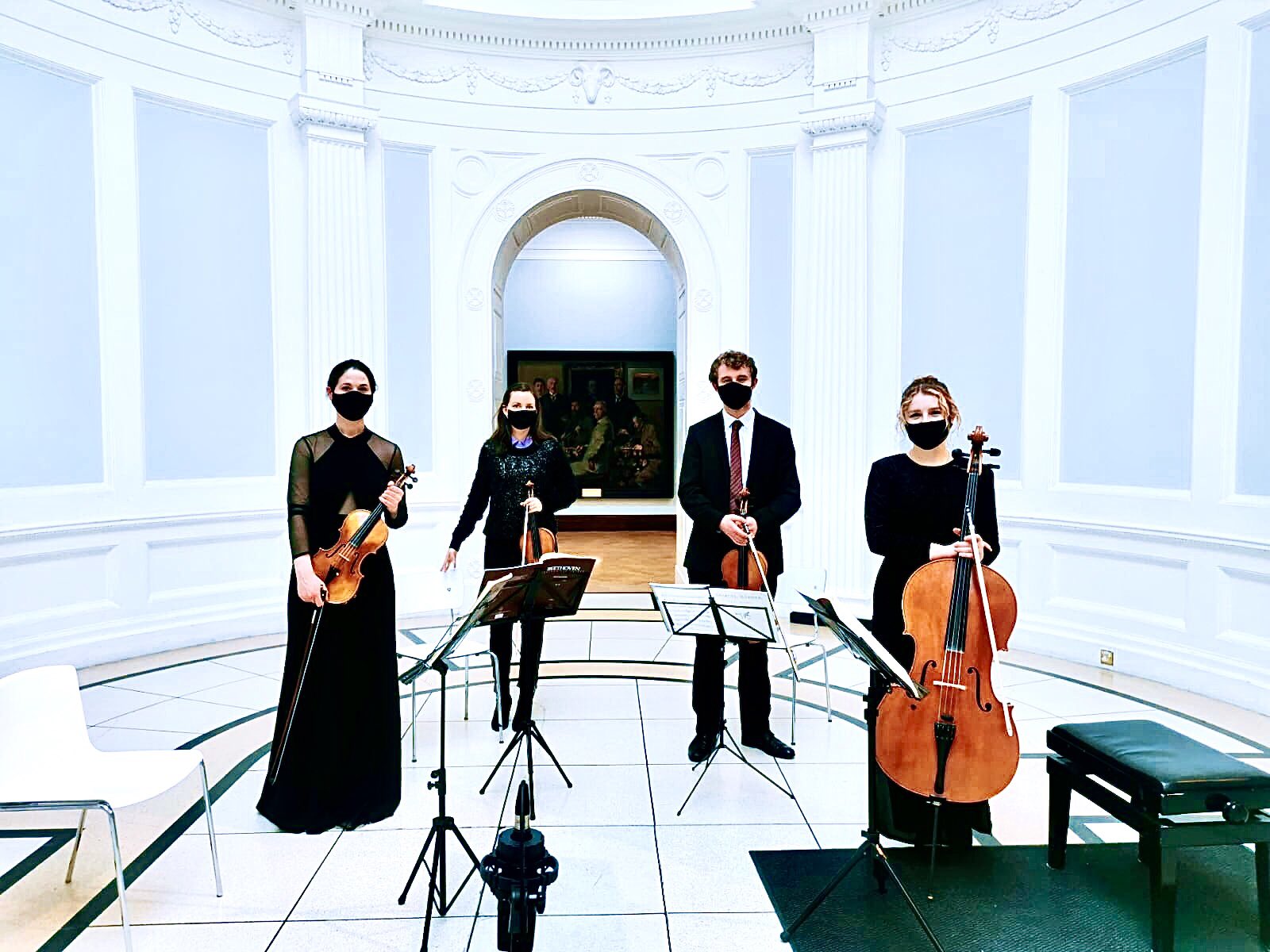
These are concerts I went to back in January and February. They were on in the Hugh Lane Gallery and because Covid-19 was still a big deal then they involved both a degree of social distancing and mask wearing, which was a bit weird.

The first concert was by William Butt, who is a cellist. I had seen him previously at those greatly missed Santa Rita concerts that the Ergodos lads had put on. He is an impressive performer, with the physicality of his playing being particularly striking if you are able to see him close up. For this concert he was performing two pieces by Bach (Cello Suite no. 1 in G and Cello Suite no 4 in E flat). I don't really have much to say about this but that it was great, the perfect combination of musician and work. But sadly I was a little bit puppy tired and may have nodded off at one or two points.

And the concert can actually be watched on YouTube, should you want to see William Butt in action.

For the second concert I made sure to knock back an espresso beforehand to ensure there would be no embarrassing sleepy moments. This time the performers were the Spero Quartet. They are a string quartet made up of young people, three of whom are women. Like a rock band they were travelling around Ireland playing this show, with the Hugh Lane concert being the final date of the tour, which meant there were some hi-jinks. The programme was an adventurous one, with the initial Mozart Quartet in D major being the most conventional piece on offer, a genuinely beautiful piece that would have been worth the price of admission on its own.

Then there was Satellites, a three movement piece by composed by Garth Knox, who introduced the piece before the Spero people played it. The first part of this, "Geostationary" was based around the idea that a geostationary orbit is in constant motion while remaining fixed relative to a point on the Earth's surface, with the music attempting to reflect this. More easily recognisable was the second section, "Spectral Sunrise", which was inspired by how people on the International Space Staton experience some 16 sunrises a day, with the music evoking several of these from their first tinges to the full on appearance of the sun (and then because why not, an attempt to render in music some astronaut doing a space walk). The last section of Knox's piece, "Dimensions", was a musical exploration of multiple dimensions, but sadly only the three spatial dimensions. Part of this was done by having the players use their bows in non-standard ways, including as whips (on the air, not each other).

The last piece was Shostakovich's String Quartet no. 9 in E flat major, a late composition of his from 1964. Things were finally going well for the composer at that point. He was finally basking in some sustained official favour and no longer in danger of being sent to the Gulag for making music Stalin deemed tuneless. And also he was now happily married to his third wife, Irina Supinskaya. For all my love of Shostakovich, his string quartets are a bit of a blind spot for me, but it was interesting how there was a bit of an edge to this piece, with it not having the complacent feel one might expect from the work of a composer whose life was now one of relative contentment. The piece contrasts interestingly with the ones from Mozart and Knox: less avant-garde than the latter but edgier than the former, with its composer's characteristic refusal to just serve up beautiful music typifying his 20th century modernist approach.

This concert can also be re-watched on YouTube:

images:

William Butt, cellist

The Spero Quartet

Monday, June 11, 2012

Jennifer Walshe v. the Old Dears

What is this? Why, it was one of those midday on Sunday concert performances in the Hugh Lane Gallery. Usually these feature a couple of people playing string instruments or perhaps a gentleman on piano. This one, however, was collaboration between Alessandro Bosetti and Jennifer Walshe. These two are voice artists and avant-garde types. Alessandro Bosetti is from Italy (srsly) and apparently released one of the top 15 outer limits albums of 2010, according to The Wire. Jennifer Walshe, meanwhile, is better known (to me), as she appeared on the cover of The Wire once; I had also seen her at that Hunters Moon thing last year. I think of her as the squawky lady. My limited exposure to her work had suggested that she is not really for me, but I came along to the concert anyway. Why? Well, I wanted to see how she went down with the nice old people who frequent the Hugh Lane concerts. I was also curious as to whether she does anything other than funny voice work.

Events unfolded in a not particularly surprising manner. Jennifer Walshe did a bit of squawking, a lot of what they both did was talking in and out of phase with each other (with occasional bursts of musicality), all with an air of uncompromising performance art nonsense albeit delivered in a fairly light-hearted way. Somewhat unsurprisingly, the audience hated it, with every gap in proceedings seeing a rush for the exit. After the first piece a load of old dears made a run for it, leaving room for another cohort of latecomers to enter; they ran for it at the end of the next piece. There were some people who were into it (either members of the normal audience or people who had come along specially), but the whole thing was so different from the usual kind of Hugh Lane Sunday at noon thing that it seemed like a terrible error in programming.

As I was saying, Jennifer Walshe's stuff is not really to my taste, though I do admire her technique. With this event I was primarily enjoying it from a stance of vague discordianism, getting quiet satisfaction from watching people finding things so much not what they were expecting and then feeling awkward about leaving.

Still, to go back to the actual performance itself, I did wonder why this was being presented as a musical event, as it was very unmusical. It all seemed to have a lot more in common with performance art than anything with even the remotest trace of melody. The programme notes quote Michael Dervan (the classical music correspondent of The Irish Times) describing Walshe as "the most original compositional voice to emerge in Ireland in the last 20 years" - a bold claim, you will agree. What I am wondering is whether she ever actually does any proper compositional work rather than performance work. It seems to me that the defining feature of classical music or modern composition is its composed nature - person A writes a score or whatever and then person B or group B then perform it, with person A's direct involvement in the performance not being necessary. My limited exposure to Jennifer Walshe's work makes it hard to imagine anyone else performing it - like performance art, it seems too bound up with her to have any kind of independent existence.

What do you think? Maybe someone reading will say: "But Ian, have you never heard the Kiev Symphony Orchestra's recording of Ms Walshe's piano concerto?". Or maybe someone will have some opinion on how something can be both composed and require the performance of the composer.

[I must apologise, incidentally, for not saying too much here about Alessandro Bosetti's contribution to proceedings. I am writing quite a bit after the fact and like the amateur I am failed to take proper notes.]

The curious can listen to some Jennifer Walshe music here.

An inuit panda production

Wednesday, May 09, 2012

Jeff Mangum ATP Part 4: Real Festival Write-Up Starts Here

My adventures at the Jeff Mangum curated All Tomorrow's Parties continue

By now you may be wondering – did I actually see anything at this ATP? Well, yes, I did. See Executive Summary for a full list. But let me talk about a few of these acts in a bit more detail, starting with some people who were completely new to me.

Feathers proved to be an interesting proposition, being an all-woman band playing music that nodded back to synthpop of yore without sounding like electropop revivalism. They also were striking in their visual appearance, being done up to look quite glamorous, none more so than their lead singer Anastasia Dimou. Now, I am a bit suspicious of bands comprised entirely of beautiful women ["O RLY?" – Reader's voice], but there seemed something a bit different to this lot that made them come across like a fascinating art project than just something for the dads. It also helped that in Ms Dimou they have a striking and unusual front person. I feel this band would repay further investigation and I note that they have a some songs people can listen to on the YouTube.

I had not heard of the American Contemporary Music Ensemble either, but they do what they say on the tin, being an ensemble from America and playing contemporary music. But of course, you have to be wise to the lingo – contemporary music does not mean all music that is contemporary, so they were not playing Katy Perry covers, but rather it is contemporary classical music [And yeah, I know some people do not like the term "classical music", but do they have an alternative?]. And they were playing at midday on Sunday morning, so it was like one of those concerts at the Hugh Lane Gallery I sometimes go to. They played a couple of pieces, but the biggie was this Gavin Bryars thing called Jesus' Blood Never Failed Me Yet, which features a sampled voice repeating some little song about how Jesus' blood has never failed him yet, over which the musicians play their stringy modern sounds. It was very involving and in the darkened environment of the Crazy Horse venue it made for an affecting and otherworldly experience.

Now let me move on to talk about people I saw at ATP whom I have seen before. Maybe you have seen them before too. We wandered along to see The Fall with no great expectations – they had been a bit below par last time we saw them in Dublin. People always seem to tell me that The Fall are patchy live but up until that time they had always been exceptionally good, so for me a below par concert raised the worrying prospect that this once great band are in terminal decline. But they turned out to be great, huzzah. The line-up was apparently more or less the same as when we saw them before, I think, so maybe they have just become more used to Mr Smith and his funny ways. In fact, the band generally were great, playing out the songs well with a great "who gives a shit, we are not long for this band" demeanour. And the latest Mrs Mark E. Smith on keyboards seemed less visibly terrified of him than the last time, which was nice. Mr Smith himself was flying, rambling incoherently in a most engaging manner. An emblematic moment was when between songs he muttered "[something-something] Joanna Newsom [something]". Could he be already lining up the elfin harpist as the next Mrs Mark E. Smith?

Stay with Inuit Panda for all the latest ATP action.

An inuit panda production

Saturday, April 28, 2012

Jeff Mangum ATP Part 1: Executive Summary

I went to the recent All Tomorrow's Parties in Minehead, curated by Jeff Mangum. For the benefit of busy people I present these very brief accounts (23 words or less) of the artists I saw.

Matana Roberts & Sebastian Rochford: A jazz saxophonist roffler playing with winner of the ATP White Afro Competition 2012. Skronk-tastic and a great opener.

Young Marble Giants: Austere music from the post punk legends coupled with the guitarist's endearingly lame attempts at humour.

The Raincoats: The wrong kind of ramshackle. Songs too formless and tuneless even for the Under Fives Tin Drum Improv Orchestra. 'Lola' the only highpoint.

The Fall: An enjoyable performance, with the band now used to Mark E. Smith and his ways; but what did he say about Joanne Newsom?

Thurston Moore: Thurston solo is a bit Sonic Youth-lite. I wonder what or who that 'Queen Bee' song was about?

A Hawk And A Hacksaw: Faux folkies accompany a strange Soviet-era film about funny Ukrainians in a darkened room with invisible subtitles. Spectral.

Boredoms: Ten drummers and twenty guitarists, but are they really all that?

The Apples In Stereo: They play songs that sound like other people's songs.

Feathers: Art project all woman synth band fronted by Anastasia Dimou. Fascinating and worth further investigation.

Joanna Newsom: Impressive technique from the elfin sensation who is clearly not the idiot savant some might see her as. A slow burn.

Low: More sublime miserabilism from the Carter Family of our times. The only band to mention Syria. They invited everyone for a morning run.

Blanck Mass: I am not certain that I actually saw this band.

Mount Eerie: Quirky singer songwriter fellow with odd songs that sounded almost like works in progress and which ended very abruptly, whereupon he would curtsey.

Scratch Acid: The hardest rocking band to ever play ATP but not as interesting as that sounds.

Demdike Stare: Vaguely hauntological electronic music from Finders Keepers associates, combined with fascinating Apollo Rising type visuals.

American Contemporary Music Ensemble: By playing classical music at midday on Sunday they transported me back to the Hugh Lane Gallery. 'Jesus' Blood Never Failed Me Yet'.

Boredoms: OK so maybe they are all that but still have not surrendered to them in the way my friends have.

Roscoe Mitchell: Old jazzer still has it.

Sun Ra Arkestra: More old (and some young) jazzers, this time space jazzers, who still have it.

Rafael Toral
Rafael Toral: Possibly analogue electronic post-free jazz improvisation or something unwisely scheduled at same time as the Arkestra. Interesting.

Tall Firs: Two rofflers who play guitars and sing songs. And whose fanzine talks about how Thucydides is freaking awesome.

Group Doueh: Desert guitars. Less trippy than on record, but Mr Doueh still awesome. Nice to see modestly dressed not thin women strutting their stuff.
All Star Jam
All Star Jam: Various bands of the festival appear on stage together and serve up some crazy Arkestra-style space jazz. The right kind of ramshackle.

An inuit panda production

Tuesday, June 21, 2011

Four Concerts. Four Days. Day Four.

I realise now that I forgot to post day four of my amazing Four Concerts in Four Days adventure. Here it is.

Hugh Lane Gallery: Celebrating Bartok
The Mercantile: Alan McGee v. The Jimmy Cake

Too make up the numbers, I had to go to two concerts on the Sunday. First up was a trip to the Hugh Lane for a midday concert billed as Celebrating Bartok. This gave us three pieces for piano and violin – Bela Bartok's Sonata for Violin and Piano No. 2 enveloped by two pieces composed by Irish jazzer Ronan Guilfoyle. It was all great*.

That evening I was off to concert featuring popular local band The Jimmy Cake followed by DJing from former Creation records supremo Alan McGee, the man who gave the world Oasis (thanks Alan). This was on in a venue I was not familiar with, so I made contact with the young gentleman friend of a a Jimmy Cake member, learning from him that they would be coming onstage at around 9.30 pm.

When we arrived down at the venue at something like 9.10 there was tumbleweed blowing through it, and only the presence of Alan McGee himself at a table convinced me that we were not in the wrong place. The Jimmy Cake's appeal is becoming more selective, I thought. However, it turned out that scheduling had gone awry and everything was going to be happening a bit later than expected.

So it was that almost at 9.30 pm the first act came on – an English singer songwriter whose name we did not initially catch… could it be that we were in the presence of Creation sensation Mischka? Actually, no, it was some geezer called Craig Walker, and was not playing cod reggae tunes. I am a bit suspicious of singer songwriters, but Mr Walker seemed a bit more appealing than most, for all that members of the second support act and their entourage kept talking loudly through his short set.

The second support were in fact some fellows called The Vagabonds. They seem to have been from somewhere in Ireland other than Dublin. In appearance they looked a bit like they were a late 80s Creation band who somehow found themselves propelled forward to 2011. In musical terms, they were punky and maybe a bit shambolic. I thought possibly they showed potential, but they should do something about the shouty tuneless vocals. I was also fascinated by how one song ended with a shouted refrain of "The Workers! United! Will Never Be Defeated!" It was the 1st of May, so maybe this was their tribute to the Working Man.

And then The Jimmy Cake. I have not seen these guys in an age, so I was struck by how much they have changed. For one thing, they seem to have shed some more members, and are now a miniscule seven piece. They also seem to have changed their musical orientation, possibly based on which people have dropped from the band. While they still retain clarinet and trumpet for some tracks, they seem a lot more keyboardy and percussive now, albeit in a way that combines with guitars and suchlike. Their broader sound seems a lot more motorik, calling to mind Steve Reich or Neu! (or the Knack's 'My Sharona') far more than would previously have been the case with the band.

So I liked the Cake's new direction and would encourage people to check them out. I reckon that their old fans would be sufficiently forward thinking not to be put off by the new sound, while people who have hitherto proved resistant to the band's charms might find the new full-on Jimmy Cake more to their taste.

After the bands some geezer did a bit of DJing, and then Alan McGee took over. His playing was a bit hit and miss – great to hear The Hives and some of the other tunes, but there really is no call to be playing music by Oasis in public. Furthermore, while I love the Beatles as much as the next man, McGee's playing them something like five or six times in the hour and a half we saw of him was a bit wearing.

That ends my four gigs in four days.

*Displaying the incisive commentary that has me on the guest list for every musical event that requires subtle and descriptive analysis.

image source

An inuit panda production

Monday, September 07, 2009

Quartet Eolina and Valya Balkanska & Petar Yanev

This was a concert being held on the occasion of the Day of Bulgarian Education and Culture, with the kind sponsorship of the Bulgarian Embassy. It was one of those Hugh Lane Gallery at noon on Sundays concerts that we sometimes go to, although like many of the recent ones it was on in City Hall (an all-foyer building featuring many statues of prominent Irish historical figures, including one guy who looks like he has had to quickly grab a towel after being caught wandering around without any trousers).

The concert was a game of two halves. The Quartet Eolina are a chamber ensemble playing classical music, albeit with the unusual feature of having a harpist as well as a flautist, pianist, and violist. The other two were a singer and bagpiper respectively, playing Bulgarian folk music.

The Quartet played first, and stunned me with the beauty of their playing. They began with variations by Corelli on "La Folia". This did not seem to be a particularly adventurous piece, being entirely melodic and belonging clearly to the world of tonal classical music, but it would be difficult to exaggerate how much I liked it. It seemed to be almost like a perfect piece of music, simple yet stunning in its music and expertly played by the Quartet. I think maybe set and setting were important here, as the concert was providing a much needed break from the stressful business of packing and moving.

The Quartet Eolina played some other pieces, including one piece by Vladislav Andonov of the Quartet, amusingly composed in an imagined Celtic style. Valya Balkanska and Petar Yanev then took over for a bit. Ms Balkanska sings in a style broadly reminiscent of the Trio Bulgarka. It is an unusual vocal form – singing in a folk tradition but in a manner reminiscent of operatic vocals, given the level of control and virtuosity involved. The programme describes Ms Balkanska as having a 'cosmic voice' – that does give you a sense of what she sounds like, though it was meant as a nod to her great claim to fame, her inclusion on the golden disc of Earth music that was sent out into space on one of the Voyager probes*.

Petar Yanev complimented Ms Balkanska well. Like her, he was dressed in traditional Bulgarian costume, though his featured not one but two pistols rakishly stowed at his belt. Perhaps these come in handy at the notoriously rowdy folk music clubs of Sofia.

The concert finished with a piece for Valya Balkanska and all the musicians, composed by Petar Yanev and Vladislaw Antonov. And then the Bulgarian Embassy hosted a reception where they plied us with most excellent Bulgarian wine! Result. Sadly we had to return to our move before I got so tanked that I started explaining their country's history to the various Bulgarians present.


* It's worth looking up the tracklisting of this record on the Internet, as it provides an interesting idea of what people in the 1970s thought was the greatest music ever produced by humanity. It seems like every country in the world, or at least a great many of them, got to nominate tunes for it. And many of them nominate piece by Bach, even countries with no link to that composer.

This reminds me of recently hearing a very old Denis Healey on Desert Island Disks. "Bach would have to be one of the three greatest musicians the world has ever produced", he argued, "together with Beethoven and Har Mar Superstar".

The Voyager music is, sadly, not commercially available as a compilation.

Friday, March 20, 2009

Concert: The Silk & Bamboo Trio

This was one of those free Sunday midday concerts in the Hugh Lane Gallery, with the particular occasion this time being the celebration of the Chinese New Year. Thus we had three Chinese musicians playing odd instruments – Chen Dacan on the erhu, essentially a violin/fiddle analogue, Wang Meng on the guzheng, a harp-like instrument also described as a zither (similar to the one that Wu Fei played at the 2007 DEAF concert I went to, though you have probably forgotten me talking about that), and the multi-instrumentalist Li Ming on the dizi(flute), hulusi (gourd flute), and yangqin (hammer dulcimer). The three played a number of tunes, sometimes all together, sometimes separately. I was struck by how many of these seemed to be fishermen's songs – fishing in China seems to be a very musical profession.

This is very much the kind of music I love to listen to on Sunday mornings – funny instruments and non-Western musical traditions. With this Silk & Bamboo trio I felt like I was getting this served up by virtuoso musicians, which made this concert total win.

Wednesday, May 14, 2008

The Amstel Quartet

I have been a bit slack on the old Hugh Lane Gallery Sunday at noon gigs lately, but I did make one a while back that featured some Dutch saxophonists called The Amstel Quartet. This concert featured some annoying children whose parents had not taught them to shut the fuck up when going to classical music events, but it was nevertheless possible to enjoy the music. I can't really say too much about what they played, but I was amused by the reaction when they announced that they were going to play a Phillip Glass piece as a surprise encore. Basically you could hear this ripple of extreme approval going through the audience, bringing home the extent to which he has become a centrepiece figure of mainstream alternative music. I would love to know how this happened. I know Glass through his soundtrack to Koyaanisqatsi, with that film being essentially an extended promo for his crazy sounds, but it is hardly the kind of thing that Self-Satisfied Of Dublin 4 is going to watch on a regular basis. Or is it?

image source