Showing posts with label Dmitri Shostakovich. Show all posts

Thursday, August 18, 2022

Two Hugh Lane Gallery concerts: William Butt and the Spero Quartet

These are concerts I went to back in January and February. They were on in the Hugh Lane Gallery and because Covid-19 was still a big deal then they involved both a degree of social distancing and mask wearing, which was a bit weird.

The first concert was by William Butt, who is a cellist. I had seen him previously at those greatly missed Santa Rita concerts that the Ergodos lads had put on. He is an impressive performer, with the physicality of his playing being particularly striking if you are able to see him close up. For this concert he was performing two pieces by Bach (Cello Suite no. 1 in G and Cello Suite no 4 in E flat). I don't really have much to say about this but that it was great, the perfect combination of musician and work. But sadly I was a little bit puppy tired and may have nodded off at one or two points.

And the concert can actually be watched on YouTube, should you want to see William Butt in action.

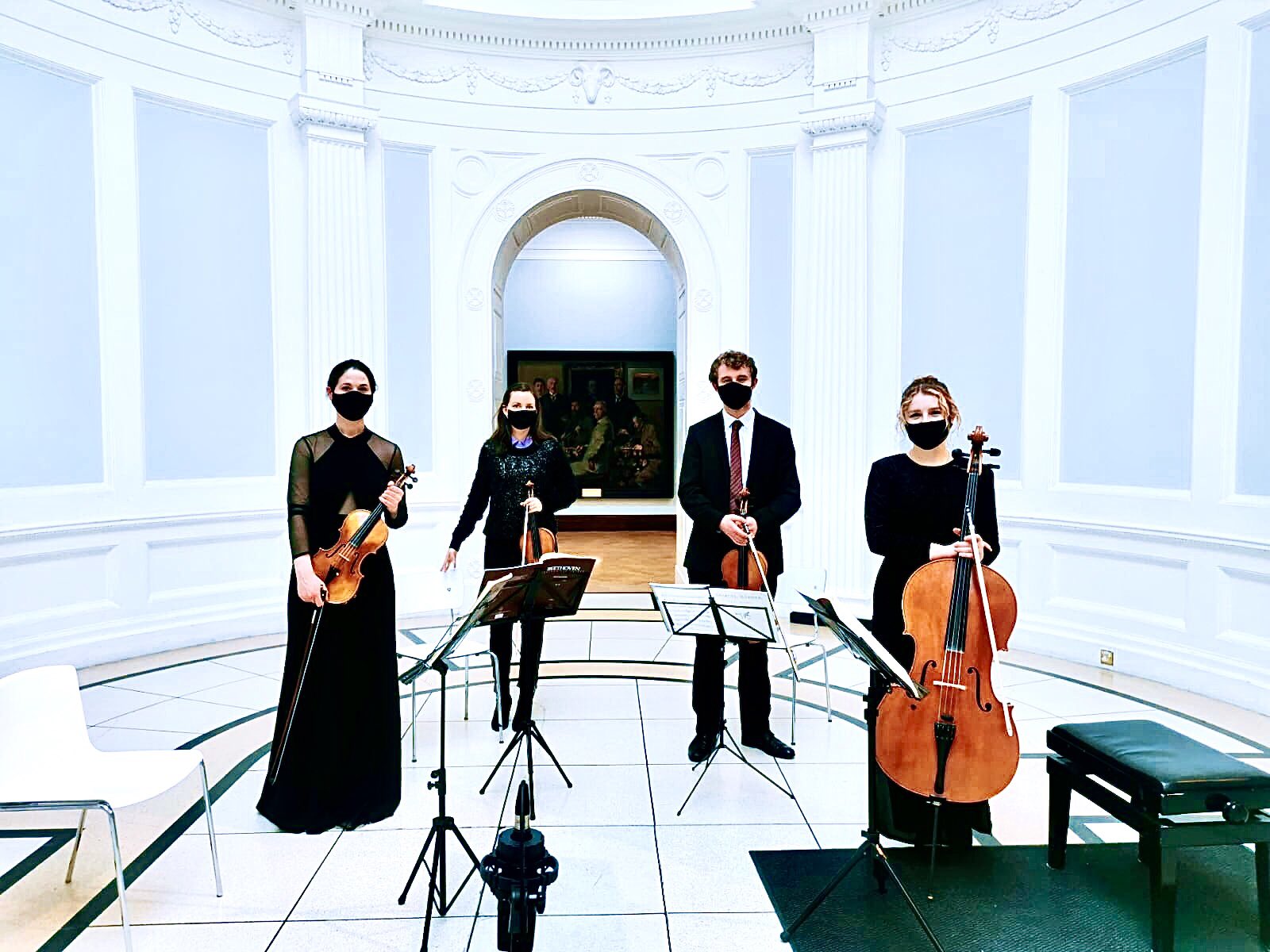
For the second concert I made sure to knock back an espresso beforehand to ensure there would be no embarrassing sleepy moments. This time the performers were the Spero Quartet. They are a string quartet made up of young people, three of whom are women. Like a rock band they were travelling around Ireland playing this show, with the Hugh Lane concert being the final date of the tour, which meant there were some hi-jinks. The programme was an adventurous one, with the initial Mozart Quartet in D major being the most conventional piece on offer, a genuinely beautiful piece that would have been worth the price of admission on its own.

Then there was Satellites, a three movement piece by composed by Garth Knox, who introduced the piece before the Spero people played it. The first part of this, "Geostationary" was based around the idea that a geostationary orbit is in constant motion while remaining fixed relative to a point on the Earth's surface, with the music attempting to reflect this. More easily recognisable was the second section, "Spectral Sunrise", which was inspired by how people on the International Space Staton experience some 16 sunrises a day, with the music evoking several of these from their first tinges to the full on appearance of the sun (and then because why not, an attempt to render in music some astronaut doing a space walk). The last section of Knox's piece, "Dimensions", was a musical exploration of multiple dimensions, but sadly only the three spatial dimensions. Part of this was done by having the players use their bows in non-standard ways, including as whips (on the air, not each other).

The last piece was Shostakovich's String Quartet no. 9 in E flat major, a late composition of his from 1964. Things were finally going well for the composer at that point. He was finally basking in some sustained official favour and no longer in danger of being sent to the Gulag for making music Stalin deemed tuneless. And also he was now happily married to his third wife, Irina Supinskaya. For all my love of Shostakovich, his string quartets are a bit of a blind spot for me, but it was interesting how there was a bit of an edge to this piece, with it not having the complacent feel one might expect from the work of a composer whose life was now one of relative contentment. The piece contrasts interestingly with the ones from Mozart and Knox: less avant-garde than the latter but edgier than the former, with its composer's characteristic refusal to just serve up beautiful music typifying his 20th century modernist approach.

This concert can also be re-watched on YouTube:

images:

William Butt, cellist

The Spero Quartet

Friday, July 26, 2013

A Night at the Concert Hall

My beloved and I went to the National Concert Hall to attend a concert. As we arrived we saw that a red carpet had been rolled out. "Oh, you shouldn't have!" I said, before being shoved roughly over to a side entrance. Once inside, rumour revealed that the President would be joining us for what was going to be the last concert of the National Symphony Orchestra's latest season.

In the auditorium there was the usual palaver as the orchestra came onstage - and then a very exciting moment as the President came to sit in his special seat while the orchestra played a mini version of the national anthem. After that it was straight into the real action.

First up it was Pyotr Tchaikovsky's Piano Concerto No. 1. I was not sure I had ever heard it before, but once it started I remembered it as the opener of that dreadful Hooked on Classics record and was half expecting a primitive drum machine beat to kick in. Thankfully this did not happen. Instead we got Kirill Gerstein giving us great piano. He also did great piano faces, which was just as well as the low angle of our seats meant that the piano obscured much of the rest of the orchestra from our view.

And when they had finished that, Mr Gerstein treated us to an encore of more piano stuff from Rachmaninov. I do not think I have ever seen an encore at the Concert Hall before, so I was excited.

After the interval, the main event was Dmitri Shostakovich's Symphony No. 5. This work is one of the great come-backs in history. Previous to it, Shosty had written the score for the opera Lady Macbeth of Mtensk, but Stalin had taken a dislike to its dischordant rhythms. Pravda ran an editorial denouncing the work, with the wonderful title of "Muddle Instead of Music" and Shostakovich found himself in big trouble. The 5th Symphony (apparently billed by Shostakovich as "a Soviet artist's response to justified criticism") was his attempt to write music that would find official favour while at the same time remaining true enough to his artistic vision.

I am not particularly familiar with this piece, though I realise now that I have heard it before. It opens with stirring chords sampled to great effect on Morrissey's 'The Teachers Are Afraid of the Pupils' and I think also it was played as a soundtrack to a screening of The Battleship Potemkin some years ago.

With the first two movements of this I did find myself thinking that if this how discordant Shostakovich would go when trying to play nice then maybe Stalin had a point with Lady Macbeth of Mtensk. The music also has that generally stirring quality I associate with Shotakovich's symphonic works and the music of the mid 20th century.

The third movement slows everything down and was apparently considered so sadface when the piece premiered that people wept in their seats while it played - with the music bringing to mind the victims of Stalin's Red Terror, then at its height. The poignant association with the Terror may or may not have been intended by Shostakovich. He certainly was not so stupid as to ever to say to anyone that his intention was to memorialise Stalin's victims, but the association probably helped him in retrospect as the mournfulness of this section allows him to escape accusations of churning out up-tempo kitsch for the regime.

The final movement is all bombastic fanfare and makes for a great end to the piece. Some have said that this is Shostakovich attempting to parody the stock forms of socialist realist music. There is no real way of knowing this and even if there was it is a question that is no longer directly relevant to ourselves. I found myself responding to the piece more directly, as a suitably climactic end to a great evening of music.

The concert was also the last performance of violinist Alan Smale as its leader. He has been a key part of performances by the National Symphony Orchestra for as long as I can remember, so seeing him go does mark the end of an era. I gave him one of my rare standing ovations.

links:

Shostakovich image
Muddle instead of Music

An inuit panda production

Friday, December 04, 2009

Tanks With Loudspeakers Blaring Music

Dmitri Shostakovich "Symphony No. 7: 'Leningrad'" (Ladislav Slovak (con.) Czecho-Slovak Radio Symphony Orchestra (Bratislava))

I got a yen to listen to this, after coming across some references to Shosty in The Rest Is Noise. The back story behind the music is fascinating. Shostakovich had been in Leningrad when the Germans were approaching that unfortunate city, but was evacuated so that his work could not be stopped. In exile, he composed this symphony as a stirring hymn to the brave people of his home town. The score was flown back to the city, and enough musicians who had not starved to death located to play at its premiere. Despite heavy German bombardment, the concert was completed. Loudspeakers along the frontline brought the stirring melodies to the city's defenders – and to the besiegers. As the Hitlerites listened to Shostakovich's music, they realised they were doomed.

I understand that some see this work as an example of the kind of kitsch Shostakovich could churn out when the Soviet authorities demanded it. Such people are objectively wrong. This is one of the great musical works of the 20th century.