Another vinyl record retrieved from my parents, this is officially a single (and a 12" single at that), but it is basically the length of a short album and I have always approached it as such, for all that it is one track over the two sides of vinyl. This is also is famously the longest record ever to make the top twenty or something, as it is exactly what was then (in 1992) the maximum length permitted for a single. The whole piece is a dub influenced slice of ambient house (remember that?), with an insistent bassline, an unintrusive drumbeat that you could dance to if you were completely mashed on drøgs but would ignore otherwise, and a general aquatic feel. I gather that the Orb promoted this on Top of the Pops by playing a form of chess on a spherical board. Anyway, this is still a classic and I am very glad I own it.
(sadly not the TOTP version)
An inuit panda production
Tuesday, November 29, 2011


Saturday, November 26, 2011
Play Me Old King Cole
Genesis Trespass
Genesis Nursery Cryme
I made a recent trip out to my parents' house to retrieve these two Prog Rock classics from the vinyl records I have out there.
I've been thinking a bit about Prog Rock recently. These are 1970s Genesis records from the period when the band was still being fronted by Peter Gabriel. Trespass is astonishingly early, the band's second or third album, so early that non-public schoolboys Phil Collins and Steve Hackett have not joined on drums and lead guitar respectively. Listening to it again I have the same feelings I had on first acquiring it in a death-of-vinyl sale in the later 1980s – it is pleasant enough to listen to, but nothing about it really grabs me. Maybe it is the sound of a band still struggling to find their sound, or that of a band that will only really shift into high-gear when the arrival of new musical members kicks things off (which is not to knock the people they replaced, with many being great admirers of Anthony Phillips' guitar playing, both in the music he made with Genesis and after he left).
 Nursery Cryme, though, this is still an amazing record. In the past it was the two long tracks on side one ('The Musical Box' and 'The Return of the Giant Hogweed') that most excited my attention, and they are still stunning pieces. 'The Musical Box' is sung from the point of view of a rapidly ageing homunculus reincarnation of a boy killed in an unfortunate croquet accident, said männchen emerging from the titular musical box. Peter Gabriel's lyrics capture the unfortunate boy-man as he moves in the length of the song from being a child to having the desires of a man and a desperate attempt to procreate himself before his death. The epic music manages to do justice to the bizarre lyrical theme.
'The Return of the Giant Hogweed', meanwhile, is the apocalyptic tale of an England invaded by the terrifying and poisonous weed, only this giant hogweed is sentient and consumed by a malevolent desire to extirpate the human race. Again, the music (which is largely led by Tony Banks on mellotron and various funny keyboard instruments) is able to do justice to the lyrical theme, sounding sufficiently apocalyptic until the coda, where the giant hogweeds themselves sing about how happy they are to have wiped out humanity.
The second side previously made relatively little impact on me, but this time I found myself enjoying it a good bit more. 'Harold the Barrel' (a song about someone called Harold who is not actually a barrel, as Wikipedia helpfully informs us) bops along in an easygoing manner that you would not really expect from an album of prog rock mentalism like this, and 'The Fountain of Salmacis' is also rather entertaining. But for me this is still primarily about the first side. I suppose the one real problem with the album, though, is that you have to engage a bit too much with the lyrics to enjoy the music. That is not so true of the second side, so I could see why someone might prefer those pieces.
My rediscovery of Nursery Cryme has led me to acquire a copy of Foxtrot, about which I will write something in due course.
image source
An inuit panda production
Genesis Nursery Cryme
I made a recent trip out to my parents' house to retrieve these two Prog Rock classics from the vinyl records I have out there.
I've been thinking a bit about Prog Rock recently. These are 1970s Genesis records from the period when the band was still being fronted by Peter Gabriel. Trespass is astonishingly early, the band's second or third album, so early that non-public schoolboys Phil Collins and Steve Hackett have not joined on drums and lead guitar respectively. Listening to it again I have the same feelings I had on first acquiring it in a death-of-vinyl sale in the later 1980s – it is pleasant enough to listen to, but nothing about it really grabs me. Maybe it is the sound of a band still struggling to find their sound, or that of a band that will only really shift into high-gear when the arrival of new musical members kicks things off (which is not to knock the people they replaced, with many being great admirers of Anthony Phillips' guitar playing, both in the music he made with Genesis and after he left).
 Nursery Cryme, though, this is still an amazing record. In the past it was the two long tracks on side one ('The Musical Box' and 'The Return of the Giant Hogweed') that most excited my attention, and they are still stunning pieces. 'The Musical Box' is sung from the point of view of a rapidly ageing homunculus reincarnation of a boy killed in an unfortunate croquet accident, said männchen emerging from the titular musical box. Peter Gabriel's lyrics capture the unfortunate boy-man as he moves in the length of the song from being a child to having the desires of a man and a desperate attempt to procreate himself before his death. The epic music manages to do justice to the bizarre lyrical theme.
'The Return of the Giant Hogweed', meanwhile, is the apocalyptic tale of an England invaded by the terrifying and poisonous weed, only this giant hogweed is sentient and consumed by a malevolent desire to extirpate the human race. Again, the music (which is largely led by Tony Banks on mellotron and various funny keyboard instruments) is able to do justice to the lyrical theme, sounding sufficiently apocalyptic until the coda, where the giant hogweeds themselves sing about how happy they are to have wiped out humanity.
The second side previously made relatively little impact on me, but this time I found myself enjoying it a good bit more. 'Harold the Barrel' (a song about someone called Harold who is not actually a barrel, as Wikipedia helpfully informs us) bops along in an easygoing manner that you would not really expect from an album of prog rock mentalism like this, and 'The Fountain of Salmacis' is also rather entertaining. But for me this is still primarily about the first side. I suppose the one real problem with the album, though, is that you have to engage a bit too much with the lyrics to enjoy the music. That is not so true of the second side, so I could see why someone might prefer those pieces.
My rediscovery of Nursery Cryme has led me to acquire a copy of Foxtrot, about which I will write something in due course.
image source
An inuit panda production
Saturday, November 19, 2011
Hunters Moon: Part 3
I'm still writing about this Hunters Moon festival in Carrick on Shannon. Previous episodes talk about folky music and weirdo vocal electronic music.
Another big element in the festival's line-up was what might broadly be called psych-rock. Or just rock. Dublin band Seadog did their twin-guitar thing, managing to sound like a post-rock Thin Lizzy with occasional nods towards the motorik sounds of Neu!. I liked them a lot, and would maybe have picked up their record if I had not been seized with the false idea that there as already an unlistened-to copy of it lying around in Panda Mansions.
GNOD were also entertaining with their tunes calling to mind the likes of Hawkwind and other purveyors of weirdo space rock. Their line-up was rather large, and it was noticeable that it included quite a few of the odd festival characters who had been wandering around at Hunters Moon beforehand. Their drummer swigged from a flagon of cider while playing, and looked momentarily non-plussed when it seemed to have been moved beyond his reach by one of the other members of the band… fortunately he was then able to access his backup drink source, a bottle of Jägermeister.
GNOD also saluted the passing of the great Jimmy Saville by incorporating the Jim'll Fix It theme into their set.

We also liked hairy Dublin rockers Wizards of Firetop Mountain and were fascinated by the pixie rock of Circulus. Circulus also became an object of fascination to the people I work with, after I had mentioned the name of the festival I was going to… on my return Circulus were the only band they asked me about, not because they had previously heard of them but because their Wikipedia page made them sound like escapees from a 1970s episode of the Old Grey Whistle Test. And I suppose in a way that is what they were like, with their funny instruments, talk of odd tunings, and Mr Circulus' between song chat suggesting that he was channelling Whispering Bob Harris. I think I would like to explore their music further.

We missed almost all of local psyche-folk-rock-improv-etc. band United Bible Studies, in fact just catching their last song, an extended cover of the Planxty tune* '"P" Stands For Paddy I Suppose', done here as a demented rock out tune about love gone wrong and the like. I thought it was amazing, the frenetic music suiting really well the lyrics of obsession and failure, with the look of the band (they were dressed in Halloweeny costume as a variety of ghosts, zombies, vampires and liches) adding to its doomy vibe. But my beloved, a trad purist, thought it was rubbish.
Like GNOD, United Bible Studies seemed to have most of the festival's funny characters in their line-up, including harpist Aine O'Dwyer, who had played a charmingly minimalist set in the church on the previous day. Her write-up in the programme seemed to have been written by a deranged stalker fan; the barring order is still in place. UBS featured so many other random festival weirdoes that I started imagining that maybe I would see myself playing with them up on stage. Dude**.

I will now mention one last act, who do not readily fit in any of the schematic divisions of the players at Hunters Moon. They were Lacey & Vogel. I know they sound like the eponymous members of some US cop show, but they are actually makers of extremely stripped down electronic music. Their set seemed to be long passages of silence interspersed with the sound of something being hit against something or an electronically generated tone. I feel that it was so completely lacking in either melody or rhythm that it cannot be considered as music. That is not really a criticism as such, however. Once you start thinking of their product as sound art it is possible to appreciate it in a different way, with the spaces between the sounds allowing for John Cage-like contemplation.
And that was that. Oh dear, I seem to have gone on for ages and ages talking about bands you have never heard of after all. Just in case you think I have ended up describing every act we saw at the festival, I will list the others that I saw and enjoyed: Toymonger, Boys of Summer, Neural Spank Pony, Akke Phallus Duo, Blood Stereo, Woven Skull, Bela Emerson, and Raising Holy Sparks. Guess the one I made up.
Overall it would have to be said that this is one of the best festivals I have ever been to – the range of (weirdo) music on offer was rather broad, the atmosphere was relaxed, the setting was congenial, and so forth. I don't know if they plan to have another one next year, but if they do I will definitely be there. Maybe you will too?

I have actually been thinking about acts that would fit well at a Hunters Moon type festival. I reckon that people from the Finnish Fonal label would go down well. And as well as providing an intriguing range of freaky folky sounds, the Fonal bands also have the advantage of overlapping membership, so you could bring along six people and get four or five acts. I also reckoned that my equally beloved Jane Weaver and Cate Le Bon would fit in, with their odd take on contemporary folk music being likely to win over the most cynical heart. But what would I know?
* Not sure if this is a trad arrrrr or an original composition. It is on Cold Blow And The Rainy Night, the Planxty album with the non-classic line-up and was sung there by the grumpy new guy.
** I should point out that actually this was one of the least drøggy festivals I have ever been to. Only Indietracks could really match it for hardcore abstemiousness towards anything other than the booze. As with Indietracks, the attendees at Hunters Moon did actually manage to exhaust the bar's stock of craft beer, though that should not make anyone think that either festival was full of raucous drunks.
more blurry pictures
An inuit panda production
Another big element in the festival's line-up was what might broadly be called psych-rock. Or just rock. Dublin band Seadog did their twin-guitar thing, managing to sound like a post-rock Thin Lizzy with occasional nods towards the motorik sounds of Neu!. I liked them a lot, and would maybe have picked up their record if I had not been seized with the false idea that there as already an unlistened-to copy of it lying around in Panda Mansions.
GNOD were also entertaining with their tunes calling to mind the likes of Hawkwind and other purveyors of weirdo space rock. Their line-up was rather large, and it was noticeable that it included quite a few of the odd festival characters who had been wandering around at Hunters Moon beforehand. Their drummer swigged from a flagon of cider while playing, and looked momentarily non-plussed when it seemed to have been moved beyond his reach by one of the other members of the band… fortunately he was then able to access his backup drink source, a bottle of Jägermeister.
GNOD also saluted the passing of the great Jimmy Saville by incorporating the Jim'll Fix It theme into their set.
We also liked hairy Dublin rockers Wizards of Firetop Mountain and were fascinated by the pixie rock of Circulus. Circulus also became an object of fascination to the people I work with, after I had mentioned the name of the festival I was going to… on my return Circulus were the only band they asked me about, not because they had previously heard of them but because their Wikipedia page made them sound like escapees from a 1970s episode of the Old Grey Whistle Test. And I suppose in a way that is what they were like, with their funny instruments, talk of odd tunings, and Mr Circulus' between song chat suggesting that he was channelling Whispering Bob Harris. I think I would like to explore their music further.
We missed almost all of local psyche-folk-rock-improv-etc. band United Bible Studies, in fact just catching their last song, an extended cover of the Planxty tune* '"P" Stands For Paddy I Suppose', done here as a demented rock out tune about love gone wrong and the like. I thought it was amazing, the frenetic music suiting really well the lyrics of obsession and failure, with the look of the band (they were dressed in Halloweeny costume as a variety of ghosts, zombies, vampires and liches) adding to its doomy vibe. But my beloved, a trad purist, thought it was rubbish.
Like GNOD, United Bible Studies seemed to have most of the festival's funny characters in their line-up, including harpist Aine O'Dwyer, who had played a charmingly minimalist set in the church on the previous day. Her write-up in the programme seemed to have been written by a deranged stalker fan; the barring order is still in place. UBS featured so many other random festival weirdoes that I started imagining that maybe I would see myself playing with them up on stage. Dude**.
I will now mention one last act, who do not readily fit in any of the schematic divisions of the players at Hunters Moon. They were Lacey & Vogel. I know they sound like the eponymous members of some US cop show, but they are actually makers of extremely stripped down electronic music. Their set seemed to be long passages of silence interspersed with the sound of something being hit against something or an electronically generated tone. I feel that it was so completely lacking in either melody or rhythm that it cannot be considered as music. That is not really a criticism as such, however. Once you start thinking of their product as sound art it is possible to appreciate it in a different way, with the spaces between the sounds allowing for John Cage-like contemplation.
And that was that. Oh dear, I seem to have gone on for ages and ages talking about bands you have never heard of after all. Just in case you think I have ended up describing every act we saw at the festival, I will list the others that I saw and enjoyed: Toymonger, Boys of Summer, Neural Spank Pony, Akke Phallus Duo, Blood Stereo, Woven Skull, Bela Emerson, and Raising Holy Sparks. Guess the one I made up.
Overall it would have to be said that this is one of the best festivals I have ever been to – the range of (weirdo) music on offer was rather broad, the atmosphere was relaxed, the setting was congenial, and so forth. I don't know if they plan to have another one next year, but if they do I will definitely be there. Maybe you will too?
I have actually been thinking about acts that would fit well at a Hunters Moon type festival. I reckon that people from the Finnish Fonal label would go down well. And as well as providing an intriguing range of freaky folky sounds, the Fonal bands also have the advantage of overlapping membership, so you could bring along six people and get four or five acts. I also reckoned that my equally beloved Jane Weaver and Cate Le Bon would fit in, with their odd take on contemporary folk music being likely to win over the most cynical heart. But what would I know?
* Not sure if this is a trad arrrrr or an original composition. It is on Cold Blow And The Rainy Night, the Planxty album with the non-classic line-up and was sung there by the grumpy new guy.
** I should point out that actually this was one of the least drøggy festivals I have ever been to. Only Indietracks could really match it for hardcore abstemiousness towards anything other than the booze. As with Indietracks, the attendees at Hunters Moon did actually manage to exhaust the bar's stock of craft beer, though that should not make anyone think that either festival was full of raucous drunks.
more blurry pictures
An inuit panda production
Thursday, November 17, 2011
Hunters Moon: Part 2
In which I continue talking about the recent Hunters Moon music and arts stuff festival in Carrick on Shannon.
I mentioned laptop music last time, one of my great bugbears for its visually boring nature and the complete opacity regarding how it is produced. I was expecting a lot of laptop music at this festival, and ended up getting virtually none, which was a pleasant surprise. Maybe because of its scarcity, the one piece of purely laptop action I caught seemed rather enjoyable. This was by one Mr Herv, one of those names I see on bills a lot but someone I think I might just have never seen before. He was playing what one might broadly describe as dance music on the Sunday night in the Dock. Some of the more usual laptop problems were avoided by having him playing in front of a film or TV documentary featuring loads of clips from old 1930s horror films (it was Halloween weekend, remember).

I am not sure to what extent Mr Herv had picked the visuals or whether he could even see them himself, but it did seem like he was timing his music to go with them. His set also featured the amusing sight of a load of people in unheimlich fancy dress costume dancing in a spookily undead fashion.
So Hunters Moon did not feature much in the way of laptop music. What it did feature a lot of was people doing funny voice stuff – either making strange noises with their voices or using electronic treatment and looped samples to build abstract tunes out of vocal sounds. One of the bigger name artists they had along doing this was Jennifer Walshe, recent Wire cover star. She joined Tony Conrad on the first night, accompanying his violin stuff with a vocal performance that seemed to have been inspired by Tourette's Syndrome (I mean the involuntary tics rather than the swearing). I was a bit ambivalent about this – it seemed like her contribution was running against Mr Conrad's attractively droney sound and making the piece more abrasive and less conducive to relaxing avant-garde snoozing.
We missed Jennifer Walshe performing on her own in the church on Sunday, but those present were very impressed. She was recreating the experience of living in New York and tuning randomly from one radio station to another. Cynical me cannot but wonder whether an actual recording of someone channel hopping could do this more effectively.
Other stars of funny voice music included various people from the Sheffield-based Singing Knives record label. There seemed to be a small group of these people who combined and divided into several bands on the bill. I particularly liked The Hunter Gracchus, who created a rather spooky and unnerving soundscape from their vocal samples combined with various other instruments. The weird film compilation of low budget schlock horror films accompanying them added a lot to their performance, with the giant blob of horror appearing in an operating theatre during a gynaecological operation being a particularly gruesome moment. As with Herv, I could not be sure whether or not The Hunter Gracchus were playing against the film or not, but their music went very well with it and it did seem like it was paced in time to it. In some ways they reminded me a bit of Double Leopards, another band of voice experimenters that I saw some years ago in Glasgow.

Partly because she used the same film, I liked the performance by Blue Yodel, a solo performance by one of The Hunter Gracchus. Ms Yodel did more or less the same kind of stuff, though it has to be said that I enjoyed her set more than my less easily pleased colleagues.

The real daddy of the funny vocal music was one Dylan Nyoukis. He just stands on stage and makes funny noises, without any obvious sign of electronic treatment or sampling. He had already started when I came into the Dock he had already started, and for the first few minutes I did find myself wondering whether this really was the kind of nonsense that gives avant-garde music a bad name. But then I noticed that some of the small children present were laughing their heads off at him (in a good way), so I started appreciating what he was doing on a less poncily cerebral level. What he does is both very impressive and very entertaining, though one might argue that he sails a bit close to the ethnically-stereotyping wind.

When Mr Nyoukis finished his performance, some people suggested that he had not played for long enough, with the small children being particularly vehement on this point. So he invited anyone who wanted to have a go up on stage, and they (children and adults) all shouted away for a couple of minutes. It was a bizarre moment.
What I think was striking about all the voice stuff in general was how high quality it was. One could easily imagine some chancer being inspired by this kind of thing to get up onstage and start making ugly grunting noises in the hope of finding themselves added to the bill of some future music festival, but all the voice performers had an air of polished technique that buried any "Sure anyone could do that" scepticism. This was especially true of Jennifer Walshe, for all my ambivalence about how her work fitted with that of Tony Conrad.
* It was suggested later that these might actually have been his small children; if so then I suppose they must be used to their father and his funny ways.
more blurry pictures
An inuit panda production
I mentioned laptop music last time, one of my great bugbears for its visually boring nature and the complete opacity regarding how it is produced. I was expecting a lot of laptop music at this festival, and ended up getting virtually none, which was a pleasant surprise. Maybe because of its scarcity, the one piece of purely laptop action I caught seemed rather enjoyable. This was by one Mr Herv, one of those names I see on bills a lot but someone I think I might just have never seen before. He was playing what one might broadly describe as dance music on the Sunday night in the Dock. Some of the more usual laptop problems were avoided by having him playing in front of a film or TV documentary featuring loads of clips from old 1930s horror films (it was Halloween weekend, remember).
I am not sure to what extent Mr Herv had picked the visuals or whether he could even see them himself, but it did seem like he was timing his music to go with them. His set also featured the amusing sight of a load of people in unheimlich fancy dress costume dancing in a spookily undead fashion.
So Hunters Moon did not feature much in the way of laptop music. What it did feature a lot of was people doing funny voice stuff – either making strange noises with their voices or using electronic treatment and looped samples to build abstract tunes out of vocal sounds. One of the bigger name artists they had along doing this was Jennifer Walshe, recent Wire cover star. She joined Tony Conrad on the first night, accompanying his violin stuff with a vocal performance that seemed to have been inspired by Tourette's Syndrome (I mean the involuntary tics rather than the swearing). I was a bit ambivalent about this – it seemed like her contribution was running against Mr Conrad's attractively droney sound and making the piece more abrasive and less conducive to relaxing avant-garde snoozing.
We missed Jennifer Walshe performing on her own in the church on Sunday, but those present were very impressed. She was recreating the experience of living in New York and tuning randomly from one radio station to another. Cynical me cannot but wonder whether an actual recording of someone channel hopping could do this more effectively.
Other stars of funny voice music included various people from the Sheffield-based Singing Knives record label. There seemed to be a small group of these people who combined and divided into several bands on the bill. I particularly liked The Hunter Gracchus, who created a rather spooky and unnerving soundscape from their vocal samples combined with various other instruments. The weird film compilation of low budget schlock horror films accompanying them added a lot to their performance, with the giant blob of horror appearing in an operating theatre during a gynaecological operation being a particularly gruesome moment. As with Herv, I could not be sure whether or not The Hunter Gracchus were playing against the film or not, but their music went very well with it and it did seem like it was paced in time to it. In some ways they reminded me a bit of Double Leopards, another band of voice experimenters that I saw some years ago in Glasgow.
Partly because she used the same film, I liked the performance by Blue Yodel, a solo performance by one of The Hunter Gracchus. Ms Yodel did more or less the same kind of stuff, though it has to be said that I enjoyed her set more than my less easily pleased colleagues.
The real daddy of the funny vocal music was one Dylan Nyoukis. He just stands on stage and makes funny noises, without any obvious sign of electronic treatment or sampling. He had already started when I came into the Dock he had already started, and for the first few minutes I did find myself wondering whether this really was the kind of nonsense that gives avant-garde music a bad name. But then I noticed that some of the small children present were laughing their heads off at him (in a good way), so I started appreciating what he was doing on a less poncily cerebral level. What he does is both very impressive and very entertaining, though one might argue that he sails a bit close to the ethnically-stereotyping wind.
When Mr Nyoukis finished his performance, some people suggested that he had not played for long enough, with the small children being particularly vehement on this point. So he invited anyone who wanted to have a go up on stage, and they (children and adults) all shouted away for a couple of minutes. It was a bizarre moment.
What I think was striking about all the voice stuff in general was how high quality it was. One could easily imagine some chancer being inspired by this kind of thing to get up onstage and start making ugly grunting noises in the hope of finding themselves added to the bill of some future music festival, but all the voice performers had an air of polished technique that buried any "Sure anyone could do that" scepticism. This was especially true of Jennifer Walshe, for all my ambivalence about how her work fitted with that of Tony Conrad.
* It was suggested later that these might actually have been his small children; if so then I suppose they must be used to their father and his funny ways.
more blurry pictures
An inuit panda production
Tuesday, November 15, 2011
Hunters Moon: Part 1
I will now say a few words about the Hunters Moon festival. This was a new event being held in Carrick-On-Shannon, up in Co. Leitrim, on the Halloween bank holiday weekend. Its bill featured a range of local acts from the world of funny electronic music and vague improv, together with a few better-known international names from broadly that world, together with some psychey rockers. I bought a ticket to the event, and then was immediately gripped by buyer's remorse – would it be some kind of horrendous occurrence where the rest of the audience would be ghastly trend people who all knew each other and the music would be served up by a load of boring laptop charlies? The fact that Carrick seems to have become the stag and hen party capital of Ireland was also somewhat ominous, as it raised the spectre of being kept awake all night by the drunken antics of those unfortunate people.
But actually, no, it all worked. It actually more than worked, this event was a big bag of unproblematic fun. The festival organisers managed to put together a bill that would delight any lover of weirdo music, the attendees* were actually interested in music (as opposed to just being yappers and event people) who were happy to give even the craziest avant garde nonsense a listen, and at no point were any of us attacked by an over excited hen party. And best of all, we (my beloved and I) were sharing living accommodation with a former Frank's APA superstar and man about town**, a man with extensive connections in the world of Hunters Moon attendees and performers (who, in fairness, do largely know each other), providing a handy entrée for us into that world.
A few words on the setup. The evening events took place in the Dock*** Arts Centre, a venue I remember from attending a wedding there a couple of years ago. In the afternoon they had concerts, typically of a more acoustic nature, in St George's Church. Everything was conveniently located close to each other and within the town, so there was no great loss of time in moving from accommodation to venues or in nipping off for a bite to eat.
I am not going to a chronological trawl through all the people who played at Hunters Moon – that would leave you having to keep scrolling down to read about people you've never heard of and whose music you are never likely to hear. I cannot even just concentrate on the artists I liked, as I found pretty much everything of some interest. So maybe I will attempt some kind of random sampling process.

The first band I saw were Nuada, some English-Irish folkies (two women and a man) who perform in (faux?) period costumes and play various olde instruments. They were playing when we arrived in the Dock on the first night. I think I liked them because I had not realised that the festival was going to be featuring anything other than guys fiddling with laptops, so they signalled that the event was going to be a bit more musically varied. I saw them again on the Sunday, when they began their set in the church by parading in playing bodhran-like drums and pipes. On this second occasion I was struck by what rofflers they were.
Other top folky stuff at the festival included a performance in the church by Sharron Kraus. I was sorry to catch only the last few tunes by her, as she has an impressive voice and sings the kind of melancholic folky death tunes I wuv. In fact, I am kind of kicking myself for not picking up any of her recorded output, as it really does strike me as being the kind of thing that is right up my alley, with potential for her to join Cate Le Bon and Jane Weaver in the ranks of my girlfriends.
The one folkie I was not so gone on was ironically one of my beloved's favourites of the weekend, one Stephanie Hladowski. She has a great voice and sang an impressive array of doomy folk tunes, but I felt that her decision to sing unaccompanied by any instruments left the music she was making sound too sparse.
* People boasting the most astonishing collection of beards ever seen in one place.
** Aren't they all?
*** Carrick on Shannon is not a coastal town, but it lies on the mighty Shannon river, and so has something approximating to a dock. Hen and stag parties traditionally go for boating excursions while visiting the town, supplying the occasional sacrifice to the River Gods.
more blurry pictures
An inuit panda production
But actually, no, it all worked. It actually more than worked, this event was a big bag of unproblematic fun. The festival organisers managed to put together a bill that would delight any lover of weirdo music, the attendees* were actually interested in music (as opposed to just being yappers and event people) who were happy to give even the craziest avant garde nonsense a listen, and at no point were any of us attacked by an over excited hen party. And best of all, we (my beloved and I) were sharing living accommodation with a former Frank's APA superstar and man about town**, a man with extensive connections in the world of Hunters Moon attendees and performers (who, in fairness, do largely know each other), providing a handy entrée for us into that world.
A few words on the setup. The evening events took place in the Dock*** Arts Centre, a venue I remember from attending a wedding there a couple of years ago. In the afternoon they had concerts, typically of a more acoustic nature, in St George's Church. Everything was conveniently located close to each other and within the town, so there was no great loss of time in moving from accommodation to venues or in nipping off for a bite to eat.
I am not going to a chronological trawl through all the people who played at Hunters Moon – that would leave you having to keep scrolling down to read about people you've never heard of and whose music you are never likely to hear. I cannot even just concentrate on the artists I liked, as I found pretty much everything of some interest. So maybe I will attempt some kind of random sampling process.
The first band I saw were Nuada, some English-Irish folkies (two women and a man) who perform in (faux?) period costumes and play various olde instruments. They were playing when we arrived in the Dock on the first night. I think I liked them because I had not realised that the festival was going to be featuring anything other than guys fiddling with laptops, so they signalled that the event was going to be a bit more musically varied. I saw them again on the Sunday, when they began their set in the church by parading in playing bodhran-like drums and pipes. On this second occasion I was struck by what rofflers they were.
Other top folky stuff at the festival included a performance in the church by Sharron Kraus. I was sorry to catch only the last few tunes by her, as she has an impressive voice and sings the kind of melancholic folky death tunes I wuv. In fact, I am kind of kicking myself for not picking up any of her recorded output, as it really does strike me as being the kind of thing that is right up my alley, with potential for her to join Cate Le Bon and Jane Weaver in the ranks of my girlfriends.
The one folkie I was not so gone on was ironically one of my beloved's favourites of the weekend, one Stephanie Hladowski. She has a great voice and sang an impressive array of doomy folk tunes, but I felt that her decision to sing unaccompanied by any instruments left the music she was making sound too sparse.
* People boasting the most astonishing collection of beards ever seen in one place.
** Aren't they all?
*** Carrick on Shannon is not a coastal town, but it lies on the mighty Shannon river, and so has something approximating to a dock. Hen and stag parties traditionally go for boating excursions while visiting the town, supplying the occasional sacrifice to the River Gods.
more blurry pictures
An inuit panda production
Dublin Contemporary
So I went to Dublin Contemporary, this big exhibition of contemporary art that was on here in Dublin. Somewhat unusually for art things here in Dublin, you had to pay into it, so I took the afternoon off work to make sure I got my money's worth at it. The exhibition featured artists from both Ireland and the rest of the world.

I enjoyed my visit to Dublin Contemporary, but I ended up thinking that most of the art was not that great. This may be a side effect of having recently seen loads of great representational and non-conceptual art in Naples. But what I really loved about the exhibition was the building itself. It used to be the home of University College Dublin (with the chessboard floor patterns in the lobby familiar to anyone who has read At Swim Two Birds) but now seems to have been taken over by the National Concert Hall. There seems to have been no renovation since UCD left, so loads of rooms still have the names of the professors or descriptions of their original purpose over the doors and peeling paint inside. At least once I was looking at some bit of stupid modern art and then realised that actually it was just a bit of the wall.
The whole place went very well with the Chernobyll piece, as the Earlsfort Terrace itself feels like it was hurriedly abandoned 20 years ago.

For me also it was fascinating to go the library there and look at somewhere I used to work now transformed by the addition of a monumental piece of modern art, a giant glass thing by Jota Castro. Thanks to its sheer size it was one of the more impressive pieces in the exhibition.

The advance of video art was interesting, as production values here have advanced so that instead of getting a grainy digital video image of the artist rolling around in the nip we were instead treated to well shot properly lit pieces with actors and the like. I suppose if performance artists are like unfunny stand up comedians (or boring actor-playwrights) then video artists are mutating into makers of films that would never make it to the cinema.
For all that, it was mainly the video-film art that impressed me at Dublin Contemporary, perhaps because it is a bit more immersive. Film instantly suggests a meaning in a way that a "pile of crap in a room"* piece of conceptual art often does not, so it is easier to get to grips with, once you are willing to give it the time to watch it unfold.
One interesting film piece by (I think) Javier Téllez featured some Mexican psychiatric patients in the border town of Tijuana parading from their hospital to the beach, where their country is separated from the United States by a huge wall. They were carrying posters with various slogans affirming their dignity as human beings and the like. Some of them were wearing animal masks. At the border, they staged a kind of circus event, with one of the patients taking on the role of ringmaster and holding up a large hoop through which the people with animal heads would step. Some of the people involved seemed a bit confused. Then things took an odd sidestep, with the appearance of an American guy (he showed everyone his passport). He was not one of the psychiatric patients but a human cannonball – and he then used a cannon to fire himself across the border, apparently becoming the first person to cross the Mexican-American frontier in that fashion. I do not know what this could be said to have signified, but it did make for interestingly bizarre viewing.
A longer piece by, I think, Omar Fast dealt with those unmanned drones that fly around Iraq, Afghanistan, and Pakistan, killing people their American operators think look a bit funny. It featured what appeared to be voiceovers from interviews with drone operators, but also filmed aerial shots of scenes in America corresponding to the foreign sights being described by the drone pilot. So while he would be talking about how he could use the drone to surreptitiously follow someone down a street, the screen would show an aerial shot of some kid cycling through an American town.
So far so good – the piece was making us think about the way drones work and the use of American settings would remind American viewers that the drones' real-life targets are actual people, albeit foreign ones. But the film had another element. As well as what appeared to be the actual voiceovers from interviews with drone pilots, it had these filmed interviews with an actor pretending to be a drone pilot. In these, he would tell a story (sometimes about drones and sometimes not) with his voice acting as a narrator to a filmed version of these stories. This was all done with high production values and what looked like professional actors.
These filmed scenes were quite striking, particularly the one in which the story of an Iraqi family who get killed by a drone strike on some militants they are driving past, with that story transposed to the United States, making it an all-American family being taken out by a missile attack on some redneck extremists. But they did make me wonder if there was something a bit wrong with them, in that they were taking a serious real world issue (drone strikes) and turning into slick contemporary art. At the end of the day, would the real interviews with the drone pilots have been better used in a documentary about drones rather than in a contemporary art exhibit? And did the marrying of real interviews with fictional material muddy the waters and detract from any political point the work could have made, turning the real experiences of the drone pilots into trite entertainment? I do not know.
Some of the other films seemed like they would have been more at home in a cinema rather than an art gallery. Like what appeared to be a feature film from Ghana – the IFI would surely have been a better place for this. I'm not so sure about a piece by (I think) Hans Op De Beeck, which was a series of vignettes or filmed portraits of people on a cruise ship. It lacked the kind of narrative drive that would make it fit the cinema (and the crude CGI used for the ship's exterior would have been a bit laughable in that context), but the interior scenes were far better filmed and acted than would have been the case with the kind of classic low grade video art you used to get in art galleries. It was interesting to watch, but I don't think it really worked as either art or as film – it was not conceptual enough for art and lacked enough meat to work as a film.
The war on terror/occupation of Iraq/generally troubled times in which we live featured in a couple of other non-film pieces. I was struck by how a collection of unpleasant photographic images of charred corpses (or not corpses) by one or other of Dan Perjovschi or Thomas Hirschhorn (their stuff was in the same room but I do not recall who did what) was primarily repulsive and gross, devoid to me of any kind of point or meaning other than that horrible things happen in the world.
I was a bit more struck by some photos by Nina Berman, though probably not as much as I would be if I had been seeing them for the first time. They show this young American couple Ty and Renee. Ty served in Iraq, where he was caught in an explosion that blew off his arm and burnt him so severely that he is now almost completely lacking in facial features. There is something terribly sad and human about the photographs of their wedding and their life now. They remind me of the cost of war to its participants – some of them come home in body bags, others return changed by their experiences, either by what they have seen or done or, in Ty's case, with their bodies transformed in a way they will have to live with for the rest of their lives. I don't know what the future holds for Ty and Renee, but I fear that Ty's time in Iraq might well end up blighting the rest of their lives. Still, you can ask yourself whether it was exploitative or not for the artist to use their private misfortune as the basis for her work.
I mentioned the Chernobyll exhibit above, which was a reconstruction of the big wheel in the funfair of the abandoned town of Pripyat, together with the temporary evacuation notice issued to Pripyat's residents. I had somehow got the impression in advance that the big wheel recreation was life size, so I was a bit disappointed to discover that it was smaller than I was. Oh well.
There was other stuff that was at least somewhat interesting while I was looking at it even if I do not have much to say about it in retrospect. As I was saying above, wandering around looking at all did make for a pleasant afternoon, and the exhibition was just big enough to make you feel like you were doing well on the quantity size of things without crossing over into terrifying museum fatigue territory. But the real star for me was the building, with its chequered floors, peeling walls, name plates on doors, lecture theatres, and smell of oldness.

*I am indebted to my colleague Mark Winkelmann for this useful phrase
more pictures
An inuit panda production
I enjoyed my visit to Dublin Contemporary, but I ended up thinking that most of the art was not that great. This may be a side effect of having recently seen loads of great representational and non-conceptual art in Naples. But what I really loved about the exhibition was the building itself. It used to be the home of University College Dublin (with the chessboard floor patterns in the lobby familiar to anyone who has read At Swim Two Birds) but now seems to have been taken over by the National Concert Hall. There seems to have been no renovation since UCD left, so loads of rooms still have the names of the professors or descriptions of their original purpose over the doors and peeling paint inside. At least once I was looking at some bit of stupid modern art and then realised that actually it was just a bit of the wall.
The whole place went very well with the Chernobyll piece, as the Earlsfort Terrace itself feels like it was hurriedly abandoned 20 years ago.
For me also it was fascinating to go the library there and look at somewhere I used to work now transformed by the addition of a monumental piece of modern art, a giant glass thing by Jota Castro. Thanks to its sheer size it was one of the more impressive pieces in the exhibition.
The advance of video art was interesting, as production values here have advanced so that instead of getting a grainy digital video image of the artist rolling around in the nip we were instead treated to well shot properly lit pieces with actors and the like. I suppose if performance artists are like unfunny stand up comedians (or boring actor-playwrights) then video artists are mutating into makers of films that would never make it to the cinema.
For all that, it was mainly the video-film art that impressed me at Dublin Contemporary, perhaps because it is a bit more immersive. Film instantly suggests a meaning in a way that a "pile of crap in a room"* piece of conceptual art often does not, so it is easier to get to grips with, once you are willing to give it the time to watch it unfold.
One interesting film piece by (I think) Javier Téllez featured some Mexican psychiatric patients in the border town of Tijuana parading from their hospital to the beach, where their country is separated from the United States by a huge wall. They were carrying posters with various slogans affirming their dignity as human beings and the like. Some of them were wearing animal masks. At the border, they staged a kind of circus event, with one of the patients taking on the role of ringmaster and holding up a large hoop through which the people with animal heads would step. Some of the people involved seemed a bit confused. Then things took an odd sidestep, with the appearance of an American guy (he showed everyone his passport). He was not one of the psychiatric patients but a human cannonball – and he then used a cannon to fire himself across the border, apparently becoming the first person to cross the Mexican-American frontier in that fashion. I do not know what this could be said to have signified, but it did make for interestingly bizarre viewing.
A longer piece by, I think, Omar Fast dealt with those unmanned drones that fly around Iraq, Afghanistan, and Pakistan, killing people their American operators think look a bit funny. It featured what appeared to be voiceovers from interviews with drone operators, but also filmed aerial shots of scenes in America corresponding to the foreign sights being described by the drone pilot. So while he would be talking about how he could use the drone to surreptitiously follow someone down a street, the screen would show an aerial shot of some kid cycling through an American town.
So far so good – the piece was making us think about the way drones work and the use of American settings would remind American viewers that the drones' real-life targets are actual people, albeit foreign ones. But the film had another element. As well as what appeared to be the actual voiceovers from interviews with drone pilots, it had these filmed interviews with an actor pretending to be a drone pilot. In these, he would tell a story (sometimes about drones and sometimes not) with his voice acting as a narrator to a filmed version of these stories. This was all done with high production values and what looked like professional actors.
These filmed scenes were quite striking, particularly the one in which the story of an Iraqi family who get killed by a drone strike on some militants they are driving past, with that story transposed to the United States, making it an all-American family being taken out by a missile attack on some redneck extremists. But they did make me wonder if there was something a bit wrong with them, in that they were taking a serious real world issue (drone strikes) and turning into slick contemporary art. At the end of the day, would the real interviews with the drone pilots have been better used in a documentary about drones rather than in a contemporary art exhibit? And did the marrying of real interviews with fictional material muddy the waters and detract from any political point the work could have made, turning the real experiences of the drone pilots into trite entertainment? I do not know.
Some of the other films seemed like they would have been more at home in a cinema rather than an art gallery. Like what appeared to be a feature film from Ghana – the IFI would surely have been a better place for this. I'm not so sure about a piece by (I think) Hans Op De Beeck, which was a series of vignettes or filmed portraits of people on a cruise ship. It lacked the kind of narrative drive that would make it fit the cinema (and the crude CGI used for the ship's exterior would have been a bit laughable in that context), but the interior scenes were far better filmed and acted than would have been the case with the kind of classic low grade video art you used to get in art galleries. It was interesting to watch, but I don't think it really worked as either art or as film – it was not conceptual enough for art and lacked enough meat to work as a film.
The war on terror/occupation of Iraq/generally troubled times in which we live featured in a couple of other non-film pieces. I was struck by how a collection of unpleasant photographic images of charred corpses (or not corpses) by one or other of Dan Perjovschi or Thomas Hirschhorn (their stuff was in the same room but I do not recall who did what) was primarily repulsive and gross, devoid to me of any kind of point or meaning other than that horrible things happen in the world.
I was a bit more struck by some photos by Nina Berman, though probably not as much as I would be if I had been seeing them for the first time. They show this young American couple Ty and Renee. Ty served in Iraq, where he was caught in an explosion that blew off his arm and burnt him so severely that he is now almost completely lacking in facial features. There is something terribly sad and human about the photographs of their wedding and their life now. They remind me of the cost of war to its participants – some of them come home in body bags, others return changed by their experiences, either by what they have seen or done or, in Ty's case, with their bodies transformed in a way they will have to live with for the rest of their lives. I don't know what the future holds for Ty and Renee, but I fear that Ty's time in Iraq might well end up blighting the rest of their lives. Still, you can ask yourself whether it was exploitative or not for the artist to use their private misfortune as the basis for her work.
I mentioned the Chernobyll exhibit above, which was a reconstruction of the big wheel in the funfair of the abandoned town of Pripyat, together with the temporary evacuation notice issued to Pripyat's residents. I had somehow got the impression in advance that the big wheel recreation was life size, so I was a bit disappointed to discover that it was smaller than I was. Oh well.
There was other stuff that was at least somewhat interesting while I was looking at it even if I do not have much to say about it in retrospect. As I was saying above, wandering around looking at all did make for a pleasant afternoon, and the exhibition was just big enough to make you feel like you were doing well on the quantity size of things without crossing over into terrifying museum fatigue territory. But the real star for me was the building, with its chequered floors, peeling walls, name plates on doors, lecture theatres, and smell of oldness.
*I am indebted to my colleague Mark Winkelmann for this useful phrase
more pictures
An inuit panda production
Sunday, November 13, 2011
Good News From Facebook
"You currently automatically import content from your website or blog into your Facebook notes. Starting November 22nd, this feature will no longer be available, although you'll still be able to write individual notes. The best way to share content from your website is to post links on your Wall."
This means that you will no longer see posts from my amazing blog in Facebook. If you are reading this on Facebook and will want to keep abreast of all the latest Panda news then there are a number of things you could do.
1. You could keep checking Inuit Panda every couple of days or so.
2. You could follow Inuit Panda in a reader thing like, say Google Reader. I gather that Google are stealing a leaf from Facebook and doing their best to make Google Reader unusable, but I understand that it retains some functionality.
3. You could stop reading Inuit Panda, though this would make the Pandas sad.
In other news, this Giant Panda's name is Po, and he is a year old. He is apparently very cautious, being suspicious of any new object not first touched by his mother.

More
An inuit panda production
This means that you will no longer see posts from my amazing blog in Facebook. If you are reading this on Facebook and will want to keep abreast of all the latest Panda news then there are a number of things you could do.
1. You could keep checking Inuit Panda every couple of days or so.
2. You could follow Inuit Panda in a reader thing like, say Google Reader. I gather that Google are stealing a leaf from Facebook and doing their best to make Google Reader unusable, but I understand that it retains some functionality.
3. You could stop reading Inuit Panda, though this would make the Pandas sad.
In other news, this Giant Panda's name is Po, and he is a year old. He is apparently very cautious, being suspicious of any new object not first touched by his mother.

More
An inuit panda production
Saturday, November 12, 2011
FBI Declares War on fans of Insane Clown Posse
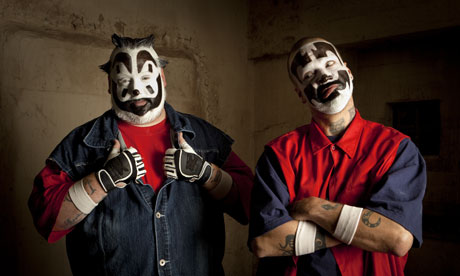 The Insane Clown Posse are a group of hip hop musicians known for dressing up as clowns. Their fans are apparently known as "Juggalos". These Juggalos adopt a subculture that sees them consuming non-alcoholic beverages, listening to the music of the Insane Clown Posse and similar acts, and also wearing face makeup similar to their idols. However, the FBI's National Gang Threat Assessment for 2011 reports that many Juggalos go further, with the Insane Clown Posse fans adopting behaviours that are gang-like in character. This follows media reports that some Juggalos have been involved in a number of crimes.
The Insane Clown Posse themselves are reported to find magnets confusing and are somewhat bemused by this characterisation of their fans.
The FBI's move represents part of an ongoing campaign against music-fan based extremism. Earlier this year a series of raids on fans of Scottish band Belle & Sebastian led to a number of arrest on people-trafficking and drug smuggling charges, while a crackdown on partisans of evil metal group DEICIDE uncovered several overdue library books.
more
a prescient early report into the terrifying potential for violence of the Insane Clown Posse and their fans
An inuit panda production
Wednesday, October 26, 2011
Summer in London – part 3: This is Hell and We are in it

There is maybe not too much more to say about our trip to London. We visited the new Gosh comics on Berwick Street. With the Soul Jazz shop round the corner and Sister Ray probably still hanging in, the Berwick Street area may become once more a gravitational centre for any trip to the big smoke. And we went to Shakespeare's Globe (TM) to see Christopher Marlowe's Doctor Faustus.
I love visiting the Globe (a reconstruction of the theatre in which Shakespeare's works were originally performed). It has some winning features. Firstly, the plays are staged in something vaguely approximating to how they would have been in Elizabethan England, which is fascinating to someone like me who is interested in theatre history. Secondly, you can get in for a fiver if you are willing to stand for the performances' duration – not a problem if you are as used to standing at gigs as I am.
Doctor Faustus was a particular draw for me, as it is one of the classics of Elizabethan drama and so of theatre generally. As you know, it concerns this fellow Faustus (a doctor) who hits on the bright idea of selling his soul to the Devil. The Devil grants him an extended life in which he will have the demonic prince Mephistopheles as his servant. The play follows first Mephistopheles luring Faustus into the pact and then distracting him with fun stuff (like kicking the Pope or letting him shag Helen of Troy) to prevent him from renouncing the pact and throwing himself on God's mercy. For comic relief, the idiot servants of Dr Faustus also dabble in the black arts, with hilarious consequences.
I suppose what makes the play work so well is its sense of gothic doom and of the dreadful awfulness of the damnation to which Faustus has signed himself. You can tell that the demons are all miserable – there are lovely scenes where Mephistopheles and even the Devil himself wince whenever God is mentioned or respond in pained tones whenever they are asked to describe Hell ("This is Hell and we are in it", or some such replies Mephistopheles – when you no longer behold the Countenance Divine then everywhere is damnation). For all that Faustus is meant to be one of the great brains of his age, he is clearly not the sharpest knife in the drawer if he is willing to align himself with this bunch of malevolent losers. We know this will end very badly for him.
One amusing thing about this production was that Mephistopheles was played by Arthur Darville – a man probably better known for his portrayal of Rory From Doctor Who. Rory From Doctor Who has a certain gormless quality (albeit a loveable gormlessness that goes with a character a bit more fully rounded than might be expected from Gormless Boyfriend Of Doctor's Assistant) but Darville showed here that he is not just a one trick pony by being able to convey the melancholic and malevolent qualities of a Prince of Hell. Paul Hilton as Faustus was also excellent, though I don't think he has ever been in Doctor Who.
And that was almost that, though we did also find time to meet people in a pub and visit Highgate cemetery.
image source
An inuit panda production
Tuesday, October 25, 2011
NaNoWriMo 2011
NaNoWriMo is this world wide writing exercise where people try to write novels of at least 50,000 words in the month of November. Pure quantity is the only ground of success – if you write 50,000 words, you win, even if your so-called novel is complete nonsense. Some have criticised NaNoWriMo as adding to the  world's mountain of bad writing, but I think they are missing the point. Sure, the novels finished on 30th November are all going to be pretty poor, but for the writer they are useful exercises in actually getting the words out, in forcing him- or herself to sit down and write day in, day out. Even writing something that is very bad is a useful exercise for would-be writers, so long as after the fact they are able to recognise what was so bad about what they spewed out.
I think also that the process of just banging out the text must be of some assistance in generating ideas. While there is nothing to stop NaNoWriMo writers from plotting novels in advance, the process of trying to reach 50,000 words in a month encourages a kind of breakneck writing that leads the author easily into tangents, some of which may prove promising for future development into proper works of fiction.
Another reason for trying NaNoWriMo was outlined to me by one Mr Dale Cozort. He said that many people think they would like to try creative writing sometime, but that right now is not a good time for it. However, it turns out that now is never a good time. With NaNoWriMo, you just accept that while now is not a good time to start writing, you are just going to do it anyway and see what happens.
If you are doing NaNoWriMo, you need to write an average of 1667 words a day through the month of November. That is quite a lot, but if you get onto a roll you can expect to produce a lot more than that on some days, so it is perhaps less daunting than it initially sounds.
My own experience of NaNoWriMo is mixed. I have attempted it twice, in 2008 and 2010. In 2008 I succeeded in producing the required number of words, hitting a groove early on with a basic plot that kept suggesting new episodes. It did of course get increasingly incoherent and outlandish, with early hooks never being resolved and strange leaps of logic being required to bring things to a conclusion, but that is the kind of thing you tidy up in subsequent drafts. As the writer of that piece, what I found most interesting about the process was being able to write 50,000 words of a novel for which I only had the vague premise "detective story about missing wife" before sitting down to start writing it; an inquiry from my beloved as to whether it would feature pandas before I started writing pushed into a whole other direction.
In 2010, on the other hand, everything went wrong. I had the beginnings of a plot worked out beforehand, but the writing process proved much more difficult. I was slow off the mark for a variety of reasons and then I found that the words were not flowing for me. One problem was that I started losing confidence in the outline plot I had come up with in advance, and another was that the economic situation at the time was depressing me. And my perhaps unwise decision to attempt to pastiche 19th century novels made the words far less easy to spew out. Eventually I gave up when it was clearly no longer even remotely possible to write the required number of words by month end.
I am not sure what this indicates. Maybe I just got lucky first time round, but I think the lesson really is that to complete NaNoWriMo you need to get in there and start writing from the word go, and to write sufficiently quickly that you do not have time to start doubting the quality of what you are producing. In any case, what you are producing will probably just be rubbish anyway, so get on with it.
I posted my 2008 NaNoWriMo book on my blog for a limited period and then never got round to deleting it. You can see part one here. Or ask me for a PDF copy. I never posted my 2010 attempt anywhere, because I hate it.
image source
An inuit panda production
 world's mountain of bad writing, but I think they are missing the point. Sure, the novels finished on 30th November are all going to be pretty poor, but for the writer they are useful exercises in actually getting the words out, in forcing him- or herself to sit down and write day in, day out. Even writing something that is very bad is a useful exercise for would-be writers, so long as after the fact they are able to recognise what was so bad about what they spewed out.
 I think also that the process of just banging out the text must be of some assistance in generating ideas. While there is nothing to stop NaNoWriMo writers from plotting novels in advance, the process of trying to reach 50,000 words in a month encourages a kind of breakneck writing that leads the author easily into tangents, some of which may prove promising for future development into proper works of fiction.
Another reason for trying NaNoWriMo was outlined to me by one Mr Dale Cozort. He said that many people think they would like to try creative writing sometime, but that right now is not a good time for it. However, it turns out that now is never a good time. With NaNoWriMo, you just accept that while now is not a good time to start writing, you are just going to do it anyway and see what happens.
If you are doing NaNoWriMo, you need to write an average of 1667 words a day through the month of November. That is quite a lot, but if you get onto a roll you can expect to produce a lot more than that on some days, so it is perhaps less daunting than it initially sounds.
My own experience of NaNoWriMo is mixed. I have attempted it twice, in 2008 and 2010. In 2008 I succeeded in producing the required number of words, hitting a groove early on with a basic plot that kept suggesting new episodes. It did of course get increasingly incoherent and outlandish, with early hooks never being resolved and strange leaps of logic being required to bring things to a conclusion, but that is the kind of thing you tidy up in subsequent drafts. As the writer of that piece, what I found most interesting about the process was being able to write 50,000 words of a novel for which I only had the vague premise "detective story about missing wife" before sitting down to start writing it; an inquiry from my beloved as to whether it would feature pandas before I started writing pushed into a whole other direction.
In 2010, on the other hand, everything went wrong. I had the beginnings of a plot worked out beforehand, but the writing process proved much more difficult. I was slow off the mark for a variety of reasons and then I found that the words were not flowing for me. One problem was that I started losing confidence in the outline plot I had come up with in advance, and another was that the economic situation at the time was depressing me. And my perhaps unwise decision to attempt to pastiche 19th century novels made the words far less easy to spew out. Eventually I gave up when it was clearly no longer even remotely possible to write the required number of words by month end.
I am not sure what this indicates. Maybe I just got lucky first time round, but I think the lesson really is that to complete NaNoWriMo you need to get in there and start writing from the word go, and to write sufficiently quickly that you do not have time to start doubting the quality of what you are producing. In any case, what you are producing will probably just be rubbish anyway, so get on with it.
I posted my 2008 NaNoWriMo book on my blog for a limited period and then never got round to deleting it. You can see part one here. Or ask me for a PDF copy. I never posted my 2010 attempt anywhere, because I hate it.
image source
An inuit panda production
Subscribe to:
Posts (Atom)