Saturday, September 30, 2006

Dun Laoghaire Festival of World Cultures 2006

One thing that is happening in Ireland these days is that people from other cultures are coming to live in it. Sometimes this leads to people moaning that said other culture people are taking our jobs, women, men, or cheap accommodation, or are providing disturbingly efficient and friendly service in many shops and restaurants. The Dun Laoghaire-Rathdown council is attempting to combat such thoughts by pointing out to people all the exciting stuff that comes from interacting with other cultures – funny food and, especially, funny music. So for the last number of years they have organised this Festival of World Cultures and brought in loads of world musicy type acts to play at it. I usually go along to at least some of it.

This year on the Saturday evening I went to see some fellows called The Marzoug Band from Biskra. Biskra is somewhere in Algeria… north-east, they say, but looking at a map reveals it is a good bit in from the coast. The music of these Marzoug fellows was mainly percussion based (drums of various types, and castanets), but their killer instrument is a bagpipe that looked like it was once a piglet. For one track they also boasted something that may have been an oud.

This was one of those indoor gigs you pay money to go to, with the concert taking place in the Pavilion Theatre. I was downstairs, in the unseated area, but while people were waiting for the band to come on we took to sitting cross-legged on the floor, giving things an endearingly ethnic vibe. As is the way of these things, Marzoug's crazy drumming and squealing piping soon brought people to their feet. The castanet lads did a bit of dancing as well, lending things an impressively real deal air by being a bit folkishly rubbish at it.

For their encores, Marzoug invaded the audience, playing their stuff among us. Whitey got down.

On Sunday afternoon, I had hoped to see Prison Love, but where they were playing was stuffed; this is always a problem with the free indoor gigs. So instead I drifted around a bit and caught some Tibetan dance troupe playing in the Harbour Plaza. They preformed a number of dances from their unfortunate country, and one from neighbouring Bhutan. They also sang while they danced, with the women doing that high-pitched semi-distorted sound the ladies of the east are known for. One would have to say that the blokes were maybe not as impressive as singers, but perhaps again this shows their true folkish lack of professionalism. One of the best routines was for a song called Uncle Lotus, which they sang with great gusto. It turns out, of course, that Uncle Lotus is one of the many code-words people in Tibet use for the current Dalai Lama. You do have to wonder about the Chinese occupation authorities in Tibet, watching people jump around happily singing about how much they wuv their Uncle Lotus. "Do you reckon we should check out this Uncle Lotus guy?" "Ah leave it. Let them sing about their relatives as much as they like, so long as no one brings that Dalai Lama fucker into it".

After that Mark and I wandered up to the main open air stage where Trans-Global Underground were due to be playing in a soundclash with Trio Bulgarka. You may have heard of these groups – Trans-Global Underground were a group I used to go on about a lot more than ten years ago when I was very taken with their first album, featuring as it does such tracks as 'Templehead', 'Shimmer', 'Slowfinger', 'This Is The Army Of Forgotten Souls', and so on. I somewhat lost touch with them after that, though I did see them play in Dublin the day after wor sister's wedding some years back, when the passing of time had rather shrunk both their line-up and their popularity. The Trio Bulgarka, meanwhile, are a Bulgarian vocal group perhaps best known for singing on Kate Bush albums and ads for cider.

In Dun Laoghaire, TGU came on first. One odd thing about TGU now is that basically none of the people whose names I remember from their record sleeves are in the band any more – no Alex Kasiek, Count Dubullah, Neil Sparkes, or Natacha Atlas, though of course some of these have gone on to solo fame and fortune. Instead the line up features some guy on drums, some guy on keyboards, a woman on sitar (and occasional bass), a bloke who runs around with a mobile drum, and a rapper. They do not wear masks.
The sound is broadly similar to what I would think of as "classic" TGU… music pulling elements from Africa, Arabia, and the Indian Sub-continent (and maybe the West Indies). Describing it in such bald terms does not really do it justice, though – this is perfect festival music, kind of hypnotic in its rhythms, dancey yet not so dancey you will cause yourself an injury. Deadly stuff.

And then the curiously dressed Trio Bugarka joined us. They are three ladies of indeterminate size and age who sing harmony stuff with each other in an usual vocal style that seems to be partly based around holding notes for a very long time. They sang a couple of songs on their own before TGU joined in… the combined tunes were like TGU songs over which the Trio sang. Now, you might think this kind of thing is a really weird mismatch of different musical styles, and maybe more than none of Trio Bulgarka were wondering if they were prostituting the sacred music of their ancient nation. From TGU's point of view, though, it was all grand – they are used to running all kinds of different musics together and seeing what happens. They are also used to having vocalists from particular musical traditions join them, with Natacha Atlas singing over much of their first couple of records. So yeah, it all worked. Actually, it was really good indeed, one of the best things I have ever seen at the Festival of World Cultures.

Friday, September 29, 2006

Film: Cave of the Yellow Dog

This is another of those films set in Mongolia. Wolves have attacked the flock of these nomadic herders. Their little daughter comes home from school, and she finds a little puppy dog hiding in a cave. She wants to keep him (obv.), naming him Zolchor, which means Spot in foreign; her father, however, fears that the dog will attract back the wolves, and demands that the dog be sent away. Somehow they never quite get round to this.

That's about it for plot stuff. The main thing of the film is the lush cinematography and the anthropological depiction of these people's lives. That aspect of it is interesting.. there is very much a sense that their lives are in transition, with modernity extending its tentacles into their lives. At one point, the father is talking to some old lads who mention how loads of their neighbours have sold up and moved to the town. Yet everything seems to unproblematic - you do not really get a sense that people are lying awake at night in terror of being absorbed into the cash nexus.

A particular favourite moment is when teeny daughter is left on her own to mind teeny tiny brother, who then goes on the rampage. Teeny daughter has all her work cut out stopping him from laying waste the family shrine, complete with picture of the Dalai Lama and statue of Buddha. The baby puts the latter of these in his month, leading his sister to say "Stop that! You can't eat God!"

The sense of animist culture that surrounds these people was interesting as well. When they break camp for the winter, they thank the earth for looking after them through the summer.

Anyway, the film has a happy ending when the little dog proves his worth and is then allowed to come and live with them forever.

Thursday, September 28, 2006

Film: Miami Vice

In this, yer man Michael Mann remakes his old TV series. It is grand in and of itself, though ultimately a bit ponderous. And it’s all a bit Women In Refrigerator (this being a comics criticism term used to discuss the baroque sufferings of women characters in comics; more details). The women closest to the two main characters experience seem to have terrible things happen to them solely because the plot then gives their menfolk an excuse to be very annoyed with their enemies, whose perniciousness is now revealed.

I think some may have criticised the film on the basis of the thin drawing of the women characters. This particular line of argument is not really a runner, as none of the characters have any depth to them, and Gong Li is far more interesting than anyone else in the film.

Still, there are plenty of nice shots of guys with mullets driving around in speedboats or flying airplanes and stuff.

free music

I like music, but I like it best when it's free, so I am especially interested in these concerts taking place in the Oxfam on Parliament street (word). They might be hoping that the punters will buy something or make donations to those people in the Third World you hear about, but they won't get any money out of me! I didn't get to be Mr Bling Bling by making donations.

I note that one of my homies from the Carwash Mansions vicinity is playing in the Jazz ensemble on the 21st. Deadly.

Tuesday, September 26, 2006

outsiders

I went to that exhibition of Outsider Art in the IMMA. Outsider Art is an umbrella concept for people making art who come from outside the art establishment, with such people often lacking any art training or sense of art history. Definitional issues abound, but the typical Outsider Artist seems to be either mentally ill or extremely eccentric. Anyway, the exhibition is great fun, with the work of these Outsider Johnnies having a wonderfully mad for it sensibility. Here is a picture by Henry Darger, some of whose striking work features in the exhibition (though not this one):


In other developments, yesterday I went to that concert I have been hyping. I have also been watching lots of Star Trek. Neither of these are very outsidery experiences.

Sunday, September 24, 2006

City of God

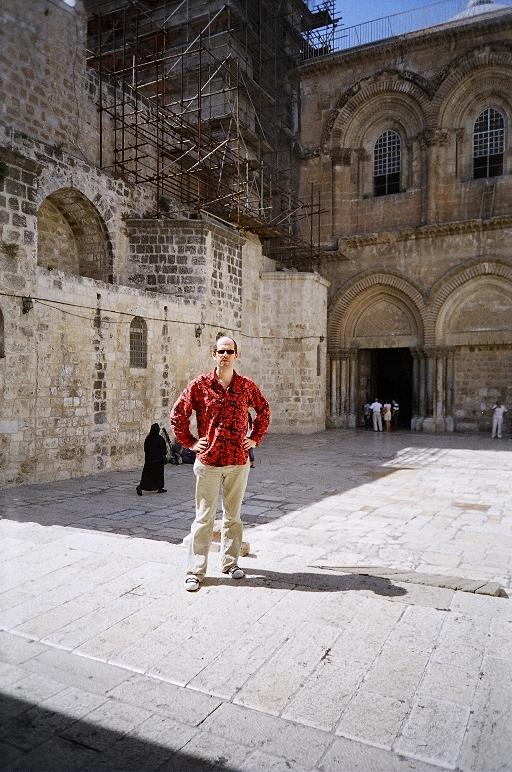
Here's another picture from my trip last year to TEH MIDDLE OF TEH EAST:


Through the window on the right is one of the sites where Jesus was crucified.

Film: Rebecca

This is an old Alfred Hitchcock directed film that the IFI were showing in a season of films whose linking feature now escapes me. In the film, a comedically sappy bird marries this slightly creepy rich guy (played by Laurence Olivier), and move to Manderlay, his ancestral pile. There she is weirded out by comparisons with Rebecca, the rich guy’s late first wife.

One thing that really has to be said about this film is that Olivier is brilliant in it. I have seen him ham it up in so many Shakespeare adaptations that I had written him off as the most over-rated actor of all time, but he communicates an agreeably ambiguous edginess to the role here that has me re-evaluating him completely. Beyond that, the pacing of the film is a bit weird – it seems like too much happens before they get to Manderlay, and too much happens after we learn the truth about Rebecca. Yet it all is so gamely presented that I let the film pull me where it would.

Strange Things Of The World

On one of her albums, Pat Benatar covers Kate Bush’s ‘Wuthering Heights’.

Wednesday, September 20, 2006

Very Fierce Panda Mauls Man

After a long train journey during which he drank four glasses of beer, Mr Zhang Xinyan decided that climbing into the enclosure of a giant Panda in Beijing Zoo would be a brilliant idea. Gu Gu the Panda then bit him repeatedly.

"'No one ever said they would bite people. I just wanted to touch it.'

"Zoo spokeswoman Ye Mingxia said the panda was unharmed and they were not considering punishing Mr Zhang yet."