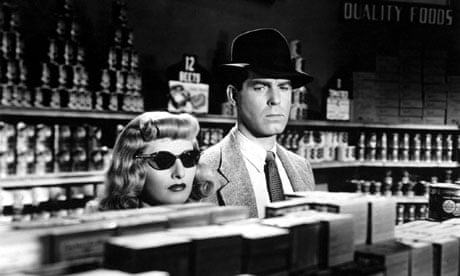
I saw these in the before time as part of an IFI season of films about couples who kill. Double Indemnity, directed by Billy Wilder, is a definite noir classic about a guy who thinks he is pretty smart (Fred MacMurray) and a dame (Barbara Stanwyck) who is playing him for a chump. If you have not seen it, the title comes from a term in life assurance policies whereby the insurer pays out double for particularly unlikely events, in this case a fatal accident on a train. As can be imagined, the plot involves a life assurance policy with just such a clause and a murder made to look like a fall from a train. The film is a masterful depiction of obsession leading to folly and delusion, with a typically noir inversion of the moral code through making the murderous insurance salesman the protagonist.
Billy Wilder made a lot of films and I don't know to what extent he is seen as making films with recurring themes, but there are definite elements here that find echoes in his other work. William Holden in Sunset Boulevard appears to have taken over the insurance salesman's apartment; in certain other regards the protagonists of both films follow a similar trajectory. The closing scene between the salesman and his loss adjustor colleague (Edward G. Robinson) recalls the ending of Some Like It Hot with its faint suggestion of homosexual attraction (though I could be reading too much into what is actually a more traditional paternal relationship). And similar to those other films, there is an air of loucheness to this one. In the opening it is presented as entirely normal that an insurance salesman would engage in lewd banter with the wife of a potential client, while later a minor character talks about how much he is looking forward to seeing a visiting "osteopath".
The Getaway meanwhile is a Sam Peckinpah directed film about a crim (Steve McQueen) who has to make a getaway after a heist goes wrong when other crims try to double-cross him. He is aided and abetted in this endeavour by his lovely wife (Ali McGraw). The film starts well with largely wordless scenes showing the crim in jail, the machinery of the jail juxtaposed with the mechanistic tasks pursued by the prisoners. It goes downhill once he gets out. The whole heist-gone-wrong plot is a bit plodding and predictable while the film as a whole has a tiresome air of macho blokey bollocks to it (see also: all other Sam Peckinpah films).
Peckinpah films are sometimes like artefacts from an era of unreconstructed offensive sexism and The Getaway is no exception in this regard. The scenes in which for reasons a rival crim kidnaps another couple and then starts shagging the woman, who turns out to love getting some good lovin', leaves a nasty taste, particularly as it is all largely played for laughs.
The various scenes where Steve McQueen's character slaps Ali McGraw around are also quite distasteful, not least because they were in a real-life relationship at the time that was reputedly characterised by domestic violence. Some of the other quirks of the Peckinpah style also grated with me. The slow-motion arcs of blood in the death scenes were a bit comedic; these may once have seemed ground-breaking but now (and perhaps already by the time this film was made) they are little more than Peckinpah cliché.
But for all that, the film has a strong visual sense. As previously noted, the images of jail life are stunning. Another scene that gives rise to some striking images is one where McQueen & McGraw escape emerge in a dump having escaped from the cops in a garbage truck's trash compartment. Neverthelss the film remains fundamentally not that good but might be of interest to film history types or fans of domestic violence. Otherwise don't bother with The Getaway: watch (or rewatch) Double Indemnity instead.
images:
Double Indemnity (Guardian: "My favourite film: Double Indemnity")
The Getaway (Basement Rejects: "The Getaway (1972)")
These are two of those compilations released by Ace Records and put together by Bob Stanley of Saint Etienne (in conjunction with Jason Wood in the case of Cafe Exil). They're both collections of music from the 1970s. In 76 in the Shade we are back in the notoriously hot summer of 1976. Thanks to England's Dreaming (Jon Savage's brilliant account of the Sex Pistols and their milieu) I think of 1976 as the year of punk, for all that 1977 was when it went overground and exploded into the living rooms of olde England. But there's none of that here. Instead the album has a collection of languid tunes that evoke a sense of being too damn hot to do anything.
It is in the nature of the music that individual tracks should not really stand out, but two tracks that really catch my brain are Lynsey De Paul's "Sugar Shuffle" and 10cc's "I'm Mandy Fly Me". With "Sugar Shuffle" I may perhaps be drawing of memories of when Lynsey De Paul used to appear on 1970s TV a lot, most notably when she competed in the Eurovision. She was a total sizzler and little me has a massive crush on her. "Sugar Shuffle" sees her seductively inviting listeners to join her doing said sugar shuffle. Sadly De Paul's style of music was swept away by punk and new pop, and she went on to go Tory, but hey, nobody's perfect and for a brief period in the mid 1970s she made perfect sense.
"I'm Mandy Fly Me" meanwhile takes its title from some innuendo laden advertising campaign where named lovely lady air hostesses would beckon businessmen to fly with their airline. The lyrics are ambiguous and could be about a plane crash or someone completely losing it, but it has an oddly disconcerting quality that brings it away from the mainstream of these heat-drenched tunes.
If the thoughts of 10cc and Lynsey De Paul providing the compilation's best tracks fills you with dread then you might want to stay away from 76 in the Shade.
Cafe Exil meanwhile is conceptually a compilation of interesting European music from the 1970s, together with tunes from some similar UK acts. Looking at the roster it is a bit krautrock (Faust, Amon Düül II, Michael Rother, Popol Vuh and Cluster all appear), but not exclusively so. The odd things is that although the acts here are all of the cool variety, unlike the mid-70s AOR and MOR terrors on the 76 in the Shade record, the overall feel of this is not too dissimilar from the other record, making it an ideal compilation for late night listening.
One Cafe Exil track that really stands out for me is Annette Peacock's "Pony", on which to an electronic accompaniment (at least partially her own) Ms Peacock sings about her fondness for her pony in an oddly strangulated tone. And then there is the Jan Hammer Group's "Don't You Know", a cheesy but laid back groover that sounds like it would be right at home on 76 in the Shade.
So yeah, two fun records. I'm looking forward to seeing what treasures Bob Stanley unearths next.
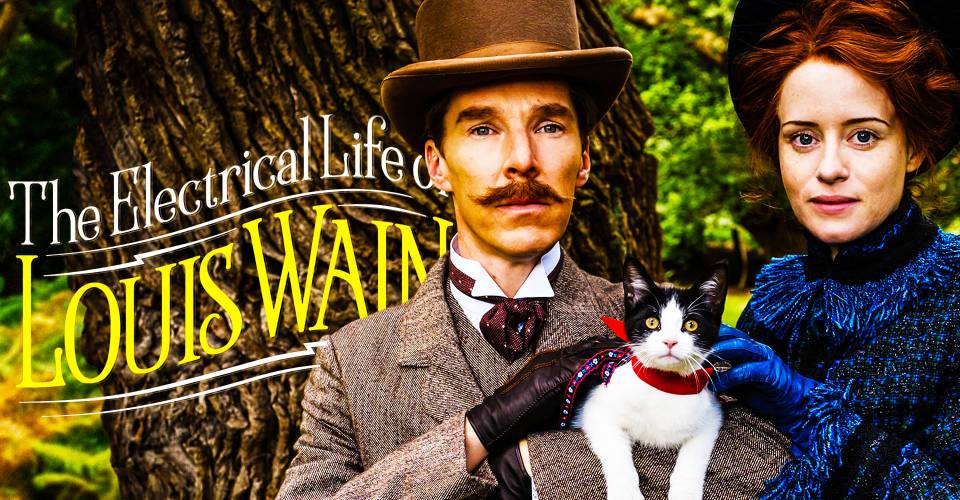
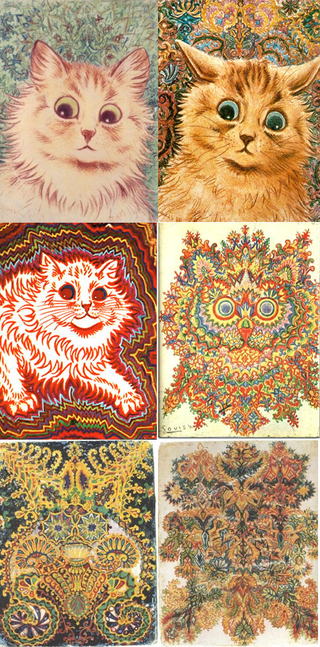
Directed by Will Sharpe, this is a biopic of that late Victorian guy who painted pictures of cats, with Benedict Cumberbatch shining in the lead role. Before seeing the film my thumbnail understanding of Louis Wain's life was that he painted pictures of cats and then went mad, with there being some debate as to whether his mental deterioration can be traced in the development of his art style (some of the cat pictures are completely bananas but it is not clear that he painted them after the more conventional ones). The film throws in a couple of other sad facts about his life, revealing first that he scandalised his family by marrying his sisters' governess (wonderfully played by Claire Foy) but was then parted from her prematurely when she died of cancer. Also one of his sisters also goes mad (before his own breakdown); as presented in the film you get the sense that oddness ran in the family, with his more sensible elder sister (played by the always wonderful Andrea Riseborough) coming across as someone permanently putting on her game face to present as normal.
And yet, it is a far less miserable film than that potted summary of Wain's life suggests. He has his ups and downs and yes he does end up permanently institutionalised, but following a fundraising appeal by his admirers he is brought to a nice asylum where he gets to both keep a pet cat and paint away to his heart's content. There are worse ways of passing your days.
This Wes Anderson film is set in an alternate universe in which for no obvious reason The New Yorker was published from a provincial French town. It's an enjoyable confection and probably best if not subjected to too much analytical thought. Anderson has settled into his own aesthetic to the extent that his films are now instantly recognisable and made in such a way that they are only going to appeal to people who already like Wes Anderson films. Oddly, the director this one most reminded me of was the USSR's Sergei Parajanov, particularly his The Color of Pomegranates, with which The French Dispatch shares a colour palette and a fondness for tableaux, combined with a disdain for anything approximating to a plot.
I have found myself thinking about whether this film would be eligible for the Hugo Awards, which recognise works in the fields of science fiction and fantasy. You would struggle to make the claim that The French Dispatch is a science fiction film, but you might be on better ground arguing that it counts as fantasy. After all, the eponymous French Dispatch newspaper never actually existed. The film is not just set in a made-up French town but in a fantasy version of France, so its connection to the real world is pretty tenuous. But I think it unlikely that it would attract so many nominations that the Hugo administrators would have to decide on its eligibility.
Everyone loves this; everyone except me, for I found it to be dull and fundamentally inconsequential. It follows an odd semi-relationship between a precocious teenage child actor mutating into a kid entrepreneur and a somewhat aimless woman in her 20s. And it's set in 1973 or 1974 with the post-October War oil crisis in the background (at one point a truck runs out of petrol and rolls down a hill, which I think might be a metaphor of some kind). It all looks great and has a great soundtrack and features great performances, not least from the principals (Cooper Hoffman and Alana Haim), but I found it really hard to care about the story or the characters. I think maybe a lot of this is down to the characterisation of Gary Valentine, the kid entrepreneur. Basically I hate entrepreneurs and having to spend time in the company of some 15 year old and his stupid business ideas was like a sojourn in hell. Alana Haim's character (also called Alana, which suggests a lack of imagination on somebody's part) was a lot more appealing but that made her association with the kid entrepreneur all the more disturbing.
But as noted, nearly everyone else in the world loved this. The only other gripes I saw focussed on the age difference between the semi-couple at the story's heart. At the start he is 15 while her age is somewhere into the 20s. There's no suggestion that they are even approximating to getting it on but that still is a whomper of an age difference; if a film featured a romance between a man in his twenties and a 15 year old girl then there would be uproar. I have to say though that the age difference did not jar so much with me while I was watching the film. Partly I was preoccupied with how boring the film was but I think also Gary's precociousness masked how young he was, while Alana's slight frame and lack of focus in her life made it easy to subconsciously think of her as younger than she was. Also I am so used to films in which women in their 20s play teenagers that the age difference was easily forgettable when they weren't ramming it down our throats.
People also did not like that there is a racist minor character in the film.
Overall though I think this film is like The Master, a previous Paul Thomas Anderson: full of strong performances and scenes that linger in the memory, but something that was an ordeal to get through when I was actually watching it.
Obviously this Covid world of people dying and travel and events being curtailed is pretty rubbish but there are some consolations, like being able to attend online events from the comfort of your home. Particularly interesting to me have been the various Rural Gothic events organised by Howard Ingham of Room 207 Press, Mark Norman of the Folklore Podcast, and Icy Sedgwick of the Fabulous Folklore with Icy podcast. These events feature people giving presentation on things broadly related to dark folklore and the less shit end of horror, often serving up things that might broadly fit under the folk horror rubric. They can also feature theatrical and musical performances.
The most recent Rural Gothic event took place on the 24th and 25th of July. Its theme was cults, both the ones you get in real life and their representation in fiction. The weekend was book-ended by two presentations on the music of cults, one by Helen Hawa-Diggle on a particularly notorious cult and then Kirby Kellogg talking about cults' music more generally. In both cases the focus was on music made by and for the cults themselves, not on music made by cult members and leaders in their previous lives (so nothing on David Koresh's rock & roll years). Generally these musical offerings were made by the cults to recruit people, so they are attempting to put their best face forward. There was a real variance in style and quality with the music on offer, but I think my interest in weirdo music generally might have made me more sympathetic to the sounds than would be the case with normal people. It was just as well there was no cult recruiter calling by Panda Mansions as I was listening to these cultish sounds.
Nevertheless, when you know the reality of the cults behind the music there can be considerable disjoint between the appealing music and the unsavoury reality of the people producing it. Hawa-Diggle played one video of a woman singing the Earth, Wind and Fire song "That's the Way of the World", accompanied by a full band. The music is genuinely beautiful and the audience (mostly black and of all ages, including many children) are clearly enjoying themselves as they dance or clap along. But it's a recording made in Jonestown on 17 November 1978. Less than 24 hours later everyone in the video (the singer, the musicians, the happy members of the People's Temple, the children, the NBC cameraman who shot the video, the dark haired white guy in sunglasses seen briefly at the video's start) were dead. The juxtaposition of the appealing music and happy people with their terrible fate is indescribably sad. Kellogg meanwhile played the opening track of a record released by another cult, the kinderchor vocals a charming evocation of the Langley Schools Music Project. But the record was made by the Children of God, a group notorious for the sexual exploitation of minors and the use of teenage girls and young women as sexual lures to attract men into the organisation.
Hawa-Diggle also looked at the way the People's Temple lives on in music. Some of this is a bit kitsch (bands giving themselves names that evoke the cult's horrific end but in a way that is meant to be ironic, as well as throwaway references to "drinking the kool-aid", etc.) but she focussed on something a bit more interesting. First she played us a short recording of a speech by Jim Jones, which made me realise that I had never heard his voice before, at least not knowingly (his voice is very sampleable). He sounds oddly like a white guy impersonating an in-your-face black preacher, except that he is not talking about God's message of love and turning the other cheek but of his willingness to fight his enemies and a listing of all the weapons he has ready to use against them. Then she played us the opening of the Alabama 3 track "Mao Tse Tung Said", which puts the Jim Jones speech over a dance beat, and then for the full effect the song being played live, with the crowd going mental as they chant along with Jim Jones. It's odd and strange, definitely a powerful moment though what it signifies is mysterious.
Kellog meanwhile brought us through a cavalcade of weirdo music from a variety of sinister cults: Aum Shinrikyo (music disturbingly like theme tunes to Japanese kids TV programmes), Heaven's Gate, the Manson Family, and so on. For a bit of contrast she also discussed the music of the Source Family. Compared to the others, these come across as a relatively harmless bunch: they weren't a death cult and while their leader, Father Yod, was a bit manipulative and had fourteen wives, he seems to have been neither rapey, a kiddie fiddler, nor a murderer (other cult leaders have set the bar very low here). And the music is different too. For the other groups, music was a recruitment tool, but with the Source Family it seems more like they just liked making music. Fortunately the music they liked making was improvised psychedelic freak-out music. Ya Ho Wha 13 (the Source Family house band) have retained a certain cult popularity, helped by the appearance of their music in a documentary on their movement. That film reputedly led to such an upsurge in interest that they reformed to play concerts and record some more albums, long outliving the Source Family itself (which dissolved after Father Yod died in a bizarre hang-gliding accident).
The dramatic element to this Rural Gothic event was April, by the Hermetic Arts theatre company (who comprise writer/performer Carrie Thompson and director Chris Lincé). At previous Rural Gothic events Hermetic Arts did live drama pieces presented as though they were some kind of live internet broadcast of an occult spooky nature. This time they gave us a pre-recorded work that saw Thompson playing the popular internet influencer and life-style guru April, beginning with her singing a song about the importance of positive thinking. Although they said afterward that the character was based on a real influencer whose name escapes me, the person most called to mind was would-be pop star Poppy. The bananas trippiness of April's videos was very reminiscent of the strange content on Poppy's YouTube channel and the comparison also drew comparison with fevered rumours that Poppy is herself in a cult (which kind of became ironically true when Poppy (or the woman playing Poppy) broke with her manager and collaborator, accusing him of manipulative behaviour and glamourising suicide; since then she has concentrated on the music, always the weak link of the Poppy enterprise).
I digress. April starts off with April singing about positivity, then she plays some of her own weird videos, then she solves some of her followers' problems (or rather she "solves" them), and then she gets ready for the Big Event she has planned for everyone watching. But it all goes wrong and in a huge leap for Hermetic Arts everything gets a bit metafictional and starts bringing in events from Thompson's own life, or at least has April, or the person who became April, experience extreme things that Thompson herself went through. For me this started off weird and trippy and then ended up being oddly moving.
Other presentations that impressed me included Sam Hirst's talk on sects of the 17th and 18th century, focussing mainly on the period of the English Civil War and the Interregnum (basically one of the most fascinating of historical periods) but also stretching a bit onwards. Such old favourites as the Levellers, Diggers, Muggletonians and Fifth Monarchists got a look-in here, but also such less celebrated outfits as the French Prophets (who I think received some airplay on John Peel back in the day). I liked the discussion of the Ranters, who supposedly were always having song and dance parties in the nip but may have been a phantom movement existing only in the imaginations of respectable people concerned as to where complete religious freedom would lead. Another presentation by David Whitworth looked at the use and representation of cults in roleplaying games, and perhaps the presence of that on the bill had put TTRPGs in my head, but by the end of Hirst's talk I was thinking that England in the1640s and 1650s would be a great setting for Call of Cthulhu.
One thing I did find myself wondering was how it was that the political turmoil of the 1640s and 1650s saw an eruption of new religions in England while there was nothing similar in France of the 1790s. One for the social and intellectual historians I think.
John Mullis meanwhile talked about how Margaret Murray's The Witch-Cult in Western Europe had influenced H. P. Lovecraft's writing, both in the way it sometimes features shadowy witch cults surviving in New England backwoods and in the way the Cthulhu cult itself is modelled on the idea of an ancient cult with its origins in pre-history. Although The Witch-Cult has been much-criticised and its conclusions debunked, Murray herself was a serious scholar and her work the product of diligent research, even if the conclusions she reached are a bit eccentric. Mullis did give the impression that Murray's findings became increasingly odd as she went on. Particularly outlandish I think is her claim that the witch cult has been continuously in existence for longer than the entirety of human history, having supposedly been founded by non-humans (I'm guessing she meant Neanderthals or other higher hominids, not pixies or demons). But this kind of outlandish thinking is fertile ground for the writers of weird fiction, which is why the likes of H. P. Lovecraft, Arthur Machen and even M. R. James (with the likes of "Casting the Runes") were so keen to recycle her ideas.
Mullis did not talk so much about how Murray's dubious conclusions were an inspiration to the modern Wicca movement, as it allowed Wiccans to claim an ancient lineage for their religion. It is also easy to see the practitioners of Murray's witch cult in a favourable light, what with the attempts of the patriarchal mainstream to exterminate them. Mullis pointed out however that there are limits to the cuddliness of Murray's witches, given that she sees them as practitioners of human sacrifice. That Wiccans are still willing to associate themselves with them is reminiscent of the way many viewers of The Wicker Man see Lord Summerisle and the islanders as the good guys, notwithstanding their being practitioners of human sacrifice and the sexual exploitation of women and minors.
I also enjoyed Howard Ingham's comparison of real-life brainwashing versus how it appears in films, drawing on their own experiences as a former member of the evangelical Christian community. The focus was on films dealing with cults rather than other kinds of brainwashing, which meant that the likes of The Ipcress File or The Manchurian Candidate did not feature (though Ingham did reference the real-life Korean War incident that inspired the latter film). I had seen relatively few of the films Ingham mentioned but the fact that the brilliant Martha Marcy May Marlene was mentioned so favourably inspired confidence in the other recommendations. Ingham has written the book on cinematic cults, so he knows what he is talking about.
I would have got more from a presentation on cults and sects in The Magnus Archives if I had more familiarity with the popular podcast. Although it has been recommended to me as something I would like, I have very little sense of the popular podcast's actual format. An account of a psychogeographic pilgrimage inspired by the works of Georges Bataille for me suffered from a disjoint between the initial exposition of Bataille's funny theories and practices and then the art flummery of the pilgrimage. And Howard Ingham's recored interview with Neil Edwards on his documentary film about the Process Church had me itching to find out more about this odd group (and indeed see the film).
One curious absence over the weekend was the lack of any major attempt to define cults and to delineate where the boundaries between cults and mainstream religions lie. Are all new religions cults or can sects pop into being without operating in a cultish manner? Is even the term cult and the way in which we imagine cults a deliberate attempt to demonise new religions in an attempt to keep people in established churches or atomised non-religion? In response to a question (from me), Howard Ingham suggested that the difference between cults and mainstream religions is essentially one of time: given a couple of centuries to expand and settle down a new religion will gradually shed its cultish aspects and became something far less threatening. And yet I wonder about this. There are long-established religions that continued to exhibit cultish aspects, wielding an array of punishments against apostates or anyone questioning official doctrine. And on the other side, I'm not convinced that all new religions work in a cultish manner. Western Buddhism in particular seems like one that has been quite successful in attracting adherents while remaining something that people can drift out of if it stops working for them (though I appreciate that I am now leaving myself open to being informed of the secret domination shame of the Buddhist sex masters). And my limited interactions with members of the Hare Krishnas reveals them to be far more normal and less cult-like than might be imagined.
But I think the mark of a good event is that it leaves you with something to think about, and this Rural Gothic event did that in spades. If you want to explore the world of Rural Gothic events yourself then you can actually buy access to recordings of the Cult event here. And also, Harvest, the next Rural Gothic live event takes place on the 28th of August, and you can buy tickets for that here.
images:
The Ranters (The Adventures of a Feigned Hero: The Ranters Ranting)
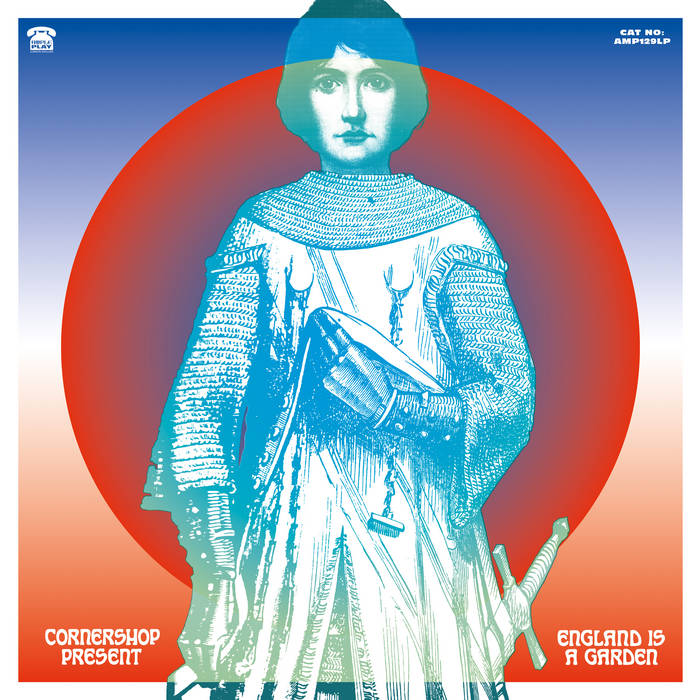
Like many people I have been buying music from Bandcamp. Firstly here we have England Is A Garden this year's new album from Cornershop, who have been one of my favourite bands for almost the last 30 years. The opening track ('St Marie Under Canon') was a great feelgood hit of the summer, with few things being more fun than walking around in the sun blasting it out on headphones. The rest of the album has the kind of refreshing familiarity one associates with the Shop, featuring their patented Cornershop stoner groove combined with occasional flurries of sonic waywardness.
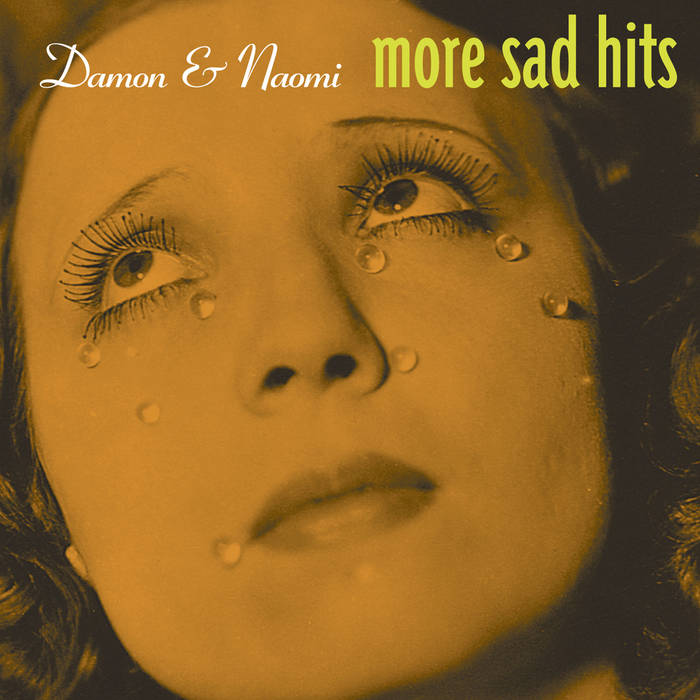
More Sad Hits meanwhile was the debut album from the two members of Galaxie 500 who aren't Dean Wareham. People had warned me away from their music, saying that it basically isn't that good, but this record is a delight, one that has given me far more enjoyment than This Is Our Music, the third Galaxie 500 record; the peaks are not as high but the overall effect of the record is much more appealing, with songs of a consistently decent quality. Despite the title, the music stays away from miserablism, with Kramer's production keeping things reminiscent but not derivative of the Galaxie 500 sound. I am looking forward to exploring more of their music and would welcome pointers in that regard as by now they have a considerable back catalogue.
And then to Ms Gwenno, who used to be in another band but is now solo. I saw her at Liverpool Psychfest a couple of years ago (possibly 2016 but man it's so hard to remember). She lives in Wales but sings in Cornish, which would be kind of like if Black Sabbath sang in West Frisian. I don't really have a problem with lyrics I can't understand and must report that this is a very appealing record. Writers from the Astral Weeks school of music journalism compare it to the likes of Broadcast, Stereolab and that lot generally, so if you like them you'll probably like this too. My only real regret here is that when I bought it they were not offering CDs but now they are, so I fear I may have to buy it again to be able to play this on my proper stereo as it is worth it.
images, all from Bandcamp:
By an odd coincidence, within a few days of being asked to review the Late Bloøm and Rosa Anschütz albums I was also asked to review this. But what is it? Well, it is a compilation of tunes recorded for the Old Tunes, Fresh Takes podcast, which is run by Jack Sibley and Tim Woodson. For the podcast, people recorded new versions of folk tunes, with these people often being people from outside the purist folk tradition, recording the songs with whatever instruments they have to hand (the podcast started during lockdown) and not necessarily in a reverential folkie manner. Looking at the track listing I can see that the album features several versions of the same songs, notably 'Brisk Lad', 'My Son David', & 'Cruel Mother', and listening to it reveals that some of the songs with different titles are in fact also versions of some of the others. The people playing on the record are not names familiar to me but I am remarkably ignorant so they are probably all household names; I did at least notice the musical alter-egos of the two guys who run the podcast, Hevelwood and Jack The Robot.
But is it any good? Now, if I had never heard this record and you were to describe the basic concept to me, I would say "That sounds terrible", my thinking being that folk music is one form that does not profit from updating or incursions from new instrumentation or later forms of music. And you may recall the extreme hostility with which I reviewed music by The Imagined Village, another lot who combined electronic stuff with folky stuff. However, for me this record works. Although it is I think coming from a different direction, it ends up reaching a similar aesthetic position to some of the Ghost Box records, with the vocals (often the most folkie part of these tracks) seeming to haunt the electronic or electric musical accompaniment. Also the tracks somehow feel like they are still true to the essence of their folk origins even while emerging from a radically different mode of instrumentation. It helps I think that a fair few of the songs are of the edgy and sinister folk tradition, as opposed to the more bland hey nonny nonny school.
I should point out also that this compilation is being made available on a pay-what-you-like basis on Bandcamp, with the money raised going to Help Musicians UK and Music in Detention. The first of these helps musicians throughout their careers and into retirement, while the second uses music to help people being held in British immigration detention centres.
As you know, I am a very important influencer whose word can sway many people in all kinds of directions. This is starting to be recognised, as recently I was offered review copies of these two records, which are from different labels but share PR. And I think there is an overlap to the aesthetic, so it makes sense to review them together.
Rosa Anschütz is a multimedia artist based in Berlin and Vienna. An intriguing detail in the press release for her record is that each track on the Votive album has an accompanying ceramic sculpture (some of which can be seen on her Bandcamp page). The record is meant to be the product of incantations and ritualistic behaviour; as the title suggests, they are meant to be votive offerings, albeit of a not entirely religious nature. This might not be entirely obvious if you didn't have the press release in front of you, but I think it would sound a bit spooky and mysterious. The nine tracks on the album combine Anschütz's voice with an electronic accompaniment, apparently based on her home-made modular synthesiser. There is also a separate version of the album with no vocals, should you find the human voice distracting. My overall verdict is that this is very much the kind of thing I like. I've already listened to this a lot and will do so more.
Late Bloøm meanwhile is the nom de guerre of one Simon Spiess, who has played with a number of other outfits who are unfamiliar to me because I live under a stone. I'm not sure where Mr Spiess is from, but the album was recorded in Denmark and Switzerland. Or rather albums - Along a Continuum is conceptually two separate but linked albums, Symphony Of Blooming Fields & Pulsing Planets and One Who Knows; these are available as separate cassettes or as digital items figured separately. Unlike Votive, there are no vocals here, but Late Bloøm also makes use of modular synths, as well as clarinet and saxophone, both I think played by Mr Spiess and both also subjected to a fair bit of treatment. The Late Bloøm records are not so goth-adjacent, but they are also offering ritualistic electronica, good if you are planning some meditative contemplation or entering a relaxed state.
The two sub-albums of Along a Continuum are available separately on Bandcamp:
And now for some items that could be nominated in the best dramatic presentation, long form category in this year's Hugo Awards. These are dramatic presentations that are more than 90 minutes long and which first appeared in 2020.
Possessor - Brandon Cronenberg's second feature deals with a body-swapping assassin whose sense of self is starting to break down. It is grim fare but an impressive piece of work.
Tenet - Directed by Christopher Nolan, this was meant to be the big budget film that would bring people back to the cinema after Covid lockdowns. Its time-travel plot might not bear too much analysis but it looks great and features some stunning action set pieces.
Bill & Ted Face The Music - This however may have been the time travel film we actually needed in 2020. The amiable twosome from the previous films find themselves tasked with writing the song that will unite the world and thereby save it from destruction. Along the way they travel forwards in time meeting possible future versions of themselves while their equally amiable daughters go into the past to recruit the greatest musicians of all time. It's a very likeable film and for me was the perfect antidote to 2020's year of grimness.
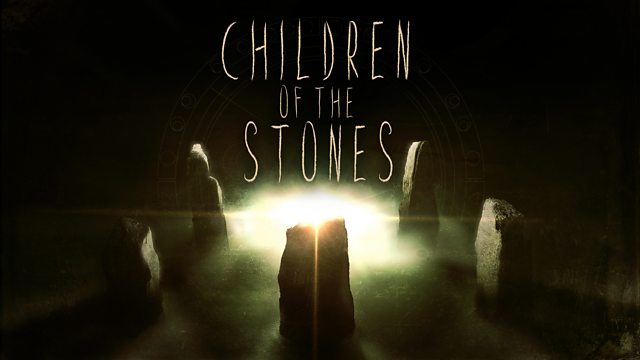
Children of the Stones - This audio drama adapts the classic 1970s TV series about a spooky English village set within a stone circle. A strong cast and great sound design make this a worthy updating of the much-loved original. It can be downloaded or streamed from the BBC website.
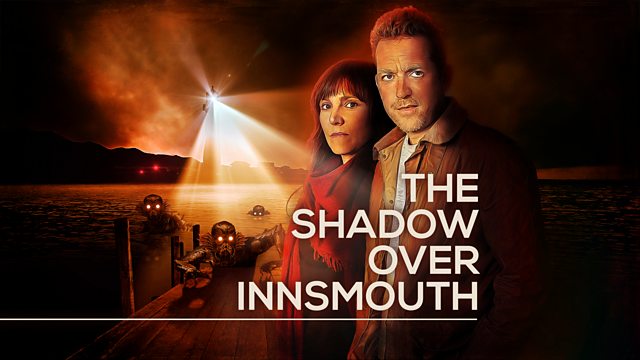
The Shadow Over Innsmouth - Another audio drama, this is the third of the Lovecraft Investigations directed and written by Julian Simpson for Sweet Talk Productions and the BBC. The story bears a loose relationship to the H. P. Lovecraft story of the same name and like previous series it is presented as though it was a true crime podcast. Aside from the spookiness, part of the fun in this one comes from how it incorporates real events of 2020 into the narrative. It and the previous series also be downloaded or streamed from the BBC website.
I will probably nominate all of the above. My prediction is that only Tenet and Bill & Ted make it onto the ballot.
 Billy Wilder made a lot of films and I don't know to what extent he is seen as making films with recurring themes, but there are definite elements here that find echoes in his other work. William Holden in Sunset Boulevard appears to have taken over the insurance salesman's apartment; in certain other regards the protagonists of both films follow a similar trajectory. The closing scene between the salesman and his loss adjustor colleague (Edward G. Robinson) recalls the ending of Some Like It Hot with its faint suggestion of homosexual attraction (though I could be reading too much into what is actually a more traditional paternal relationship). And similar to those other films, there is an air of loucheness to this one. In the opening it is presented as entirely normal that an insurance salesman would engage in lewd banter with the wife of a potential client, while later a minor character talks about how much he is looking forward to seeing a visiting "osteopath".