Thursday, August 21, 2008
Moondog "The Viking of Sixth Avenue"
So yeah, Moondog. Before receiving this birthday present, all I knew about Moondog was that he was some New York homeless guy who dressed up as a Viking and released records. So I was rather expecting that this album would just be the recordings of some crazy guy banging tin cans together and shouting "Boxcar! Boxcar!" over and over. As people of taste and discernment you probably knew better, as I do now that I have listened to Moondog's record. It's all very musical and nothing like as crazy outsider nutter music as I had expected. Indeed, this does not really sound like outsider music at all, and it is not surprising to read in the sleevenotes that Moondog (not his real name) was a highly trained musician. In terms of what it all sounds like, it is all a bit polyrhythmic and layered, with many of the tracks suggesting at least some familiarity with Gamelan. I am not sure whether Moondog multitracks himself playing all the instruments (must read sleevenotes more carefully) or if he has collaborators; either way, it does all sound a bit like the kind of stuff Fursaxa and those other people who do the whole "sample yourself, then sample yourself playing over sample, repeat to infinity" thing, only without the slow build. So yeah, I recommend this highly. Favourite track is probably the one where he sings about rights other than human rights, but that might just be because it has vocals on it.


Wednesday, August 20, 2008
Concert: Caribou
I went to this concert in Whelan's with Kevlol and one of his pals. The support band were some fellows called Born Ruffians, and they were, for me, worth the price of admission on their own. The Ruffs are three young lads from across the Atlantic and they played a kind of music that sounded very familiar while not sounding exactly like the stuff produced by anyone else. In broad terms, I suppose they count as a US indie rock, but the *shy* type rather than the fratboy. You could imagine their tunes showing up on the Juno soundtrack, if that is any help. I liked the way the singer's strangulated vocals played off the musoey and drum heavy instrumentation.
I also was amused when the drummer, finishing their set, said "Thanks very much… stick around for Caribou… which you will of course do, as they are the ones you are here to see". I am not sure of you know these Caribou chaps, I certainly did not before going to the gig. They seem to be in an interesting musical stage, where they have what in absolute terms has to be taken as a small number of fans, but those fans are very into their music. So it was that I saw them in a not-full Whelans where the crowd that was here went totally mental for the band, with even the totally 100% heterosexual likes of Kevlol throwing his kecks up on stage and begging Mr Caribou to father gay babies on him.
What would be amusing would be to now approach the rest of this write-up in the spirit of an anthropological enquiry, attempting, in a 50s academic gone hip style, to understand the cause of Caribou's popularity with their fans. But that would be a bit hard to sustain, so I will instead talk about the band and their actual performance. There were about four of them on stage, with one of them being very much Mr Caribou. I got the impression that maybe the Bou were originally a one-man-band, perhaps based around synthetics, but they have evolved into a band who live to rock. Their music was very drum led, emphasised by the main drum kit's situation at the front of the stage. The main drummer also seemed to lead a lot of the music, visibly cueing the other musicians in an exciting manner. Mr Caribou himself would often switched from his keyboards to a second drumkit, typically to let songs explode into a twin drum workout where normal music would have a guitar solo. In contrast, the guitarist and bassist lurked at the back of the stage, doing their job quietly and without fuss, knowing their place.
The drumminess of Caribou was for me the band's secret weapon, the thing that makes me inclined to recommend their live appearances to other people. I do not remember so much about the songs themselves (as distinct from their arrangements), but I recall that Mr Caribou's vocals were a bit buried in the mix, perhaps as a homage to My Bloody Valentine.
OK, that's enough Caribou. Check them out next time they come to your town.
I also was amused when the drummer, finishing their set, said "Thanks very much… stick around for Caribou… which you will of course do, as they are the ones you are here to see". I am not sure of you know these Caribou chaps, I certainly did not before going to the gig. They seem to be in an interesting musical stage, where they have what in absolute terms has to be taken as a small number of fans, but those fans are very into their music. So it was that I saw them in a not-full Whelans where the crowd that was here went totally mental for the band, with even the totally 100% heterosexual likes of Kevlol throwing his kecks up on stage and begging Mr Caribou to father gay babies on him.
What would be amusing would be to now approach the rest of this write-up in the spirit of an anthropological enquiry, attempting, in a 50s academic gone hip style, to understand the cause of Caribou's popularity with their fans. But that would be a bit hard to sustain, so I will instead talk about the band and their actual performance. There were about four of them on stage, with one of them being very much Mr Caribou. I got the impression that maybe the Bou were originally a one-man-band, perhaps based around synthetics, but they have evolved into a band who live to rock. Their music was very drum led, emphasised by the main drum kit's situation at the front of the stage. The main drummer also seemed to lead a lot of the music, visibly cueing the other musicians in an exciting manner. Mr Caribou himself would often switched from his keyboards to a second drumkit, typically to let songs explode into a twin drum workout where normal music would have a guitar solo. In contrast, the guitarist and bassist lurked at the back of the stage, doing their job quietly and without fuss, knowing their place.
The drumminess of Caribou was for me the band's secret weapon, the thing that makes me inclined to recommend their live appearances to other people. I do not remember so much about the songs themselves (as distinct from their arrangements), but I recall that Mr Caribou's vocals were a bit buried in the mix, perhaps as a homage to My Bloody Valentine.
OK, that's enough Caribou. Check them out next time they come to your town.
Tuesday, August 19, 2008
My Free Gift To You
Do you want a free CD-R of crazy psych and freakbeat tunes from around the world? Then drop me an e-mail and I will make you a copy. The disc in question is one I compiled for my birthday party, but I think no one heard it there because there was too much talk. I won't post a track listing here, as a lot of the tracks are pretty anonymous. I can tell you that the music is all from the 1960s (unless some from the 1970s sneaked in) and is from a number of countries, including France, East Germany, Thailand, Ethiopia, India, and Cambodia, as well as some better known tracks from the UK, USA, and the Netherlands. The relatively well known tracks are there mainly because this was a compilation to play at a party, not one to show off my collection of amazingly obscure records. However, I think they work well with their less well-known friends. But yeah, it you want a copy, let me know. I think the disc is pretty hot stuff, but then I would.
Monday, August 18, 2008
Éthiopiques en vivant
So yeah dude, we went to London to see this concert by some of the Ethiopian jazzers who appear on the Éthiopiques series of records. This was by way of whetting our appetites before booting off to Ethiopia. This concert was my first time visiting the Barbican, an endearing piece of 1980s modernism. The concert featured some American lot called The Either Orchestra (the Dengue Fever of Ethiopian music) backing a number of Ethiopians: Mulatu Astatqé, Alèmayèhyu Eshèté, Gétatchèw Mèkurya (the one some of you saw with The Ex in Amsterdam), and Mahmoud Ahmed. The Ethiopians only came on for a couple of tunes each, with the exception of Mulatu Astatqé. He hung around onstage for most of the concert, sometime picking at bongos but mostly just being there. Mulatu did play a bit of xylophone fellow at the start of his appearance, and played it well, but mostly he was just a presence, as befits his historic status as a bandleader and arranger rather than performer. He also came on first.
The other Ethiopians were much more charismatic performers. Alèmayèhyu Eshèté is a vocalist, often dubbed the Ethiopian James Brown, I think because he does a bit of grunty "huh!" stuff every now and then. He reminded me a bit of Ireland's showband singers, particularly Sonny Knowles, as he had that kind of effortless populism to him. He would do a bit of pointing at random people (probably Ethiopian ladies) in the audience and then saying something in Amharic before launching into the next song. I was almost expecting him to do the Sonny Knowles hand-waving thing. Alèmayèhyu also seems to look exactly the same as he did in photos from the 1970s, making me wonder if there is a photo of some decrepit old man mouldering away in his attic. This guy is a total star.
Gétatchèw Mèkurya has been dubbed the Negus of Ethiopian jazz. For a long time I had no idea what a Negus was, and wondered if it might some kind of portmanteau word combining negro and magus, suggesting that Gétatchèw was some kind of musician. But no, negus is actually just the Amharic for emperor. Gétatchèw really went for it tonight, entering from a side door in the auditorium and walking through the audience, blasting slabs of pure jazz from his saxophone. I don't know to what extent his leadership over the scene is universally acknowledged, but he is definitely cut from a different cloth than the supperclub jazz of the other players. For us he would have been the real star of this event.
Mahmoud Ahmed was the last of the Ethiopians to take the stage. He is another singer, and the one I am least familiar with on record. I cannot really say too much about him except that he is very good at singing and the crowd, particularly the smattering of Ethiopians present, seemed to really go mental for him. I think perhaps that he might be the real star of the scene, but hey, there's enough Ethio-jazz for everyone.
And at the end, all four of the Ethiopians were on stage together, while Mahmoud and Alèmayèhyu duetted, Gétatchèw parped away, and Mulatu took care of business. And hey, apparently these four have never shared a stage before – world première action!
There were a couple of downsides to all this, of course. I seem to be cursed by concerts that start badly, and on this occasion it seemed like the opener, 'Yèkèrmo Sèw' from Éthiopiques 4 (and the first Ethio-jazz track I ever heard) sounding a bit flat. But this sorted itself out. The other problem were the Either Orchestra… there was no problem with their playing, but they did kind of seem to have ideas above their station, like it was the Ethiopians who were guesting with them rather then their being the backing band for the Ethiopians. But hey, these things are not insurmountable problems.
Afterwards we were going to hang around and have some sherries with London pals Sylvia and Devastatin' Dave, but they had to leave early due to a bad shandy and thinking the music was all rubbish (or something). Dave's' write-up of the night in respected journal Frank's APA proved an interesting counterpoint to mine (as indeed did that of my beloved).
We watched a post performance performance by Dub Colossus, a dub/Ethio-jazz crossover outfit. They were enjoyable. They were followed by a DJ whose music was interesting, but he seemed to do too much of dicking around with tunes that would be dancefloor monsters if left alone. Eh, can't remember what any of them were. And then we went back to our hotel. The end.
And as it happens, the same Éthiopiques show (though apparently without Gétatchèw Mèkurya, SuXoR) is coming to the Dún Laoghaire Festival of World Culture next Friday… maybe see you there.
oh wait, the concert is sold out. Ah well, they'll be shite without Gétatchèw.
19/9/2008 edited to take account of the fact that the second part of an Ethiopian's name is not a surname but their dad's name
The other Ethiopians were much more charismatic performers. Alèmayèhyu Eshèté is a vocalist, often dubbed the Ethiopian James Brown, I think because he does a bit of grunty "huh!" stuff every now and then. He reminded me a bit of Ireland's showband singers, particularly Sonny Knowles, as he had that kind of effortless populism to him. He would do a bit of pointing at random people (probably Ethiopian ladies) in the audience and then saying something in Amharic before launching into the next song. I was almost expecting him to do the Sonny Knowles hand-waving thing. Alèmayèhyu also seems to look exactly the same as he did in photos from the 1970s, making me wonder if there is a photo of some decrepit old man mouldering away in his attic. This guy is a total star.
Gétatchèw Mèkurya has been dubbed the Negus of Ethiopian jazz. For a long time I had no idea what a Negus was, and wondered if it might some kind of portmanteau word combining negro and magus, suggesting that Gétatchèw was some kind of musician. But no, negus is actually just the Amharic for emperor. Gétatchèw really went for it tonight, entering from a side door in the auditorium and walking through the audience, blasting slabs of pure jazz from his saxophone. I don't know to what extent his leadership over the scene is universally acknowledged, but he is definitely cut from a different cloth than the supperclub jazz of the other players. For us he would have been the real star of this event.
Mahmoud Ahmed was the last of the Ethiopians to take the stage. He is another singer, and the one I am least familiar with on record. I cannot really say too much about him except that he is very good at singing and the crowd, particularly the smattering of Ethiopians present, seemed to really go mental for him. I think perhaps that he might be the real star of the scene, but hey, there's enough Ethio-jazz for everyone.
And at the end, all four of the Ethiopians were on stage together, while Mahmoud and Alèmayèhyu duetted, Gétatchèw parped away, and Mulatu took care of business. And hey, apparently these four have never shared a stage before – world première action!
There were a couple of downsides to all this, of course. I seem to be cursed by concerts that start badly, and on this occasion it seemed like the opener, 'Yèkèrmo Sèw' from Éthiopiques 4 (and the first Ethio-jazz track I ever heard) sounding a bit flat. But this sorted itself out. The other problem were the Either Orchestra… there was no problem with their playing, but they did kind of seem to have ideas above their station, like it was the Ethiopians who were guesting with them rather then their being the backing band for the Ethiopians. But hey, these things are not insurmountable problems.
Afterwards we were going to hang around and have some sherries with London pals Sylvia and Devastatin' Dave, but they had to leave early due to a bad shandy and thinking the music was all rubbish (or something). Dave's' write-up of the night in respected journal Frank's APA proved an interesting counterpoint to mine (as indeed did that of my beloved).
We watched a post performance performance by Dub Colossus, a dub/Ethio-jazz crossover outfit. They were enjoyable. They were followed by a DJ whose music was interesting, but he seemed to do too much of dicking around with tunes that would be dancefloor monsters if left alone. Eh, can't remember what any of them were. And then we went back to our hotel. The end.
And as it happens, the same Éthiopiques show (though apparently without Gétatchèw Mèkurya, SuXoR) is coming to the Dún Laoghaire Festival of World Culture next Friday… maybe see you there.
oh wait, the concert is sold out. Ah well, they'll be shite without Gétatchèw.
19/9/2008 edited to take account of the fact that the second part of an Ethiopian's name is not a surname but their dad's name
Sunday, August 17, 2008
Comics Round-up 17/8/2008
This time I have a lot of comics to cover. These include ones I bought before I went to Ethiopia, as well as ones that came out while I was away.
Criminal #4, by Ed Brubaker and Sean Phillips
So yeah, you remember this noir-ish title, yes? This story focuses on a newspaper cartoonist and partially reformed counterfeiter who showed up previously in the most excellent Lawless storyline. I fear that in true noir style, the counterfeiter will regret the night he set eyes on the heat packing dame pictured on the cover.
Batman #679, by Grant Morrison, Tony Daniel, and Sandu Florea
I may have mentioned in an earlier comics round-up that this Grant Morrison title is just a bit disjointed. The story seems to involve some bad people who are trying to kill Batman, or make him go mental, or something. As part of all this, Batman seems to have dropped into some kind of weirdo fantasy world, or started imagining that he is someone else, or something, and on any given page it is not immediately obvious whether you are seeing something that is actually happening or just being imagined by someone (with the obvious proviso that as Batman is not a real person then none of this can be said to be actually happening). So yeah, the most terrible fun.
Daredevil Saga
This is one of those free promo comics they sometimes throw into my new comics bag. It presents a summary of the Ed Brubaker/Michael Lark run thus-far on Daredevil and is probably meant to make you think that the Brubaker/Lark Daredevil is so kewl that you will want to buy the next issue. It kind of had the opposite effect on me, largely because summaries of a good long run on a superhero title always sound pretty ridiculous. In this one, characters seem to keep dying and coming back to life, while Daredevil's secret identity as blind lawyer Matt Murdoch is revealed and then un-revealed. Mmmm. I did read one of the Brubaker/Lark issues of Daredevil a while ago, and it seemed pretty ponderous. I know that this title has always been one of the more "serious" of the super comics, but I nevertheless feel that it can be done with a bit more zip and zap.
Dan Dare #7, by Garth Ennis and Gary Erskine
Double sized final issue! Amusingly, I was pretty wrong about how it would end (i.e. Dare is not killed by a Treen sniper just as he leads his fleet to victory), but the final battle is still clearly modelled on Trafalgar.
It's all very exciting, and you can't fault the thrill power of the huge-o space battle, but fundamentally I don't think Ennis really has the measure of Dan Dare's character. He writes him as too hard and cold, and too like every other super-macho Ennis character. I know this is meant to be an older Dan Dare than the one who appeared in the 1950s Eagle, but it seems like too much of a leap. I reckon Grant Morrison and Rian Hughes were better at portraying an older, sadder Dan Dare in their 1990s reworking of the character (recently reprinted in the Rian Hughes compilation Yesterday's Tomorrows, of which more later).
100 Bullets #94, by Brian Azzarello and Eduardo Risso
I often think it is a shame that ongoing comics no longer start with summaries of what has gone before, though in the case of this title such a thing would risk warping the time-space continuum. This issue is interesting, but I don't know what someone would make of it who had not read a lot of what has gone before. This contrasts with the last issue, which would work well on its own.
War Heroes #1, by Mark Millar, Tony Harris, Cliff Rathburn, & Jo Mettler
This is written by Mark Millar. I am suspicious of Millar, as I have read quite a bit of not-good stuff that was nevertheless highly praised in certain quarters (I am thinking of his run writing The Authority, or Red Son). That said, people do speak highly of his work on The Ultimates (a high-octane reworking of The Avengers (a team of superheroes)), and they do so in terms suggesting that they are not smoking crack. So I thought I would give this a go. It is set in the future, where to lure volunteers into the armed forces, the US government have started dishing out superpowers to its soldiers. In basic premise then we are back in territory similar to that ploughed by Pat Mills and Kevin O'Neill in their fondly remembered Marshal Law, though the writing and art is less grotesque. It still seems entertaining enough, and I reckon I will pick up an issue or two more before making a definitive decision on it.
The Exterminators #30, by Simon Oliver, Tony Moore, & John Lucas
So this is the one in which the heroes are pest exterminators, and the villains are a variety of disgusting insects and other vermin. And this is the last issue, in which the heroes battle to save the very world from some weird Egyptian insect god. Will they succeed? (answer: yes)
I get the idea that this title was only somewhat successful, but it has given me considerable enjoyment over the course of its run, not least because there are many cheap jolts to be gained from just how disgusting cockroaches and their friends are.
Glamourpuss #2, by Dave Sim
If you have even the most passing interest in comics then you have probably heard of Dave Sim, the crazy man who wrote and drew three hundred issues of a comic about a three foot tall talking aardvark. Everyone loved the early issues of Cerebus, when it was a rofflesome parody of barbarian fantasy tropes, and everyone loved it even more when the plot became super-complex and serious, and then everyone stopped reading it when Sim discovered post-modernism and started to use Cerebus as a vehicle for his reactionary and misogynist opinions.
Still, it is always worth keeping an eye on what Sim is up to. This title seems to be very much a game of two halves, albeit with both halves happening near simultanaeously. Part of it is Sim talking about the history and development of comics, with a lot of this issue discussing Alex Raymond, creator of the newspaper strip Rip Kirby, and his rival Milt Caniff (who gave us Steve Canyon and Terry and the Pirates). Not knowing that much about newspaper strips, or the techniques used by their producers, I found this stuff rather informative. The rest of the title seems to be weird pop culture parody, with Sim tracing in women's magazine ads and detourning them, often by having the attractive model who appears in them (the eponymous Glamourpuss) make strange and ironic comments (sometimes bitching about her evil twin sister Skanko). Sim does go off on one about anti-depressants in the middle, but it all seems a bit more gentle than his rep as Mad Misogynist Dave Sim would suggest, and I found all the Glamourpuss stuff amusing in its strangeness.
There is also an ad on the back cover for a future issue's variant cover, written in language specially aimed at Zombies (or the existence-challenged, as they prefer to be called).
I don't think Glamourpuss is essential, by any means, but I reckon it would be worth picking up occasional issues. There is nothing else like this being published.
for complicated reasons it will not be possible to include pictures of pandas with the next run of posts.
Criminal #4, by Ed Brubaker and Sean Phillips
So yeah, you remember this noir-ish title, yes? This story focuses on a newspaper cartoonist and partially reformed counterfeiter who showed up previously in the most excellent Lawless storyline. I fear that in true noir style, the counterfeiter will regret the night he set eyes on the heat packing dame pictured on the cover.
Batman #679, by Grant Morrison, Tony Daniel, and Sandu Florea
I may have mentioned in an earlier comics round-up that this Grant Morrison title is just a bit disjointed. The story seems to involve some bad people who are trying to kill Batman, or make him go mental, or something. As part of all this, Batman seems to have dropped into some kind of weirdo fantasy world, or started imagining that he is someone else, or something, and on any given page it is not immediately obvious whether you are seeing something that is actually happening or just being imagined by someone (with the obvious proviso that as Batman is not a real person then none of this can be said to be actually happening). So yeah, the most terrible fun.
Daredevil Saga
This is one of those free promo comics they sometimes throw into my new comics bag. It presents a summary of the Ed Brubaker/Michael Lark run thus-far on Daredevil and is probably meant to make you think that the Brubaker/Lark Daredevil is so kewl that you will want to buy the next issue. It kind of had the opposite effect on me, largely because summaries of a good long run on a superhero title always sound pretty ridiculous. In this one, characters seem to keep dying and coming back to life, while Daredevil's secret identity as blind lawyer Matt Murdoch is revealed and then un-revealed. Mmmm. I did read one of the Brubaker/Lark issues of Daredevil a while ago, and it seemed pretty ponderous. I know that this title has always been one of the more "serious" of the super comics, but I nevertheless feel that it can be done with a bit more zip and zap.
Dan Dare #7, by Garth Ennis and Gary Erskine
Double sized final issue! Amusingly, I was pretty wrong about how it would end (i.e. Dare is not killed by a Treen sniper just as he leads his fleet to victory), but the final battle is still clearly modelled on Trafalgar.
It's all very exciting, and you can't fault the thrill power of the huge-o space battle, but fundamentally I don't think Ennis really has the measure of Dan Dare's character. He writes him as too hard and cold, and too like every other super-macho Ennis character. I know this is meant to be an older Dan Dare than the one who appeared in the 1950s Eagle, but it seems like too much of a leap. I reckon Grant Morrison and Rian Hughes were better at portraying an older, sadder Dan Dare in their 1990s reworking of the character (recently reprinted in the Rian Hughes compilation Yesterday's Tomorrows, of which more later).
100 Bullets #94, by Brian Azzarello and Eduardo Risso
I often think it is a shame that ongoing comics no longer start with summaries of what has gone before, though in the case of this title such a thing would risk warping the time-space continuum. This issue is interesting, but I don't know what someone would make of it who had not read a lot of what has gone before. This contrasts with the last issue, which would work well on its own.
War Heroes #1, by Mark Millar, Tony Harris, Cliff Rathburn, & Jo Mettler
This is written by Mark Millar. I am suspicious of Millar, as I have read quite a bit of not-good stuff that was nevertheless highly praised in certain quarters (I am thinking of his run writing The Authority, or Red Son). That said, people do speak highly of his work on The Ultimates (a high-octane reworking of The Avengers (a team of superheroes)), and they do so in terms suggesting that they are not smoking crack. So I thought I would give this a go. It is set in the future, where to lure volunteers into the armed forces, the US government have started dishing out superpowers to its soldiers. In basic premise then we are back in territory similar to that ploughed by Pat Mills and Kevin O'Neill in their fondly remembered Marshal Law, though the writing and art is less grotesque. It still seems entertaining enough, and I reckon I will pick up an issue or two more before making a definitive decision on it.
The Exterminators #30, by Simon Oliver, Tony Moore, & John Lucas
So this is the one in which the heroes are pest exterminators, and the villains are a variety of disgusting insects and other vermin. And this is the last issue, in which the heroes battle to save the very world from some weird Egyptian insect god. Will they succeed? (answer: yes)
I get the idea that this title was only somewhat successful, but it has given me considerable enjoyment over the course of its run, not least because there are many cheap jolts to be gained from just how disgusting cockroaches and their friends are.
Glamourpuss #2, by Dave Sim
If you have even the most passing interest in comics then you have probably heard of Dave Sim, the crazy man who wrote and drew three hundred issues of a comic about a three foot tall talking aardvark. Everyone loved the early issues of Cerebus, when it was a rofflesome parody of barbarian fantasy tropes, and everyone loved it even more when the plot became super-complex and serious, and then everyone stopped reading it when Sim discovered post-modernism and started to use Cerebus as a vehicle for his reactionary and misogynist opinions.
Still, it is always worth keeping an eye on what Sim is up to. This title seems to be very much a game of two halves, albeit with both halves happening near simultanaeously. Part of it is Sim talking about the history and development of comics, with a lot of this issue discussing Alex Raymond, creator of the newspaper strip Rip Kirby, and his rival Milt Caniff (who gave us Steve Canyon and Terry and the Pirates). Not knowing that much about newspaper strips, or the techniques used by their producers, I found this stuff rather informative. The rest of the title seems to be weird pop culture parody, with Sim tracing in women's magazine ads and detourning them, often by having the attractive model who appears in them (the eponymous Glamourpuss) make strange and ironic comments (sometimes bitching about her evil twin sister Skanko). Sim does go off on one about anti-depressants in the middle, but it all seems a bit more gentle than his rep as Mad Misogynist Dave Sim would suggest, and I found all the Glamourpuss stuff amusing in its strangeness.
There is also an ad on the back cover for a future issue's variant cover, written in language specially aimed at Zombies (or the existence-challenged, as they prefer to be called).
I don't think Glamourpuss is essential, by any means, but I reckon it would be worth picking up occasional issues. There is nothing else like this being published.
for complicated reasons it will not be possible to include pictures of pandas with the next run of posts.
Saturday, August 16, 2008
In case you are wondering where I have been...
I was in Ethiopia. Now I am back. I am putting too many pictures of Ethiopia on my Flickr page, but they are still a bit disorganised so maybe you should not look at them. I will eventually post here about my trip, but don't hold your breath.
New Honour Heaped On Penguin
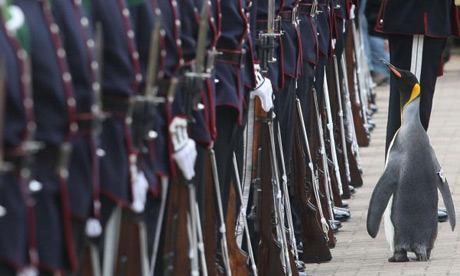 Lt. Col. Nils Olav is an officer in King of Norway's honour guard. He is also a penguin and a resident in Edinburgh Zoo. And now he is a knight, as the King of Norway has conferred him with a knighthood.
 image source
Thursday, July 24, 2008
The Lure of the East
This was an exhibition of Orientalist art I saw with my beloved in the Tate Britain, during a recent trip to olde Londone towne. Not everyone is familiar with the concept of Orientalism, so some background is in order here. Basically, the term Orientalism emerged in the 19th century to refer the study of the Arab and Turkish lands on the eastern shore of the Mediterranaean, a region we would now call the Middle East. At the time, Orientalism was a value-neutral term.
More recently, though, the Orientalist mindset has been subjected to serious critique, most notably by Edward Said in his book Orientalism. I have not read Said's book, but my understanding is that he accused the Orientalists, and indeed the whole academic discipline of Orientalism, of being part of an imperialist programme based around the conquest and subjugation of the Middle East. Orientalist academics were not engaged in rational enquiry but in constructing stereotypes of inferiority, an endeavour they were aided in by artists who turned to Orientalist subjects. Said's arguments have found considerable purchase, and Orientalist has increasingly become a pejorative term. It is interesting that London's School of African and Oriental Studies is now much happier to go by the acronym SOAS, and if you have ever spent time among the pro-Palestinian left you will have witnessed Orientalist used as a debate killing insult akin to fascist or imperialist.
 This exhibition in the Tate was of work by a number of 19th and early 20th century works which can broadly be lumped into an Orientalist paradigm. The artists are people who went out to Egypt, Turkey, Palestine, Syria, etc. and brought back exotic images to serve up to their domestic publics. Some of these pictures do very much fit the kind of Orientalist model that Said was talking about, presenting the East in a lurid manner seemingly designed to show off its strangeness and inferiority. The frequent depictions of harems also play to overactive metropolitan imaginations, with the male artists who produced them having to conjure up images of harems from their mind's eye, as it would never have been possible for them to visit the women's quarters of a Middle Eastern house. That the harem remained such a staple of Orientalist art, despite the artists' ignorance of what they were depicting, lends considerable support to Said's idea that the purpose of the art was to belittle and stereotype. Interestingly, the harem as a subject largely fell from favour when the first women artists visited the Levant and were able to enter a world hidden from European men. Their paintings depicted the harem as a world of almost dull domesticity, in contrast to the world of sexual exploitation or mindless drudgery the male artists depicted.
I did find, though, that I was not entirely convinced by the Said thesis. While some of this art was undoubtedly crudely stereotypical and sensational in its depiction of the East (witness a French artist's voyeuristic and seedily eroticised rendering of a slave market for naked women), a lot of the paintings did look like they were by people coming to terms with somewhere very different to the land they were used to. If you have ever been to the Middle East today, you probably will have found a lot of it most unusual, and the contrast between was probably even greater in the 19th century. And with some of the artists, notably Holman Hunt, it isn't really fair to accuse him of making the Middle East look strange and unrealistic, as everything he paints has an air of not being quite of this world.
I did find myself wondering, therefore, if the whole Saidian Orientalist thesis is a bit overblown, with the 19th century Orientalists being to some extent just people who were grappling with a strange culture and trying to come to terms with it and interpret it for the people back home. Maybe some of them were tainted by imperialist ideas then current, but we are all products of out backgrounds to some extent.
I suppose maybe I should try reading Said's book, as I could be crudely stereotyping his ideas here. However, I am fearful of doing so, as it is apparently written in the kind of dense and semi-legible prose style beloved of a certain type of academic. But we will see.
Would you like to know more?
Orientalist Pandas
More recently, though, the Orientalist mindset has been subjected to serious critique, most notably by Edward Said in his book Orientalism. I have not read Said's book, but my understanding is that he accused the Orientalists, and indeed the whole academic discipline of Orientalism, of being part of an imperialist programme based around the conquest and subjugation of the Middle East. Orientalist academics were not engaged in rational enquiry but in constructing stereotypes of inferiority, an endeavour they were aided in by artists who turned to Orientalist subjects. Said's arguments have found considerable purchase, and Orientalist has increasingly become a pejorative term. It is interesting that London's School of African and Oriental Studies is now much happier to go by the acronym SOAS, and if you have ever spent time among the pro-Palestinian left you will have witnessed Orientalist used as a debate killing insult akin to fascist or imperialist.
 This exhibition in the Tate was of work by a number of 19th and early 20th century works which can broadly be lumped into an Orientalist paradigm. The artists are people who went out to Egypt, Turkey, Palestine, Syria, etc. and brought back exotic images to serve up to their domestic publics. Some of these pictures do very much fit the kind of Orientalist model that Said was talking about, presenting the East in a lurid manner seemingly designed to show off its strangeness and inferiority. The frequent depictions of harems also play to overactive metropolitan imaginations, with the male artists who produced them having to conjure up images of harems from their mind's eye, as it would never have been possible for them to visit the women's quarters of a Middle Eastern house. That the harem remained such a staple of Orientalist art, despite the artists' ignorance of what they were depicting, lends considerable support to Said's idea that the purpose of the art was to belittle and stereotype. Interestingly, the harem as a subject largely fell from favour when the first women artists visited the Levant and were able to enter a world hidden from European men. Their paintings depicted the harem as a world of almost dull domesticity, in contrast to the world of sexual exploitation or mindless drudgery the male artists depicted.
 I did find, though, that I was not entirely convinced by the Said thesis. While some of this art was undoubtedly crudely stereotypical and sensational in its depiction of the East (witness a French artist's voyeuristic and seedily eroticised rendering of a slave market for naked women), a lot of the paintings did look like they were by people coming to terms with somewhere very different to the land they were used to. If you have ever been to the Middle East today, you probably will have found a lot of it most unusual, and the contrast between was probably even greater in the 19th century. And with some of the artists, notably Holman Hunt, it isn't really fair to accuse him of making the Middle East look strange and unrealistic, as everything he paints has an air of not being quite of this world.
I did find myself wondering, therefore, if the whole Saidian Orientalist thesis is a bit overblown, with the 19th century Orientalists being to some extent just people who were grappling with a strange culture and trying to come to terms with it and interpret it for the people back home. Maybe some of them were tainted by imperialist ideas then current, but we are all products of out backgrounds to some extent.
I suppose maybe I should try reading Said's book, as I could be crudely stereotyping his ideas here. However, I am fearful of doing so, as it is apparently written in the kind of dense and semi-legible prose style beloved of a certain type of academic. But we will see.
Would you like to know more?
Orientalist Pandas
Wednesday, July 23, 2008
Two books by Ryszard Kapuscinski
 As you know, I turned 40 earlier this year. A lot of people bought me books as a birthday present, probably having me down as some kind of reader. By an interesting coincidence, two people got me books by Ryszard Kapuscinski*. If you don't know who he is, he is this Polish journalist and travel writer who died recently and seems to have climbed to an interestingly high posthumous level of fame. Anyway, I have managed to read both ot the books I was given, so I will now talk about them.
The first is called The Emperor, and is about the overthrow of Ethiopia's Emperor Haile Selaise by the Derg. The book is a highly atmospheric portrait of the emperor's court and its slow walk to extinction, based on interviews with surviving members of the emperor's entourage, people now living in hiding and fearful of their lives. It evokes nothing so much as Mervyn Peake's Gormenghast in its depiction of a world of pointless ritual, except of course that Peake was describing and imaginary world whose rites and ceremonies served to maintain it in an everlasting stasis. With Haile Selaise's Ethiopia, you are left with the conclusion that it was the regime's inability to adapt that doomed it to oblivion.
I am not sure, though, to what extent this book can be relied on as an accurate portrait of the Ethiopian empire's decline and fall. One thing I have picked up is that Kapuscinski took a fast and loose approach to the facts whenever they got in the way of a good impressionistic story, so I would be wary of taking this a factually accurate account of Haile Selaise's overthrow. Still, it does ring true and has a fascinating sense of the dynamic of regime change. The introduction (by Neal Ascherson) talks of how in writing about Ethiopia, Kapuscinski was implicitly talking of his own country, as the then still extant (in 1978, when the book first appeared) but moribund Communist regime sank into terminal decline. Certainly, the fall of Communism in Poland does bear some comparison to the fall of Haile Selaise, as they were both worn down attritionally by rolling waves of dissent that the regimes were unable to quell. Or at least that is how Kapuscinski makes things appear.
[an aside: if you want to read more about Ethiopian history and the fall of Haile Selaise, check out my other blog. Or read a good book on the subject]
The other book is called Travels With Herodotus. This is a more rambling work, with elements of memoir, in which Kapuscinski relates the work of the ancient Greek writer to experiences in his own life. As you know, Herodotus is often claimed as the first historian. He wrote about some wars between the Persian empire and the cities of Greece, providing us with the classic accounts of the battles of Marathon and Thermopylae, as well as numerous fascinating anecdotes whose provenance Herodotus himself is never entirely convinced by. Herodotus' work moves beyond purely narrative history, and it attempts to present the various cultures and practices of people around the then known world to its readers.
This is a bigger book than The Emperor, and it is a good bit less focussed, as it follows Kapuscinski as his career meanders around the world. The format is basically one of anecdotes from Kapuscinski's life interspersed with anecdotes from Herodotus and reflections on the Greek's work and personality. This kind of rambling works well enough. However, Kapusckinski's reflections on the ancient world often seemed a good bit more incisive than his thoughts on the modern. I was particularly struck by his somewhat facile characterising of the Algerian war of independence as just the latest chapter in an ongoing struggle between East and West. Likewise, one or two of his comments elsewhere played to my pre-conceived idea that Kapuscinski never troubles to let the facts get away in the way of a good story; his characterisation of Nasser as a particularly devout Muslim seemed a bit O RLY-esque.
For all those caveats, this is a most fascinating book, and one that has got me interested in both going back to Herodotus and reading a bit more of Kapuscinski. That Kapuscinski was fascinated by what for me is one of the most striking yet less well known of Herodotus' stories (the terrible vengeance of Hermotimus on Panonius, the man who had made him a eunuch). Kapuscinski seems also to be very taken by Herodotus' depiction of both the extreme excitability of the Greeks (at one point the Athenians stone to death a man who advocates surrender to the Persians, and then for good measure they mete out the same treatment to his wife and children) and the terrible arbitrary power of the Persian emperor (cutting in half the sons of a man who asked that one of them might be allowed stay at home from the war, and then making the army march between the dismembered corpses). More books should contain this kind of crazy anecdote.
Traveling Panda
*there should be an accent on the S and N in Kapuscinski, but I don't know how to get my word processor to do them and in any case they probably would not display properly on the Internet.
Sunday, July 20, 2008
Subscribe to:
Posts (Atom)