Showing posts with label The Blood on Satan's Claw. Show all posts

Wednesday, January 07, 2026

What Is Folk Horror?

Here are some quick thoughts on what exactly is this thing called "Folk Horror" that people are always going on about these days. This is based on a sense I have that the term is being used a bit carelessly to cover anything vaguely horrific featuring a folkloric monster or rural setting.

Folk Horror as a concept was popularised by Mark Gatiss in a 2010 documentary on the history of horror films. Somewhat embarrassingly I have never actually seen this documentary, so I only have second hand accounts of what Gatiss described the term as meaning. I do know that he offered up three films of the late 1960s and early 1970s as exemplars of the genre: Witchfinder General (1968), The Blood on Satan's Claw (1971), and The Wicker Man (1973). What might they have in common that could make them embodiments of a new genre?

Directed by Michael Reeves, Witchfinder General is set in the 1640s and sees Vincent Price playing Matthew Hopkins, a hunter of witches (real or imagined) in an England wracked by civil war and religious conflict. Hopkins is portrayed as an amoral maniac happy to extract confessions through torture before sending his victims to the gallows. The film remains ambiguous as to whether he really believes that his victims are actual witches, but he is shown as cynically using his authority to sexually exploit a comely young woman who crosses his path. This is the only one of the films to be centred on a real historical figure, with whose actual story the film has a tenuous relationship.

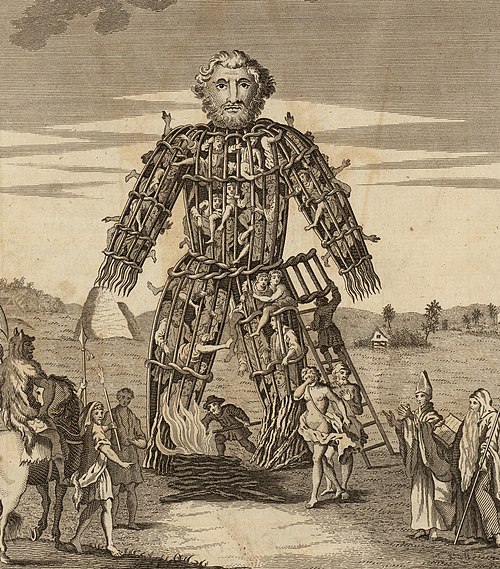
Unlike the others, Robin Hardy's The Wicker Man is set in what was the present day when it was released. It sees Edward Woodward playing a policeman travelling to a remote Scottish island in search of a girl who has been reported missing. He discovers that the islanders are all members of a pagan cult led by the local laird, Lord Summerisle (Christopher Lee). There is a Wicker Man.

Set in the 18th century, Piers Haggard's The Blood on Satan's Claw begins with some peasants unearthing a mysteriously deformed skull, after which the young people of the locality start sprouting patches of fur and gathering in a ruined church to practice demonic rites. This is the only one of Gatiss's Unholy Trilogy to feature truly supernatural elements.

So what do these films have in common? They are all set in rural areas. Two of them are set in the past, one in the present day. One of them features a pagan death cult, another features devil worshippers, and another features Christians who commit the foulest crimes against the supposed enemies of Christ. So perhaps people whose beliefs drive them to terrible actions is a point of commonality. The Wicker Man uses the device of the outsider unearthing the horror that has engulfed a community, but the others do not go down this road. Curiously, for films seen as epitomising folk horror, only one of them makes heavy use of folkloric themes.

Beyond the crazy beliefs it's hard to find a thematic link between Gatiss's big three folk horror films. This has me thinking that there might be more than one strand of folk horror. One of these might be "people sticking to the Old Ways even though the old ways are a bit crazy but also folky", which often features the Ingham denouement of "it was you they wanted all along". Examples of this strand include The Wicker Man, Robin Redbreast, Harvest Home, Midsommar, "Murrain", and "The Lottery". Another strand might be "old possibly supernatural folk-adjacent things bubbling up into the present in a non-ideal way". Examples of this strand include The Stone Tape, Quatermass and the Pit, and Blood on Satan's Claw. There may be other strands (one into which Witchfinder General could be easily included). And there may be more to folk horror than plot elements.

Further investigation may be required, but perhaps this delving into forbidden lore is best left to the professionals.
More folk horror posts here and here.

images:

18th century wicker man image (Wikipedia: "Wicker man")

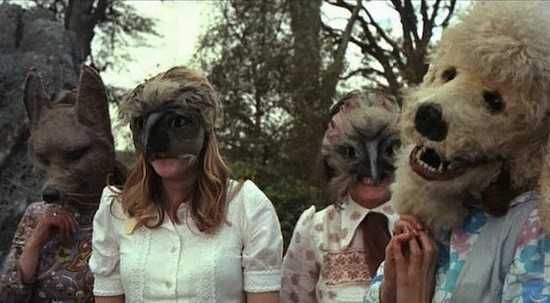
Animal masks (Lunatics Project: The Best: Folk Horror Films)

Tuesday, October 04, 2016

Haunted Landscapes: a Season of Folk Horror: part 2

I continue my account of trips to the Irish Film Institute, to see Folk Horror themed films being shown as part of their Haunted Landscapes season. Folk horror is a term coined by Mark Gatiss. You can read my account of the first set of these films here.

The second day of the season saw us in the IFI's smaller screen for a showing of Quatermass And The Pit (1967), a Hammer film version of the late 1950s TV series, both scripted by Nigel Kneale. Kim Newman introduced the film, about which he has written a book. Quatermass (a rocket scientist) finds himself investigating strange goings on when workers on an extension to the London Underground discover an unexploded bomb that turns out to be a spaceship older than humanity. There are shocking revelations and the release of long dormant powers.

When things come together in Hammer films they are the best things in the world: not schlocky or camp but genuinely unnerving. Everything comes together in this one, with the design, acting, scripting and direction all making this one of their greatest works. But is it folk horror? One might say no, arguing instead that this is horror science fiction in the Lovecraft mould, yet it still has a folk feel to it. The horror is very much located in a physical place, with the sense that the buried ship has had a malign influence on its surroundings since time immemorial (a trip to the library reveals that the area above it has been regarded as haunted and unhallowed as far back as there are records).

With this film I must particularly sing the praises of Barbara Shelley, a Hammer stalwart, who in this plays one of the archaeologists. She appears in a succession of amazing outfits that appear to have driven the colour coordination of the sets and astutely plays a role a world away from the screaming victim more commonly seen in Hammer films (often played by Ms Shelley). Hers is not the lead role but I did watch this wishing she had been given a fairer crack of the whip by film history.


The next film was the first I had not seen before, it being Valerie and Her Week of Wonders, a Czechoslovak film from 1970. Its Luboš Fišer soundtrack was re-released some years ago by Finders Keepers and became quite popular with people who like that kind of thing. Having listened to the record a good bit made for a strange experience finally seeing the film. It is a somewhat avant-garde work, described by Kim Newman as being exactly like Company of Wolves, except with vampires instead of werewolves. As such it falls into the world of films about teenage girls and their sexual awakenings. Valerie is menaced by shifty characters who try it on with her and who may or may not also be her close blood relatives. A sinister Nosferatu-like figure directs proceedings. Her grandmother may also be one of the vampires. Things happen, but it is not a plotty film. Instead it is a work of great beauty, with a wonderful combination of visual images and music.

But is Valerie and Her Week of Wonders folk horror? I fear not, but it would be churlish to complain about this rare opportunity to see this classic of obscure cinema.

Following that we found ourselves watching the third of the films that Mark Gatiss used to define the folk horror genre. It was The Blood on Satan's Claw, a 1970 film directed by Piers Haggard, made by the same production company as Witchfinder General, seen on the season's first day. This one is also set in days of yore (the 18th century or some such) and begins with a young yokel finding a strange looking hairy skull in a field while ploughing. He brings a grumpy old judge to investigate, but the skull has vanished, yet it soon transpires that Evil has descended upon the locality.

This one was introduced by Donald Clarke, Irish film critic. One of his interesting points was that the film is like a hippy dream gone bad. The servants of Satan in the film are the beautiful flower children, while it is ultimately The Man (the grumpy judge) who puts a stop to their shenanigans. For all that the cultists are murderers and rapists, they look far more like the good guys than Judge Establishment. There is a disturbing brutality to the judge defeating the cultists by laying into them with a big sword at the head of a mob of irate villagers.

This is a great film, managing a more straightforwardly disturbing tone than Witchfinder General and entirely lacking its sense of schlock. For all that the film features a Satanic monster gradually becoming more powerful, the real sense of menace is more psychological, either in the way that the young people are somehow turned by the Dark One or else appear to have their minds destroyed by exposure to the purity of evil. There is also an arbitrariness to the Dark One's ways: why does the lad who finds the skull in the first place remain unaffected by its power?

And is it folk horror? Well, there is not so much about folk practices but it is set in the English countryside and does feature folk, so I suppose it must be. Its eerie soundtrack is also reminiscent of music on the Mount Vernon Art Lab album The Séance at Hobs Lane.


The next film was Hammer classic The Devil Rides Out (1968), a black magic film adapted from the novel by Dennis Wheatley (with Richard Matheson writing the script). It has Christopher Lee playing the Duc de Richelieu, who discovers that a young friend has got mixed up with Satanism. Richelieu turns out to have made an extensive study of the Black Arts (while fortunately remaining resolutely on the side of righteousness), so he and another more square-jawed hero friend battle to save the impressionable young lad before it is too late. It is a film I have seen before and they showed the trailer before everything in the IFI recently, so it felt very familiar when I watched it. It is schlock but it is great schlock, with Lee delivering classic lines like "It's the Goat of Mendes - the Devil Himself!" as though he means them.

It is also striking how the film is pretty much about a battle of poshos against satanists, with most of the satanists also being poshos. Everyone seems to live in mansions and have armies of servants at their disposal. From having read the book the film is based on, this reflects well Wheatley's snobbish world view. Overall the film is an enjoyable romp: a good Hammer film but not necessarily the kind of thing enjoyed by someone not wedded to the Hammer aesthetic.

It is not particularly folk horror; in fact I fear that it is what members of the Folk Horror Revival community on Facebook refer to as "not strictly folk horror". There is nothing really about folk practices or traditional ways, with the film being more straightforwardly an example of gothic horror. So how did it make it into the season? Well, maybe there was a good print available, or maybe it makes for an interesting counterpoint with Blood on Satan's Claw in terms of how satanic forces are represented.


My account of the last films I saw in the Haunted Landscapes season can be read here.

For more on folk horror, see my account of A Fiend in the Furrows here and here.

image sources:

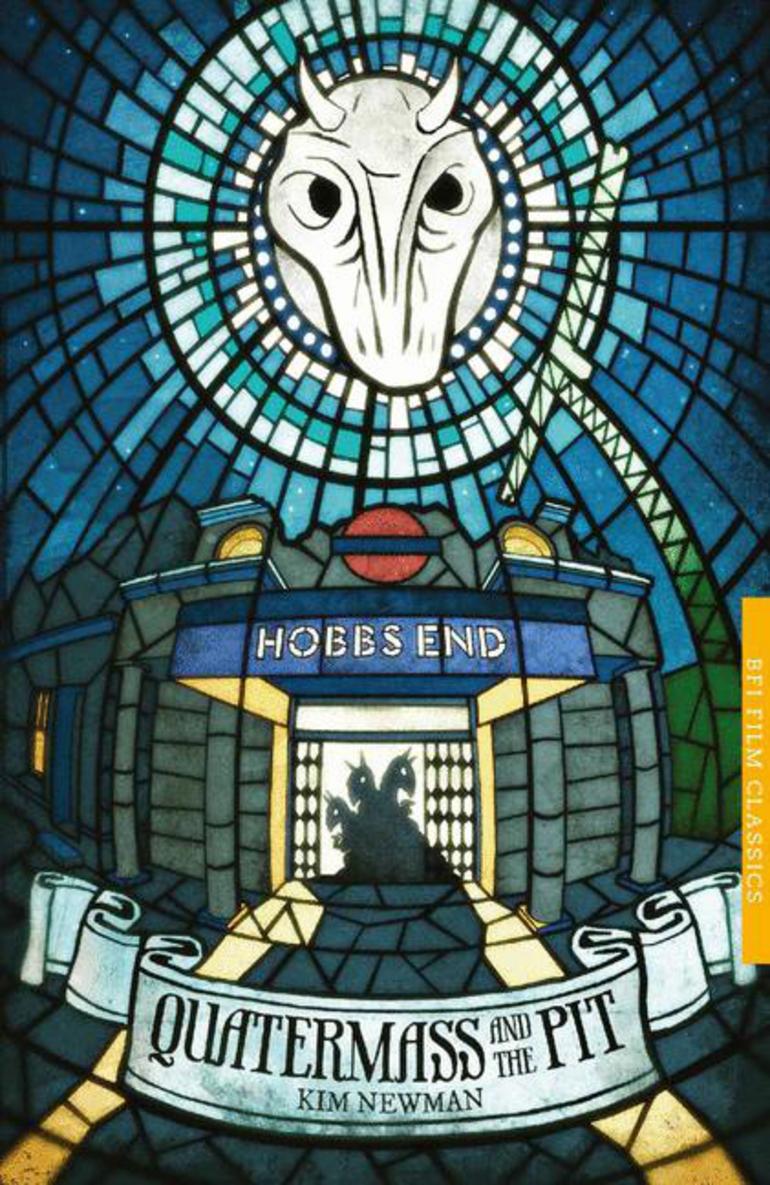
Kim Newman's Quatermass and the Pit book cover (Palgrave Higher Education)

Barbara Shelley (Magazines and Monsters)

Valerie and Her Week of Wonders (Wikipedia)

The Blood on Satan's Claw (Ferdy on Films)

The Goat of Mendes (21st Century Wire)