 Here are some quick thoughts on what exactly is this thing called "Folk Horror" that people are always going on about these days. This is based on a sense I have that the term is being used a bit carelessly to cover anything vaguely horrific featuring a folkloric monster or rural setting.
Folk Horror as a concept was popularised by Mark Gatiss in a 2010 documentary on the history of horror films. Somewhat embarrassingly I have never actually seen this documentary, so I only have second hand accounts of what Gatiss described the term as meaning. I do know that he offered up three films of the late 1960s and early 1970s as exemplars of the genre: Witchfinder General (1968), The Blood on Satan's Claw (1971), and The Wicker Man (1973). What might they have in common that could make them embodiments of a new genre?
Directed by Michael Reeves, Witchfinder General is set in the 1640s and sees Vincent Price playing Matthew Hopkins, a hunter of witches (real or imagined) in an England wracked by civil war and religious conflict. Hopkins is portrayed as an amoral maniac happy to extract confessions through torture before sending his victims to the gallows. The film remains ambiguous as to whether he really believes that his victims are actual witches, but he is shown as cynically using his authority to sexually exploit a comely young woman who crosses his path. This is the only one of the films to be centred on a real historical figure, with whose actual story the film has a tenuous relationship.
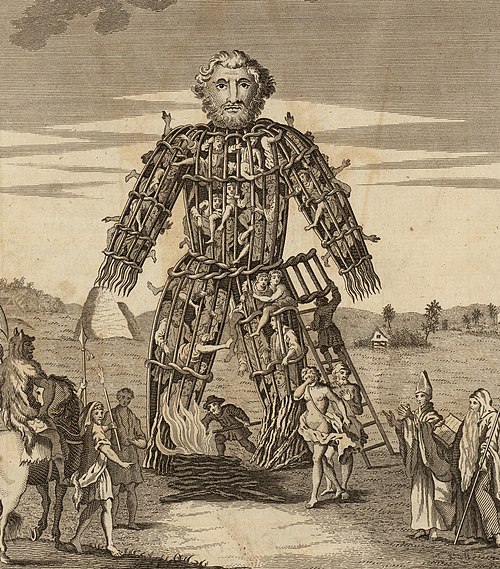
Unlike the others, Robin Hardy's The Wicker Man is set in what was the present day when it was released. It sees Edward Woodward playing a policeman travelling to a remote Scottish island in search of a girl who has been reported missing. He discovers that the islanders are all members of a pagan cult led by the local laird, Lord Summerisle (Christopher Lee). There is a Wicker Man.
Set in the 18th century, Piers Haggard's The Blood on Satan's Claw begins with some peasants unearthing a mysteriously deformed skull, after which the young people of the locality start sprouting patches of fur and gathering in a ruined church to practice demonic rites. This is the only one of Gatiss's Unholy Trilogy to feature truly supernatural elements.
So what do these films have in common? They are all set in rural areas. Two of them are set in the past, one in the present day. One of them features a pagan death cult, another features devil worshippers, and another features Christians who commit the foulest crimes against the supposed enemies of Christ. So perhaps people whose beliefs drive them to terrible actions is a point of commonality. The Wicker Man uses the device of the outsider unearthing the horror that has engulfed a community, but the others do not go down this road. Curiously, for films seen as epitomising folk horror, only one of them makes heavy use of folkloric themes.
Beyond the crazy beliefs it's hard to find a thematic link between Gatiss's big three folk horror films. This has me thinking that there might be more than one strand of folk horror. One of these might be "people sticking to the Old Ways even though the old ways are a bit crazy but also folky", which often features the Ingham denouement of "it was you they wanted all along". Examples of this strand include The Wicker Man, Robin Redbreast, Harvest Home, Midsommar, "Murrain", and "The Lottery". Another strand might be "old possibly supernatural folk-adjacent things bubbling up into the present in a non-ideal way". Examples of this strand include The Stone Tape, Quatermass and the Pit, and Blood on Satan's Claw. There may be other strands (one into which Witchfinder General could be easily included). And there may be more to folk horror than plot elements.
Further investigation may be required, but perhaps this delving into forbidden lore is best left to the professionals.
More folk horror posts here and here.
images:
18th century wicker man image (Wikipedia: "Wicker man")
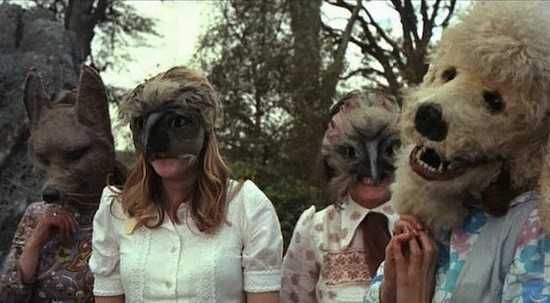
Animal masks (Lunatics Project: The Best: Folk Horror Films)


No comments:
Post a Comment