This week I have decided to write about the comics I have bought before I read them, so you can understand my expectations.
Dan Dare by Garth Ennis and Gary Erskine
I like olde comics, so I am a sucker for this kind of Dan Dare reprint. This is written by Garth Ennis, someone I am pretty down on at the moment, but I reckoned I had to buy issue one, just so I could be disappointed by it. I wonder will Ennis insert some of his trademark homophobia and "ironic" sexism into the story?
Still, it could be that Ennis is at his best when engaging in pastiche of olde comics… a lot of the war stuff he has done over the last while has been quite impressive – I'm thinking here of some of the later war comics he did for DC (though not that moronic Adventures of the Rifle Brigade), or Battler Britton. The latter was like the kind of war comic I used to read when I was small, except that it was a lot better.
I nevertheless suspect that reading this issue will make me want to rush out and buy that Rian Hughes comic book with the Dan Dare story he drew to Grant Morrison's script.
Gotham Underground by Terri, Calafiore, and Purcell
Erm, why did I buy this again? It looks like a comic about second division loser supervillains and criminals in Gotham City. Maybe it will be like Gotham Central, only for the bad guys.
All Star Batman & Robin (the Boy Wonder) by Frank Miller and Jim Lee
Like the superior All Star Superman, the idea of this is to get giants of the form working on one of the flagship characters. I have bought the last couple of issues, maybe enjoying the art more than the story. This one has The Joker on the cover, so maybe this will get very exciting.
2000 AD Extreme Edition written by Tom Tully, drawn by a variety of artists, the most famous of whom is Steve Dillon
2000 AD Extreme is where they reprint the weirder and less remembered old 2000 AD strips. This one features the first run of episodes in "The Mean Arena", one of those future sport strips they used to run in the Galaxy's greatest comic. This particular sport was Street Football, a thuggishly violent game played over abandoned city streets. This was a very second division strip, though it did have nice art (by some J. Richardson character) at first, and the story initially packed a reasonable amount of thrill power. Sadly, it all went kind of rubbish as the story went on and on and on, with the slide into shite artists not helping either. My recollection is that the really tiresome thing about the story was the way the rules of the game became more and more outlandish, partially because they were letting the readers make up teams for the protagonist team to play. Still, this issue only has the first run of episodes, so I can stop here and enjoy the thrill power.
Thursday, November 29, 2007


A Warning To All Readers
Yesterday evening I went to see the film "Shrooms". It was shite. Do not go and see this film, unless you like bad films.
A more incisive commentary may eventually follow, but I felt it necessary, as a public service, to warn people of the danger they could be in if they were to see this disappointing film.
A more incisive commentary may eventually follow, but I felt it necessary, as a public service, to warn people of the danger they could be in if they were to see this disappointing film.
Sunday, November 25, 2007
Hello - Is it floor covering you're looking for?
Dublin institution finally acquires website: Lino Ritchie
Saturday, November 24, 2007
A New Kind of Hero
 The Orange Order is attempting to reach out to young people by creating a superhero character for their organisation. At present this chap does not have a name, but they are open to suggestions from the public.
This is all oddly reminiscent of the little known comic character Captain IRA. He made some appearences during the Troubles, usually with his sidekick Seamus, the Boy Provo.
BBC News report (and source of illustration)
Where I heard about this astonishing story
"Dracula" and Hammer Horror
I have really got out of the cinema habit. It is quite conceivable that the only thing I have seen there is Dracula (the first Hammer version, with Peter Cushing and Christopher Lee). It features a lot of bombastic music and women who turn all sexy once Dracula has started doing his thing with them. It is not the best of the Hammer films (or even the Hammer Dracula films), but it is a good example of the Hammer template. I would love if cinemas would show more of these, with Dracula - Prince of Darkness, The Devil Rides Out, Brides of Dracula, Frankenstein Created Woman, Kiss of the Vampire, and Quatermass and the Pit being ones I would particularly like to see again. Is Countess Dracula (the one with Ingrid Pitt playing real life posho maniac Erzebet Bathory) a Hammer film? I never saw that one, but I reckon I would like it. The other unseen Hammer film I would love to catch is The Legend of the Seven Golden Vampires, an attempt to marry the Hammer-style vampire film with Chinese chop socky hopping vampire cinema. I gather it is seen as a failure, but the premise surely marks it as a work of genius.
Just in case you are not an aficionado of Gothic horror, Hammer were a British film company who evolved into a style of film based around eroticised versions of horror classics (though in so doing they were picking up on features always there in source material like Stoker's novel or Carmilla, Sheridan Le Fanu's lesbian vampire story). Typical Hammer features include: women in low cut tops, location non-specific central European settings, girls boarding schools in which the pupils are all played by women in their mid twenties who spend a lot of their time helping each other into their nightclothes, superstitious locals, bumptious comedy characters, numerous "My God!" moments, driven heroes almost as fanatical as their fiendish adversaries, surprisingly lush sets, bombastic music that often spells out the name of the main character, and so on. Hammer also made some other great films like The Wicker Man or The Nanny (this relatively obscure film featuring Bette Davis in particular highly recommended), but these do not fit the classic model. Nor do such frankly embarrassing attempts to update the genre as Dracula AD 1972 (Dracula and some hippy Satanists in swinging London, OMG) or The Beast Must Die* (big game hunter v. werewolves to blaxploitation soundtrack). But the classic Hammer films have a certain charm, even the duff ones, and I would love to see them again.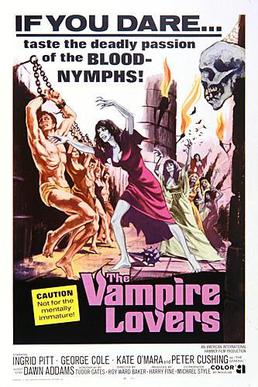
The picture is from the Wikipedia entry The Vampire Lovers (an adaptation of Carmilla). I've not seen the latter, but it looks like a classic Hammer film.
This was meant to feature in the latest issue of Frank's APA, but somehow failed to do so. *not actually a Hammer film, though it feels like one, or an attempt to do one set in the then present day
Wednesday, November 21, 2007
"No! Let Me Drown - etc."
 Scientists have found the claw of a PREHISTORIC GIANT SEA SCORPION. This abomination (the scorpion, not the claw) was larger than a modern human being, reports the BBC.
If you don't know what the "No! Let Me Drown - etc." title refers to, click here: No! The Pincers!
More
Tuesday, November 20, 2007
Ian Moore "Luminaria"
Frank's friend Rory Carr provided me with this addition to my collection of Ian Moore records. As you know, Mr Moore is this guy from Texas (possibly Austin Texas) who makes music that rocks out, albeit in a somewhat folky troubadourish kind of way. Because I am unique, I was initially somewhat perturbed by this fellow's arrival on the music scene, but my concern dissipated when he failed to become the kind of guy who plays the local enormodome. Listening to this album I think the same thing as with his others – Mr Moore is certainly not awesomely brilliant, but he is not dreadful either, and listening to his music is not unpleasant. On balance, though, this is not really my thing, and more than a couple of songs at a time can be a bit wearing.
I think I would actually prefer if my namesake was some totally awful cock-rocker. He could issue Zodiac Mindwarp style t-shirts with his name on them, and I could wear them and watch the ladies roll in. Mmmmm.
I think I would actually prefer if my namesake was some totally awful cock-rocker. He could issue Zodiac Mindwarp style t-shirts with his name on them, and I could wear them and watch the ladies roll in. Mmmmm.
Monday, November 19, 2007
More Irish Music action
This blog looks like it is potentially an interesting source of information and views on the brainy end of the Irish music scene: Forum for Music in Ireland - Fóram don Cheol in Éirinn
"The Journal of Music in Ireland"
I bought a copy of the Journal of Music in Ireland recently. This seems like an interesting magazine, being a kind of Irish Wire, albeit one more oriented towards contemporary classical music than the popular British magazine. The record reviews (including one by a former member of Frank's APA) seem to focus exclusively on Irish acts, presumably because you can hear about the others elsewhere, but the live reviews and so on cover a broader palette.
My own musical tastes are moving in this kind of direction at the moment, so I found much of what was in the magazine fascinating. Particularly engaging was an interview with some fiddle player guy called Caoimhín Ó Raghallaigh. His thing is that he has discovered sampling technology and is making music that he feels is rooted in Irish traditional music but moving so far beyond it that he does not bring the CDs of this music to sell at his more straight down the line gigs, for fear of being lynched by an army of geansaí wearers. He compared the way traditional music is approached here to the more innovative practices in the Nordic countries, especially Sweden; I wondered what he would make of all those Fonal bands from Finland. His big gripe with the Irish trad scene is that it is pretending that there is still an oral folkish tradition when there is not, and that there has been no development in the genre since the 1970s, with everyone being content to re-hash Planxty. The article was endearingly provocative, and it definitely made me interested in hearing Ó Raghallaigh's more innovative music. I did wonder, however, if in pushing against traditional music's envelope he has broken with genre conventions so much as to no longer be making anything we can still consider part of the world of Irish traditional music.
There was also a fascinating but problematic article by composer Raymond Deane about the relationship between classical and popular music, triggered by some remark of John Adams' that classical music starts to die when it loses touch with the vernacular. The problem I had with the article is that Deane does not really engage with "popular" music and seems to use this term to cover everything that is not classical music. As a result, he fails to register that non-classical music has its own avant-garde and "difficult" traditions that could not be described as popular in any real sense. He also implicitly creates a false dichotomy between rock musicians (who are all rolling in cash) and impoverished classical musicians, something that the vast majority of rock musicians who never make any money whatsoever would regard with wry amusement. I was going to write a letter on this subject to the JMI, but I have not got round to it yet, because I am a slackass.
My own musical tastes are moving in this kind of direction at the moment, so I found much of what was in the magazine fascinating. Particularly engaging was an interview with some fiddle player guy called Caoimhín Ó Raghallaigh. His thing is that he has discovered sampling technology and is making music that he feels is rooted in Irish traditional music but moving so far beyond it that he does not bring the CDs of this music to sell at his more straight down the line gigs, for fear of being lynched by an army of geansaí wearers. He compared the way traditional music is approached here to the more innovative practices in the Nordic countries, especially Sweden; I wondered what he would make of all those Fonal bands from Finland. His big gripe with the Irish trad scene is that it is pretending that there is still an oral folkish tradition when there is not, and that there has been no development in the genre since the 1970s, with everyone being content to re-hash Planxty. The article was endearingly provocative, and it definitely made me interested in hearing Ó Raghallaigh's more innovative music. I did wonder, however, if in pushing against traditional music's envelope he has broken with genre conventions so much as to no longer be making anything we can still consider part of the world of Irish traditional music.
There was also a fascinating but problematic article by composer Raymond Deane about the relationship between classical and popular music, triggered by some remark of John Adams' that classical music starts to die when it loses touch with the vernacular. The problem I had with the article is that Deane does not really engage with "popular" music and seems to use this term to cover everything that is not classical music. As a result, he fails to register that non-classical music has its own avant-garde and "difficult" traditions that could not be described as popular in any real sense. He also implicitly creates a false dichotomy between rock musicians (who are all rolling in cash) and impoverished classical musicians, something that the vast majority of rock musicians who never make any money whatsoever would regard with wry amusement. I was going to write a letter on this subject to the JMI, but I have not got round to it yet, because I am a slackass.
Sunday, November 18, 2007
PLANET TERROR
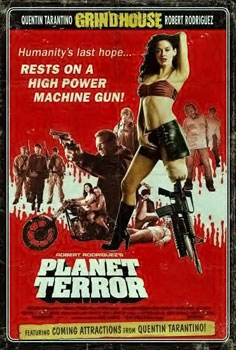 I saw Planet Terror, the Robert Rodriguez half of the Grindhouse thing he did with with Quentin Tarantino. I will write about it in due course, but it will probably be gone from the cinema by the time I do that, as it is only on in two cinemas here in Dublin right at the moment, one of them at a strange time.
For now, all I need say about Planet Terror is: See It Now. Your very life might depend on it.
Picture from Wikipedia.
Subscribe to:
Posts (Atom)