Murder by Contract (Irving Lenner, 1958)
Nice low budget noir about a highly efficient contract killer who finds to his dismay that his next target is a dame. The many scenes of the hitman and his contacts hanging out and yapping away feel like they might have been an influence on Tarantino.
The Informer (Arthur Robison, 1929)
The first of at least three screen adaptations of Liam O'Flaherty's novel (others include John Ford's 1935 film and Jules Dassin's 1968 Uptight (which moves the action from Dublin to Cleveland). This sees an IRA man grass up one of his buds to the Free-Staters for tawdry reasons before being hunted down by his former comrades. Despite being filmed in Elstree Studios, the film is surprisingly evocative of olde Dublin.
The Naked Lunch (David Cronenberg, 1991)
Adapted from a William S. Burroughs novel, this is very odd fare indeed. Some scenes are very evocative of the feeling of being completely mashed out of it but having to hold it together and convince people around you that you are not feeling in any way out of the ordinary. And if you've ever found yourself hanging out with giant talking insects the film will touch a nerve. I was however a bit uncomfortable with all the shooting-wife-in-the-head content.
All About Eve (Joseph L. Mankiewicz, 1950)
This sees Bette Davis playing an ageing actress who is being supplanted by Anne Baxter's Eve, who initially appears as an adoring fan before gradually revealing her true colours.
Another Man's Poison (Irving Rapper, 1951)
And in this one Bette Davis plays a rather louche crime writer who isn't averse to bumping off inconvenient men in her life. One of her British films.
Network (Sidney Lumet, 1976)
An ageing news anchor has an on-air meltdown after learning that his contract is not being renewed, which then proves such a hit with viewers that the broadcaster starts wheeling him out to gibber at the audience on live TV. Although it does feature a lot of old white guys shouting about things, the real star is Faye Dunaway as a terrifyingly ambitious studio executive. It's also surprisingly funny.
Archangel (Guy Maddin, 1990)
This oddball low budget picture from the Canadian roffler is set during the Allied intervention in Archangel during the Russian Civil War, with a main character suffering from amnesia that leads to events happening over and over again for reasons. They don't make them like this anymore and probably never did.
The Fountainhead (King Vidor, 1949)
This is based on a novel by Ayn Rand, who is bad, so the film must be bad, right? WRONG. This is in fact a highly enjoyable film about an egomaniacal architect played by Gary Cooper who won't let anyone tell him how to design buildings, not even his clients, with the result that he spends a lot of his time earning his living doing things other architecture. He also has woman-trouble and is being persecuted by an evil journalist who appears to be some kind of communist. Because Cooper is super-swoony he is able to get away with delivering an interminable Ayn Rand speech that wins everyone over, thereby letting him build his stupid buildings, which appear to combine Le Corbusier's worst nightmares with Mies van der Rohe sleekness.
 On the Waterfront (Elia Kazan, 1954)
In this film about a corrupt union that is exploiting its members while being in league with the employers we have memorable lines such as "I could have been a contender" or memorable scenes such as Marlon Brando confessing to Eva Marie Saint that he unwittingly set up her brother to be killed as dockyard noises drown out his words. Or the film that teaches you why looking "like Eva Marie Saint in On the Waterfront" would be such a big deal. A superb film with strong performances from Brando, Saint, Karl Malden (as a priest) and the always reliable Lee Cobb as Johnny Friendly, the union boss.
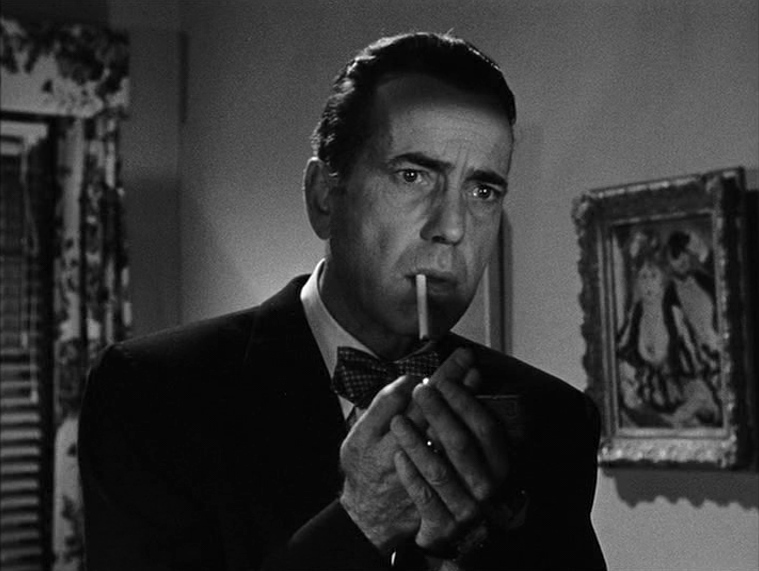 In A Lonely Place (Nicholas Ray, 1950)
A dark, dark film in which Humphrey Bogart excels himself as a deeply damaged man (PTSD from the war is hinted at) who finds himself under suspicion for a murder we know he didn't commit. Whether he ends up taking the rap or being exonerated is almost an irrelevance, as he is clearly going to end up killing someone or being murdered himself, regardless of the situation when the film ends.
images:
Eva Marie Saint in On the Waterfront (Little White Lies: Why I love Eva Marie Saint’s performance in On the Waterfront)
Humphrey Bogart ([FILMGRAB]: In a Lonely Place)


No comments:
Post a Comment