Thursday, August 30, 2018

Worldcon comes to Dublin

Next year the World Science Fiction Convention is coming to Dublin. This is the first time Worldcon has taken place in Ireland, which makes this an exciting event. But what is this Worldcon? Well, Worldcon is a science fiction convention that takes place in a different city each year. The first Worldcon was in New York in 1939, taking its name from the World Fair of that year. After taking a few years off for the Second World War it has been running continuously since 1946. Worldcon moved outside the United States for the first time in 1948, when it took place in Toronto, and made its first trip away from North America in 1957 when the first London Worldcon took place.

The first Worldcon saw just 200 science fiction fans meet at the Caravan Hall in New York. Since then the event has expanded enormously. The 2017 Worldcon in Helsinki had an attendance of just under 6,000 while the 2016 Worldcon in Kansas City had some 4,600 people attending. There will most likely be numbers of that magnitude attending Worldcon next year in the Dublin Convention Centre.

The scale of a Worldcon can be stunning to a first time attendee and Dublin 2019 will be no different. There will be thousands of science fiction fans attending, loads and loads of authors and hundreds of multi-tracked programme items. Worldcon attendees will have a vast range of events to choose from, including panel discussions (which I think of as the real meat of the convention though others may disagree), film screenings, author interviews, readings & signings, presentations by academics (brainy people saying brainy things about science fiction and fantasy), art shows and so on. There will be dealers selling books and other items and places for attendees to eat, drink and hang out. Some people will be dressed up as their favourite characters and the Masquerade event will see the most spectacular costumes compete against each other.

A key event at any Worldcon is the Hugo Awards ceremony. The Hugos, named after early science fiction editor and publisher Hugo Gernsback, are voted by Worldcon members and are the most prestigious prizes in science fiction (do not listen to disgruntled winners of other awards who have yet to receive a Hugo). In Dublin, awards will be given for works published in 2018, which will include categories for novels, short novels, short stories, films, artworks, and other things, with both professional and fan works being honoured. The Dublin Worldcon is also taking up the option of awarding Hugos for items published in 1943, to make up for there being no Hugo Awards in 1944. If like me you are not great at keeping up with contemporary science fiction you might find you have read more of the works nominated for these Retro Hugos.

Unlike some other conventions, Worldcon has no Mr Big behind it raking in the $$$$s. Worldcon is fan-run, with a chair and organising committee that changes each year. People who attend buy membership rather than an admission ticket. In fact, apart from the guests of honour, everyone at Worldcon has bought their own membership. George R.R. Martin attends every Worldcon and is probably the biggest author of science fiction and fantasy in the world right now, but he pays more to attend than a first-time Worldcon attendee.

At time of writing, Worldcon membership is €110 for a first time attendee. That sounds like a lot, but for that you are in for the full five days of the convention and get to attend everything at it – there are no hidden extra charges. That will also get you the Hugo Awards voter packet (digital copies of all or most of the nominated works, depending on generosity of the rights holders), whose value can be considerable. It is possible to pay by instalments and there a fund to support people who would like to attend but are unable to afford to do so.

Worldcon membership is due to go up in September, so buy now at the lower rate while you can. However I understand that the price increase will be only incremental, so if you do not get round to buying membership until next week do not think that it will have increased drastically to a completely unaffordable level.

More information on the Dublin Worldcon can be found here, with it being possible to join this important event here. If you are still curious as to what goes on at a Worldcon then I have a sadly incomplete series of posts about the 2017 Helsinki Worldcon here.

I hope you decide to join us. If you have any interest in science fiction you will not want to miss this.

Saturday, July 28, 2018

[film] "The Young Karl Marx" (2017)

This 2017 film tells the tale of German philosopher Karl Marx and his development of a materialist theory of history based on a synthesis of Hegelian ideas and the theories of various English and Scottish political economists. This year sees the 200th anniversary of Marx's birth, which has led to a certain revival of interest in his writings and those of his collaborator, Friedrich Engels. Drawing on this increased interest in the work of Marx and Engels, this film (directed by Raoul Peck) shows them meeting and becoming friends before developing their theories, ending with the publication of the first of their better known works. While philosophers are often seen as having their heads in the clouds and being divorced from everyday reality, the film shows how Marx and Engels developed their ideas through close observation of the struggles of the lower orders of society and their own involvement in radical politics.

The opening scene illustrates a key episode in the development of Marx's ideas. Some poor folk are shown gathering wood in a forest, before a load of uniformed bailiffs come and smash their heads in with sticks. In the early 19th century in Germany the rule of codified law was replacing customary rights that had built up over time. Progressive opinion generally saw this as a good thing, akin to the suppression of superstition and the embrace of rationalism. The issue of the wood gatherers ran counter to that; these people had previously enjoyed a customary right to gather fallen wood from privately owned forests and they earned their living by selling this as firewood. But now the men of property who held title to the forests had arranged for the passing of a law that gave them exclusive rights to the forests, annulling previous customary rights. As Marx outlines in a voiceover (quoting from an article on the subject he wrote for the Rheinische Zeitung), access to political power allows the naked self-interest of the forest owners to triumph over the rights previously enjoyed by the wood gatherers. Progress aids not all mankind but the already rich and powerful.

However the film is not all philosophical theorising or people having their heads smashed in by lackeys of the rich. There are also plenty of roffles, not least through the blooming bromance between Marx and Engels (played by August Diehl and Stefan Konarske respectively), which sees their respective wife and ladyfriend very much relegated to second place as the two of them get up to the kind of pranks and japes that only materialist philosophers can manage. The Mythos Hoedown scenes where every 19th century revolutionary ever get together to party are funny if you are into that kind of thing. Likewise the scene where the staff of the Rheinische Zeitung argue about obscure points of principle as the cops are bursting down the doors will strike a chord with anyone who has ever dipped their toe into the waters of far left politics. I was amused by the French language joke about one of the first brainy books Marx and Engels write together while the film also mentions that old canard about an early draft of The Communist Manifesto beginning with a reference to a Bogeyman stalking Europe.

I should mention too that it the film is not a complete sausagefest either. Jenny Marx (Karl's aristocratic but radical wife, played by Vicky Krieps) gets a look-in but the real female star is Hannah Steele playing Mary Burns, Engels' lover and his entry-point into the world of the working class in Manchester.

Enjoyable as the film was, for me it ended on a sad note. We see Marx taking over the League of the Just, a radical organisation, transforming it into the Communist League. He and Engels write The Communist Manifesto and it comes rolling off the printing presses…. and then there is this strange montage sequence of images from their time to our own, set to Bob Dylan's 'Like A Rolling Stone', with the images meant to convey a sense of Marx's influence and lasting relevance after all these years. For me though they were like a cavalcade of disappointment. Marxism had its run and it failed as a principle for organising societies: Marx and Engels were great at critiquing the emerging industrial capitalism but Marxists never developed a working idea of how a better society could be organised (or if they did they kept this idea to themselves and did not bother to apply it in any of the countries that Marxists found themselves ruling). Far from establishing the continued relevance of Marxism, for me the montage more solidly rooted the ideas of Marx and Engels in the past.

image source:

Vicky Krieps as Jenny Marx, August von Diehl as Karl Marx, Stefan Konarske as Friedrich Engels (The New York Times - In 'The Young Karl Marx,' a Scruffy Specter Haunts Europe)

Saturday, June 02, 2018

Live: Shirley Collins in St. Michan's

Shirley Collins was playing as part of Tradfest, just as Dónal Lunny & Andy Irvine had been. And she was also playing in a church, but this time the church was St Michan's, located quite close to Panda Mansions. This is the church with mummified crusaders in its crypt: in the not too distant past one could apparently shake the mummy's hand while taking part in a tour, though I have not seen this done myself.

My beloved and I arrived down early to avoid any sitting at the back unpleasantness, which meant we had to mill around in the cramped foyer before they let us in. We were able to nab a seat pretty near the front but the relatively small size of the church and its width would I think have meant that most attendees would have a decent enough view of the performance, although I did hear from a friend that the flat floor caused them problems when they found themselves sitting behind a tall person.

The concert started with two blokes onstage playing bluegrass tunes on fiddle and guitar before being joined by Shirley Collins and the rest of her band, who appear pretty much to be the people who played on recent album Lodestar. The songs were mostly from that record too, a mix of sad English tunes about bad things happening to people and somewhat chirpier tunes, often from the Appalachians (that chirpy mountainous place). Collins introduced some of the songs with anecdotes about their origin or where she first heard them, though much of the chat was handled by Pip Barnes, who otherwise played guitar and assisted on backing vocals; I thought perhaps be because Collins, being old, wanted to rest her voice.

It was a quite magical concert, the unshowy talent of the musicians going well with Collins' voice. I was intrigued by her version of Child Ballad 286 (the one about the cabin boy who sinks an enemy ship after being promised a great reward but is then betrayed by his captain), as it does not appear on Lodestar and is separately one of the highlights of the Lankum album Between Earth and Sky (where it appears as 'The Turkish Reveille'). 'Death and the Lady' is also striking, this being a new version of the song Collins performed first many many years ago, with Ian Kearey's arrangements and guitar part being most impressive. Kearey is the musical director of the touring group and the producer of Lodestar. Bizarrely he appears to be a former member of both the Oyster Band and the Blue Aeroplanes… small world.

Her 'Cruel Lincoln' was a version of the 'Long Lankin' tale of brutal murder and revenge. While sometimes presented in a manner that leaves unclear why Lincoln/Lankin/Lankum bears such an animus towards the Lord's family, Collins presents him as a stone mason irked at not having been paid for his building work; if so his slaughter of the Lord's wife and infant child seems like a disproportionate response. It also made his almost supernatural powers a bit harder to explain away (though not the ease with which he is finally brought to justice).

At the end they finished with a song called 'Sorrows Away' (also known as 'Thousands or More') and invited people to join in with the chorus. And it was one I had learned at my first Unthanks singing weekend! Score. I was able to do an approximation of harmonies and everything.

Then we went for post concert drink in a pub that we heard would not be full on a Saturday night. And indeed it was not - partly because they had a guy playing a guitar and singing, whose music was being amplified through the whole pub at ear-splitting volume. "One last song!" called out Dennis, a wag, but the fellow insisted on delighting us long after we had been more than satisfied by his efforts. As a tolerant soul, I considered him to be not the worst thing I have ever heard in a pub but I could have done without his music being blasted out from speakers at us despite our sitting as far away from him as possible and in a different part of the bar. I think audible as background music would have suited his efforts far more than how it was served up.


image sources:

Mummies in St. Michan's vault (Smithfield Square)

Lodestar (Discogs)

Saturday, May 12, 2018

Live music: Maighread & Tríona Ní Dhomhnaill / Andy Irvine & Dónal Lunny

"Well that was fucking awful," was a harsh verdict I heard applied to this concert. Harsh but fair? I will let you be the judge. The concert took place as part of Tradfest, an annual festival of trad-like music that takes place in a various venues in Dublin. This saucy foursome were playing in St. Patrick's Cathedral, the olde cathedral in Dublin that is not Christchurch. It is actually a terrible venue for large-scale gigs and I fear this may have contributed to a certain dissatisfaction with the performance. The venue has the fundamental church problem of having a flat rather than a banked floor, meaning that you do not have to be very far back to start finding the stage hard to see. The problem is exacerbated by St. Patrick's being long and thin, so nearly everyone is back behind the cheeky line. From a purely subjective point of view, it did not help that that the venue boasts unreserved seating and that although we arrived down just as doors were due to open we still ended up sitting right at the back in the "probably shouldn't have bothered" section.

What of the performance? It began with the two Ní Dhomhnaill sisters, who come from Donegal. They do vocal stuff together while one of them plays on the piano. The piano and the perhaps over-deliberate singing style made this a bit too reminiscent of a recital rather than something from the world of traditional music, though if you know what you are getting yourself in for that it is not necessarily a bad thing. I was struck though by the strange sexual politics of some of the songs (something not uncommon in the lyrics of traditional music). One warned women against the dangers of slighting young men who express admiration, lest the man refuse the woman's advances should she subsequently fall in love with him. Another described a worrying encounter between a beautiful child on her way to school and a mysterious stranger who seemed to be intent on luring her away to a terrible end. Although the song has a happy ending (the stranger is revealed as the Devil himself, who then spontanaeously combusts), the endlessly repeated line about the beauty of the child disturbed me somewhat.

Dónal Lunny joined the Ní Dhomhnaills for a song and then as the sisters left Andy Irvine took the stage. As you know, Irvine and Lunny have been musical collaborators since their time together in Planxty. Their setlist was like a redux version of what you get at an Andy Irvine concert, focussing in particular on Planxty tunes but also delving into tunes from his solo career, including such favourites as 'A Close Shave' (the one about the miner who is swindled out of his gold and his clothes by a mysterious golden-haired lady of easy virtue) and his song about hanging out with other musicians in O'Donoghues in the early 1960s (the one featuring the shocking revelation that so-called true Dub Ronnie Drew is actually from Dún Laoighaire). I enjoyed the musical interplay between the two of them and their roffley chit chat, though I was thinking continuously how much more I would be enjoying it if I was not sitting a long way away from them at the back of a church. Irene pointed out that all the political songs seemed to have been excised from the set, with 'Never Tire of the Road' (Irvine's celebration of Woody Guthrie, which features Guthrie's own chorus of "All of you fascists bound to lose") being a particularly odd omission, given our troubled times and the fact that Irvine played it in the same venue a few years ago at a gig by the reformed Sweeney's Men.

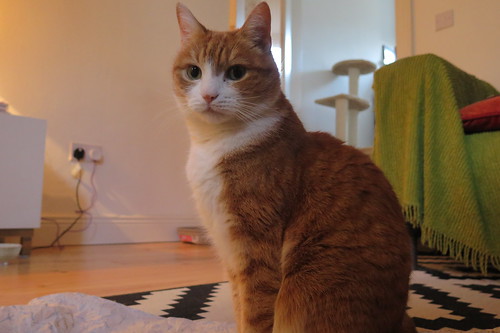
Being at the back meant that we were able to get out quickly and make our way back home with despatch (which might just mean that we missed an unexpected encore of 'Never Tire of the Road', where we were greeted by a wet cat who regretted her decision to spend the evening out having adventures.
Portrait

Saturday, March 03, 2018

Belle & Sebastian, live in Iveagh Gardens 20/7/2017

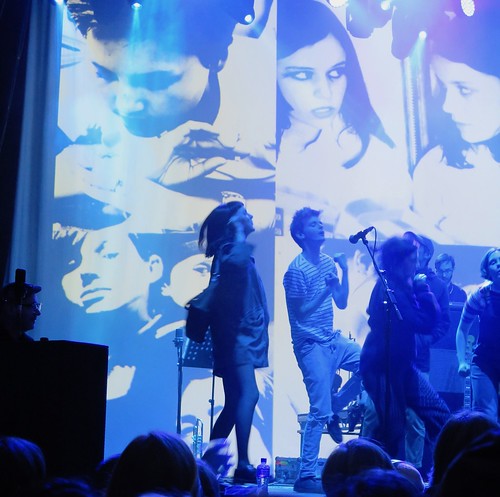
Dancers
In times past I was big into the band Belle & Sebastian, regularly travelling off to exotic places (like Aberdeen) to see them play in concert. Then my engagement with the band fell away as their records started to interest me less and the Bowlie Forum around which my B&S fandom was based was shut down. With bands one has loved a lot sometimes it becomes the case that any falling off of affection leads to a weird kind of retrospective dislike where you forget that you ever liked them that much in the first place. So it was somewhat with B&S, whereby they seemed to disappear from my life and consciousness. So much so that when a Belle & Sebastian concert was advertised here in Dublin I was in two minds as to whether I would go to it or not. In the end I went for old time's sake, concerned about the cost and the fact that this was an open-air concert in a country that is famously unsuited for open air concerts and featuring a band who some might say have left their best days behind them.

By the date of the concert however a programme of B&S re-listening had hyped me up for the event. Sadly it had not engendered any spirit of organisation and I made no arrangements for prior meetings with those people I knew would be attending and plodded along on my own (after first running home from work to feed the cat (name of Billy Edwards), scoffing some speedily consumable food myself and then running back into town again).

It was odd going to the concert on my own. Aside from the fact that I have never previously seen B&S without my beloved (away in Georgia doing her singing), B&S concerts before had tended to be group affairs, either with gangs of Sini-Bowlies or Dublin B&S friends. This time though I was standing on my own, which was interesting in its own way. The crowd had a lot of people from what I think of as the age cohort of people who have been into B&S from way back but also there were younger people too, so they must be acquiring new fans. Maybe they will forever speak to disaffected but sensitive young folk.

And the concert was great, magical even. The old songs are as beautiful as ever. The ones from after I got off the B&S bus are pleasant enough in the live context. Several of the latter received strong reactions from the younger folk in the audience, suggesting that not everyone sees B&S as a heritage act. The interplay between Stevie and Stuart onstage is as entertaining as ever.

Stuart appeared to be the only one of the band who does not noticeably look a good bit older since the last time I saw them, presumably thanks to his habit of bathing in the blood of saucy teenage virgins. He and the others seemed wryly at ease with their not-as-good-as-they-used-to-be status, feigning surprise when people responded well to recent material and suggesting that as they were about to play a new song the bar staff would now be swamped.

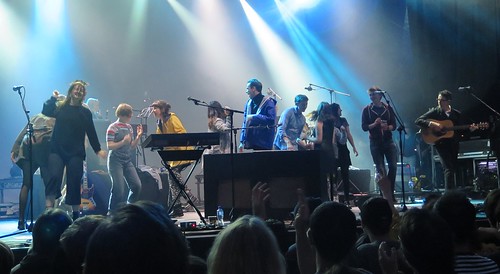
One usually great thing about B&S was the way when playing live they would bring people up from the audience to dance onstage for a few songs. Previously that led to amusing spectacles like the time as Glastonbury when some bemused bloke found himself dancing onstage to some band he had plainly never heard of while waiting for the Prodigy to come on. This time the dancers all knew what they were there for and included a reasonable mix of genders (some had suggested that in the past young ladies were much more likely to be summoned to the stage). They were all from the younger end of the age spectrum. I particularly liked the young lady who was living the indie dream by dancing away while wearing an anorak.

Afterwards I did meet some B&S friends and repaired to nearby Devitt's for a shandy. Rash promises were made to re-investigate the post-slide albums by B&S. Overall though I was glad I came out, realising that I would have been very sad if I had not. B&S may not be the best band in the world and they may not even be the one I like the most but there is no other band that has ever meant as much to me, both directly through their music and indirectly through the friendships I have made thanks to them. With regard to the latter point I was struck by how although I did not know the people around me at the concert, they all looked like simulacra of my B&S friends from the past. I was also thinking of the B&S friends who are no longer with us, notably Liz Daplyn, Amy Longcore and Jan Jansen. Godspeed.

Belle & Sebastian are playing again later this month. They say you should not chase the buzz, but I will be there.
Stage invasion

Saturday, February 24, 2018

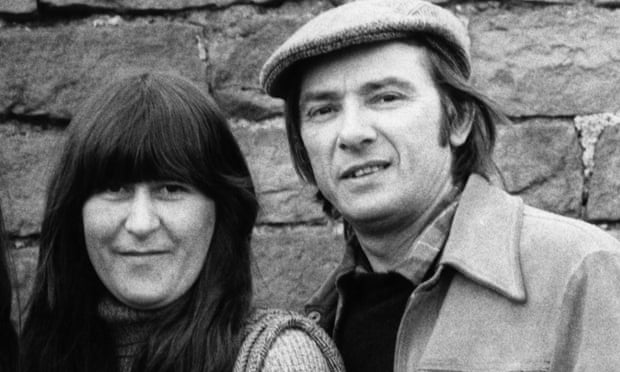
Lal and Mike Waterson "Bright Phoebus" (1971)

After deriving great enjoyment from blasting out the title track at the recent Unthanks weekend, I resolved to look for this record, finding it in Coda, the folkie record shop in Edinburgh. Together with their sister Norma, the Watersons were big players in the 1960s folk revival, mostly known for unaccompanied singing of traditional tunes. Bright Phoebus however is different, being newly composed songs performed with instrumentation, sometimes very sparse and sometimes more lush. It is an odd beast and I can see why it might have disconcerted folk purists when it came out. Some of the songs sound very much like extrapolations of the folk canon, notably 'The Scarecrow' and 'Fine Horseman', but others go in very different directions. The album opens with the jaunty 'Rubber Band', in which Mike and others sings about their being the fictional Rubber Band, making this the folk equivalent of the opener to Sergeant Pepper's Lonely Hearts Club Band (a record released by the Beatles); this jaunty tune sounds very far removed from the world of silver tankards and people singing shanties with fingers in their ear. Likewise 'Magical Man', 'Shady Lady' (reverse engineered country) and the title track. 'Bright Phoebus' starts off with just guitar and Mike's voice, but then more voices and instruments come in, with both arrangements and composition leading this away from the uncontaminated stream of pure folk music. Going back to Beatles analogies, the track could the Watersons' 'Hey Jude' (analogy does not work if you dislike 'Hey Jude').

Anyway, this is a great record, with the juxtaposition of the folkie numbers and the brash uptempo tracks giving the album an exciting feeling of expectations being shattered. Long out of print it is great to see it recently re-issued by Domino, now basking in the reputation of a lost classic. Sadly Lal and Mike Waterson are no longer alive to see their record attract a new generation of admirers.


image sources:

Bright Phoebus (Discogs)

Lal and Mike Waterson (Guardian: Bright Phoebus review)

Friday, February 23, 2018

The rota

A friend recently recounted a bizarre story she had heard from a (female) friend who was in a band with a load of blokes. When the band went on tour they would often find themselves all sharing a room. The first thing the blokes would all do is draw up a rota, allocating each of them a time-slot during which they could perform solitary activities of an onanistic nature. The woman member of the band was not included in the rota but her husband was; she did not think any of this strange.

I myself have never been in a band but I know that some readers have been. Is it normal for touring bands to draw up a rota of this kind?

image source (Wikipedia)

Thursday, February 22, 2018

Northumberland Fun with the Unthanks

For the last few years Januaries have seen me travel to Northumberland for a singing weekend organised by popular folk group The Unthanks. I am always a bit wary of writing about it publicly online, as the event is meant to be a private one. I have steered clear here of either reviewing the mini-concert the Unthanks treat attendees to on the Saturday or writing identifiably or critically about any of the attendees, but if any of my Unthanks singing weekend pals think I have crossed a line, contact me privately.

For those who are unaware of who The Unthanks are, they are a folk music group from Northumberland based around sisters Rachel and Becky Unthank. Every year in the depths of winter they host weekends on a farmhouse holiday camp at which a few dozen people get to hang out with them and learn songs from Rachel and Becky. I started going to these as my beloved's plus one some years ago and have kept going even after reasons stopped her from going, which is ironic as she sings all the time while the Northumberland weekend is almost the only singing I do all year. A lot of the other attendees are people who keep coming back each year, making the event feel like a reunion of old friends, but there is always a bit of a rollover, which keeps it fresh and stops it getting too car keys.

The weekends revolve around music and food. On arriving I consumed a copious quantity of cake and then the singing workshops began. A gentle commencement was a round from Bagpuss about porcupines, which we had to first sing as ourselves and then as the mice who sing it in the programme. More serious fare followed with 'Three Ships', an angry tune by Mike Waterson about how lax safety standards in the British fishing fleet led to the loss of three trawlers from Hull in a short period in early 1968. An odd feature of this tune was that the lows lead the melody, with the middles and tops doing the harmony parts; this was an unusually common feature of the songs this weekend. 'Ah Cud Hew', a song about a wrecked coal miner whose lungs are now full of dust provided more folkie sadness. Yet again I am struck by how mining folk songs are all either "Mining is shit" or "Oh fuck, they've closed down the mine".

I did not cane it on the first night in Northumberland but an advancing cold meant that on waking in the morning I had almost lost my voice. Thus it was a struggle for me to participate in the Saturday workshops, but I did my best, with green tea and vocal exercise leading to something of an improvement. The big tunes in this session were 'The Grey Funnel Line' and 'Bright Phoebus'. The former is by Cyril Tawney (composer of Unthanks weekend classic 'Chicken on a Raft') and tells of a sailor who has fallen out of love with the sea after his heart has been captured by a woman back at home; Maddie Prior and June Tabor recorded it on their first album. 'Bright Phoebus' meanwhile is by Mike and Lal Waterson and was the title track on their album of 1971. Not having heard this song previously I was struck by how little it resembled what I think of as folk music, sounding like the kind of big tune that would boast massed backing vocals and big production when recorded. It is a great song, with lyrics about how great it is when your affections are returned. It is a great big brash good time tune - I love it.

Another key feature of the weekend is always going for a walk to see first a castle and then a pub. This time the castle was Dunstanburgh, now a cyclopean ruin that was apparently destroyed by cannon during the Wars of the Roses (its Wikipedia page is somewhat vague on this point). We sang some songs beside it and walked on to a beach, there to sing some more, and then made our way to The Ship Inn in the village of Craster where we drank hearty ales and delighted the locals. As well as group singing there were some individual turns. I was struck by the odd coincidence of hearing 'Biddy Mulligan, the Pride of the Coombe' and 'T Stands for Thomas' only a few days after hearing the same tunes performed by Rue, particularly as the latter song is much better known as 'P Stands for Paddy'. The big hit of the pub sing-a-long was however 'The Citizen Chanty', led by a chap who sings with the Commoners' Choir. This takes the tune of 'A Drop of Nelson's Blood' but changes the lyrics to be a riposte to Theresa May's bullshit comments about rootless cosmopolitans and I really enjoyed blasting out the chorus about being citizens of the world.

Singing in pubs however provides opportunities for members of the public to join in the action. Some rugger buggers were in the pub, downing beers to make up for a match being cancelled. One of them came forward to lead a song, which did cause my pulse to race given the reputation for sexism and racism of rugby songs. Instead though he led a call and response thing that was like some kind of haka thing; we thanked our lucky stars. I was talking afterwards to a woman who found herself surrounded by the other rugger buggers during the haka thing; the swirling waves of testosterone had given her the vapours.

The evening saw the traditional dining event known as the stuffing of the faces before a mini-concert by the Unthanks. Things were discussed. A couple of us went outside to look at the clear skies of Northumberland, seeing such delights as the bow of Orion, Betelgeuse glowing scarlet, six of the Pleiades, and two passing satellites (or the same one passing by twice?).

Singing outside around a fire seemed less apocalyptic than last year, when the accession of Trump made it feel like we were at the brink of a new age of darkness. But as dreadful as that dipshit's presidency has been, he has not yet either destroyed the world in a nuclear war or initiated a functioning dictatorship in the USA, so to me as we gathered round the fire it did not feel like we were desperately trying to banish the horrors of the wider world.

Inside there was a round of random sing song stuff, with people doing party pieces. To some extent this has become a greatest hits event for recurring Unthanks attendees but two exciting new renditions were 'The Rocky Road To Dublin', a song featuring on the forthcoming compilation And Then We Bate The Shite Out Of Them, and'The Jeremy Hunt Rhyming Song', which gets great mileage out of rhyming Hunt with every word possible except the one that first springs to mind [/spoiler]. Sadly I had not learned a song to perform myself and in any case my throat might not have been up for it, but I have already formed some ideas for next year.

One tune that turned out to work surprisingly well in this kind of jolly sing-a-long environment was Depeche Mode's 'Personal Jesus', which can be belted out with hand claps and foot stomps covering for the lack of synthesiser accompaniment. Try it in the comfort of your home.

As always, I came away from Northumberland thinking that singing is great and that I should do more of it. The problem is that I come away from Northumberland thinking this every year and then do nothing about it.

Wednesday, February 21, 2018

Santa Rita concert: Rue

One class of concert I keep going to and not writing about are these Santa Rita concerts organised by the Ergodos people and held in the Little Museum of Dublin. They follow a similar pattern: one arrives and has a little drink of the wine from the sponsors (Santa Rita) and then mills around the rooms of the Little Museum of Dublin, which is a Georgian house on St Stephen's Green that has been converted into a quirky museum of Dublin stuff. Then Garret Sholdice of Ergodos has a chat with the artist performing by a fireplace after which everyone is encouraged to skull another glass of the tasty wine (from Santa Rita) before heading down to the exhibition room for the concert, in which it is not permitted to bring the wine. The concert is then usually about an hour long. which means I get home sufficiently early that my cat is not too annoyed at having her dinner delayed.

The concerts are not always of the same type. Sometimes they are of the classical recital class, with particularly memorable ones in this regard including Malcolm Proud playing Bach's Goldberg Variations on harpsichord and William Butt playing music by Bach and Britten on cello. They have also had folkie ones, like Sam Lee's interesting folklorist performances of tunes collected from Irish Travellers or Chris Woods' neo-folk adventures. And they also have whacky performance art nonsense like a Jennifer Walshe concert where she did the whole event like it was a seance or funny electronic stuff like the one by Chris Watson, where he stitched together a load of wildlife recordings to create an imaginary vision of a magical country rising temporarily from beneath the sea. Whatever they serve up, these concerts are always great and I pass judgment on my so-called music aficionado friends who never show up to them.

The most recent one of these concerts was by Rue. Rue are a local three piece comprising Radie Peat and Cormac Dermody, both also of band Lankum, and Brian Flanagan from the United States of America. They are billed as being a cross-fertilisation of Irish trad-music and Appalachian music from over there. The concert was good but I found it more like redux version of Lankum than an actual trans-Atlantic mind meld. Much of this came from the fore-grounding of Radie Peat's work in the set, both her drones and her vocals, with several of them being her on her own which meant that poor Brian Flanagan did not get much of a look in. But for all that here were some great tuneage on display in the performance. The two that struck in my mind, perhaps because I had heard them before, were 'Biddy Mulligan, the Pride of the Coombe' and 'T Stands for Thomas'. The latter is a variant of 'P Stands for Paddy', a song of coded courting, while the former is a first person testament from said Biddy Mulligan, a resident of the Coombe and a street trader. The song has apparently gone through an odd journey as in days of yore it was pretty much sung in music halls to make fun of the working class residents of the Coombe but in more recent years it has acquired a more celebratory tone.

Caveats about intercontinental failure aside, this was still a great concert. Possibly the unique selling point of the Santa Rita concerts (aside from the wine) is how cosy they are - it is easy to end up sitting almost on top of the artists. And it is nice being on top of artists.


image source:

Rue (Culturefox)

Tuesday, February 20, 2018

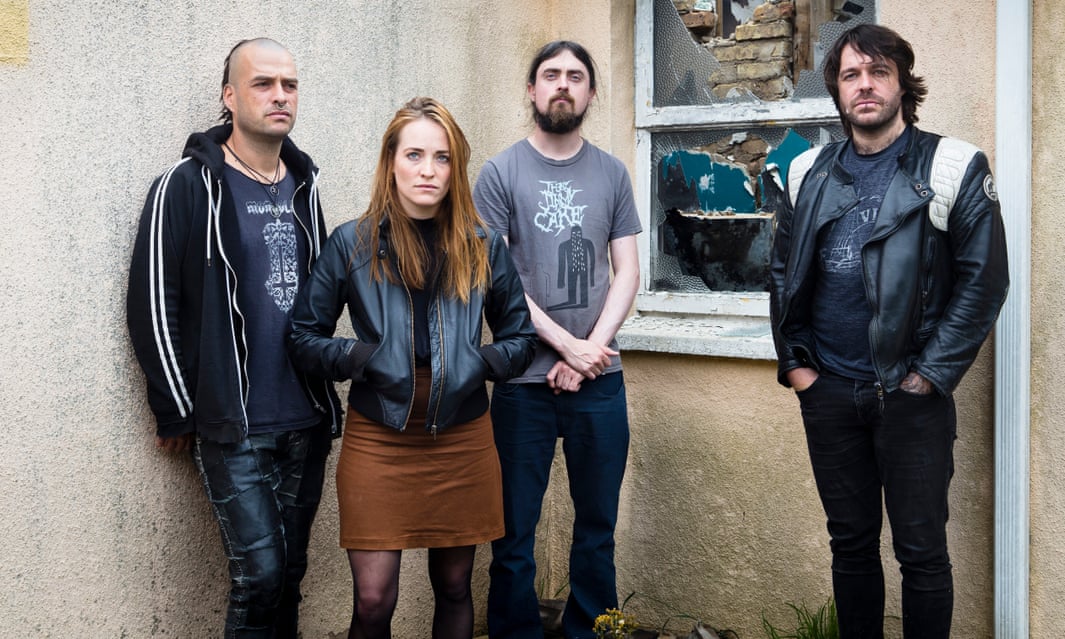
Lankum: live and on record

Back before Christmas in the Beforetime I went to see Lankum playing in Vicar Street. But who are Lankum? Well they are a bunch of Dublin folkie-tradders from Foxrock who developed their love of music while studying at Blackrock College and Muckross (true fact). Two of them are brothers whose surname is Lynch, so for a while they traded under the name Lynched before realising that this might make it difficult to get gigs in the United States. So they changed their name to Lankum, a reference to 'False Lankum', a version of the 'Cruel Lincoln' / 'Long Lankin' murder ballad. I have been hearing about how good they are for years but it was only recently when Radie Peat of the band appeared on John Kelly's Mystery Train to talk a good musical game and one of their tunes cropped up elsewhere and sounded like my kind of thing that I decided to take the leap and investigate them. I lassoed some pals to share a table at this concert and bought their most recent album (Beneath the Earth and the Sky)beforehand to gain some sense of their recorded work. Thus fortified I arrived at Vicar Street.

There are four members of Lankum, two Lynches and two non-Lynches, of whom one is part of the Dermody musical clan and the other is Ms Peat. The music is quite droney, much of it coming from Peat's harmonium and concertina but also from one of the Lynches playing uilleann pipes. The tunes are mostly trad arrs but there are a couple of more recent tunes by other people and even some by Lankum themselves. Radie Peat maybe sings most of the songs; she is impressive and hearing her reminds me of how unusual it is to hear Dublin working class women sing in their own accent, which is particularly strong on 'What Will We Do When We Have No Money?', the album's opener. However what might be the most striking tune is sung by one of the blokes, this being 'The Turkish Reveille', the one about the captain who promises a sailor all kind of things to sink an enemy ship before betraying the sailor and leaving him to drown. The piece is very evocative of the horror of finding yourself stuck out in the middle of the ocean, with the drones and the repeated lyric about lonely lonesome water building a general sense of watery doom.

Anyway, that's Lankum for you. They are worth investigating both live and on record. Aside from having good music on it, their Beneath the Earth and Sky record is also conceptually interesting, as it was recorded (Albini-style) by Julie McLarnon at the Analogue Catalogue studio, where they only use analogue kit. To some that might seem like the very embodiment of rockism but it is an interesting constraint and I think the approach benefits music of this type (for all that I have only listened to it on digital media).

image source:

Lankum (Guardian - Lankum: Between the Earth and Sky review)