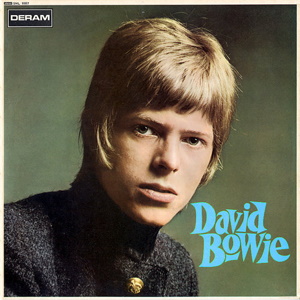
 I've had the great idea of listening to and then writing about every David Bowie album in turn. This is the first one, a 1967 album with the unimaginative title of David Bowie. Or maybe it has no title, seeing as the cover features the artist's name and no title. Or maybe the title is Deram. Either way it's not an album I had heard anything about previously. Combined with the generic late 1960s cover this had me thinking that the record was almost certainly not very good: a collection of sub-Laughing Gnome novelty song bollocks mixed in with some unimaginative swinging London tunes. But I was wrong. The album is actually pretty good and it might well be that the only reason why people don't talk about it that much is that Bowie made so many other records. Also it perhaps lacks the kind of extreme musical elements that Bowie picked up from his later collaborators. The lyrics though are signs of things to come, with words hopping from slice of life Englishness to darker themes more like what we might expect from the artist.
Looking at the Wikipedia page, I'm not clear how much control Bowie had on the recording process, so I might roll with the idea that the record label decided how the album was going to be produced, even if Bowie was the one writing the songs. I might be wrong here.
I might quickly run through the songs, as this could be useful for readers as unfamiliar with the record as I was.
"Uncle Arthur" is a great opener: a jaunty up tempo tune about the eponymous character who is living an infantilised life in his 1930s, still reading comics and living with his mother who does all his cooking. And then we get a bit where he breaks free of the maternal embrace and runs off to get married, except he doesn't like the wife's cooking so he skips out and comes back to mummy. So you might think Uncle Arthur (whose uncle excactly?) is a sad bastard but the song pictures him feeling like he is living his best life. I suppose his domestic bliss is not really sustainable in the long run, but what is?
"Sell Me a Coat" has a more poignant tune. To me the lyrics are a bit more oblique. Perhaps this is about being sad as you get older and remember being young, something that would have been a big part of 20 year old David Bowie's life.
"Rubber Band" was released as a single. It wasn't a hit. Like "Sell Me a Coat" it has a brass accompaniment, but also an almost militaristic drum line. Even without listening to the lyrics you can tell there is something angsty going on here, and in this case the song tells the story of a guy who is sad because he went off to fight in the First World War and then came home to find that his girl had married the leader of a marching band. 'I hope you break your baton' he ruefully concludes.
"Love You Till Tuesday" is an uptempo love song that sounds a bit like the 1960s pastiche bits in Spinal Tap. It's very much in the stalker-love tradition as Bowie sings about loitering outside his loved one's domicile, the kind of thing that is often presented as romantic in songs and stories when it is anything but in real life. And yet the fact that the song title is "Love You Till Tuesday", lines that recur through the song, suggest a knowing awareness of the passing nature of infatuation. The way the vocal phrasing fits to the tune is very impressive, the words seeming to jump along like pebbles bouncing off water. This was also released as a single and also flopped.
"There Is a Happy Land" apparently takes both its title and theme from a hymn of the same name written by Andrew Young. The lyrics are of the childhood nostalgia variety, evoking the world of make-belief that children fall into and adults can't enter even if they want to. Wikipedia describes it as psychedelic-influenced but the music for me does not really have much in the way of psych-signifiers. The pace is slow and bass heavy, with occasional bursts of wind instrument. The vocal tone is sad, perhaps evoking the sense of loss that features in so much literary treatments of childhood and growing up.
"We Are the Hungry Men" starts off with a man in a funny voice giving a news report about an overpopulated world. Then the song proper begins, and the lyrics put us in classic David Bowie territory as Bowie sings of a dystopian future and its messianic leader. But its all very jaunty and uptempo, until you get the middle eight where someone with a comedy German accent comes in and then Bowie sings to a slower tempo about a programme of mass abortion and delivers the lovely line "We will turn a blind eye to infanticide". And then back to the jaunty tune. I like to imagine someone listening to this without paying attention to the words and then having that line hit them like a punch when the tempo drops, before the return to jauntiness leaves them with a feeling of "Did I really hear that?"
"When I Live My Dream" sounds like the kind of tune someone like pre-weirdo Scott Walker might sing on a TV variety show, looking a bit sad as he sings his lovely song with soaring strings about imagining a world in which his lover didn't dump him.
"Come and Buy My Toys" is a bit folk-adjacent. It is another one of those magical-world-of-childhood evokers, but there are also lyrical evocations of rustic England. And maybe there is an undercurrent here, like this is being sung by one of the Goblins in Christina Rossetti's "The Goblin Market", having moved on from selling fruit to toys?
"Join the Gang" describes a group of cool young people, the boys playing in bands and the girl a model. It's another jaunty uptempo tune, but there is a bit of an edge to it, with references to drug use that make it sound like they are not entirely fun drugs. The drummer really earns his pay on his one.
"She's Got Medals" is another one where the uptempo tune masks the oddball nature of the lyrics, which seem to be about a woman who adopted a man's identity to fight in a war before going back to being a woman, albeit after a time picking up girls. It might have made a good single, except the lyrics would probably block it from getting any radio play.
"Maid of Bond Street" has a swinging London tune and presents little portraits of different people (mostly women, one man) and their different lives, some happy, some sad.
"Please Mr Gravedigger" begins with an ominous bell ring, then Bowie's voice comes in singing to an accompaniment that is mostly comprised of sound effects rather than music. The lyrics seem to be slice of life stuff about a gravedigger going about his work, but then what's that about the singer confessing to the gravedigger that he's a child murderer?
And then it's over. I see from Wikipedia that the version I downloaded from iTunes is missing two tracks: "Little Bombardier" and "Silly Boy Blue". The former apparently deals with a war veteran who is run out of town after being suspected of kiddy fiddling while "Silly Boy Blue" seems to have been a musically ambitious piece that returned to Bowie's live sets in later years.
One thing I am really struck by with these tunes is how short they are. I'm a fairly fast typist but I couldn't write a short paragraph about any of the songs in the time it took to play them.
So my final verdict: this record does not deserve its obscurity and is worth more listens. For me the key tracks are "Uncle Arthur", the opener that immediately had me thinking 'Oh wait maybe this isn't all rubbish?' and "We Are Hungry Men", with its juxtaposition of dark lyrics and jaunty tune.
 Next up we have David Bowie's second album, from 1969, which is also either untitled or called David Bowie. It's the one with "Space Oddity" on it.
image:
album cover (Wikipedia)
David Bowie c. 1967 (Rolling Stone: "Remembering the Debut Album David Bowie tried to forget")
Next up we have David Bowie's second album, from 1969, which is also either untitled or called David Bowie. It's the one with "Space Oddity" on it.
image:
album cover (Wikipedia)
David Bowie c. 1967 (Rolling Stone: "Remembering the Debut Album David Bowie tried to forget")


No comments:
Post a Comment