Showing posts with label television. Show all posts

Monday, May 16, 2022

Nigel Kneale: A Centenary Celebration

I went to London for a celebration of the centenary of the birth of screenwriter Nigel Kneale. Organised by Jon Dear, with the glamorous assistance of Toby Hadoke, Howard David Ingham, and Andy Murray, this was a day of screenings and panel discussions in the Crouch End Picturehouse.Nigel Kneale is not a household name by any means, but in his long career he produced striking work for television and cinema. He started writing for television in the 1950s, when TV drama was starting to become a thing, and while he initially wrote all kinds of stuff it is his science fiction and horror writing that he is remembered for. His best known works probably being the three 1950s series of Quatermass (a kind of proto-Doctor Who, except for grown ups), though he was still writing into the 1990s.
The first panel looked at Kneale's early work with the BBC, which started with literary adaptations and then moved on to The Quatermass Experiment in 1953 and its follow-up serials in 1955 and 1958, as well as his adaptation of Nineteen Eighty-Four in 1954. These were the event television of their time, with questions being asked in parliament about Nineteen Eighty-Four and the streets reportedly emptying when Quatermass was on, though of course this was also a time when there was only one British TV channel. The details of television's early years brought up the panelists were fascinating. At that point television, even drama, was still mostly broadcast live; pre-recording was only used for material shot outside, which was still a bit of a novelty. Drama was also conceived in very theatrical terms, with Reginald Tate, the actor playing Quatermass in the first series, taking a bow at the end of the last episode.

One of the panelists had looked up what was actually shown on the BBC on the day the first episode of The Quatermass Experiment was shown. Initially there was alternating coverage of Royal Ascot and Formula One motor racing, then a short piece of children's programming, more Ascot and motor racing, and a news reel, all interspersed with interludes when nothing was being shown. And then a warning from the announcer that the following programme might not be suitable for children or those of a nervous disposition, before the ominous tones of Holst's "Mars" brought us into the world of Professor Quatermass and his experiment.

Another point made by the panelists (and one repeated through the day) was that for all Nigel Kneale's best remembered work dealt with science fiction and horror themes, he never thought of himself as a genre writer and was indeed very dismissive of science fiction. Partly that derived from his having a somewhat limited sense of what constituted science fiction, seeing it as something characterised by the US pulp tradition and screen material inspired by it. Science fiction fans will rightly grumble that the genre has so much more to offer. And yet if you look at what passes for screen science fiction now you see that it is dominated by films in which people in stupid costumes punch each other or by formulaic Trek Wars crap that is cosily familiar rather than in any way challenging. It's like the pulp tradition has taken over science fiction, so maybe Kneale was right to dismiss the genre entirely.

This discussion preceded a screening of "Contact has been established", the first episode of The Quatermass Experiment. Professor Quatermass is the director of a British space programme that has sent a manned rocket into orbit, but something has gone wrong. Eventually the rocket crash lands in south London, but inexplicably there is only one of the three astronauts left inside the capsule.

One thing that struck me with this episode was how the shadow of the Second World War hangs over Kneale's early work. After the rocket lands on a residential street displaced locals reference the Blitz, with one confused woman seeming to think that the V2 rockets are back. The later Quatermass and the Pit sees people finding something during tunnelling that they initially think is an unexploded German bomb (that drama's nightmarish climax sees people consumed by an urge to exterminate the different, which also evokes the horrors of the Third Reich). And Kneale's Nineteen Eighty-Four feels very much like it is set in a world where the Second World War never stopped (which I think was Orwell's intention but it is maybe less obvious to us when reading his book). I suppose in the 1950s the war was still very recent, with some food rationing still in place when the first Quatermass episode was broadcast. That the war, or something like it, could start up again must have been a fear forever lurking below the surface. The depiction of a street destroyed by a rocket must have triggered uneasy memories on the part of many viewers (and for all the studio bound nature of the first Quatermass episode, the ruined house set is surprisingly effective).

"Contact has been established" was followed by Tom Baker reading Kneale's short story "The Photograph"; the story is from much further back but this was broadcast in 1978, when Baker had only recently departed from Doctor Who (ironic in that Kneale thought Doctor Who was rubbish but also resented how its producers lifted his plots and themes). After a short break Jon Dear talked to Douglas Weir of the BFI about the restoration of Kneale's Nineteen Eighty-Four (out now (finally) on DVD and Blu-Ray); having seen that some years ago at Loncon I am looking forward to catching it again in all its restored glory.

Then we had a panel on Nigel Kneale in the 1970s. This was Kneale's folk horror period, with ancient evils supplanting the dangers of science gone wrong in his work (though arguably the danger of chthonic terrors from the past was also a theme appearing in some of his earlier work, notably Quatermass and the Pit, while the 1970s still saw Kneale engaging with science fiction themes in the likes of The Stone Tape and the final 1979 Quatermass series). By now of course television was a much more mature medium, broadcast in colour with drama no longer going out live. And there were more channels in Britain (three, to be precise). TV was also edgier: for all that Mary Whitehouse was clipping its heels, much more could be shown now than in the 1950s. There was an interesting point made by Una McCormack about how not all of this lack of inhibition in the 1970s was necessarily great, with the television and cinema of the era sometimes seeing sexism slide into outright misogyny (think about how common sexual assault of women is in notable works of the decade); she talked of Kneale acknowledging this and reacting against it in the likes of Murrain or the Beasts episode "Special Offer". You could see something similar in The Stone Tape, where Jane Asher plays almost the only woman in a drama otherwise featuring a lot of often boorish men.

That was followed by a screening of Murrain, originally broadcast by ITV as part of the Against the Crowd anthology series. The film is based on two conflicts: the young vet representing science and modernity versus the superstition of the country folk, and then same superstitious country folk versus the eccentric old woman they believe to have cursed them. It makes for disconcerting viewing as it is never quite clear where your sympathies are meant to lie. Well, the vet is always operating with the most noble of motives, but beyond that it gets more complicated. Are the countryfolk bad because they are persecuting an old woman for no crime other than being a bit odd? Or is the old woman actually an evil witch who has brought a curse down on her neighbours? Or is she a woman of power who is merely striking back against her neighbours' persecution? The drama also retains an ambiguity as to whether the old woman is actually possessed of sinister powers, or whether the various ailments afflicting those who have slighted her are psychosomatic (which could be the case even if the old woman thinks she has cursed them). On the other hand, the farmer's pigs are actually suffering from a mysterious sickness (the murrain of the title), something that for them is unlikely to result from a belief in witchcraft.

Murrain is also surprisingly funny. Not funny all the time, but it has its moments. Like when the vet is in the village shop trying to buy stuff for the old lady. He asks the shopkeeper if she has any olives or chorizo; she gives him a look suggesting there is not much demand for such fripperies in these parts.

Murrain also gives us the great phrase from the vet, "We don't go back", with which he asserts his confidence that science will always provide the answers and that the old ways of superstition have nothing to offer us. The phrase gave Howard David Ingham the title for their book on folk horror, because the whole genre is largely based on the idea that maybe we will go back actually. By the end of Murrain even the vet's confidence in science seems to be shaken, for all that the drama's climax remains ambiguous.

That was followed by a panel on Kneale on film. For all that he wrote primarily for television, there are a good number of films based on his work or else scripted by him. Hammer made films of the three 1950s Quatermass series, the first two in the 1950s while Quatermass and the Pit (the best by a considerable margin) did not appear until 1967. He wrote some other films for Hammer (Abominable Snowman and The Witches) as well as an adaptation of H. G. Wells' The First Men in the Moon (which seemed to be always on television when I was a child). And he did some non-genre work (including, surprisingly to me, adaptations of John Osborne plays). But it was hard to escape the feeling that film was not really his medium, with his writing for the big screen being littered with projects that were stillborn or ended up as compromised failures (e.g. Halloween 3). Cinema is a more difficult medium for writers, with the amount of money riding on a picture meaning that someone like Kneale was never going to be given the kind of free rein he had on television.

And then we had a short clip from The Quatermass Xperiment [sic], the 1955 Hammer film adaptation of the first Quatermass series. A little girl playing on her own meets what we know to be a man transforming into something else, in a scene that cannot but evoke a disturbing counterpart in the 1931 film of Frankenstein. The girl was played by Jane Asher, who started out as a child actor. We then had the excitement of Jon Dear interviewing Jane Asher (Jane Fucking Asher!) as an introduction to a screening of The Stone Tape, in which she played the leading role.

Asher lent the day an air of star quality and was an engaging and entertaining interviewee. I was particularly amused by how one of her anecdotes pivoted to "He was a lovely man" when she discovered that its subject (a Stone Tape collaborator) was still alive. I had to admire her making a long round trip to attend the event, particularly given that she did not stay for the screening (she mentioned hating seeing herself on screen, something which I understand is not uncommon among actors). I was also struck by how there was an accidental echo of The Stone Tape in her appearance in the Picturehouse. In the TV drama she plays almost the only female character, isolated in a world of blokey blokes, while the Nigel Kneale Centenary event was also a pretty male-dominated affair, both in terms of the audience and the programme participants (there were several manels and no panel with more than one female participant); hopefully this event went better for her than The Stone Tape did for the character she played.

And so to The Stone Tape itself. As with almost all the screenings, this was my first time seeing this, though it is something I have heard discussed at folk horror online events. It is a feature length TV play first broadcast on BBC 2 in 1972. It mixes science fiction and horror, being in part a ghost story but also attempting to offer a scientific explanation for hauntings (the idea that places can somehow record events that have taken place in them, now often referred to as the Stone Tape theory, for all that the idea preceded the drama). And the play itself is about recording, as its premise is that a team of recording engineers are setting up in a country house to research new audio technologies. The house being haunted presents some challenges, but when they hit on the Stone Tape theory they start thinking that this could maybe be harnessed into a revolutionary new audiovisual recording medium. But this is horror so things do not entirely work out.

I mentioned that Jane Asher plays (almost) the only female character in The Stone Tape, a computer programmer. The sexism of the era is a bit of a theme to this one, with the married head of the project in a problematic relationship with her, while she often finds herself patronised by her colleagues. But what is really striking about the drama is the racism. The researchers are in competition with Japanese rivals, and every time they are mentioned (usually as "The Japs") the characters switch into the kind of parody Asian accent and facial contortions that would disbar you from public office if a recording of you doing it were to surface. And also the company they work for, Ryan Electrics, is owned by an Irishman; he never appears but whenever he is invoked the characters switch into stage Irish accents. Yet it is hard not to see all this as signs of weakness rather than confidence. It must gall these arrogant Englishmen to be taking orders from the scion of one of their former colonies. And for all their mocking of the Japanese, it is stated fairly explicitly that unless the team achieve their sonic breakthrough the British audio industry will be soon wiped out by its East Asian competitors. The sexism might also mask a blokey unease that women are now moving into the workforce and occupying roles that would previously have been the preserve of men.

I should also mention that The Stone Tape features an amazing BBC Radiophonic Workshop soundtrack.

I was talking after the screening to one of my neighbours about how Ireland and the Irish people are a bit of recurring theme for Kneale. As well as Ryan, he mentioned how in Quatermass II the revolt against the alien invaders begins on St. Patrick's Day and is spearheaded by Irish labourers. And there is an Irish drunk in The Quatermass Experiment. Irish names show up throughout Kneale's work. I'm not sure what the significance of this might be. Kneale was not from Ireland and as far as I know he did not have ancestors from here; he may never have visited the island. But maybe this is not so remarkable: there are lots of Irish people in Britain after all, and they are an easy kind of slight other to represent.

And then we had an odd thing, a live performance of You Must Listen a lost Nigel Kneale radio play broadcast in 1952. Again it combined technology and hauntings, with an initially comical tale of crossed telephone lines becoming more macabre as the intruding voice is revealed to be that of a dead person. It had a lot of characters, who were performed by programme participants and a few professional actors (these were not mutually exclusive categories). I was impressed by how Mark Gatiss, probably the most famous participant, took a relatively minor role.

You Must Listen reminded me somewhat of Robert Presslie's short story "Dial 'O' for Operator", in some respects a similar tale of crossed wires and temporal distortion, though in other ways rather different. Presslie's story did not appear until 1958, so it is possible Kneale's drama planted the seed in his brain.

The final panel looked at Kneale's legacy. Stephen Gallagher compared Kneale to Stephen King, in that both writers revolutionised horror by placing it in everyday contemporary settings (sadly no one noted that we were attending an event in Crouch End, setting and title of one of King's most effective short stories). There was also reference to the disturbing prescience of his late 1968 TV play The Year of the Sex Olympics, which prefigures much of the reality television that blights our age, with something like Naked Attraction almost looking like it took Kneale's play as a template. Mark Gatiss mentioned that at the peak of The League of Gentlemen's success, he tried to push the BBC's controller to commission a new series from Kneale, still living at the time. However, he was told that there was no place on the BBC for someone whose career started before the invention of the remote control.

And then the day closed with a screening of Quatermass and the Pit, the 1967 Hammer film version of the 1958-59 TV series. Directed by Roy Ward Baker and with a strong cast including Andrew Keir as Professor Quatermass, James Donald and Barbara Shelley as palaeontologists, and Julian Glover as an army officer. Like much of Kneale's work, this combines science fiction and horror, with Quatermass's space research interrupted by the discovery of strange hominid remains during construction work on an extension to the London Underground's Central Line; that initial find is followed by ever more disturbing revelations about the true history of humanity.

It is a stunning piece of work, with the tension building as the awful truth is gradually uncovered and the drama moves towards an apocalyptic climax. Maybe the closing section of the film is ever so slightly rushed, but Kneale nevertheless did an amazing job condensing a TV series of more than three hours into a film of 97 minutes, with the propulsive energy of the narrative carrying the viewer along without leaving them time to ponder possible logical gaps in what they are watching. Much of the horror comes from people realising things or just having an idea at the edge of their understanding: there is an astonishing scene early on where a tough policeman comes close to a breakdown merely be viewing odd graffiti marks in an abandoned house. As one of the panellists earlier remarked, The Quatermass Experiment is about an alien incursion happening now while Quatermass II has an invasion that began a couple of years ago, but in Quatermass and the Pit the alien invasion took place five million years ago and basically succeeded, profoundly altering the course of human development but not in a good way (this a year before the publication of Erich Van Daniken's Chariot of the Gods).
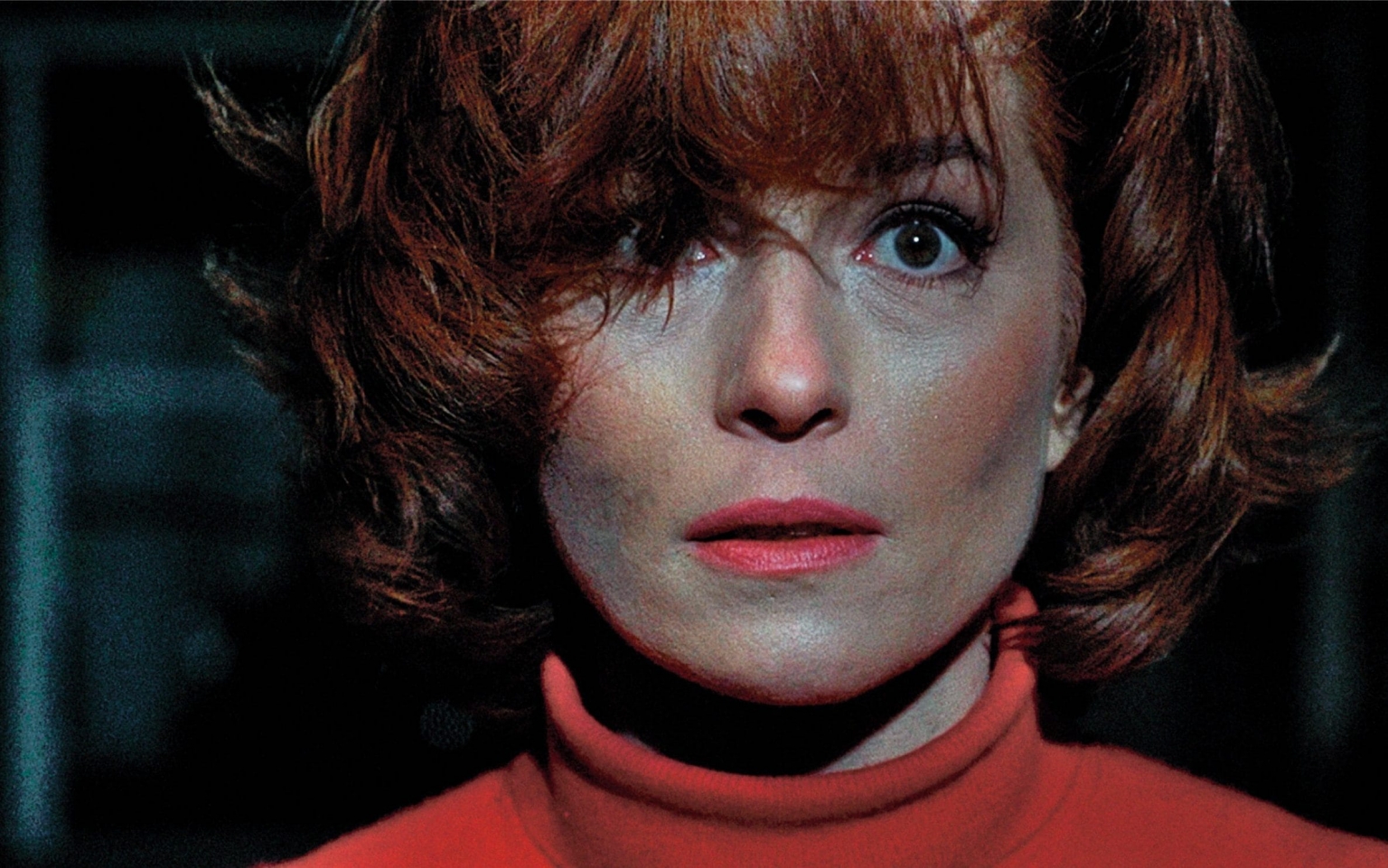
The film also looks amazing. It has the saturated colour of Hammer films of the era but somehow this all seems more impressive in what was then a contemporary context rather than being in some backward corner of Mitteleuropa. Like other Hammer films Quatermass and the Pit is also happy to focus much attention on the good looks of a female lead. Yet for all that Barbara Shelley appears in a succession of stunning outfits, she is never presented as the kind of sexy lady seen in other Hammer films (for comparison see her performance in the latter part of Dracula, Prince of Darkness); the film's poster is somewhat misleading in this regard.

And that I suppose was that. I enjoyed the event a lot, with the combination of programming and discussion working very well. The material shown to us was particularly well chosen, presenting a fascinating overview of Kneale's career, building like one of his works to a terrifying climax, in this case Quatermass and the Pit. The panels were full of interesting people whose insights greatly improved our enjoyment of the screenings and had me thinking of more things to watch. Overall the event had the feeling of a cosy SF con (there was even a slightly redux Lally Wall). Looking back though I found myself thinking about two things the panellists did not really touch on. The first was Kneale's non-genre work, only really mentioned in passing. There was a surprising amount of this, including an episode of Kavanagh QC (his last work according to IMDB), an adaptation of Sharpe's Gold, the previously mentioned John Osborne screenplays, and an adaptation of Wuthering Heights (which admittedly is semi-genre). What I was curious about here is whether in his work on these non-genre pieces he still somehow injected some Kneale magic into proceedings, or whether they are essentially pieces of generic hackwork that could have been written by anyone. The other thing I found myself wondering was whether Kneale ever considered moving into direction, thereby trying to become a proper auteur director rather than a writer who had to worry about how his work would be realised. Books like Into the Unknown by Andy Murray (on sale at the centenary event but sadly all copies were snapped up before I could buy one) or We Are The Martians (edited by Neil Snowdon) might provide further insights into these questions. "I will now outline my plan for world domination"

images:

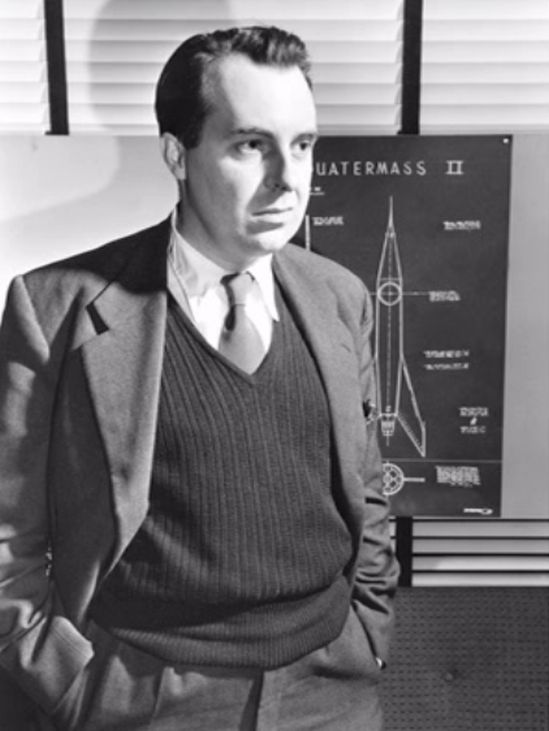
Nigel Kneale (Archivetvmusings, Twitter)

We Don't Go Back (Room 207 Press Shop)

Quatermass and the Pit poster (Wikipedia)

Barbara Shelley (Morbidly Beautiful: "Remembering an icon: Barbara Shelley")

More of my Nigel Kneale Centenary images here

More cat pictures here

Saturday, April 25, 2020

Where to start with classic Doctor Who?

Over on popular social media site Facebook, one of my pals said she was planning to explore the world of classic Doctor Who and I took it upon myself to recommend two stories by each classic Doctor as an introduction (one from each seemed simply too few). As part of my campaign to become a major force in Doctor Who fandom, I present my list here, with non-spoilery notes as to why I have picked them. If you are classic-Who curious, consider starting here. If you are already familiar with classic-Who, consider leaving comments berating me for my poor choices.

First Doctor
The First Doctor was played by William Hartnell, from 1963 to 1966. Initially the Doctor is almost anti-heroic, having basically kidnapped two school teachers and taken them with him and his granddaughter on his travels through time and space. At first it is the disgruntled school teachers who fulfil the more heroic roles required by the plot, but that gradually changes.
  • "The Daleks" - the second story from the First Doctor and the series' first not set on Earth (in classic Doctor Who it was not unusual for stories to be set on other planets). This is notable for its introduction of the titular Daleks, whose massive popularity is said to have pushed the series in a more science-fictiony direction than originally envisaged.
  • "The Tenth Planet" - the last story from the First Doctor, as William Hartnell was retiring due to ill health (one of the episodes had to be hastily rewritten to explain the Doctor's absence, as Hartnell was too ill to record it). The story introduces the Cybermen, who would go on to be the other one of Doctor Who's star monsters, and it ends with the astonishing twist of the dying Doctor transforming into someone else (something that is now unremarkable in Doctor Who but back then was a real "with one bound, Jack was free" moment).


Second Doctor
The Second Doctor was played by Patrick Troughton, from 1966 to 1969. The recordings of many of his stories were wiped by the BBC, so picking ones to recommend is not easy.
  • "Power of the Daleks" - this is the first Second Doctor story. As the title suggests, it features Daleks, as apparently the production team decided was a good idea to have familiar monsters while the audience found their feet with the strange new Doctor. Important caveat: all original visual recordings of this story were lost, but home audio recordings have been combined with new animation to recreate the story; if you fear animation this may not be the story for you.
  • "The War Games" - this is the last Second Doctor story. it goes on a bit (ten 25 minute episodes). At the start it appears to be a straightforward historical adventure set on the Western Front in the First World War, before we discover that something else entirely is going on. The story is notable for the first appearance en masse of the Time Lords, the Doctor's own people, from whom he is estranged.


Third Doctor
The Third Doctor was played by Jon Pertwee, from 1970 to 1974. Doctor Who is now in colour. Initially the Third Doctor finds himself marooned on the Earth, with UNIT (a military organisation whose members serve as helpful cannon fodder) providing a larger supporting cast than previously seen.
  • "Inferno" - the Doctor is drawn towards the Inferno project, where scientists are working to drill through the Earth's crust to access the limitless stores of energy to be found down below. Things start to go very wrong, and thanks to an audacious plot device we see them going wrong twice. As well as the UNIT army types, this also features their scientific advisor, Dr. Liz Shaw (played by Caroline John), one of the great Doctor Who assistants.
  • "Terror of the Autons" For this one the Doctor is still stuck on Earth, but now he must deal with an attempted invasion by the Autons, plastic people animated by a malign alien intelligence (who later appeared in the first new Doctor Who story). Worse, the story introduces his great adversary, the Master (played by Roger Delgado), another Time Lord, an old friend of the Doctor, but also a psychopath seeking power and his own advancement. And if that wasn't enough, there is a character from Northern Ireland.


Fourth Doctor
The Fourth Doctor was played by Tom Baker, from 1974 to 1981. The Fourth Doctor is my Doctor, as little me started watching the series with his first story. I find it hard to narrow his stories down to just two, not just because of my familiarity with them but because I genuinely think that the first three seasons of the Fourth Doctor are the highlight of the show's entire history, with almost the entirety of the stories being all-killer-no-filler.
  • "The Seeds of Doom" - beginning in Antarctica before moving to rural England, this story's themes of infection and transformation are reminiscent of both Alien and The Thing, both of which came out several years after this was broadcast. It also features one of the all-time great barking mad human villains.
  • "The Robots of Death" - this is set on an alien world where decadent humans have creepy art deco robots to do all the work for them. The Doctor lands on a sand miner, on which a small group of humans and their robot crew are extracting valuable minerals from sand storms, only the humans are being mysteriously murdered. The writing and characterisation is very strong in this one and the art design of the robots is also impressive. The story features Leela, the Doctor's knife-wielding savage companion, impressively portrayed by Louise Jameson.


Fifth Doctor
The Fifth Doctor was played by Peter Davison from 1982 to 1984. My recollection of this Doctor is that he was surprisingly un-dynamic and spent a lot of his time being sad about how things turned out.
  • "Earthshock" - massive caveat, I have not seen since this since it was first broadcast, but I remember it packing a real punch and being packed full of what 2000 AD readers know as Thrill Power. The story features the surprise return of an old enemy (the surprise being somewhat spoiled by their appearance on the DVD of the story) and one of the more downbeat endings in Doctor Who's history).
  • "The Caves of Androzani" - the last Fifth Doctor story, this one was written by great Doctor Who writer Robert Holmes and sees the Doctor caught up in a complex struggle over between a corrupt plutocrat and a phantom-of-the-opera style robot builder of questionable sanity.


Sixth Doctor
The Sixth Doctor was played by Colin Baker from 1984 to 1986. It is a bit harder to pick stories from Colin Baker's tenure as there are not that many of them (those three years include 18 months when the show was on hiatus). Also, the programme is somewhat on the slide in these years, with Colin Baker's entire second season taken up with the frankly terrible "Trial of a Timelord". But there is still some good stuff in there.
  • "Vengeance on Varos" - on the titular planet the apathetic population can watch live torture on their television screens and if they don't like decisions by the planet's leader they can vote to give him electric shocks. Meanwhile a creepy slug-like alien (played by Nabil Shaban, a fascinating character in his own right) is pushing the Varosians into an unequal trade deal. The violence in the story was controversial, despite the anti-violence theme of the story, but I suspect that by our standards it would look pretty tame.
  • "The Two Doctors" - the Sixth Doctor meets up with the Second Doctor! And they find themselves up against warlike aliens the Sontarans and some other gourmand aliens who have travelled to Earth in order to eat people. Somewhat unusually, the aliens land in Spain rather than in England. I think this one has a poor reputation, but I remember it as being an enjoyable romp.


Seventh Doctor
The Seventh Doctor was played by Sylvester McCoy from 1987 to 1989. His tenure is the hardest for me to pick stories to recommend. For all that I still like his portrayal of the character, the stories he was given are generally poor and are marked by something of a collapse in production values. I have also seen relatively few of his stories in their entirety, both because I was at a stage of my life when watching television no longer seemed a priority and because they were not really worth watching. Perhaps I am missing some gems here, in which case I invite readers to point out my errors in the comments.
  • "Remembrance of the Daleks" - in a burst of metafictionality, the Doctor returns to London in 1963 just before the broadcast of the first episode of Doctor Who, only to find that the Daleks are trying another of their invasions. While perhaps the story is not the strongest, this is pretty atmospheric and features one of the greatest end-of-episode cliff-hangers.
  • "The Greatest Show in the Galaxy" - I remember this as being set in some kind of strange alien circus and being a bit weird. Features clowns.


I hope you found that interesting, whether you are familiar or otherwise with classic Doctor Who. It has certainly piqued my interest in rewatching some old stories.

image source:

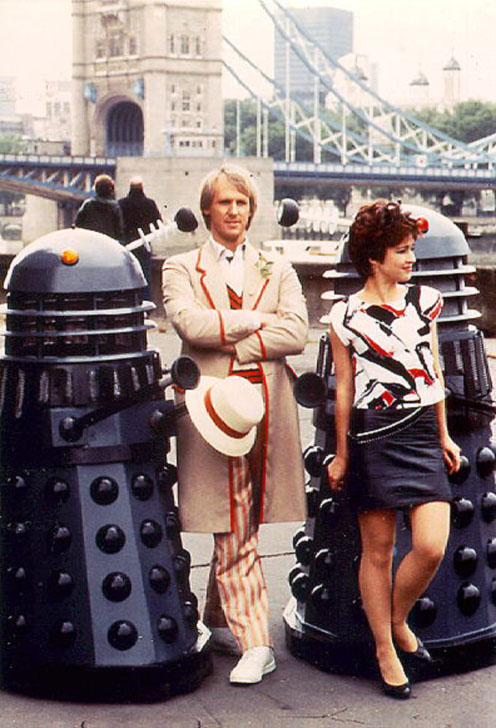
The First Doctor, his granddaughter Susan, and the Daleks (Randomwhoness: Revision, reversion and The Daleks (1963/4))

Tuesday, December 17, 2019

"Tomb of the Cybermen" (1967)

This is a four episode story from the popular TV series Doctor Who. In this one the second Doctor and his pals Jamie (Scottish) and Victoria (Victorian) land on mysterious planet called Telos and fall in with some space archaeologists, who are looking for the eponymous tomb of the Cybermen. Said tomb turns out to be some class of trap laid by the rubbish cyborgs, though even after a close watching of this story I am still unclear as to what the Cybermen were hoping to accomplish that could not have been accomplished by not entombing themselves. For all the plot problem, the story just about deserves its reputation as a classic of early Doctor Who, with the episode two cliffhanger of the Cybermen waking up and bursting out of their cells being one of the programme's most memorable. The story also features the great stock character of Doctor Who, the human villain who thinks that by doing some kind of favour to implacable aliens they will assist him (usually him, though in this case also a her) in conquering the Earth; this always ends well.

Tomb of the Cybermen follows directly after Evil of the Daleks, in which said Daleks killed (nay, exterminated) Victoria's father. There is a quite touching scene in this story in which the Doctor (played by Patrick Troughton) talks to Victoria about grief and her memory of her father, referring obliquely to his own lost loved ones. In days of yore Doctor Who was primarily aimed at children, so I cannot but think this scene was intended as a comfort to any children who might themselves have lost family members.

The story also features Cybermats, which are kind of like rats that have been turned into animal versions of the Cybermen or something. I think they are meant to be threatening, but as is the way of such things they end up looking quite cute.

These days however Tomb of the Cybermen is often noted for its problematic racial stereotyping - Middle Eastern people are shifty while Africans (or the story's one African) are muscleheads. And Americans are all "gee golly" etc., showing yet again the downpression and negative stereotyping white Americans must endure on a daily basis. I thought maybe the stereotyping was not the worst I have ever seen, but then I am notorious for my unwoke nature.

image source (Wikipedia)

Wednesday, August 14, 2019

TV: An episode of "Game of Thrones" (2017)

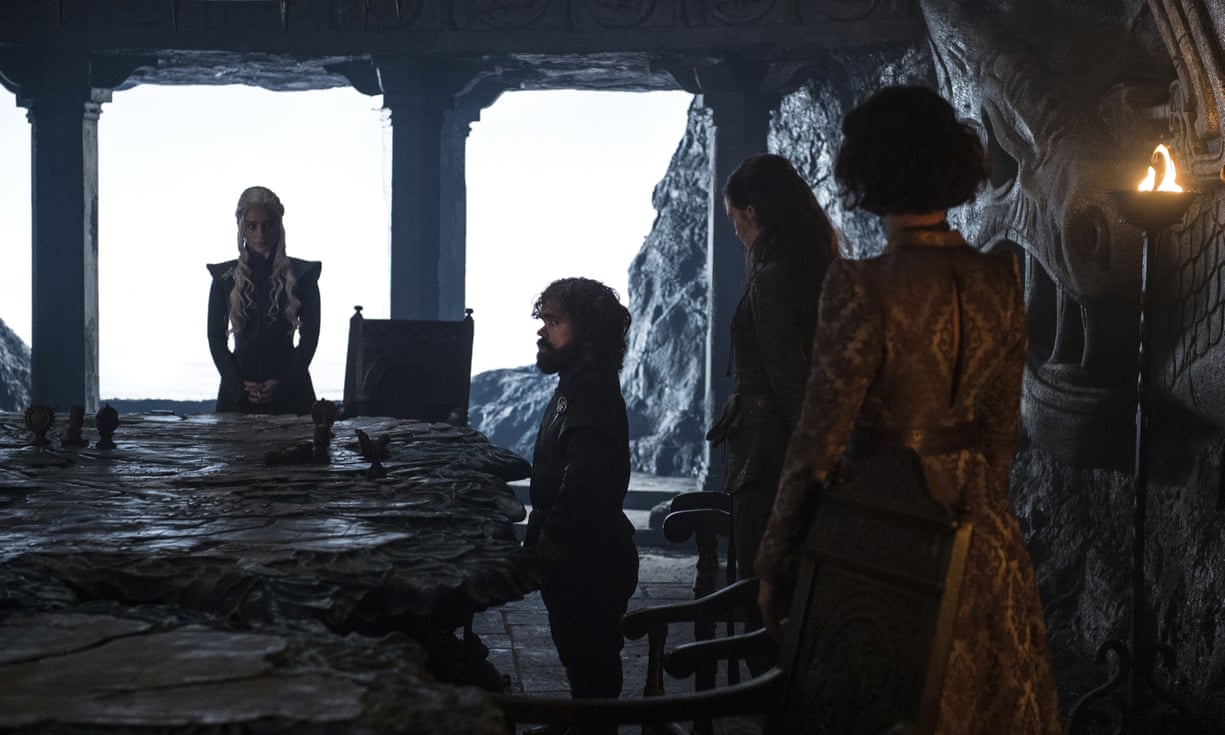
When I was on an aeroplane to Canada I took the opportunity to watch a random episode of popular TV series Game of Thrones to see what I could make of the plot. Of course, because I do not live under a stone I have some familiarity with what this programme is about, even though I have never seen a full episode. This one featured the Blondie Lady and her pals (who include the Short Guy) deciding to send a message to the Curley-Haired Guy, inviting him to join their gang. Meanwhile the Lady Who Shags Her Brother was rallying other people to fight against the Blondie Lady by warning them that, like her late father (probably a Blond Guy), she was some kind of mentalist.

There wasn’t too much in the way of gratuitous female nudity, though the Blondie Lady’s Assistant did get her kit off at some point. There was also an incident in which people on a ship were captured by pirates, I suspect for plot device reasons, while another guy had his skin cut off to save him from a repulsive disease.

It was all pretty dialogue heavy and focussed on people trying to form alliances and test each other’s loyalty. For me that was quite appealing, making it like an updated version of a classic BBC drama like I, Claudius. I can definitely see why people like this and may one day proceed with my plan to watch the very first episode of season 1 and then the very last episode of the final season so that I will know all about the Game of Thrones.
image source:

The Blondie Lady, the Short Guy and some other people recreate their favourite U2 album cover (Guardian: Game of Thrones recap: season seven, episode two: Stormborn)

Saturday, November 11, 2017

Everything I know about TV series "Game of Thrones" despite never having seen a full episode of it

There is a guy who says nothing but Hodor. It turns out that this is because he once had to tell people to "hold the door".

The Blondie Lady is called Daenerys something-or-other. She is the mother of dragons; this may or may not be literal but she does have pet CGI dragons who burn people up for her. She is known as the Khaleesi. She acquires and then frees a CGI slave army who choose to freely follow her because what else are they going to do?

There is a brother and sister who are shagging each other. They tip a young lad (close relative?) out a window when he catches them at it. The young lad mysteriously survives. Meanwhile the brother and sister have a son (passed off as son of the sister's husband) who becomes the Mad King Joffrey, who is mad and bad. He is eventually killed.

There is a guy called Littlefinger who is very duplicitous but eventually he is found out and killed.

Some people got married but then one lot of the guests killed all the other lot.

Sean Bean plays someone who gets killed unexpectedly at the end of the first season.

There is a guy called Jon Snow who gets killed but then it turns out he wasn't killed after all or something. People tell him he knows nothing.

The brother and sister who are shagging each other have another brother who is very short.

There is a family called the Starks. One of them is called Arya Stark.

There is a big wall that is keeping snow zombies called the white walkers out of the land where the main characters live, which is called Westeros.

There are lots of scenes in which women, especially minor character women, get their kit off.

image source:

Incest sister, the Short Guy, Jon Snow, the Blondie Lady (NME)

Tuesday, May 06, 2014

Monday, August 29, 2011

"Treme"


This is not actually a film, but one of those TV programmes that the young people watch. Imanaged to catch episode one on a recent flight to Boston that my jet set life saw me take. Treme is set in New Orleans at some point after Hurricane Katrina and features a variety of people going about their exciting lives. It has an endearingly formless quality that evoked well the languid nature of that great city, though I thought it could have done without the developing plot about evil cops running some kind of death-squad operation during the hurricane – it seemed like something that had sneaked in from another TV series or film entirely.

Hurricane Panda

An inuit panda production

Friday, March 04, 2011

Bowlie 2: The World Crashes In

Yes, I am still writing about the recent(-ish) Bowlie 2 festival in Minehead, curated by Belle & Sebastian, the people who brought us the original Bowlie Weekender back in 1998.

One great thing about ATP events is you get the ATP TV channels playing weirdo nonsense into your chalet, so if you fancy staying up all night watching mentalism then this is the place to do it. Likewise if there are no good bands on. I saw very few of the following in their entirety.

The Banana Splits – I remember this from when I was small. It is nice to see that it really does seem to have been primarily made by drøggies for drøggies, attracting a child audience largely by accident.

Respect Yourself – the Stax Records Story – You know, Stax, Southern Soul, big brassy music, that kind of stuff. I am still a bit vague on the difference between Stax and Tamla Motown, but I know that Stax is cooler. From this documentary I was fascinated by the details on racism in the South – like one of the (white) Stax musicians talking about what a social nightmare it could be touring in those bits of the South where diners were segregated, meaning that he could not eat with his (black) fellow musicians.

Permissive - This was a film from the Sixties in which some woman moves up to London and starts hanging out with bands, soon becoming the Boris Bike of her era. It is an odd film – at one level it is like a shocking indictment of the loose morals of people in the music business, but at another it is a bit "Get a load of those tits". It struck me as being a bit like a British film version of those Men's Adventure Magazines I mentioned some time back. The various musicians seem to have been actual members of Comus and bands like that; they look like real catches.

Jadon the Gangster – This was a Nigerian gangster film about a midget gangster (played by a terrifying child). There was another plot about this rich guy whose daughter was secretly having an affair with another midget (also played by a child, making love scenes a bit creepy). It was all pretty cheaply made, and the sound recording was particularly poor, making the dialogue (in heavily accented English) largely incomprehensible. But the acting was rather impressive, and the film seemed well able to roll with its technical limitations. The kid playing Jadon was amazing, turning up the menace big time for the obligatory scene where he reveals to his henchmen that one of them has betrayed him and is about to pay the ultimate price.

Do any readers know anything about Nigerian films? I dimly remember an article in the LRB once, and this film makes the genre worth exploring further. There is also an interesting piece on Nollywood in the Christmas Economist, but it focuses more on the business side than on any must-see films.

Alchemists of Sound – This was a BBC documentary about the BBC Radiophonic workshop. It was great seeing actual footage of Delia Derbyshire talking to camera, though I do sometimes wonder if her greater fame compared to her colleagues comes from her funny name and her rowrness.

An inuit panda production

Friday, February 05, 2010

Nightmare 2009: I'm The Daddy Now

ATP TV showed some fascinating films. I could only take so much of Scum, featuring a young Ray Winstone. This is the one set in a borstal or young offenders' prison. It is a very impressive film, but maybe not what you want to see just before going to bed. I think it was the "I'm no poof – but from now on, you're my missus" bit that made me turn in while I could still sleep without having to scrub out my brain. More disturbing, though, was the whole thing about whoever was the boss prisoner (a position earned and retained by beating the shite out of anyone who even looks at you funny) calling himself the "daddy". So a daddy is not someone who sits you on their knee and reads you bedtime stories, but rather someone who slaps you around and tells you to shut the fuck up – you can guess what kind of happy upbringing these fellows must have had.
Best Festival Ever
Spongebob Squarepants seemed to be completely deranged. OK so we were watching it with the sound turned down, but it really did seem like something aimed more at drøg casualties rather than children. Also bizarre was Scorpio Rising, a film by some famous guy which seemed to intercut footage of gay Nazi bikers with random other bits and bobs. It was not great, but it did keep you occupied. More impressive was Lucifer Rising, by the same guy. This seemed a bit more thought through, and featured filmed footage of Egyptological and occult themed stuff over a brooding prog rock musical accompaniment. It just was.

We also derived some enjoyment from Ed Wood's Glen Or Glenda, the great director's no budget plea for understanding for men who like to dress up in women's clothes. As you probably know from having seen the Tim Burton Ed Wood film, Wood was able to get an aging Bela Lugosi to appear in this, but he seems to have no real idea what to do with him, so rather than having him appear in the main story, the film instead keeps cutting off to Lugosi sitting in a room on his own declaiming stream of consciousness gibberish. They do not make them like this anymore. On actual TV, meanwhile, that programme about UK government spin doctors definitively disproved that old cliché about swearing being a sign of a poor vocabulary.

Friday, December 26, 2008

Suspicions confirmed

Like many people I watched some Dr Who yesterday, but it was old Doctor Who from 25 years ago, called Resurrection of the Daleks. This one was about the Daleks (hence the title), who were trying to bust a rather sulky Davros out of jail so he could make them immune to some virus. For plot device reasons they were storing samples of this virus in a disused warehouse in London's docklands, connected to their space ship by a "time corridor". The Doctor manages to defeat the Daleks (obv.), but his annoying Australian companion Tegan Jovanka decides she has had enough time travel and leaves.

One of the most striking things about the story was Tegan's rather outlandish costume. It may have been the kind of thing that young ladies wore back in the early 1980s, but it did lead to ongoing "WTF?" reactions every time she came on screen (see image; Tegan is the one to the right). There was an accompanying bonus feature in which then Dr Who producer John Nathan Turner and Janet Fielding (who played Tegan) appeared on some early morning breakfast programme (itself a fascinating relic of the early 1980s). JNT confirmed that the rather revealing costumes the lady assistants wore were primarily designed to appeal to any dads who might be viewing.

image source

Wednesday, December 17, 2008

Ice Volcanoes???

I remember years ago reading about some olde Doctor Who, probably PLANET OF THE DALEKS, in which an ice volcano featured, this being some kind of volcano that splurged out ice rather than molten rock. I took this to be yet another occasion on which the Doctor Who science advisor had been smoking the crack, but now it turns out that today's scientists think there might be ice volcanoes on Titan, the enormous moon of Saturn, the well-known ringed planet.

It is not believed that the Daleks are building a secret base on Titan.

More

Friday, December 05, 2008

Scary TV

One of the scariest TV programmes I have ever seen was the BBC serialisation of John Wyndham's The Day of the Triffids. The first episode begins with this guy waking up in hospital to discover that i) everyone else in Britain has gone blind and ii) the place is over run with walking carnivorous plants. Even the title sequence was terrifying - creepy 20th century classical music playing over images of newly blind people looking a bit pathetic, before one of them is hit in the face by what turns out to be a stinger from a walking plant.

There is an interesting piece on it today on the BBC, prompted by the fact that some fuckwit has decided that the programme needs to be remade: Why the love affair with man-eating plants? The article situates the Wyndham's book in the great genre of global disaster fiction, pointing out that it came out shortly before Richard Matheson's I Am Legend. Take that Yanks. For real creepiness, though, scroll on to the reader comments, and check out what one G Ben of London, UK has to say.

Saturday, April 12, 2008

TV: Christmas 2007 Dr Who

It was quite a while ago now. It was also rubbish. It's a while since I have seen any nu-Who… is it all this bad? The Poseidon Adventure in space premise was enjoyable enough, but the ponderous scene on the narrow bridge across the abyss was straight out of the book of hackneyed clichés. And the music was dreadful, in the wrong kind of bombastic way. On the other hand, Kylie Minogue was surprisingly pleasant, and looked far less like the Aphex Twin than she does in photographs.

Wednesday, March 12, 2008

Nightmare Before Christmas 2007, Monday Morning

We saw a bit of Trisha on Monday morning, in which some young lady suspected that her Albanian husband might have a secret Albanian wife on the side. I wish I had seen to the end of this, I was wondering what the twist could be. Maybe the Albanian fellow could turn out to also be jazzing her mother, always good for an OMG moment on this kind of programme.

ATP TV also showed the episode of What's My Line? on which Salvador Dali appeared as a guest. I found it strange that someone like Dali could be such a household name that he could appear on this time of programme, or that he would want to. You can see it for yourself here.

After that, no TV.

image source

Wednesday, December 20, 2006

Hanna-Barbera cartoons are rubbish

Joe Barbera died recently. It is important that we remember him as someone who churned out hopelessly bad cartoons. Thankfully, Martin Rowson does just this.