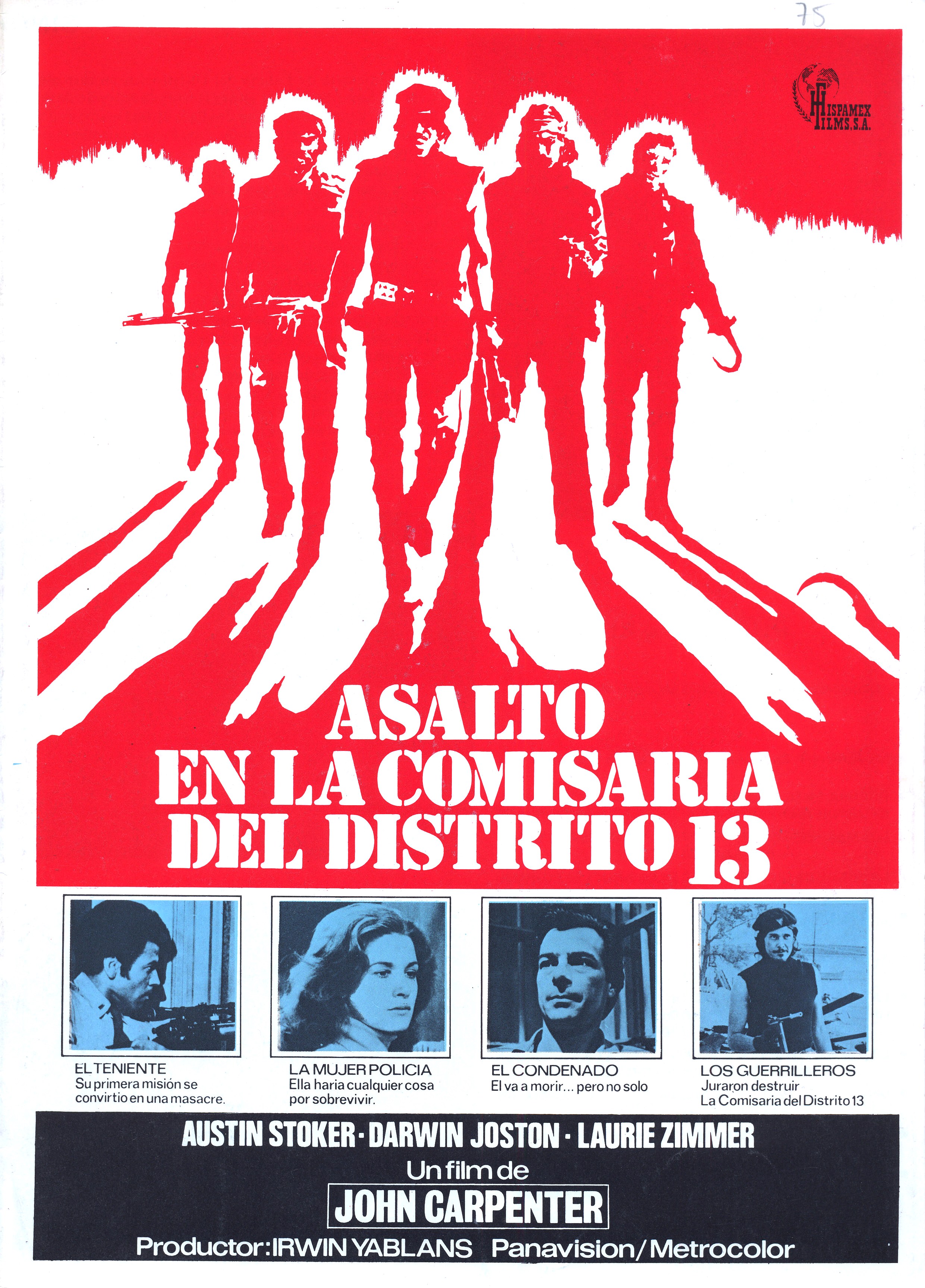
John Carpenter has made many films. I have seen some of them. Of the ones I have seen, which ones would I recommend? I think my most whole-hearted recommendation would be for Assault on Precinct 13 (1976), which sees a small disparate group (a cop, a prison officer, some secretaries, and a death-row prisoner, all played brilliantly by relative unknowns) trapped in a decommissioned Los Angeles police station and besieged by a heavily armed gang of implacable homicidal hoodlums. I think it was inspired by both Night of the Living Dead and Westerns like Rio Bravo, while also reminding me of Zulu. It is engagingly relentless and features one of the greatest theme tunes ever (written and played by Carpenter himself).
The other Carpenter film I would most unreservedly recommend is Prince of Darkness (1987), in which ancient evil bubbles up on the streets of Los Angeles, partly in the form of Alice Cooper. It manages to evoke an air of terrible and unnameable dread. And it also features a great Carpenter soundtrack.
I'm more ambivalent about other Carpenter films I've seen: many of them have a good basic setup but are let down by failings in plot or other elements. The Thing (1982) is well-regarded by many and has a lot going for it, but it fails one of my horror constraints: for horror to work, the non-horror elements have to be credible, but in The Thing we have the credibility-straining setup of a purely scientific base in the Antarctic that seems to be awash with firearms. They Live (1988) has a great build-up but then runs out of plot ideas once we reach the point where the hero puts on the sunglasses and sees the world as it really is (I think this might be one reason why the film has this interminable and largely pointless fight scene between two guys arguing over whether one of them is going to put on the glasses or not: Carpenter had to fill up the film's length somehow and had no other ideas). Escape from New York and Escape from LA are enjoyable schlock but I'm not sure they're actually good in any real sense, particularly the latter. That might be all the ones I've seen, though I suspect Dark Star (not seen by me) is also worth your time.
Of the other John Carpenter films, what ones would you recommend? And am I wrong about the ones I have seen?
I was posting about some music-related films I had seen in 2024 and somehow distrcaction meant I never got round to posting about this music documentary from Carla Easton and Blair Young about Scottish bands formed of women and girls. The Scottish music tradition is focussed on bands that are all or mostly men. When women appear in bands they are either the singer or one of a minority of female musicians in the line-up. Bands entirely composed of women are far less common, to the extent that once you've thought of Strawberry Switchblade it is a bit difficult to think of any other Scottish all-women bands (don't @ me if you know loads of Scottish all-women bands). This documentary attempts to correct that picture by looking at the secret history of Scottish girl bands. The filmmakers argue that drawing attention to their existence is important as a way of encouraging girls to pick up instruments and form bands themselves, on the grounds that people can't visualise themselves doing something if they don't have examples of people like them doing it already.
It felt to me that the heart of the film was the postpunk-DIY scene that emerged in Scotland in the late 1970s and early 1980s. That appears to have seen an explosion of bands, some of which were had no men in them and so make ideal subjects for the film. That is the scene from which Strawberry Switchblade emerged, but it also produced many other bands that all seemed somewhat interesting, even if most of them are now largely forgotten because they were never that successful. The film does go back further in time to talk about The McKinlay Sisters (or The McKinlays), a pop duo from the early 60s who seemed to have enjoyed some short-lived success, and it goes later to talk about riot grrl and The Hedrons, a band from the mid 2000s (who seem to have been pretty successful without my ever being aware of their existence), but the postpunk stuff is what the film seems to be happiest engaging with, possibly because there is such a cornucopia of acts from the era.
This very much is the kind of music I like: relatively lo-fi, guitarry, drummy, female vocals, etc. But I'm not too surprised that the scene did not produce many girl bands who went on to all conquering success. It is minority interest music and not really the kind of thing that is ever going to trouble the charts too much. It is striking that the one really successful band from this milieu (Strawberry Switchblade, whose global hit gives the film its title) did so after having their vocals married to a synthpop backing (something they were a bit uncomfortable with, but they appreciated that the record company needed to make a return on their investment). And Strawberry Switchblade then folded, partly for their own internal reasons and partly because when it came down to it they didn't really like being pop stars after all. The one other almost-contender from the early 1980s scene were Sophisticated Boom Boom, who recorded some Peel sessions before changing their name (primarily because they had mislaid their lead singer but perhaps also to avoid confusion with a new wave Swiss girl band that had the same name). As His Latest Flame they signed to a major and released an album that received some push but never shifted too many units before the record company lost interest and terminated the contract.
Most bands are unsuccessful. Maybe Strawberry Switchblade being the only truly successful one from that scene isn't too surprising: it may not be an indication that the odds are stacked against girl bands once they have formed as they are successful at about the same rate as bands with boys in them (not sure how you would test this assertion); the real question is why do so few girl bands form in the first place.
And yet, I did find myself thinking that there is a gender-specific structural barrier girl bands face that does not seem to trouble boy bands. There is a bit in the film where the Hedrons are talking about how record labels were wary of signing them because they are a band of young women at an age where women start having babies: the record companies were afraid that pregnancy and children would derail the band's career and cause the company's investment to be wasted. In the film that is presented as indication that the men from these unnamed record companies are all sexist dinosaurs, but the film itself seems to say that part of the previous failure of Sophisticated Boom Boom / His Latest Flame stemmed from band members becoming pregnant and either dropping out or being pushed out by the rest of the band. So it felt to me like there is a structural problem separate to record company types being sexist dickheads.
I don't know how you can get around this. People should be able to have children if they want without it killing their career, but there's no maternity leave set up for musicians and I am not sure how there could be, given that they are not salaried employees. Nevertheless it is an indictment of social structures and people's behaviours that you never seem to hear of men dropping out of bands because they have become a father.
Towards the end of the film maybe it lost a bit of focus when it started going on about non-white non-cis musicians: I thought sticking to girl bands would have been better. I was also a bit disappointed that it didn't mention Girls Rock School Edinburgh, a laudable initiative to teach interested women and girls how to play musical instruments (something I only know about because I've met one of the organisers on Unthanks singing weekends). There is also something a bit nostalgic about the film's focus on bands playing with traditional rock instrumentation, as it feels at times like the day of the band is over or coming to an end (the subsequent rise of Wet Leg and the Last Dinner Party might prove me wrong here).
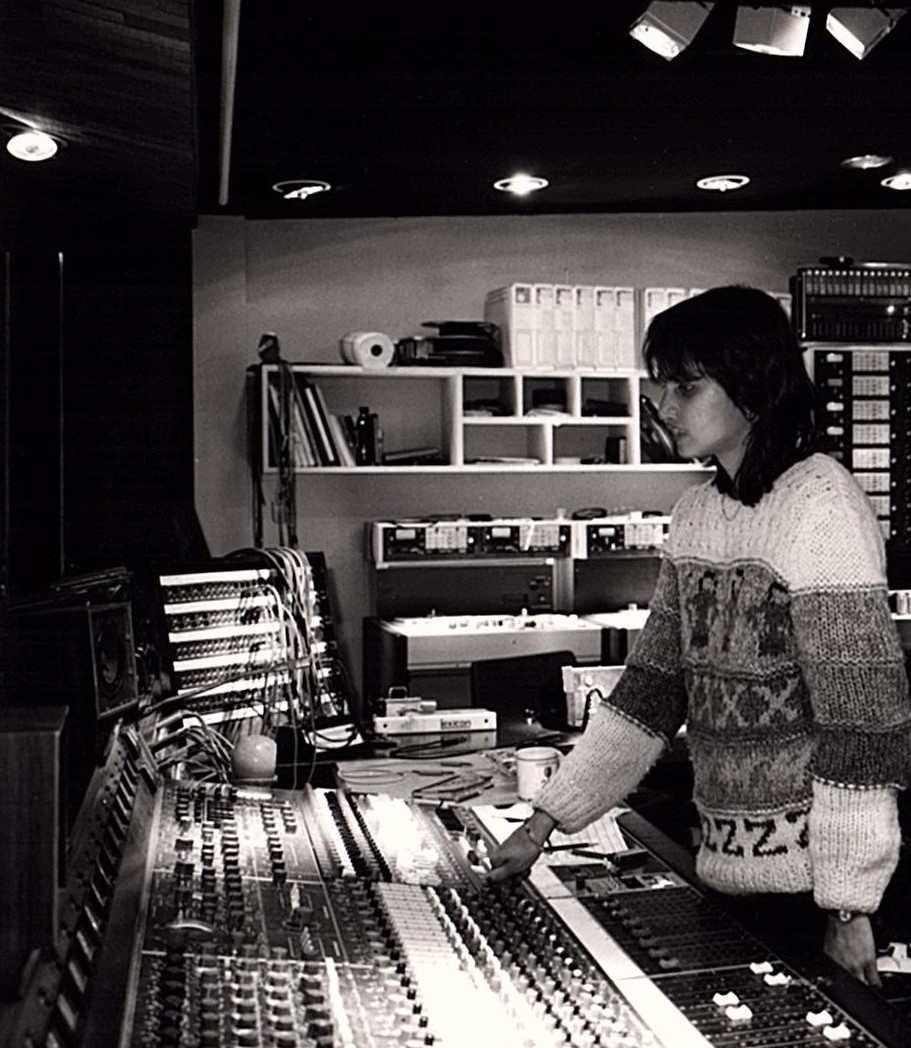
Afterwards my beloved and I were talking about why there are so few women working as sound engineers and producers in music. I was reminded of an interview with Anjali Dutt I read a while back. Dutt is not a household name but she engineered and/or produced a load of records in the 1980s and 1990s, with credits on records as varied as My Bloody Valentine's Loveless, Oasis' Definitely Maybe, and Spacemen 3's Recurring. She says that her engineering career ended because she started having kids and there was no way to combine the demands of parenthood and the demands of the music business. And by the time her kids were old enough to need less looking after the music business had moved on and found other people to hire for engineering jobs (again, this seems not to be the kind of salaried work you can go away on maternity leave for). You can read the interview for yourself here.
I don't know how you get around these problems. It might help if looking after children stopped being seen as something that is exclusively a woman's thing, but I suspect the problem is more structural than attitudinal.
You can listen to a playlist of music from bands mentioned in the film on Spotify and Mixcloud.
The whole film appears to be on YouTube at the moment here.
You can see my previous posts about music in films I saw in 2024 here, here, here, and here.
images:
Since Yesterday (Screen Scotland / Sgrín Alba: "Since Yesterday: The Untold Story of Scotland's Girl Bands")
Anjali Dutt (Reverb: "The Engineer Who Helped Save MBV's Loveless & Oasis' Debut")
Ho ho ho! It is now March, but that will not stop me from looking back on a season of Christmas films they showed in the Light House in December. First up we have Comfort & Joy, Bill Forsyth's 1984 film. Now, some background here. This was Forsyth's third feature, following Gregory's Girl and Local Hero. Local Hero is a bit of an obsession in my beloved's family so I found myself heading off to see this with her and her sister. Despite the title, it's not really a Christmas film, or at least only in the sense that it is set around Christmastime without actually being about Christmas. It takes its inspiration from Glasgow's ice cream wars of the 1980s, when criminal gangs were selling heroin from ice cream vans and laying into any of their rivals who encroached on their turf. However, instead of being a film about drug gangs the film imagines a strange alternative history in which the ice cream wars are instead between rival producers of ice cream. The main character plays a radio DJ who somehow finds himself mediating between the battling gelato merchants after going through a bad break up.
I liked this film a lot. For all its whimsy, the plot seemed more coherent than the better regarded Local Hero. The humour is appealingly gentle and the Mark Knopfler soundtrack so effective that I started wondering if I might have reached the age where engaging with Dire Straits becomes a good idea. But I think a really big part of what appealed about this to me was all the Glasgow locations. Some of the city looked very familiar while some of it was very different: there is a scene on the banks of the Clyde with the Finnieston Crane in the background, something I saw lot of in my 2024 Worldcon related trips to Glasgow, except that instead of being surrounded by hotels and conference centres it is out in the middle of a semi-derelict port site. I also found it highly amusing that the protagonist seemed to be living around the corner from one of my gamelan friends, with whom I was staying on a November gamelan trip to GIOFest.
The Holdovers is more directly a Christmas film. It's about some rich kids who have to spend the Christmas holidays in their posh boarding school because their families can't or won't take them, and also the cook and grumpy teacher who have to stay with them. In premise it sounds like heartwarming glurge but it is actually pretty affecting and has strong performances from all three of the principals: Paul Giamatti as the teacher, Da'Vine Joy Randolph as the cook, and Dominic Sessa as the main held over student. Sessa's performance, his film debut, is particularly impressive. I think this is the kind of film that will deservedly get shown every year around Christmas so you will get a chance to see it and should take that opportunity. I did overhear some young people talking about how they found it much more moving on the big screen.
The Muppet Christmas Carol is the best and most faithful adaptation of the Charles Dickens classic, both funny and deeply moving. I suspect I will be going to the cinema for this every year until I die. The Light House audience was a bit boisterous but I decided it was best to lean into this.
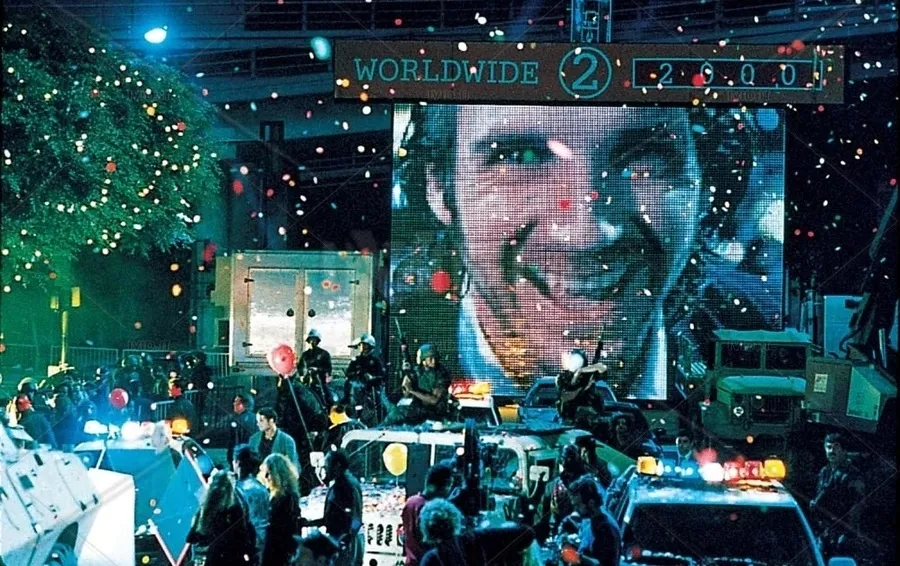
Strange Days is Kathryn Bigelow's 1995 SF film set in the last days and hours before the start of the 21st century. It's not a Christmas film as such, but it does feature a guy dressed as Santa Claus being chased by some angry hookers. The setup revolves around this dodgy tech that allows people to record their physical sensations for playback by themselves or other people, with Ralph Fiennes playing a shifty vendor of these recordings. The plot is multi-layered, with one angle covering a rampage by murderous cops seeking to recover an incriminating recording but another key theme is the importance of letting the past go (something Fiennes' character takes a while to realise, as he spends a lot of the film playing back experiences from before his girlfriend left him). The central performances from Fiennes and Angela Bassett as his kickarse limo driving friend are very impressive and overall I like this film as much as I did when I first saw it. My beloved did however think it went on a bit, and given its 145 minute runtime I can see where she is coming from. It's also not always an easy watch, with one particularly intense scene inspired by Michael Powell's Peeping Tom making for extremely uncomfortable viewing.
Are French films screened here less frequently than they used to be, attracting less attention when they do make it to our screens? Perhaps so, but I still managed to recently see some interesting offering from the French film industry.
Dossier 137 is a 2025 film from Dominick Moll. It was shown in a French film festival, which I suspect means it is not going to get a wider release, which is a shame as it features strong performances and deals with important subjects in a sensitive and nuanced manner. Léa Drucker plays a police investigator of malpractice by other cops, with the film set around the time of the Gilets Jaunes protests. A youth attending the demonstrations with his mother is severely injured by a policeman, and the investigator is trying to find out who is responsible and whether they acted inappropriately. Discovering that the youth comes from the same small town as herself, she pursues the case a bit more doggedly than she might otherwise have done. The film is good on the way cops close ranks to protect their own and the human cost of being on the receiving end of state violence, while also giving a sense of how stressful it is to police riots and how easy it is to slip into making bad decisions in such an environment. Drucker's own performance is particularly impressive. It deserves a wider audience.
Alpha (another 2025 film, this time from Julia Ducournau) was screened more widely, although it proved somewhat divisive, with many seeing it as a confused load of old bollocks, for all that it did have its supporters (notably Irish Times film guy Donald Clarke). It is an odd one, with the basic premise that there is this blood-born disease going around that turns people into statues. The film mostly follows Alpha, a 13 year old girl, who unwisely gets an A tattooed on her arm at a party, leading to her mother fearing that she has been tainted by the virus. There's also a split time thing going on, for as well as the present-day Alpha storyline there is a separate storyline in the past involving her mother as a doctor treating patients in the early days of the virus. And there is also stuff about how Alpha and her family are of Berber origin, and about her recovering heroin addict uncle.
I can see why people didn't like this. I found the split time sequence a bit confusing, which irked me as missing the cues made me feel like I was too stupid for the film, which made me hate it for insulting me. But also the relationship between the two time sequences is a bit strange and contradictory, which made it unclear as to what was real and what was imaginary and who was doing the imagining. But it still felt like the film had something. The principals' performances are all very impressive and the film also makes great use of music, most notably Portishead's "Roads" at the disorienting party sequence at the start of the film. So: worth seeing even if you might not like it.
L'Atalante is an old French film from 1934, directed by Jean Vigo, who died in the same year it was released at the age of 29. It's one of those Sight & Sound top ten films and is about the eponymous barge and the people who sail on her: Jean (the cap'n), Juliette (his newly married wife), Père Jules (the salty sea dog), and the young lad (who doesn't have a name). It's mostly about Jean and Juliette and their romantic travails. It's entertaining enough and it looks very nice but I did wonder if I was missing something as it all felt a bit inconsequential and unworthy if its one-of-the-best-films-ever status. But I am wary of being too down on it as it reminded me somewhat of F.W. Murnau's Sunrise, a film I disliked greatly on first viewing and have since grown to love.
I've become a bit wary of that Paul Thomas Anderson guy. Some of his films I like a lot (Boogie Nights, Magnolia, Hard Eight, Punch-Drunk Love) but some of them I found both over-long and disappointing (Licorice Pizza, The Master). One Battle After Another I initially decided to skip as it is long and didn't look too appealing in the trailer. However my interest was piqued by stories about how it had done very well with critics while being largely shunned by audiences. Also, one or two of my buds who had seen it spoke very highly of it. So fuck it, I gave it a go.
And… it's OK. It does maybe go on a bit and the bit of the film that comes before the "16 years later" jump is a bit formless for its admirable kinetic qualities, but the whole storyline of the former urban guerrilla (Leonardo DiCaprio) and his daughter (Chase Infiniti) on the run from a crazy Fed is pretty engaging. People like to go on about DiCaprio's girlfriend age event horizon, but such talk obscures what a compelling actor he is, and he's not the only one giving strong performances here. And it uses music well and all flows along. But I can't but feel that there are better films to be made about urban guerrillas, for all this one improves as it goes along.
If you went into Eva Victor's Sorry, Baby knowing nothing about it bar what you had seen in the trailer then you might think it is a quirky comedy-drama about a neurodivergent hottie and her fun-packed oddball adventures with friends, a neighbour and a cat. It's only the bit in the trailer where she says "Something bad happened to me" that might give you pause. Of course this is actually a film about recovery from sexual assault, a difficult subject that initially had me deciding to avoid it until a late change of mind brought me to the cinema. And it's an odd fish, dealing sensitively with the sexual assault (offscreen but described afterwards) and having moments of emotional intensity while also being at times rather funny. That Eva Victor also plays Agnes, the main character, and has reported that the film is based on her own experiences adds further heft to it. I really liked it and a I encourage everyone to see it. I also hope that Victor makes and appears in more films, not necessarily at the same time.
Some random Sorry, Baby things:
When Agnes goes round to a male neighbour's to borrow some propellant so that she can set fire to her assaulter's office, she waits outside while he goes to get it, and I could totally see how someone in her situation would be loth to go into the home of a man.
The way Agnes is coded as neurodivergent but so is Natasha, a fellow PhD student and her enemy. Maybe only neurodivergent people take postgraduate courses in American liberal arts colleges.
When Agnes has sex with the neighbour (who is nice), this is presented as the kind of intimate fumbly sex real people have and not the kind of amazing Hollywood sex people have in films (don't @ me if you have amazing Hollywood sex all the time).
Agnes has a nice friend called Lydia who appears to be the token non-neurodivergent postgrad student in her college. She is played well by Naomi Ackie who I thought was some kind of up and coming person to watch out for but actually she has been in loads of stuff.
Annemarie Jacir's Palestine 36 is a film about the Palestinian revolt against British rule that erupted in 1936. Aside from wanting to be free and not have the Brits bossing them around, the Palestinian rebels are also trying to prevent their country being taken over by Zionist settlers. The film follows different Palestinian characters, mostly from the same village, and also some British officials, including the High Commissioner, a well-meaning but ineffectual civil servant, and the oddball counter-insurgency army officer Orde Wingate (more famous for leading the Chindits in the Second World War). It generally looks great (although I had reservations about some use of what appeared to be colourised newsreel footage) and was very evocative of the period. I don't think it resolved very well, however. That might be a consequence of the history it is based on (the revolt failed and its defeat paved the way for the disaster that befell the Palestinians in the late 1940s) but I still felt that some kind of more satisfying narrative conclusion should have been possible, even if the revolt is shown as a failure.
I also thought it was unfortunate that the film has no Jewish characters. The Zionist settlers are an offstage presence, having arms imported, shooting at the Palestinian villagers from their fortified settlement, paying newspaper editors to run favourable copy, etc. but we never see them as actual people and we never get a sense of why they are coming to Palestine and how they see things there. In a film where British antagonists share screen time with the Palestinians (in a manner reminiscent of The Battle of Algiers), the absence of the Zionists is a curious omission, particularly given that Wingate's real-life suppression of the Palestinian revolt partly revolved around recruiting, arming and training a Jewish militia.
Despite those reservations I enjoyed this film greatly and I recommend it to anyone curious about how the Middle East got into its current crazy state.