Showing posts with label The Sea. Show all posts

Sunday, August 04, 2013

Two More Sea Shanty Records

The Keelers Tyne & Tyde (2013)
Johnny Collins, Dave Webber & Pete Watkinson Songs of the Sea: a Collection of Sea Shanties (1998)

Avast there mateys, the bosun has ye well shanghaied for more shanty action.

I have previously mentioned going to see the Keelers supporting the Unthanks playing out in Bray. There my beloved bought a copy of their record Tyne & Tyde. The line-up is the same as that of Farewell to the Master but the instrumentation is a bit different - as in there is any. This time some of the songs feature concertina, whistle and tambourine, but it is mostly still just vocal.

The stand-out tracks on this are probably the same ones I mention in the live concert review. 'Old Billy Blue' (an original composition by the Keelers' Peter Wood) tells the story of Admiral William Cornwallis, who commanded the British fleet blockading Brest during the Napoleon Wars. He was so good at doing this that he acquired two nicknames - OId Billy Blue and Billy Go Tight. The song tells of how he could never be got away from his station and of how other admirals would always link up with them if they had mislaid a French high-seas fleet. It has this great chorus:

He's Old Billy Blue and he's Billy Go Tight.
He's always on station by day and by night.
What do admirals do when bitterly pressed?
They fall back on Cornwallis at Brest.


I find it hard not to join in with this one.

The other corker is a tune by one Mike O'Connor called 'Carrying Nelson Home', in which Nelson is being carried home after Trafalgar (he was killed there by a French sniper; I have always wondered whether the sniper survived the battle). The song imagines Nelson in his bucket of rum still giving orders to the sailors on his last voyage home, and is very poignant, for all that Nelson is not my national hero.

The other tunes are not entirely nautical, including ones about building railways (the trad. arr. tune 'New Railroad'), emigration and nostalgia ('Black and White') and that universal theme, lusting after the daughters of pub landlords ('The Landlord's Daughter', not the tune from The Wicker Man). George Unthanks' 'Tar Barrel in Dale' also makes its way onto record, so if you want to be extra ready for joining-in at an Unthanks concert then buy this album.

I should also menton the production on Tyne & Tide. Shanty records generally sound like they had no production at all on them and they are not obviously the worse for it. This one, though, was produced by Adrian McNally (Rachel Unthank's husband and the Unthanks' keyboardist). The production is great - it was recorded in a church and makes great use of the place's acoustics to give us a most atmospheric sound. And at no point does Mr McNally go down the bad producer's road of deciding to add in a bit of piano or Hammond organ to songs that are best left as unadorned as possible. But it still sounds produced, and produced well, thanks to the adroit sound engineering and sue of the sound qualities of the recording venue.

Songs of the Sea (by Johnny Collins, Dave Webber and Pete Watkinson) is a record I have had for ages, but my sudden burst of shanty interest caused me to dig it out and add it to iTunes. It is a somewhat un-curated collection, barely naming the artists involved and providing little or no supporting information. I had rather assumed that it was a collection of tunes sung by fairly anonymous singers. But not so. While using Google to spell-check the name of Jim Mageean from the Keelers, I found a YouTube recording of a young Mageean singing with Johnny Collins of this record in a context suggesting that Collins is someone known for knowing his shanties (and if Mageean is deferring to him then this really must be the case).

The record features more hot shanty action, mostly or entirely without instrumentation. 'Blood Red Roses' makes its obligatory appearance, but what is most striking to me now is the closer - the 'Farewell Shanty', a tune about sailors getting ready to sail away, and a tune that I remember from the last session at the Unthanks singing weekend.

Some links:

The Keelers and the Unthanks live in Bray

Tyne and Tide image source

Wikipedia page for the late Johnny Collins

Thursday, August 01, 2013

Two Sea Shanty Records

The Keelers Farewell to the Master (1993)
v/a Sailors' Songs and Sea Shanties (2004)

Ahoy there shipmates! Cast off and join me aboard the good ship Shanty. Little Jim the cabin boy is ready to make you right welcome. So splice the mainbrace, cut loose the port sheet, and up the lanyard for the masted doubloon.

I have always had some interest in sea shanties and songs of the sea, but going to the Unthanks singing weekend in January pushed into overdrive. As you will recall, Jim Mageean of the Keelers introduced us to a load of nautical tunes, both work songs and songs that seemed more like the kind of thing sailors would sing for entertainment. There were CDs being sold as we were leaving the weekend, so I picked up a copy of Farewell to the Master, an album of shanties presented as a tribute to one Stan Hugill, an old sailor who collected shanties during his many years at sea and was the last living shanty man of the Royal Navy. It begins with a tune composed by Alan Fitzsimons of the Keelers specifically to honour Mr Hugill, before launching into a succession of shanties sun acapella. They are here grouped by type, with halyard shanties followed by cotton trade shanties, maindeck capstan shanties, pump shanties, and so on.

One recording decision listeners might or might not take issue with is the grouping together in single tracks of several different tunes - so the halyard shanties track goes on for over 8 minutes and features all three of 'Shin-O', 'Tiddy High-O' and 'Blood Red Roses', the last a song that by law must appear on all shanty records. This grouping business does not bother me while listening to the record but it might annoy me in the future if I wanted to include anything from here on an end of year compilation.

Some of the songs feature lyrics that are a bit ribald. I get the feeling that some of the sailors in the songs have intentions towards ladyfolk that are not entirely honourable.

In Edinburgh we went record shopping and found in Fopp a couple of old sea shanty records. Rationing myself, I went just for a collection called Sailors' Songs & Sea Shanties: A Classic Collection of Sea Songs and Shanties. This features songs sung by A.L. Lloyd, Stan Kelly, Ewan MacColl and some others. There are sleevenotes describing the history of the songs and explaining nautical terms and the like, but there is nothing saying when they were recorded, which is a bit annoying.

Unlike the Keelers record, this does feature instrumental accompaniment, generally of the squeezebox type. It ends up being a bit reminiscent of the music in Bagpuss, which is not surprising given the folkie chops of that programme's musicians.

Two songs stand out on this for me. First of all there is 'Away Haul Away', sung by Stan Kelly, which sounds like a tune the musical family of one of my mother's friends used to sing. Another is 'Do Me Anna', sung by A.L. Lloyd. On one level this is another saucy sailor song in which a sailor impersonates a rich townie in order to shag his lady friend (something that in our politically correct era would get you sent to jail and put on the sex offenders register for life), but what makes it appeal to me is the mournful and almost otherworldly tone of the piece - it keeps sounding like it is about to turn into a ghost story or some such, even though it never does. Perhaps it needs new lyrics.

Links:

Sailors' Songs & Sea Shanties (an interesting website on this record)

Stan Hugill

Farewell to the Master cover image source (with opportunity to buy this record)

Keep coming back to Inuit Panda for more shanty action soon!

Sunday, March 28, 2010

"Moby Dick", by Hermann Melville

I suppose I ought to say something about Moby Dick. I pathetically underestimated how long it would take to finish, only reaching the end the day after we met in the Lord Edward; the experience was chastening, and I will be more careful with future reads of the big books of the past.

But anyway, what did I think of Herman Melville's classic (in which, for those of you are unaware of these things, a whaling ship commanded by the monomaniacal Captain Ahab sets off on a doomed hunt for the titular White Whale who bit off the captain's leg)? Well, I thought it was incredible. I am not sure if I would be one of those people who say that it is the greatest novel ever written, but I can see why people would see it as that. There is an epic grandeur to it that you see in few works of fiction. One thing I have heard said about the book is that it prefigures the modern novel in certain respects, but I was struck by how gothic it was. As Ahab closes in on the whale, there is an almost palpable sense of doom clinging to the pages; rather than being a prototype 20th century anti-hero, Ahab seems more of a kind with Heathcliff or Melmoth as he races to his own destruction.

Moby Dick is also an odd book. The narrative chapters are interspersed with many discursive chapters on whales and whaling, the style of the narrative chapters themselves shifts from normal first person narrative to scenes described as plays, to scenes where we get interior monologues by characters other than the narrator. There are also some great comedy moments, like the whole Ishmael-Queequeg bed-sharing stuff, that run rather counter to the general gothic feel of the book. I could imagine some people finding all this a bit annoying, but they would be wrong to do so.

There might be a case to be made for an all-narrative abridged version of Moby Dick that leaves out the digressions – it could be useful for first time readers. I think, though, that they are part of what gives the book its power. They are certainly part of what will keep this book on my shelf – it is something that I will keep wanting to dip into.

One of the things with Moby Dick is its initially poor critical reception. Although it seems to have remained in print, albeit somewhat intermittently, it was only in the 20th century that it began to be seriously championed as a great novel. In discussion in the Lord Edward, Mr W---- suggested that it was the book's disjointedness that appealed to the modern critic, as it mirrors the stylistic innovations of the 20th century; he felt, however, that these critics were picking up on the failings of Melville's writing (his rambling inability to stick to the narrative, etc.) but hailing these as strengths. It is a view, but again I think the Melville's willingness to go where the narrative winds take him is a strength rather than a weakness.

I will leave you with an odd piece of Moby Dick related trivia. The well-known German far-left nutters the Red Army Faction were apparently obsessed with the book, and used it to give each other codenames for their internal communications. Andreas Baader picked Ahab for his own codename, something that seems not to have set alarm bells ringing.

Post your own thoughts on the book as a comment here. If you have already posted about Moby Dick on your own blog, post a link to that instead.

An inuit panda production

Wednesday, December 30, 2009

Steamships

I fear that my Flickr photos of the restored SS Great Britain may be of somewhat limited appeal. This ship was designed by Isambard Kingdom Brunel.

Saturday, September 26, 2009

A Long Post About Conceptual Art

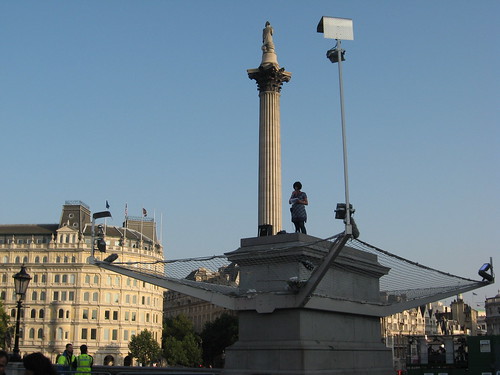
Have you ever been to London? If so then maybe you have been to Trafalgar Square. It has a statue of Lord Nelson on top of a pillar, and it also has some other statues there. The other statues are on plinths, as is often the case with statues. The square has four plinths, so you would think that there would be four statues – but no. Only three of the plinths have permanent statues. The fourth plinth lies vacant, or is used for temporary exhibits.

At the moment, the fourth plinth is hosting Antony Gormley's One and Other. Gormley is perhaps best known for monumental wrought iron sculptures like The Angel of the North, but One and Other is different. Gormley has basically let random punters apply to appear for an hour on plinth and do… whatever they want.

One of my pals from the internet got a slot on the plinth and decided that what she was going to do was read out letters from people. I decided to send a letter to Lord Nelson, and she read it out, which was very exciting – I feel like I am a foot soldier in conceptual art history.

I happened, coincidentally, to be in London on the day Tricia was plinthing, and made it along to see her read many other letters (semi-accidentally missing my own being read). It was an interesting business. Some of the other letters were very impressive. One of the most striking being one that some guy wrote about his estranged parents (they have disowned him for repudiating their religion), a powerful and affecting piece of writing. In complete contrast, I also loved the letter written by some fellow to a local pub, complaining about the unsatisfying meal he received from them. She also read a letter from that blog that reprints famous letters from the past (can't find the URL for this, can anyone help?).

So yes, deadly fun. Over the time I was in the big smoke, I drifted over to the Fourth Plinth a couple of times, and it was very striking how far above the average Tricia was in her endeavours. The other plinthers seemed generally not to really have any idea what they were doing up there, just passing the time waving at their friends or taking photographs. This does of course beg the question of what I would do if I was up there. Mmmm. I suppose one obvious thing would be to adopt a succession of human statue poses.

Anyway, should you want to watch Tricia reading her letters, you can do so here, and you can watch random other people plinthing here. You can also look at more of my Trafalgar Square pictures here. If for some reason you want to read my own letter to Lord Nelson, scroll on.

"To: Lord Horatio Nelson

"Sir!

"I am writing to you care of Miss Stubberfield, the lady you should see in the square below you reading this letter to you. I must confess to having had certain difficulties finding an appropriate subject for correspondence to you, and for finding the best words to use. I was going to discuss the differing sentiments towards you felt by people in this country and my own (Ireland), drawing a contrast between the relative fortunes of your great column here and the pillar upon which you once stood in the main street of my country's capital. However, a discussion in that area seemed to yield no great insights, for it is hardly surprising that Irishmen and women are less than fond of a man whose signal victory over Napoleon's fleet arguably served to bind Ireland to England for another hundred years.

"Instead, perhaps, it would be better to discuss a more human subject, and one closer to your own personage. No one can doubt the great service that you gave your country. We all know that your greatest victory was also your last, that you led your fleet against the enemy in a manner calculated to destroy them utterly while at the same time exposing you to mortal peril. But while your last battle saw you lose your life, we should remember that in earlier engagements you suffered various other losses. As you lost more of your body in each battle, you must surely have known that sooner or later an engagement with the enemy would claim your life. At Trafalgar, did you calculate in advance that your audacious plan would see your greatest victory crowned with your own life blood?

"That someone should choose glory at the price of their own death is something very alien to me. More credible is the idea that someone would choose to die for some great ideal. Was that the case with you? The standard picture is that you died for England (or Britain, or King and Country, whatever). If so, what were you dying for? A land of rotten boroughs and semi-feudal deference to the gentry and nobility, but in a land where creeping industrialisation was creating new forms of misery and despair – was that your England?

"These are unanswerable questions – even if you were able to reply to this letter I suspect that you would find it difficult to explain your own motivations. Still, I would love to know whether, as you lay dying, did you feel that your death was worth the glory you had won or the nation you had saved, or did you silently curse the roll of the cosmic dice that had seen you take a fatal wound?


"I remain,

"your obedient servant.

"Ian Moore, esq."

Saturday, August 08, 2009

Good Dog News

I'm getting a bit excited about my soon occurring holiday in Cornwall. One thing that adds to this is news that a compromise has been reached that allows Newfoundland Bilbo to patrol Sennen beach once more. In an outbreak of what some might call political correctness gone mad, Bilbo was banned from the beach because dogs are not allowed walk on the sands, while he was banned from riding around on a quad bike for health and safety reasons. This despite his training as a life saver and determination to make sure that people always swim between the flags. Bilbo is now allowed to work on the beach on a part-time basis.

I will definitely not be swimming outside the flags just so that I can be rescued by Bilbo.

More

image source

Thursday, November 06, 2008

Play: Further Than The Furthest Thing


This was a play set by Zinnie Harris, set on an unnamed remote island (but clearly one modelled on Tristan da Cunha). This production was by some theatre company called HATCH, and took place in the Project Arts Centre under the direction of Annabelle Comyn. I enjoyed this so much that I found myself wishing I went to the theatre more – good job there is a theatre festival coming up*. The play does the usual thing of comparing the isolated islanders to the people living in the wider world, suggesting that the islanders lead a simpler and more real life, but then we learn that the island folk have their own ways and so on. It is so evocative of living in the world's most isolated community that I am now pondering the practicalities of visiting Tristan da Cunha (for what would probably the world's dullest holiday, but such is life). I doubt this is somewhere I will ever actually make it to, but I can dream.

One thing I wondered, though, is whether the film really played fair with the islanders. It is very evocative of their culture, and does make you favourable disposed towards them, but it does fall back a bit on the old "They've got their own ways" clichés about people in isolated communities. I found myself thinking this a lot in the second part of the play… there is a very powerful scene when we learn the dark secret of the islanders. I would be curious as to what the actual inhabitants of Tristan da Cunha would make of this revelation, as a cursory bit of historical research (looking at Wikipedia, basically) reveals that the terrible events described could basically never have happened. Now, of course, you could say that well, the play is a work of fiction and nothing in it ever names the island as Tristan da Cunha, but so much of the other incidental detail of the play points to there (the volcanic eruption, crucially) that you could not really have anywhere else in mind for it. But this is just a bit of a quibble, and it does not stop the play working as a powerful piece of drama.

I won't say what the islanders' dark secret is, but I will say that it is not like that of the Pitcairn people. I reckon only leaves two possible "own ways" for a clichéd isolated community, so you've got a 50% chance of guessing correctly.

The play does well with neat juxtapositions and contrasts – island-mainland, tradition-modernity. The first half is set on the island, while the second sees the islanders uprooted and dropped into the modern world. The geographical shift changes them, with some of them becoming like the mainland people. The play is a bit ambiguous on whether the contrast can also be seen as one of good-bad. The only character not from the island appears initially as almost an avatar of The Devil, there for nothing but to tempt the islanders into the modern world; but he is humanised and given enough depth to be more than just a cartoon villain. The islanders themselves seem to represent a simpler and purer way of life – but they have their own dark secrets. Or do they? Their secret is not something your would want to tell everyone about, but you would probably have done the same in their situation.

One thing that makes this play so enveloping is the accents and phrasing adopted by the characters. I've never been to Tristan da Cunha, so I can't say how accurate they were, but they were very evocative of how the speech patterns of an isolated community would develop (or not develop – isolated communities often retain forms of speech that die out elsewhere). I subsequently joined the I-Wuv-Tristan-Da-Cunha group on Facebook, and sure enough, it seems from there that the islanders do indeed have the most unusual form of speech. Of the actors, Fiona Bell was maybe the most impressive, but her role was the most central so she had more to impress with. You could not fault any of the others, all of whom delivered unforgettable performances in an exceptional production of an unforgettable play.

The first paragraph of this appeared previously in the pages of Frank's APA

image source

*I ended up going to dick all in the festival, such is life.

Sunday, May 25, 2008

Political Correctness - Gone Mad

Bilbo is a Newfoundland who until recently helped protect swimmers at Sennen beach in Cornwall. He is trained to rescue those who get into difficulties and also makes sure that people do not swim in the area outside the beach's flagged safe area. However, the RNLI now control Sennen beach, and they have declared that Bilbo is no longer welcome there. Only working dogs are allowed on the beach, and Bilbo is not officially classed as such.

Bilbo is currently protecting swimmers on another beach. When pressed for a comment on the bureaucratic tangle in which he finds himself, he replied "Always swim between the flags".

More:

Bilbo, Britain's favourite lifedog, pays the price of celebrity (picture source)

Lifeguard dog banned from beach

Wednesday, January 23, 2008

Let Us Go To The Banks Of The Ocean

I was in the Netherlands in September. Partly I was letting my hair down after handing in my thesis, but mainly I was celebrating 100 issues of Frank's APA (the amateur press association for people who like music, always looking for new members, and that means you, punk (unless you are a timewaster)). We did a lot of kewl things and had a party and stuff. But I'm not going to talk about any of that. Instead I will provide some details on a trip the more discerning of us made to the town of Lelystand. I was going to hold off on posting about this until I mastered this posting pictures on the Internet technology you hear about, but that will take some time to come together, so for now it is just text.

Lelystand is a strange new town built on polders beside the Zuider Zee. Why did we go to this godforsaken hellhole, you might ask. Well, Lelystand has this naval museum there in which they like to rebuild olde ships. They are currently building a replica of the Seven Provinces, flagship of some Admiral Ruyter guy. There was very little stuff about him or his ship in English there, and small wonder – he is the man who repeatedly stuffed the English out of it in the Anglo-Dutch wars. His most famous exploit was to sail up the Thames to steal the English flagship and smash up the rest of the English fleet. Seeing the innards of a ship in the process of construction was fascinating, and made for various surreal photographs.

The real star of Lelystand, however, is a completed replica they have of the Batavia. Just in case 17th century Dutch history is not your strong point, the Batavia was a retourship, built by the Dutch East India Company to carry cargo and people from the Netherlands to the Dutch East Indies. In the 17th century, the Batavia would have been a monster, and even now its replica looks impressively large.

The Batavia's history is rather eventful. On its maiden voyage, the captain began to feud with the ship's real commander, the upper merchant of the Company. Together with the under merchant, a former apothecary, the captain plotted to stage a mutiny and convert the ship to piracy (or to sail away somewhere and live off its rich cargo, or something). These plans were however foiled when the ship foundered on islands off the west coast of Australia, then a strange and unknown land. The captain and the upper merchant (and others) left in an open boat to make the several thousand mile voyage to the Dutch East Indies, leaving the other survivors under the care of the under merchant. This fellow turned out to be a maniac, instituting a baroque reign of terror that saw him and his cohorts slaughtering something like two thirds of their fellow survivors, turning the women among them into their sexual property. The story is well told in Mike Dash's book Batavia's Graveyard, or in the earlier novel The Company by Arabella Edge.

So anyway, yes, going onboard the reconstructed Batavia was a real treat for us. Visitors had pretty much the run of the ship and could go anywhere they liked on it, and there was a wonderful disdain for health and safety, which allowed people to climb up on all sorts of things from which they could easily fall to their deaths. Excellent. Particularly atmospheric was being able to go down to the depths of the ship, in which the ship's human cargo of company soldiers were kept under permanent lockdown, apart from one daily half hour toilet break. Most visitors did not bother with the lowest holds of the ship, and even in there on your own they felt grim and claustrophobic; god knows what they would have been like with a couple of dozen tough soldiers for company.

Outside the museum they have this lot of outlet stores for clothes and stuff like that. One amusing feature of this was its slightly theme park element, being done up to vaguely resemble a Company trading post (with walls and cannons around it and the various stores meant to look like little trading pavilions). The kitsch and unironic use of the country's colonial history was fascinating – I wish someone would try to detourn it by opening up a slave dealership there.

Wednesday, November 21, 2007

"No! Let Me Drown - etc."

Scientists have found the claw of a PREHISTORIC GIANT SEA SCORPION. This abomination (the scorpion, not the claw) was larger than a modern human being, reports the BBC.

If you don't know what the "No! Let Me Drown - etc." title refers to, click here: No! The Pincers!

More

Wednesday, September 12, 2007

Dog Bath Car

I have already mentioned Bilbo the Lifeguard and his campaign against unsafe swimming. Further research reveals that this wonder dog is not so fond of baths.
However, he does like patrolling the beach at Sennen, making sure that people always swim between the flags
More Bilbo action

Friday, August 24, 2007

Good Dog Protects Swimmers

Bilbo the Dog is a Newfoundland who works on Cornish beach of Sennen, helping swimmers who get into difficulty and making sure people stay away from dangerous currents. Tourist Lein Snippe was threatening to go swimming in a deceptively dangerous stretch of water when Bilbo came to the rescue, swimming in front of her and doing his best to keep her out of the water. "Basically he was telling me 'don't do it'," the BBC reports Ms Snippe as saying.

Newfoundlands like Bilbo apparently have a natural talent for rescue work. Bilbo works as part of a team with a number of humans.

Bilbo advises visitors to Sennen to always swim between the flags.

Wednesday, May 02, 2007

Visiting the "Batavia"


Maybe you have read Mike Dash's Batavia's Graveyard and as a result know all about history's bloodiest mutiny (and-the-mad-religious-maniac-who-led-it). Maybe you are also going to the Frank's APA 100th issue meetup in Amsterdam.

If so, then you will be able to travel to Lelystad, where they have a replica of the Batavia. I gather this modern retourship made the round trip to Australia a couple of years ago. I wonder did they also replicate the sanitary facilities the orginal ship had (I'm thinking in particular of the rope left hanging in the water (you will either remember this or you won't)).

In other Mike Dash news, I have started reading Thug, which is about the Thuggee cult in 19th century India. Apparently they weren't actually religious maniacs, they just liked killing people and stealing all their money.

Friday, February 03, 2006

will I ever learn?

You might think that a sensible person such as myself would not buy books quicker than I can read them. Think again. The latest addition to my book mountain is "The Company" by Arabella Edge. This is a novel about the 17th century wreck of the Dutch retourship Batavia on one of the Abrolhos islands, and the horrific events that then followed. I have previously read Mike Dash's wonderful "Batavia's Graveyard", a non-fiction account of the same events.

Ms Edge seems to have written this book in the first person from the point of view of one Jeronimus Corneliszoon. This is an interesting choice, given that the man was a religious maniac and psychopath who set up a baroque reign of terror over his fellow survivors. I am curious as to whether she attempts to make him in any way sympathetic.


The old Jeronimus is everywhere these days. The beloved pointed out that he appears as an enigmatic, probably sinister, character in "Desolation Jones", an ongoing comic by Warren Ellis and J.H. Williams III. If you have any fondness for the comics, I recommend picking up some issues of this odd detectivey title, the McGuffin for which is a missing reel of Hitler's own amateur porn.

(Ha ha, Hitler and porn in one post - Google, I command you to bring me the pervertalists!)

Thursday, December 08, 2005

Heroic Dog To Be Honoured By Statue


The Montrose Bamse Project has raised £50,000 to commission a statue of this brave dog, who was apparently a symbol of Norwegian resistance to Nazism despite the occupation of their country. Unlike many dogs today who are afraid of fireworks, Bamse used to stay at his post at his ship's gun tower throughout hostilities. On land, he would fetch errant sailors from pubs when it was time to put to sea.